


Armory Sponsor

Posted: 1/8/2014 4:03:45 PM EDT
| So I called cannon today because my safe will not open. They gave me some special codes to get it to it but it did not work. They said they would call a lock smith to come out to drill it open. How well does this work and how likely will he get it open? Is it going to ruin my safe? The safe is not even a year old yet. |
|
The answer to this question really depends on who they send out. Locksmiths key houses. Safe techs open safes. If they send the key guy out, you're likely not to get as good of a result than you would had they sent a safe guy. Maybe the locksmith in question has safe experience, maybe he doesn't. Maybe he has the proper equipment, maybe he doesn't.
If done properly, the safe is easily repaired and can be placed back into service. |
|
Quoted:
The answer to this question really depends on who they send out. Locksmiths key houses. Safe techs open safes. If they send the key guy out, you're likely not to get as good of a result than you would had they sent a safe guy. Maybe the locksmith in question has safe experience, maybe he doesn't. Maybe he has the proper equipment, maybe he doesn't. If done properly, the safe is easily repaired and can be placed back into service. a1a, How do you repair a composite safe (this is a general question - I have no idea if OP's safe is plate or composite). With a plate safe I understand and have seen photos of ball bearings and hardened taper pins driven into the drilled hole. But on a composite safe, made with thin gauge sheet metal, there isnt enough steel thickness to make this type of repair possible. Just curious. Thanks. |
|
Gun safes are a bit tougher to do a proper repair because not only is the steel thin, but there's usually nothing of substance behind it (gypsum board). Methods will vary from safe to safe, and from professional to professional. Welding is preferable if possible. Taper pins, ball bearings, and even broken carbide drill bits can be driven or welded in. I also use a two part stick similar to JB weld, but that has shredded carbide flakes in it. I can drill through it with a good bit, but a regular twist bit will have problems. Add in a few ball bearings, and you're usually in good shape.
A drilled hole in a safe still wouldn't do an amateur much good. Even if the hole wasn't plugged, they would still need to know what to do with that hole, and have the equipment necessary to use it to their advantage. |
|
Quoted:
The answer to this question really depends on who they send out. Locksmiths key houses. Safe techs open safes. If they send the key guy out, you're likely not to get as good of a result than you would had they sent a safe guy. Maybe the locksmith in question has safe experience, maybe he doesn't. Maybe he has the proper equipment, maybe he doesn't. If done properly, the safe is easily repaired and can be placed back into service. a1abdj nailed it as expected |
|
Quoted:
You could luck out and maybe its just the keypad that is bad. ^ This. The keypad will be the problem the vast majority of the time. When they come out, they should have a new working keypad and try that first. If the lock needs to be drilled (not sure if your safe has a full size Securam UL Listed lock or just a solenoid), the hole should be under the keypad so once it's repaired you won't see it at all. So drilling the safe and then plugging the hole as A1 mentioned is not a big deal at all and you don''t need to match the paint or anything like that. This will not be the case if it's a malfunction involving something other than the lock like the relocker or boltwork. |
|
Quoted:
What is the lock doing? Do you hear any slight click or nothing at all? You could luck out and maybe its just the keypad that is bad. That would be a easy test if you can get another one of the same model to try. When I put my code or the manufacture reset code in it just beeps like I have the wrong code and then locks me out. Normally you hear a click and then you can turn the bolts. |
|
Quoted: When I put my code or the manufacture reset code in it just beeps like I have the wrong code and then locks me out. Normally you hear a click and then you can turn the bolts. Quoted: Quoted: What is the lock doing? Do you hear any slight click or nothing at all? You could luck out and maybe its just the keypad that is bad. That would be a easy test if you can get another one of the same model to try. When I put my code or the manufacture reset code in it just beeps like I have the wrong code and then locks me out. Normally you hear a click and then you can turn the bolts. |
|
Quoted:
Still sounds like it could be the keypad, if you were putting in the proper combination and hearing nothing or a slight click, I would think it was the lock. It could be your keypad going bad sending wrong signal even though you are typing in the proper combination. Quoted:
Quoted:
Quoted:
What is the lock doing? Do you hear any slight click or nothing at all? You could luck out and maybe its just the keypad that is bad. That would be a easy test if you can get another one of the same model to try. When I put my code or the manufacture reset code in it just beeps like I have the wrong code and then locks me out. Normally you hear a click and then you can turn the bolts. Thats what I am hoping for. All I hear is the beeps of the wrong combo. No clicks or nothing like it should do. All They would have to do is send out a new keypad. Too bad its going to take forever. I wonder If I could talk the manger of the store I bought it from to let me barrow theirs for like an hour just to get my safe open and then bring it back. |
|
Quoted:
Have you tried new batteries yet? I got my safe in september and it killed a lithium battery by december. Apparently the capacitors need a full charge or something. good luck! not a good feeling not being able to get in your safe. yep the first thing I did was open up a pack of brand new Duracell 9v's. Tried every one of them in the pack with no luck |
|
Maybe you can try your keypad on the store safe I wouldn't waste your time with the store. If they knew anything at all about what they were selling, they would have been the ones being sent out, and not the locksmith. They should be sending a replacement lock to whomever they are sending. Give it a few days. If the guy knows what he's doing, he will attempt to properly diagnose the issue prior to drilling holes in it. That may include swapping the keypad that he was sent. If you start tinkering with it yourself, they may simply void the warranty and not do anything for you. |
|
Quoted:
I wouldn't waste your time with the store. If they knew anything at all about what they were selling, they would have been the ones being sent out, and not the locksmith. They should be sending a replacement lock to whomever they are sending. Give it a few days. If the guy knows what he's doing, he will attempt to properly diagnose the issue prior to drilling holes in it. That may include swapping the keypad that he was sent. If you start tinkering with it yourself, they may simply void the warranty and not do anything for you. Quoted:
Maybe you can try your keypad on the store safe I wouldn't waste your time with the store. If they knew anything at all about what they were selling, they would have been the ones being sent out, and not the locksmith. They should be sending a replacement lock to whomever they are sending. Give it a few days. If the guy knows what he's doing, he will attempt to properly diagnose the issue prior to drilling holes in it. That may include swapping the keypad that he was sent. If you start tinkering with it yourself, they may simply void the warranty and not do anything for you. Well I want to go out shooting with family this weekend. It's just a ribbon cable attaching in the back. I am trying to decided if it's worth my time to ask the store if I could pop the one off the floor model and take if home for a minute to try that |
|
Quoted:
Well I want to go out shooting with family this weekend. It's just a ribbon cable attaching in the back. I am trying to decided if it's worth my time to ask the store if I could pop the one off the floor model and take if home for a minute to try that I think it's definitely worth a try. If you normally hear a "click" when it opens then the safe only has a soleniod and not their UL Listed swingbolt lock with a motor. |
| You have already exhausted the power issue, so the only thing left you can do before drilling is to try some vibration. Take a block of wood, and wrap it with a soft towel so it won't mark the paint, then use a nice big hammer (up to a 3-lb sledge hammer) and smack the padded wood buffer held against the door around the keypad area. It's easier to do with help, one person dialing the code while the other does the tapping. Hit the door a few times good and try the lock again. Then, hit the door at the moment of the last keystroke so the shock is timed to coincide with the lock activation. This may sound crude, but probably 50% of lockouts can be resolved this way. Be careful not to mar the finish, but do hit it hard enough that you feel the ouch factor. |
|
Quoted: You have already exhausted the power issue, so the only thing left you can do before drilling is to try some vibration. Take a block of wood, and wrap it with a soft towel so it won't mark the paint, then use a nice big hammer (up to a 3-lb sledge hammer) and smack the padded wood buffer held against the door around the keypad area. It's easier to do with help, one person dialing the code while the other does the tapping. Hit the door a few times good and try the lock again. Then, hit the door at the moment of the last keystroke so the shock is timed to coincide with the lock activation. This may sound crude, but probably 50% of lockouts can be resolved this way. Be careful not to mar the finish, but do hit it hard enough that you feel the ouch factor. Nice tip, he said he is getting a beep like the password is wrong even with it correct thought. Could this still help? |
|
Quoted:
Wow,a linear torque wrench. 
It's shit like this that turns me away from electronic locks. Safe guy,why are the Amsec electric locks supposedly so much more reliable? Do they use a solenoid or electric motor? Don't laugh... the vibration technique I described is as old as the first mechanical safe locks. This is not a new way to fix a safe. As for electronics, unless the thing went up in smoke, and is totally unresponsive, the problems is most likely a connection issue. Connectors are the Achilles Heal of electronic products. We have conducted exhausting and extensive research over the last 20-plus years to identify and eliminate digital lock failure modes. Since I pioneered e-lock technology and we released the first retrofittable digital safe lock, reliability has been the key concern... as well as the primary barrier to wider acceptance. Our research is above reproach. For Locks that don't fail from catastrophic component failure, more than 95% are due to an electrical connection failure. So... what does vibration do for that? It's that one chance to move that mechanical failure point a few microns so it can work one more time. It works with a rather high rate of success. Mechanical locks have similar small problems that gradually get worse and worse until they cause a lockout. Most people report having dialing issues before the lockout happens. The same vibration introduced at the right moment will frequently overcome the small binding or interference that is obstructing the mechanism. The AMSEC locks are more reliable because we never stop improving them. We are constantly making little changes as we evaluate returned failures. Remember, as a safe company, we take the full burden of a lock failure because the safe is ours too in most cases. The lock guys only cover the lock, and in most cases won't cover a safe opening in their warranty compensation. If they do cover safe drill openings, their compensation limits are well below market costs. We are highly motivated to make the best lock possible because it saves us money. Simple economics. Sometimes a few pennies in lock cost can save mega-bucks on the warranty side. The lock companies don't care. They blame lockouts on the installer or the safe company, and do very little to improve their products once in production unless it's a wide-spread high profile issue that damages their market acceptance. AMSEC locks are better because they have to be. We won't tolerate high warranty costs. We choose to invest in making the products better, rather than paying safe techs to open them. All of our current products all use a solenoid. But, that is not important. Reliability is what you make it. A motorized device has just as many opportunities to fail as a solenoid operated device. Quality is independent of technology. Our relentless research and product evaluations prove that day after day. |
|
Quoted:
Nice tip, he said he is getting a beep like the password is wrong even with it correct thought. Could this still help? Sure. If a connection is altering the resistance of the keypad resistor array, the vibration could restore the connection. It works more than you might guess. The SecuRAM locks are different from most safe locks. They have a high degree of complex logic circuitry in the keypad. That is why they have widely known keypad reliability problems. Most safe locks have very simple electronics in the keypad, hence they are subject to a lower potential failure occurrence. Reliability is very closely linked to complexity. Simply put.... More complex products tend to be less reliable. |
|
On a mechanical lock, you can have a mechanical failure, and that failure can be overcome because you still have a mechanical connection to the lock. On an electronic lock, if you have a mechanical failure, your options are much more limited. Needless to say, there is an art to this type of work. You need to be familiar with the locks, how they are built , and be able to diagnose the likely cause of the issue. Some guys only know how to drill safes, and that's their one and only answer.
In this case, I suspect that the keypad is indeed the culprit. There have been a few companies having problems with these thin membrane keypads lately. Let's say your combination was 1-2-3-4-5-6, and your keypad stopped recognizing input from the 1 key. Most people would enter their combination, and if it didn't work, enter it again. In this case, the lock would think you were entering the incorrect combination of 2-3-4-5-6-2. In other cases, the keypad recognizes the key press, but due to whatever voodoo, believes it to be a different number. In this case, I don't think that shaking anything around is going to open the safe, but if beating it up a bit makes you feel better, then I don't see any harm. 
|
|
Quoted:
Sure. If a connection is altering the resistance of the keypad resistor array, the vibration could restore the connection. It works more than you might guess. The SecuRAM locks are different from most safe locks. They have a high degree of complex logic circuitry in the keypad. That is why they have widely known keypad reliability problems. Most safe locks have very simple electronics in the keypad, hence they are subject to a lower potential failure occurrence. Reliability is very closely linked to complexity. Simply put.... More complex products tend to be less reliable. Quoted:
Quoted:
Nice tip, he said he is getting a beep like the password is wrong even with it correct thought. Could this still help? Sure. If a connection is altering the resistance of the keypad resistor array, the vibration could restore the connection. It works more than you might guess. The SecuRAM locks are different from most safe locks. They have a high degree of complex logic circuitry in the keypad. That is why they have widely known keypad reliability problems. Most safe locks have very simple electronics in the keypad, hence they are subject to a lower potential failure occurrence. Reliability is very closely linked to complexity. Simply put.... More complex products tend to be less reliable. Not to mention that logic in the keypad, aside from simple multiplexing, is less secure. Not sure if that is the case here, but the less circuitry readily available means there is less possibility for exploitation. As a EE the first thing I did when I got my lock was to look inside, the Amsec lock only buffers and muxes the input before sending it to the internal board. Very secure. |
|
Quoted:
In this case, I suspect that the keypad is indeed the culprit. There have been a few companies having problems with these thin membrane keypads lately. Let's say your combination was 1-2-3-4-5-6, and your keypad stopped recognizing input from the 1 key. Most people would enter their combination, and if it didn't work, enter it again. In this case, the lock would think you were entering the incorrect combination of 2-3-4-5-6-2. In other cases, the keypad recognizes the key press, but due to whatever voodoo, believes it to be a different number. Frank alludes to the VooDoo... here is the VooDoo... The keypads on products like this use a series of resistors connected to button contacts. They all run to a single point, such that each button presents a different resistance across the circuit when the button is held. The voltage is applied to one side of the circuit, and the resistance of the circuit for each button results in a different voltage on the output line of the keypad button circuit. So, the microprocessor (MPU) is reading a voltage on a single analog input, where each button presents a different voltage result, and the MPU then compares those voltages to an expected voltage range for each button. For example, the "3" button may output 3.20 volts, and the "3" button is interpreted as any voltage between 3.12 and 3.25 volts. Every button has a range associated to a nominal design voltage. Now, you can see that the circuit for each button must be consistent to be interpreted as the correct key in the combination sequence. Part 2... a button is a contact point in a switch, and the switch is activated by the pressure you apply to the button. There are three basic button circuit design types. All three rely on shorting two metallic objects together to make the circuit. The quality of that point of contact is where problems arise. If a contact is cheap, dirty or damaged, the contact starts to introduce increased resistance to that contact circuit. That resistance shifts the output voltage result, and if it's really bad, the voltage will fall outside the correct range. So, the "3" button may result in a lower voltage, due to higher than normal contact resistance, and then become interpreted as the next button down the voltage array. So, say the "5" button is represented by the output voltage range from 2.61-3.11 volts. The dirty "3" button is now getting interpreted as a "5" button. That's the voodoo. You can't see it and have no clue this started happening, except that the combo that used to work is now getting rejected as wrong. It is, in effect, like you are pushing the wrong button... High quality button contacts are expensive. Contacts are made from high value precious metals. Low cost means less or thinner precious metals used. Cheap keypads fail early. You get the idea. These contacts decay as they are used. Cheap ones fail earlier. We test our keypads to 1 million cycles. I seriously doubt many of the other lock makers have even tested their keypad endurance. When that checkpoint is not part of your quality control process, your vendors that make the keypads cheat, use less and less precious metal, and you get reduced cycle life and don't even know it until a year or two later when your customers begin to report problems. By then, you have produced scads of bad parts that are already in the field on safes. |
|
Quoted:
Not to mention that logic in the keypad, aside from simple multiplexing, is less secure. Not sure if that is the case here, but the less circuitry readily available means there is less possibility for exploitation. As a EE the first thing I did when I got my lock was to look inside, the Amsec lock only buffers and muxes the input before sending it to the internal board. Very secure. Excellent point. I wasn't going to bring that up, but security is another facet to this design that is very important. Good to have an EE in the house that understands. |
|
Quoted:
The keypads on products like this use a series of resistors connected to button contacts. They all run to a single point, such that each button presents a different resistance across the circuit when the button is held. The voltage is applied to one side of the circuit, and the resistance of the circuit for each button results in a different voltage on the output line of the keypad button circuit. So, the microprocessor (MPU) is reading a voltage on a single analog input, where each button presents a different voltage result, and the MPU then compares those voltages to an expected voltage range for each button. For example, the "3" button may output 3.20 volts, and the "3" button is interpreted as any voltage between 3.12 and 3.25 volts. Every button has a range associated to a nominal design voltage. Now, you can see that the circuit for each button must be consistent to be interpreted as the correct key in the combination sequence. Quoted:
The keypads on products like this use a series of resistors connected to button contacts. They all run to a single point, such that each button presents a different resistance across the circuit when the button is held. The voltage is applied to one side of the circuit, and the resistance of the circuit for each button results in a different voltage on the output line of the keypad button circuit. So, the microprocessor (MPU) is reading a voltage on a single analog input, where each button presents a different voltage result, and the MPU then compares those voltages to an expected voltage range for each button. For example, the "3" button may output 3.20 volts, and the "3" button is interpreted as any voltage between 3.12 and 3.25 volts. Every button has a range associated to a nominal design voltage. Now, you can see that the circuit for each button must be consistent to be interpreted as the correct key in the combination sequence. for an electromechanical assembly that is supposed to be reliable, this is a not a good approach... Quoted:
Part 2... a button is a contact point in a switch, and the switch is activated by the pressure you apply to the button. There are three basic button circuit design types. All three rely on shorting two metallic objects together to make the circuit. The quality of that point of contact is where problems arise. If a contact is cheap, dirty or damaged, the contact starts to introduce increased resistance to that contact circuit. That resistance shifts the output voltage result, and if it's really bad, the voltage will fall outside the correct range. So, the "3" button may result in a lower voltage, due to higher than normal contact resistance, and then become interpreted as the next button down the voltage array. So, say the "5" button is represented by the output voltage range from 2.61-3.11 volts. The dirty "3" button is now getting interpreted as a "5" button. ...for this very reason. there is a fundamental implementation approach issue here, and throwing money at the problem vis-a-vis more expensive switches is just a band-aid. Quoted:
That's the voodoo. You can't see it and have no clue this started happening, except that the combo that used to work is now getting rejected as wrong. It is, in effect, like you are pushing the wrong button... High quality button contacts are expensive. Contacts are made from high value precious metals. Low cost means less or thinner precious metals used. Cheap keypads fail early. You get the idea. These contacts decay as they are used. Cheap ones fail earlier. you don't need precious metal contacts, you need a circuit that does not depend on the absolute resistance of the switch itself (which is going to change over time, no matter how good the contact materials are). for this reason, multiplexed keypad arrays are used in practically every application where reliability and double keypress detection is desired. compare: 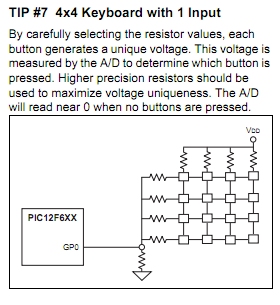
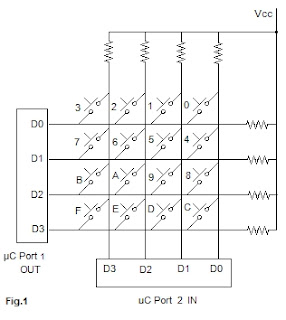
in the second example, the exact values of the resistors, and for that matter the contact resistance of the switches themselves, are irrelevant. the price is additional uC pins, but this added MOC (materials only cost) is a fraction of what high quality switches cost up front, and the warranty issues downstream. the second example is far more reliable in the long term. Quoted:
We test our keypads to 1 million cycles. I seriously doubt many of the other lock makers have even tested their keypad endurance. When that checkpoint is not part of your quality control process, your vendors that make the keypads cheat, use less and less precious metal, and you get reduced cycle life and don't even know it until a year or two later when your customers begin to report problems. By then, you have produced scads of bad parts that are already in the field on safes. [/span][/span] keypad testing is the norm in the consumer products industry -- for example, phone (cellular and cordless) keypads are tested to millions of cycles. typical consumer product implementations are silicone rubber keypads with conductive carbon "pills" that sit just off of copper trace "targets" on the underlying printed circuit board. there is no expensive keypad switch using precious metals, just a multiplexed digital decoder that does not rely whatsoever on discriminating analog voltage levels. the problem with testing to millions of cycles with a mechanical keypress tester is that it does not duplicate the environmental conditions of the real world. by and large the biggest contaminant of keypad switches is squalene -- basically salty skin oil. over the long term, squalene wreaks havoc with switch contacts, and this is yet another reason to use a keypress detection technique which is digital, and not analog. other approaches to prevent squalene contamination are suggested, such as the patent example below. ar-jedi http://www.google.sc/patents/US5500497 BACKGROUND OF THE INVENTION
Rubber dome pressure actuated switches are often used in field consoles and other telephone applications, most often over rigid circuit boards, especially where the use of hard plastic keys or hard plastic key caps are not practical, or where their incorporation into a push button type switch is not economically feasible. In addition, size and space restrictions often make the use of hard plastic caps unfeasible. It is often the case that sealants are used to impregnate the rubber dome, but the use of such materials and the process of impregnation are too costly, especially where the number of switches is extremely large, as in most telephone applications involving, for example, telephone consoles or terminals. Heretofore, circuit board assemblies using rubber dome keys have been subject to mechanical and electrical failures in large numbers over an extended period of use, or where the use, i.e., actuation of the switch by an operator pressing on the dome, is of a high frequency of occurrence. Such failures are costly, especially in the field, both as to replacement of the defective switch and also as to repair of the switch or the circuit board itself. Thus, in prior art arrangements, any defects necessitating repair of the switch generally require replacement of the entire circuit board to which the switch is affixed. Recent studies have shown that the circuit board containing the switch pads and upon which the switches are mounted and, more particularly, the switch pads themselves, are being contaminated during use by a foreign substance which chemical analysis has shown to be squalene, a salt that is expelled through the skin of the human body, most often as a component of sweat. Squalene is also found in some types of cosmetics and is thus quite prevalent. This substance or salt has an oily consistency and a very high viscosity which allows it to be readily absorbed by the silicone rubber of the domes. Over a period of time or of frequent operation, the rubber dome becomes saturated with the salt and, upon continued actuation of the switch, the salt becomes deposited on the circuit board, especially the switch pads, and almost invariably leads to failure of the switch pads or even of other components on the circuit board. One type of rubber dome switch that is susceptible to such contamination is shown in U.S. Pat. No. 4,818,829 of Nopper et al. In FIG. 2 of that patent, there is shown a structure wherein the dome, upon actuation, i.e., depression, bears against an active component of the circuitry on the circuit board. Over time, the squalene contamination will reach and probably contaminate this element. |
|
AR-Jedi...
All your points are valid. However, you are not being sensitive to the application. The networked resistor input is necessary, because we can only route 4-6 wires in the physical constraints of the safe. We don't want to make the keypad a logic processing device and communicate with the lock inside using complex serial communications. It must be kept simple, to control cost and reliability, as well as meeting the physical limitations. Moreover, this is not our first day at the races. All of your points were on the table at the genesis of this e-lock development. We do make reliable keypad circuits like this, and have been for 25 years. We still have safe locks deployed over 20 years ago that still work perfectly today. Hence the need to provide long life contact quality. Also, the I/O capacity is a cost barrier. As you increase the number of I/O points, you have more processor, you increase cost. We have worked tirelessly for the last 10 years to finally produce e-locks that are equal to the cost of the mechanical safe locks they displace. Every penny counts. The safe lock we produce today is the product of a long trail of research and development. So, the product I describe, even though it has fundamental design compromises, is the state of the art. If cost were no concern, and we could manage to route 11-12 conductors thru the small hole in the safe door, and had unlimited space to accommodate the huge connectors that would support that wiring, then things might be different. So, when you consider the physical and financial constraints, we are already producing the optimum designs. Given that the aggregate volume of production of locks of this type probably are fewer than 1/4 million per year, it's not anywhere near the many millions of cellular phones produced. So, add to the difficulty the relatively high part costs compared to mega-volume products like cell phones. Thanks for your input. It's a good opportunity to show why the technology in a cell phone doesn't apply to safe locks, and how we arrived at today's designs. |
|
Quoted:
AR-Jedi... All your points are valid. However, you are not being sensitive to the application. The networked resistor input is necessary, because we can only route 4-6 wires in the physical constraints of the safe. We don't want to make the keypad a logic processing device and communicate with the lock inside using complex serial communications. It must be kept simple, to control cost and reliability, as well as meeting the physical limitations. Moreover, this is not our first day at the races. All of your points were on the table at the genesis of this e-lock development. We do make reliable keypad circuits like this, and have been for 25 years. We still have safe locks deployed over 20 years ago that still work perfectly today. Hence the need to provide long life contact quality. Also, the I/O capacity is a cost barrier. As you increase the number of I/O points, you have more processor, you increase cost. We have worked tirelessly for the last 10 years to finally produce e-locks that are equal to the cost of the mechanical safe locks they displace. Every penny counts. The safe lock we produce today is the product of a long trail of research and development. So, the product I describe, even though it has fundamental design compromises, is the state of the art. If cost were no concern, and we could manage to route 11-12 conductors thru the small hole in the safe door, and had unlimited space to accommodate the huge connectors that would support that wiring, then things might be different. So, when you consider the physical and financial constraints, we are already producing the optimum designs. Given that the aggregate volume of production of locks of this type probably are fewer than 1/4 million per year, it's not anywhere near the many millions of cellular phones produced. So, add to the difficulty the relatively high part costs compared to mega-volume products like cell phones. Thanks for your input. It's a good opportunity to show why the technology in a cell phone doesn't apply to safe locks, and how we arrived at today's designs. Interesting. Safeguy,one of your posts you mentioned you also own a safe. Do you have an electrical lock on it? Just curious. |
|
All your points are valid. However, you are not being sensitive to the application. The networked resistor input is necessary, because we can only route 4-6 wires in the physical constraints of the safe. All your points are valid. However, you are not being sensitive to the application. The networked resistor input is necessary, because we can only route 4-6 wires in the physical constraints of the safe. IIRC, my ESL10 has an 8-pin or 10-pin ribbon cable from the lock. At any rate if you can rout 6 pins that would be plenty for a 10digit multiplexed input (GND,VCC, X0-X3). In this case where you are hard presed for bus width, 'C' or reset can be driven to to the uC through gate logic. ENA for latching data on the uC can also be synthesized through gate logic. adding two more wires would bypass the requirement for logic completely. We don't want to make the keypad a logic processing device and communicate with the lock inside using complex serial communications. It must be kept simple, to control cost and reliability, as well as meeting the physical limitations. But we aren't talking about complex serial communications. A mux with discrete I/O's and hard logic on the main board will do all three. If your internal cable or header starts to present resistive for whatever reason, with an analog input you run the risk of a drill job, as you have no way of determining the signal interpretation of the main board. The design also requires reliable operation of an ADC on the uC, which is far more complex than just latching 0's and 1's, not to mention environmentally dependent. In these ways, discrete inputs do far more to guarantee reliability, as the TTL levels can be far more tolerant to voltage variation. Also, the I/O capacity is a cost barrier. As you increase the number of I/O points, you have more processor, you increase cost. We have worked tirelessly for the last 10 years to finally produce e-locks that are equal to the cost of the mechanical safe locks they displace. Every penny counts. The safe lock we produce today is the product of a long trail of research and development. So, the product I describe, even though it has fundamental design compromises, is the state of the art. If cost were no concern, and we could manage to route 11-12 conductors thru the small hole in the safe door, and had unlimited space to accommodate the huge connectors that would support that wiring, then things might be different. Without seeing the circuit, I can't speak to the processor, but adding 3 I/O's shouldn't be a humongous endeavor, and would be something I would be willing to pay for. Again, pure speculation, but there may already be this capacity on your existing uC, at which point the difference is only PCB trace and ESD protection. You are already running 8-10 wires thru the door as-is, so I really don't understand the cost argument. What is the drive to bring the lock in on par with the cost of the mechanical locks if the consumer ends up paying more for the e-lock? I think I paid $100 more to have an e-lock on my BF. Does the extra cost just go into R&D? If I'm already paying a premium for the e-lock, what really is the difference in $5 more of components if the design proves to be more robust? I'm not trying to be critical, I just don't feel that the information presented makes the case for the design. Maybe there's something I'm missing here, so I'm eager to hear your response. |
|
Mechanical locks have similar small problems that gradually get worse and worse until they cause a lockout. Most people report having dialing issues before the lockout happens. The same vibration introduced at the right moment will frequently overcome the small binding or interference that is obstructing the mechanism.
Interesting. I have a S&G combo lock on my older safe, and while I've heard those are great locks and will last a lifetime, mine seems to work more relibilty if I crank the door handle a time before I start dialing. It's the alll shinny steel dial so I often don't see the exact numbers maybe, but it does seem that if I'm having issues with getting in by moving the handle I then get into it on the next go around. In comparion, my new FT opens every time, S&G lock, but with a black finish and white numbers and ticks to see it better. Think I should get my old safe looked at? |
Armory Sponsor