


Armory Sponsor

[ARCHIVED THREAD] - Ka Boom (Page 1 of 2)
Posted: 9/19/2015 7:39:12 PM EDT
|
Not me, spotted this in Lever Forum, people need to learn the basics.
Boom and Ouch |
|
In a pistol cartridge, the bullet being seated deeper increases pressure.
In a rifle cartridge, the bullet being seated deeper decreases pressure. Story is bologna, and he refuses to accept he messed up, which will cause him to repeat the problem in the future. ETA: Continued reading that thread, and it appears as though KBs are common in 45-70 Marlins? Just repeating what I read. |
|
Every blown marlin and winchester I've worked on (and promptly told the owner they are boned as far as repairing them goes) has been the result of hand loads using the wrong powder. About half also have never laid hands on a reloading manual or bothered with vetting the "really good" load data they found on the internet.  |
|
The way it reads suggests that recoil caused the bullet to be seated deeper, recoil does exactly the opposite, bullets tend to creep forward under recoil. One of the phenomena that is relatively well known in cartridges like 44 magnum revolvers, bullets that aren't adequately crimped the bullets creep out and the OAL becomes longer, it can get to the point of tying up the cylinder of a revolver, the cylinder can't turn anymore. A scope sight that isn't properly locked down can move with recoil, which way does it move? It will move to the front, like the bullets moving forward in the case, the scope will move forward, not rearward as you might expect, it surprised the heck out of me when it happened to me! Shortening is usually found in auto pistol cartridges that get repeated rechambered, getting short enough to cause pressures to spike. I've read the story about rifle cartridges pressure going down when the bullet is seated deeper, I've never seen one of the reloading manuals or a magazine using a pressure test gun to see if that is true or not, doesn't really ring true to me. I would be truly interested to see a scientific test of that using the proper test equipment. In this particular case they are talking about 45-70, essentially a straight walled case, much like a pistol case, and I personally know that pressures can spike when bullets are seated too deep in pistol cartridges. In the example linked to, their explanation for getting shorter doesn't wash. |
|
Quoted: In a pistol cartridge, the bullet being seated deeper increases pressure. In a rifle cartridge, the bullet being seated deeper decreases pressure. -snip- Quoted: In a pistol cartridge, the bullet being seated deeper increases pressure. In a rifle cartridge, the bullet being seated deeper decreases pressure. -snip- Quoted: -snip- I've read the story about rifle cartridges pressure going down when the bullet is seated deeper, I've never seen one of the reloading manuals or a magazine using a pressure test gun to see if that is true or not, doesn't really ring true to me. I would be truly interested to see a scientific test of that using the proper test equipment. In this particular case they are talking about 45-70, essentially a straight walled case, much like a pistol case, and I personally know that pressures can spike when bullets are seated too deep in pistol cartridges. In the example linked to, their explanation for getting shorter doesn't wash. Chamber/barrel dependent, but: http://www.ar15.com/forums/t_6_42/428271_Seating_Depth_COAL__and_the_Relationship_to_Chamber_Pressure__An_experiment_UPDATE_IN_OP.html |
|
Quoted:
The way it reads suggests that recoil caused the bullet to be seated deeper, recoil does exactly the opposite, bullets tend to creep forward under recoil. One of the phenomena that is relatively well known in cartridges like 44 magnum revolvers, bullets that aren't adequately crimped the bullets creep out and the OAL becomes longer, it can get to the point of tying up the cylinder of a revolver, the cylinder can't turn anymore. I Think he is talking about the pressure from the magazine tube that caused the bullet set back. Not from the recoil. The reason that you have bullet jump in a revolver is because the cartridge is stationary. When the gun is fired, the bullet wants to stay where it is, while the brass wants to move back. This causes the revolver to essentially act as an inertial bullet puller. In a tube magazine, the cartridges can actually slide slightly due to recoil, this is why you never use a pointed bullet in a tube fed gun. I've read the story about rifle cartridges pressure going down when the bullet is seated deeper, I've never seen one of the reloading manuals or a magazine using a pressure test gun to see if that is true or not, doesn't really ring true to me. I would be truly interested to see a scientific test of that using the proper test equipment. This graph is from Hornady, and they have a lot of other info on seating depth in rifles. It has been researched, it's just not something many people look for.  |
| Lots of good comments here, I learned to handload in the 1970's, I was lucky to have an experienced handloader and wildcat cartridge fan teach me, Speer equals the Bible, if it wasn't in the Speer Manual in was not good to go. Sadly he passed in a tragic accident a few years later, RIP. |
|
Quoted:
The way it reads suggests that recoil caused the bullet to be seated deeper, recoil does exactly the opposite, bullets tend to creep forward under recoil. One of the phenomena that is relatively well known in cartridges like 44 magnum revolvers, bullets that aren't adequately crimped the bullets creep out and the OAL becomes longer, it can get to the point of tying up the cylinder of a revolver, the cylinder can't turn anymore. A scope sight that isn't properly locked down can move with recoil, which way does it move? It will move to the front, like the bullets moving forward in the case, the scope will move forward, not rearward as you might expect, it surprised the heck out of me when it happened to me! Shortening is usually found in auto pistol cartridges that get repeated rechambered, getting short enough to cause pressures to spike. I've read the story about rifle cartridges pressure going down when the bullet is seated deeper, I've never seen one of the reloading manuals or a magazine using a pressure test gun to see if that is true or not, doesn't really ring true to me. I would be truly interested to see a scientific test of that using the proper test equipment. In this particular case they are talking about 45-70, essentially a straight walled case, much like a pistol case, and I personally know that pressures can spike when bullets are seated too deep in pistol cartridges. In the example linked to, their explanation for getting shorter doesn't wash. A more correct way to think of it is during "recoil" the brass cartridge case (which is attached to the firearm) is moving backwards. The bullet is not moving due to inertia. The case is being pulled away from the bullet. |
|
Quoted:
The same guy that loaded that round must have also stitched up that guy's hand. That was not done by a doctor with an active license. Holly crap! Glad I'm not the only one that noticed this. No way in hell that was done by a professional doctor. This story just stinks all over it. |
|
Quoted:
In a pistol cartridge, the bullet being seated deeper increases pressure. In a rifle cartridge, the bullet being seated deeper decreases pressure. If you change the seating depth for rifle cartridges in Quickload, pressure predictions do change. Shortening COAL predicts higher pressures, at least for the .223 loads I just played with. Enough to turn a safe load into a rifle-destroying load? Surely not. I'm just throwing this out there as a data point, of sorts, that contradicts the notion that bullet setback doesn't increase pressure in rifle cartridges. |
|
Quoted:
This seating depth thing has been beat to death and not relevant. That kind of blowout is almost certainly due to incorrect powder. Alternative causes include detonation from a small charge of fast powder or a squib that was not recognized. Sorry but small charges of "FAST" powders do not cause detonation. This is another mith. A small charge of fast powder can cause a squib or not create enough pressure to make the bullet exit the barrel but will not cause detonation. If it would there would be thousands of them every week from guys like me who shoot sub-sonic cast bullet loads in center fire rifle calibers. Also make no mistake about it ammo in a tubular magazine gets compressed under recoil and can shorten in length due to bullet set back if not crimped properly but that is not what caused that rifle to fail. Motor |
|
Quoted:
Glad I'm not the only one that noticed this. No way in hell that was done by a professional doctor. This story just stinks all over it. Quoted:
Quoted:
The same guy that loaded that round must have also stitched up that guy's hand. That was not done by a doctor with an active license. Holly crap! Glad I'm not the only one that noticed this. No way in hell that was done by a professional doctor. This story just stinks all over it. Wound closure depends on how bad it is. Large, necrotic or traumatic, explosive wounds cannot be closed watertight. If there's anything missing just gathering it together loosely is sometimes all you can do. Of course, thorough irrigation and debridement of dead or non viable tissue in the OR is needed along with antibiotics and tetanus prophylaxis. If it doesn't get infected and it's still widely gaping a skin graft might be needed after a few days. A wound such as this will close on its own in a few weeks if it doesn't get infected. Dressing changes is usually all that's needed. Some wounds require a Vacuum dressing which accelerates healing. One major problem in hand injuries is stiffness, so early motion is needed or the affected digits will become useless sticks. And yes, I've stayed at a Holiday Inn and I'm a plastic surgeon who's taken care of worse... Much worse... |
|
Quoted:
If you change the seating depth for rifle cartridges in Quickload, pressure predictions do change. Shortening COAL predicts higher pressures, at least for the .223 loads I just played with. Enough to turn a safe load into a rifle-destroying load? Surely not. I'm just throwing this out there as a data point, of sorts, that contradicts the notion that bullet setback doesn't increase pressure in rifle cartridges. Quoted:
Quoted:
In a pistol cartridge, the bullet being seated deeper increases pressure. In a rifle cartridge, the bullet being seated deeper decreases pressure. If you change the seating depth for rifle cartridges in Quickload, pressure predictions do change. Shortening COAL predicts higher pressures, at least for the .223 loads I just played with. Enough to turn a safe load into a rifle-destroying load? Surely not. I'm just throwing this out there as a data point, of sorts, that contradicts the notion that bullet setback doesn't increase pressure in rifle cartridges. Yes. This was my point. That graph about pressure going up as COAL increases always gets posted without any consideration of that. |
|
Quoted:
Wound closure depends on how bad it is. Large, necrotic or traumatic, explosive wounds cannot be closed watertight. If there's anything missing just gathering it together loosely is sometimes all you can do. Of course, thorough irrigation and debridement of dead or non viable tissue in the OR is needed along with antibiotics and tetanus prophylaxis. If it doesn't get infected and it's still widely gaping a skin graft might be needed after a few days. A wound such as this will close on its own in a few weeks if it doesn't get infected. Dressing changes is usually all that's needed. Some wounds require a Vacuum dressing which accelerates healing. One major problem in hand injuries is stiffness, so early motion is needed or the affected digits will become useless sticks. And yes, I've stayed at a Holiday Inn and I'm a plastic surgeon who's taken care of worse... Much worse... Quoted:
Quoted:
Quoted:
The same guy that loaded that round must have also stitched up that guy's hand. That was not done by a doctor with an active license. Holly crap! Glad I'm not the only one that noticed this. No way in hell that was done by a professional doctor. This story just stinks all over it. Wound closure depends on how bad it is. Large, necrotic or traumatic, explosive wounds cannot be closed watertight. If there's anything missing just gathering it together loosely is sometimes all you can do. Of course, thorough irrigation and debridement of dead or non viable tissue in the OR is needed along with antibiotics and tetanus prophylaxis. If it doesn't get infected and it's still widely gaping a skin graft might be needed after a few days. A wound such as this will close on its own in a few weeks if it doesn't get infected. Dressing changes is usually all that's needed. Some wounds require a Vacuum dressing which accelerates healing. One major problem in hand injuries is stiffness, so early motion is needed or the affected digits will become useless sticks. And yes, I've stayed at a Holiday Inn and I'm a plastic surgeon who's taken care of worse... Much worse... Some powders are positionally sensitive while others aren't. I don't shoot anything affected by that but there are some reported secondary detonations with pistol/shotgun powder. My personal default suspicion is always too much of the wrong powder by someone trying to win a Darwin Award. |
|
Quoted:
In a pistol cartridge, the bullet being seated deeper increases pressure. In a rifle cartridge, the bullet being seated deeper decreases pressure. Story is bologna, and he refuses to accept he messed up, which will cause him to repeat the problem in the future. ETA: Continued reading that thread, and it appears as though KBs are common in 45-70 Marlins? Just repeating what I read. Quoted:
In a pistol cartridge, the bullet being seated deeper increases pressure. In a rifle cartridge, the bullet being seated deeper decreases pressure. Story is bologna, and he refuses to accept he messed up, which will cause him to repeat the problem in the future. ETA: Continued reading that thread, and it appears as though KBs are common in 45-70 Marlins? Just repeating what I read. Well, 45-70 is in some ways more pistol like than rifle like. Quoted:
The way it reads suggests that recoil caused the bullet to be seated deeper, recoil does exactly the opposite, bullets tend to creep forward under recoil. One of the phenomena that is relatively well known in cartridges like 44 magnum revolvers, bullets that aren't adequately crimped the bullets creep out and the OAL becomes longer, it can get to the point of tying up the cylinder of a revolver, the cylinder can't turn anymore. ...snip It's tube fed. Each round has all other rounds acting on it during recoil, |
|
ronnl001.
Those"reports" are like the one in this thread. The guy double charged his case then blames detonation. Light loads of slow powder can "S.E.E." This is why you see warnings in manuals not to reduce some starting loads with some powders like H-110 for example. You don't see any warnings of this type with fast pistol/shotgun powders. But the mith will live on do to people quoting these bogus reports. Motor |
|
Quoted:
Stitch job Not all that bad considering his hand went through a meat grinder.... damn Quoted:
Quoted:
The same guy that loaded that round must have also stitched up that guy's hand. That was not done by a doctor with an active license. Holly crap! Stitch job Not all that bad considering his hand went through a meat grinder.... damn Yeah, not bad for a 3 year old... |
|
Quoted:
Quoted:
Quoted:
The way it reads suggests that recoil caused the bullet to be seated deeper, recoil does exactly the opposite, bullets tend to creep forward under recoil. One of the phenomena that is relatively well known in cartridges like 44 magnum revolvers, bullets that aren't adequately crimped the bullets creep out and the OAL becomes longer, it can get to the point of tying up the cylinder of a revolver, the cylinder can't turn anymore. I Think he is talking about the pressure from the magazine tube that caused the bullet set back. Not from the recoil. The reason that you have bullet jump in a revolver is because the cartridge is stationary. When the gun is fired, the bullet wants to stay where it is, while the brass wants to move back. This causes the revolver to essentially act as an inertial bullet puller. In a tube magazine, the cartridges can actually slide slightly due to recoil, this is why you never use a pointed bullet in a tube fed gun. I've read the story about rifle cartridges pressure going down when the bullet is seated deeper, I've never seen one of the reloading manuals or a magazine using a pressure test gun to see if that is true or not, doesn't really ring true to me. I would be truly interested to see a scientific test of that using the proper test equipment. This graph is from Hornady, and they have a lot of other info on seating depth in rifles. It has been researched, it's just not something many people look for. http://i198.photobucket.com/albums/aa91/UnknownHavoc1/pressuregraph.jpg Many people don't understand that chart you included, it is only telling you that getting closer to the land raises pressure it does NOT say seating deeper lowers pressure. Decreasing case volume raises pressure for a given charge as well. |
|
Quoted:
In a pistol cartridge, the bullet being seated deeper increases pressure. In a rifle cartridge, the bullet being seated deeper decreases pressure. . Bullshit, the world of physics does not change. How is it that I cannot use the same powder charge in a 180gr .40S&W load as I can in a 10mm 180gr load? How is it that I cannot use the same powder charge in a 150gr .308w load as I can in a 150gr 30.06 load? Case volume is the reason and by seating the bullet deeper it reduces usable case volume and pressure will go up, rifle AND pistol. |
|
Quoted:
Bullshit, the world of physics does not change. How is it that I cannot use the same powder charge in a 180gr .40S&W load as I can in a 10mm 180gr load? How is it that I cannot use the same powder charge in a 150gr .308w load as I can in a 150gr 30.06 load? Case volume is the reason and by seating the bullet deeper it reduces usable case volume and pressure will go up, rifle AND pistol. Quoted:
Quoted:
In a pistol cartridge, the bullet being seated deeper increases pressure. In a rifle cartridge, the bullet being seated deeper decreases pressure. . Bullshit, the world of physics does not change. How is it that I cannot use the same powder charge in a 180gr .40S&W load as I can in a 10mm 180gr load? How is it that I cannot use the same powder charge in a 150gr .308w load as I can in a 150gr 30.06 load? Case volume is the reason and by seating the bullet deeper it reduces usable case volume and pressure will go up, rifle AND pistol. http://m.hornady.com/ballistics-resource/internal That might be logical to you but you are wrong. Pressure isn't built up in the case volume. Pressure is built up in the barrel based on the burn rate of the powder and the speed of the bullet. Do some reading but you'll find that following "instincts" on the physics of reloading is not the right thing to do. |
|
Quoted:
http://m.hornady.com/ballistics-resource/internal That might be logical to you but you are wrong. Pressure isn't built up in the case volume. Pressure is built up in the barrel based on the burn rate of the powder and the speed of the bullet. Do some reading but you'll find that following "instincts" on the physics of reloading is not the right thing to do. Quoted:
Quoted:
Quoted:
In a pistol cartridge, the bullet being seated deeper increases pressure. In a rifle cartridge, the bullet being seated deeper decreases pressure. . Bullshit, the world of physics does not change. How is it that I cannot use the same powder charge in a 180gr .40S&W load as I can in a 10mm 180gr load? How is it that I cannot use the same powder charge in a 150gr .308w load as I can in a 150gr 30.06 load? Case volume is the reason and by seating the bullet deeper it reduces usable case volume and pressure will go up, rifle AND pistol. http://m.hornady.com/ballistics-resource/internal That might be logical to you but you are wrong. Pressure isn't built up in the case volume. Pressure is built up in the barrel based on the burn rate of the powder and the speed of the bullet. Do some reading but you'll find that following "instincts" on the physics of reloading is not the right thing to do. Ok, guess I am just ignorant, I'll do some reading. It must be OK to use a .308 charge in a 7.62x51 case |
|
Quoted:
ronnl001. Those"reports" are like the one in this thread. The guy double charged his case then blames detonation. Light loads of slow powder can "S.E.E." This is why you see warnings in manuals not to reduce some starting loads with some powders like H-110 for example. You don't see any warnings of this type with fast pistol/shotgun powders. But the mith will live on do to people quoting these bogus reports. Motor Might want to read this. http://www.reloadammo.com/liteload.htm Re:The Light Load Controversy People seem to be familiar with light load ruptures, but they are very difficult to reproduce. It lends some to believe it was from a double-charge accidently put into the case, but it does have references going back to the 1881 period of time. There is some agreement on the following: Very low density loads (meaning the ratio of powder volume to cartridge case volume) of very fast powders under varying environmental conditions can create up to 4X normal chamber pressures and may cause the light load rupture to occur. Ruptured barrels can be symptomatic of too much powder (double charge loads, etc.). Ruptured cylinders and dissappearing backstraps can be sypmptomatic of a light-load rupture. The use of low density charges with one of the top 10 fastest powders in the world at half the recommended factory charge weight may work in your gun, but it's risky. It may not work in someone else's gun. Therefore, no one should recommend very light loads, especially of fast burning powders to anyone. Stuck bullets is another matter. With very light loads and powder against the bullet, a very mild shot can stick a bullet in the barrel. The NEXT shot can have disasterous consequences, also leading to the cautions against very light loads of any type, but especially of fast burning powders at the other end of the case from the primer. There has been an article published in Trails End Magazine on this same subject (see Volume 1, No. 3 Oct/Nov 1995). ...The niggling thought was, somewhere, I had read that small amounts of 2400 when used in cases with large volumes can be extremely explosive. But not this load after all it is recommended for Trapdoor Springfield's and they are not considered to be the worlds strongest actions... ...Examing the cases I was pleased to see my first three shots yielded three perfect cases. Just as I was set to fire my fourth round Jack hollered asking a question. Pointing the barrel straight down while releasing the hammer I turned to answer. I then raised my Contender and just knew that this time I was going to bust the pigeon. Pulling the trigger my Contender exploded. Reeling and dazed by the violent explosion... ... My entire Contender was destroyed. Not damaged, but destroyed. I was probably the luckiest man alive, I had my hand(s) my head, my eyes, everything. Lucky in many ways. , |
|
Quoted:
Ok, guess I am just ignorant, I'll do some reading. It must be OK to use a .308 charge in a 7.62x51 case Quoted:
Quoted:
Quoted:
Quoted:
In a pistol cartridge, the bullet being seated deeper increases pressure. In a rifle cartridge, the bullet being seated deeper decreases pressure. . Bullshit, the world of physics does not change. How is it that I cannot use the same powder charge in a 180gr .40S&W load as I can in a 10mm 180gr load? How is it that I cannot use the same powder charge in a 150gr .308w load as I can in a 150gr 30.06 load? Case volume is the reason and by seating the bullet deeper it reduces usable case volume and pressure will go up, rifle AND pistol. http://m.hornady.com/ballistics-resource/internal That might be logical to you but you are wrong. Pressure isn't built up in the case volume. Pressure is built up in the barrel based on the burn rate of the powder and the speed of the bullet. Do some reading but you'll find that following "instincts" on the physics of reloading is not the right thing to do. Ok, guess I am just ignorant, I'll do some reading. It must be OK to use a .308 charge in a 7.62x51 case Nobody said any such thing. This discussion on OAL vs pressure is all about the same case, the same powder charge, the same powder, the same bullet. The only variable is the length of the finished round. Using a smaller cartridge or a different case with different case capacities is a totally different discussion. This is from the Hornady Link posted above. To illustrate the effects of variations in bullet travel before the bullet enters the rifling, we'll compare a standard load with adjustments made only in the bullet's seating depth. In a "normal" load with the bullet seated to allow about one 32nd of an inch gap (A) between the bullet and the initial contact with the rifling, pressure builds very smoothly and steadily even as the bullet takes the rifling. Pressure remains safe throughout the powder burning period (B), and the velocity obtained - 3500 fps - is "normal" for this load in this rifle. Seating the bullet deeper to allow more travel before it takes the rifling, as in these next two illustrations, permits the bullet to get a good running start (C). Powder gases quickly have more room in which to expand without resistance, and their pressure thus never reaches the "normal" level. Nor does the velocity; with the same powder charge it only comes to 3400 fps (D). bullet seated to touch the riflingWhen the bullet is seated to touch the rifling, as in the accompanying illustrations, it does not move when the pressure is low (E); and not having a good run at the rifling as did the other bullets, it takes greatly increased pressure to force it into the rifling. As the rapidly expanding gases now find less room than they should have at this time in their burning, the pressure rise under these conditions is both rapid and excessive (F). Velocity is high at 3650 fps - but at the expense of rather dangerous pressure. Many rifles deliver their best groups when bullets are seated just touching the rifling. Seating bullets thus can be done quite safely if the reloader will reduce his charge by a few grains. The lighter load will still produce the "normal" velocity without excessive pressure. This brings up another pointer on accuracy for shooters who may have a few thousand rounds through their rifle barrel and have noted a fall off in the accuracy they can obtain with their standard loads. Hot gases from the shots previously fired through the barrel erode the throat and thus increase the distance a bullet must travel before contacting the rifling. By loading longer bullets and seating them farther out so they'll touch the rifling - making powder charge adjustments as necessary, of course - accuracy can often be improved. ...and this from Handloader Magazine. Reducing OAL decreases peak pressure, for two reasons. The longer "jump" of the bullet to the rifling results in a lower peak pressure, since the bullet engraves more easily the faster it's going when it hits the rifling. Also involved is the "progressive" burning of almost all modern rifle powders. This means the pressure increases relatively slowly from the time of ignition. Thus peak pressure occurs when the bullet beyond the barrel throat, with very slow-burning powders as much as 3-4 inches. Handgun powders are much faster-burning, and even regressive, meaning pressure peaks when they're first ignited. Thus seating them deeper allows more time for initial pressure to build. This effect is slightly exaggerated in revolvers. The initial, quick pressure rise is relieved somewhat when the bullet passes the cylinder gap, allowing some gas to escape. When bullets are seated deeper it takes them longer to pass the cylinder gap, giving pressure more time to rise. ...so, now that we know in a Bottle Necked Rifle round, that MAX pressure is not achieved until the bullet has left the case, we can now understand why reducing case capacity with the removable bullet has no affect on actually capacity and pressure. That is determined by the chamber and the Empty Expanded case. |
|
I am done arguing with your misunderstanding of the quotes you post. They are specifically speaking about the relationship to the lands. There is another end to the spectrum of pressure.
Lower case capacity like that of a 7.62x51 vs. .308 is having the same effect as seating the bullet deeper, there is less empty space. Powder burn rate increases with pressure, the pressure within the case will be higher with less compressible free volume(deeper seated bullet), this will alter the burn rate faster causing the pressure to peak sooner and higher. |
|
Quoted:
I am done arguing with your misunderstanding of the quotes you post. They are specifically speaking about the relationship to the lands. There is another end to the spectrum of pressure. Lower case capacity like that of a 7.62x51 vs. .308 is having the same effect as seating the bullet deeper, there is less empty space. Powder burn rate increases with pressure, the pressure within the case will be higher with less compressible free volume(deeper seated bullet), this will alter the burn rate faster causing the pressure to peak sooner and higher. A FIRED Case with less internal capacity will reduce the size of the Expansion vessel thus increasing pressure. Seating a bullet deeper into this same case, will not increase the pressure as it does NOT decrease the size of the expansion vessel (case), The bullet has done left the case before peak pressure is achieved so the Expansion Vessel (chamber and case) remains unchanged. Now if Peak Pressure was instantaneous and was achieved at the point of ignition, then reducing the expansion vessel, by seating deeper, would also increase pressure, but is is not instantaneous as the bullet has left the Expansion Chamber long before peak pressure is achieved. Here it is again from Hornady. Seating the bullet deeper to allow more travel before it takes the rifling, as in these next two illustrations, permits the bullet to get a good running start (C). Powder gases quickly have more room in which to expand without resistance, and their pressure thus never reaches the "normal" level. Nor does the velocity; with the same powder charge it only comes to 3400 fps (D). ...and here from Handloader Magazine. Reducing OAL decreases peak pressure, for two reasons. The longer "jump" of the bullet to the rifling results in a lower peak pressure, since the bullet engraves more easily the faster it's going when it hits the rifling. Also involved is the "progressive" burning of almost all modern rifle powders. This means the pressure increases relatively slowly from the time of ignition. Thus peak pressure occurs when the bullet beyond the barrel throat, with very slow-burning powders as much as 3-4 inches. |
|
The point in all of this discussion that seems to be overlooked is none of the differences in pressure is enough to cause a catastrophic failure like the rifle featured in this thread.
Another thing often lost in discussion on this topic is "how" the OAL changed. This is very important because if the bullet moved because of an outside force like recoil or violent feeding it will easily move as pressure starts to rise. But if you take an established pistol load and reduce the OAL then crimp the bullet I believe you very likely will create a higher pressure load but how much higher and if it would be dangerously high will depends on the components being used. Motor |
|
Quoted:
The point in all of this discussion that seems to be overlooked is none of the differences in pressure is enough to cause a catastrophic failure like the rifle featured in this thread. Another thing often lost in discussion on this topic is "how" the OAL changed. This is very important because if the bullet moved because of an outside force like recoil or violent feeding it will easily move as pressure starts to rise. But if you take an established pistol load and reduce the OAL then crimp the bullet I believe you very likely will create a higher pressure load but how much higher and if it would be dangerously high will depends on the components being used. Motor http://dailycaller.com/2013/03/05/battered-bullets-does-bullet-setback-matter/ |
|
Quoted: Bullshit, the world of physics does not change. How is it that I cannot use the same powder charge in a 180gr .40S&W load as I can in a 10mm 180gr load? How is it that I cannot use the same powder charge in a 150gr .308w load as I can in a 150gr 30.06 load? Case volume is the reason and by seating the bullet deeper it reduces usable case volume and pressure will go up, rifle AND pistol. Quoted: Quoted: In a pistol cartridge, the bullet being seated deeper increases pressure. In a rifle cartridge, the bullet being seated deeper decreases pressure. . Bullshit, the world of physics does not change. How is it that I cannot use the same powder charge in a 180gr .40S&W load as I can in a 10mm 180gr load? How is it that I cannot use the same powder charge in a 150gr .308w load as I can in a 150gr 30.06 load? Case volume is the reason and by seating the bullet deeper it reduces usable case volume and pressure will go up, rifle AND pistol. This is a Technical Forum, if you can't state your argument without cursing, not a very good argument for this forum. dryflash3 SPECIFIC TO THE TECH FORUMS The tech forums (Ar15,AK47,Handgun,Armory,Training,Outdoors) are more "formal" and actions permitted in the GD forum aren't permitted there. These forums are there to share information and as a result, trolling, heated arguments,insulting others,etc won't be ignored. |
|
Steve. Not to nit pick but I don't really consider 2400 to be fast. Its more of a magnum pistol powder. While Bullseye is #13 on the burn rate chart 2400 is #55.
In your honest opinion do you think a load published by Hodgdon or Lyman or any of the other major publishers can cause a catastrophic failure like the Contender in your post? Then consider that 2400 is one of the most used powders in cast bullet rifle loads where and in many cases takes up less than 60% of case capacity. If there was a problem you would be seeing blown up guns in alarming numbers. Motor |
|
The cartridge overall length specified in the reloading manuals for a rifle cartridge is usually the minimum length for that bullet/powder charge combination. Staying at or above this minimum will not cause an over-pressure condition (in most cases - read the warnings below). Going shorter than the minimum length will seat the bullet deeper into the case, effectively decreasing the case volume and increasing the pressure. This practice is therefore not recommended. When you think about it, it makes good sense. After all, when you seat the bullet out longer and leave more internal case volume for powder, you’re effectively making the cartridge into a bigger cartridge by increasing the size of the combustion chamber. Figure 1 illustrates the extra volume that’s available for powder when the bullet is seated out long. http://www.bergerbullets.com/effects-of-cartridge-over-all-length-coal-and-cartridge-base-to-ogive-cbto-part-1/ |
|
Quoted:
Stitch job Not all that bad considering his hand went through a meat grinder.... damn Quoted:
Quoted:
The same guy that loaded that round must have also stitched up that guy's hand. That was not done by a doctor with an active license. Holly crap! Stitch job Not all that bad considering his hand went through a meat grinder.... damn You guys are not only not ballistics experts, you know nothing about surgically closing wounds. That wound is very ragged, and probably involves some avulsion of tissue. Without getting into a lesson about proper wound treatment, let me just say that wound is well and properly closed. There are several reasons that tissue is loosely apposed |
|
Quoted:
Thecartridge overall length specified in the reloading manuals for arifle cartridge is usually the minimum length for that bullet/powdercharge combination. Staying at or above this minimum will not causean over-pressure condition (in most cases - read the warnings below).Going shorter than the minimum length will seat the bullet deeperinto the case, effectively decreasing the case volume and increasingthe pressure. This practice is therefore not recommended. http://www.massreloading.com/rifleCOAL.html Whenyou think about it, it makes good sense. After all, when you seatthe bullet out longer and leave more internal case volume for powder,you’re effectively making the cartridge into a bigger cartridge byincreasing the size of the combustion chamber. Figure 1 illustratesthe extra volume that’s available for powder when the bullet isseated out long. http://www.bergerbullets.com/effects-of-cartridge-over-all-length-coal-and-cartridge-base-to-ogive-cbto-part-1/ This would be true if "Combustion" and Max Pressure was realized instantaneously, but it is not. The bullet is no longer in the case or even in the chamber when Max pressure is reached, therefore reducing the physical volume of the case with a seated bullet before firing has no affect. From the University of MI. 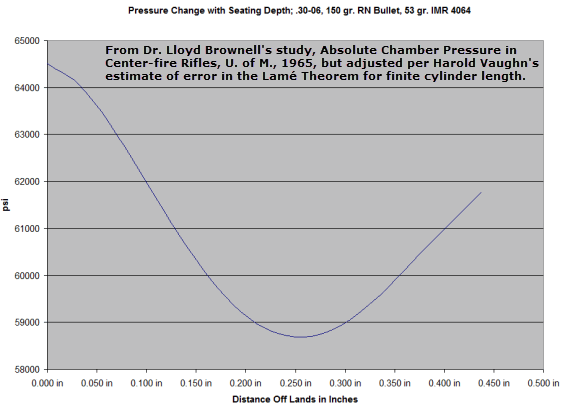
From Barnes Bullets. Note that Pressure is reduced with each decrease in OAL except for the 300RUM with extruded powder, where pressure remained relatively constant. 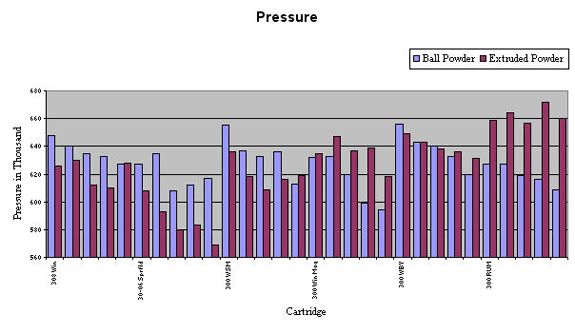
...and again from Hornady. 
These are all actual Pressure Tested Data. Not theory, not opinion and not BS, but fact. |
|
Again confusing distance off lands to seated depth in the case, they are not necessarily the same thing. Referring to the actual document "Absolute Chamber Pressure in Center Fire Rifles" we find charts that show both sides of the story, seating depth AND distance off lands, which demonstrates that the charts you are showing don't tell all the story. The charts on page 48* (Figure 20) of the document shows that pressures go up as you approach the lands, but also going up as you seat the bullet deeper. It shows the pressure when seated to the cannelure, seating deeper than the cannelure initially shows the pressure dropping, and as it is seated deeper the pressure going up. The highest pressures were measured as the bullet contacted the rifling, however the idea that seating the bullet deeper doesn't increase pressures is completely wrong according to the data in that study. http://deepblue.lib.umich.edu/bitstream/handle/2027.42/3866/bac6873.0001.001.pdf?sequence=5 Not theory, not opinion and not BS, but fact. *Page 48, Figure 20. Effect of Bullet Seating Depth on Maximum Chamber Pressure for 220 gr. Rem. SPCL Bullet and 38 gr. IMR 3031. |
|
Quoted:
Again confusing distance off lands to seated depth in the case, they are not necessarily the same thing. Referring to the actual document "Absolute Chamber Pressure in Center Fire Rifles" we find charts that show both sides of the story, seating depth AND distance off lands, which demonstrates that the charts you are showing don't tell all the story. The charts on page 48* (Figure 20) of the document shows that pressures go up as you approach the lands, but also going up as you seat the bullet deeper. It shows the pressure when seated to the cannelure, seating deeper than the cannelure initially shows the pressure dropping, and as it is seated deeper the pressure going up. The highest pressures were measured as the bullet contacted the rifling, however the idea that seating the bullet deeper doesn't increase pressures is completely wrong according to the data in that study. http://deepblue.lib.umich.edu/bitstream/handle/2027.42/3866/bac6873.0001.001.pdf?sequence=5 Not theory, not opinion and not BS, but fact. *Page 48, Figure 20. Effect of Bullet Seating Depth on Maximum Chamber Pressure for 220 gr. Rem. SPCL Bullet and 38 gr. IMR 3031. This chart already posted above came from the University of MI study you linked.
Also note, that in the University of MI chart, that seating deeper and deeper will eventually see pressures rise again, but they do not at any time raise to unacceptable or dangerous levels. One could actually conclude by reading the chart above, that a 30-06 bullet seated to .100 off the lands will have similar or same pressures (61,500) as a bullet seated an additional .350 deeper, or .450 off the lands (61,500). |
|
Quoted:
"but they do not at any time raise to unacceptable or dangerous levels." As stated above this is the point of the entire discussion. steve. Please answer my question regarding 2400. I'm interested in your opinion on this. Motor From the "new" data I have in both Hodgdon and Lyman. The fastest powder in Lyman 48 for the 45-70 is 4759, much slower than 2400. The fastest powder Hodgdon lists is 4198 much much slower than 2400. Cept "Trail Boss, but that is a unique situation. If the older Lyman manuals listed 2400 in the 45-70 and now they do not, one would be wise to ask why. The speed of the powder is only one factor. Some fast powders and some not so fast powders are also position sensitive., especially light charges in huge cases. In the article I liked the author seemed to think that his pointing the barrel down and positioning all the powder up against the base of the bullet and away from the primer is what caused his detonation. Many handloaders use fillers and other products on top of these "light" charges in huge cases to hold the powder back against the primer, even though Lyman specifically warns against it in the 45-70. So, to answer your question, I duno. All I know is it happens with both fast and slow powders. |
|
My old speer reload manual (I think it was #9 0r #10) had some interesting notes regarding the loads for 9mmx19. They had some strongly worded caution regarding seating depth. Apparently, a mer 0.10" increase in setting depth DRAMATICALLY increased chamber pressures. If memory serves, it was something on the order of an increase of 10,000 PSI due to seating depth alone. That is a scary big spike in pressures.
I'm not saying this 45-70 issue was due to seating depth, but seating depth and its attendant decrease in combustion volume inside the case most definitely do have an impact on pressures. I suspect that there is more at play in this case than just seating depth tho.... |
|
Quoted:
From the "new" data I have in both Hodgdon and Lyman. The fastest powder in Lyman 48 for the 45-70 is 4759, much slower than 2400. The fastest powder Hodgdon lists is 4198 much much slower than 2400. Cept "Trail Boss, but that is a unique situation. If the older Lyman manuals listed 2400 in the 45-70 and now they do not, one would be wise to ask why. The speed of the powder is only one factor. Some fast powders and some not so fast powders are also position sensitive., especially light charges in huge cases. In the article I liked the author seemed to think that his pointing the barrel down and positioning all the powder up against the base of the bullet and away from the primer is what caused his detonation. Many handloaders use fillers and other products on top of these "light" charges in huge cases to hold the powder back against the primer, even though Lyman specifically warns against it in the 45-70. So, to answer your question, I duno. All I know is it happens with both fast and slow powders. Quoted:
Quoted:
"but they do not at any time raise to unacceptable or dangerous levels." As stated above this is the point of the entire discussion. steve. Please answer my question regarding 2400. I'm interested in your opinion on this. Motor From the "new" data I have in both Hodgdon and Lyman. The fastest powder in Lyman 48 for the 45-70 is 4759, much slower than 2400. The fastest powder Hodgdon lists is 4198 much much slower than 2400. Cept "Trail Boss, but that is a unique situation. If the older Lyman manuals listed 2400 in the 45-70 and now they do not, one would be wise to ask why. The speed of the powder is only one factor. Some fast powders and some not so fast powders are also position sensitive., especially light charges in huge cases. In the article I liked the author seemed to think that his pointing the barrel down and positioning all the powder up against the base of the bullet and away from the primer is what caused his detonation. Many handloaders use fillers and other products on top of these "light" charges in huge cases to hold the powder back against the primer, even though Lyman specifically warns against it in the 45-70. So, to answer your question, I duno. All I know is it happens with both fast and slow powders. Your observations are dead on concerning 45-70. In fact I can't find any 2400 data for 45-70. So what "does" this tell you about the exploded Contender in your post? I was making reference to numerous other calibers where 2400 IS listed. Just a quick look in the Lyman Cast Bullet Handbook 4th Edition is all you need to do. Just one of many: 30-06 , 200gr cast bullet. Starting load is 15gr , 2400 max is 21gr. This is definitely a low density load. I rarely see any fillers used with the faster powders. Most of the time they are used with reduced charges of "normal" or typical jacketed bullet powders for the particular caliber. Motor |
[ARCHIVED THREAD] - Ka Boom (Page 1 of 2)
Armory Sponsor