


Armory Sponsor

Posted: 11/26/2014 3:36:24 PM EDT
|
I'm having a problem getting My resized .223 brass to fit the case gauge.
Using My Hornaday head space gauge, I have compared some LC XM 193, brass fired from My rifle, and My resized brass. The XM 193 sits just above the low mark, while I cannot get My brass to go below the high mark, it's perfectly flush with the top of the Dillon case gauge. I cannot get it to go down anymore. I set the press to an 1/8th turn past contact, and get good headspace, but it doesn't fit the case gauge. Turning the die down any further, just causes undo camover without setting the brass further into the case guage. So My brass is at the highmark of the case gauge with good headspace, fit's My rifle perfectly, but being that high on the case gauge makes Me a little nervous. I read some today about People having to send Their die in to have it milled down some. Hope this makes sense. Thanks, Dave. |
|
I suppose the case gauge could be out of spec but it's just a guide and not a very effective headspace tool.
Not knowing what dies or press you are using I can not help. I will say there is no real way for you to tell what the proper headspace is of your case without the aid and use of a gauge. Hornady makes a very good tool for this as it is a comparitor of sorts. It's thier version of a headspace tool. This will let you know exactly what your fired cases are by measuring from the head to the datum line on the shoulder of the case. Useing that information compare it to your sized case and subtract .002-.003. Any other means is a shot in the dark. The case gauge will make you over work your brass imo. Forgot to add check for burrs on the case rim. Flip the case over head first into the case gauge, if it does not enter the gauge there is a burr on the head/rim area and this will cause a false reading. |
|
Quoted:
Have you followed the die adjustment procedure that Dillon recommends to achieve proper cam over? V Several times, with a lot of different variations in between. Like I say, the cases all fit, feed, and eject from all My rifles just fine, I'd just like to get alittle further down in the cases gauge if I can. |
|
Quoted:
Is the rim too large to fit in the gauge? I've experienced this before. Will the offending brass's rim enter the gauge backwards? Yes they do. I took My case gauge and several cases over to My LGS, before I could even explain the issue to Don, He said "can't get it to go down?". I went over the whole procedure I have been using, He said it was not uncommon, and as long as everything was functioning allright, good to go. So, I guess it'll have to do. I have made several thousand rounds, all function and shoot just fine. I was just trying to "fine tune" My reloading skills. |
|
So, you are using Dillon dies and also the role of shell holder is being played by their tool plate in a 650.
If the cases plug into a real chamber, yet they don't seem to play well with a drop in style case gage, you will need to get some more gages or seek a little help from a more experienced reloader. The dimensions for chambers and ammo are listed on the SAMMI web site and are not hard to find. If the shoulder datum is correct, and you can't get a pass on the drop in case gage, you would need to have some reference tools to tie break the situation. The diameters are just as important as those lengths, but require more tools to check. It could be the drop-in gage has a problem too, so an easy check is to drop a factory round in and see how it sits. |
|
Quoted:
I'm having a problem getting My resized .223 brass to fit the case gauge. Using My Hornaday head space gauge, I have compared some LC XM 193, brass fired from My rifle, and My resized brass. The XM 193 sits just above the low mark, while I cannot get My brass to go below the high mark, it's perfectly flush with the top of the Dillon case gauge. I cannot get it to go down anymore. I set the press to an 1/8th turn past contact, and get good headspace, but it doesn't fit the case gauge. Turning the die down any further, just causes undo camover without setting the brass further into the case guage. So My brass is at the highmark of the case gauge with good headspace, fit's My rifle perfectly, but being that high on the case gauge makes Me a little nervous. I read some today about People having to send Their die in to have it milled down some. Hope this makes sense. Thanks, Dave. Not being able to get a properly sized case to enter one of these tubed gauges is not uncommon. Nine times out of nine, this is due to the head/rim of the fired case being dinged up during the cycling of the brass case through the action on an AR or other semi-auto. Take one of the offending cases and place it into the gauge headstamp first. If is doesn't fit, you will know that it is NOT a headspace issue, but a deformed, dented, mangled case rim. BTW, a deformed damaged rim should not affect the case entering your chamber. If I were one to use a tubed gauge, I ould purchase one of these. It will tell you much more than a Dillion gauge. http://www.sheridanengineering.com/images/SG223REM.jpg |
Make the shell plate as tight as possible so it will just turn. Check sizing from each station of the shell plate, as each station may have a different deck height. Should be around .125" This one is undersize at one station, resulting in excessive cartridge head space if die is set up on this station. After a few loadings, your sized brass may no longer chamber. 
|
|
I am going to say the same as above. If they feed and chamber in your rifle just fine, shoot them. My chamber is a little bit long, so I size my 556 loads to about .003 longer than sammi spec. Bumping the shoulder back .004 from a fired case. They feed fine, shoot fine and I don't overwork my brass. Get a head space comparator.
Or get a different case gauge, or borrow a friends to see if it is different. |
|
I have 2 of the Dillon 223 gauges, and one of them is about .002 different than the other. I need to check them as I did with the 308, as follows:
I also have the Hornaday headspace comparator and checked it against a 1.630 308 Forster chamber gauge. It indicated 1.624 which is .006 shorter than it should read. Hornaday said this offset is common as it is intended as a comparison device. I got an idea and zeroed the caliper with the gage in-place. All readings are then referenced from the HS length of that gauge . For example, a piece of brass headspaced at 1.633 will read .003. You could do the same with .223, new and fired, then know pretty much the real numbers, not just high, low or OK. Many knowledge thanks to ARFCOM reloading board. Many happiness! |
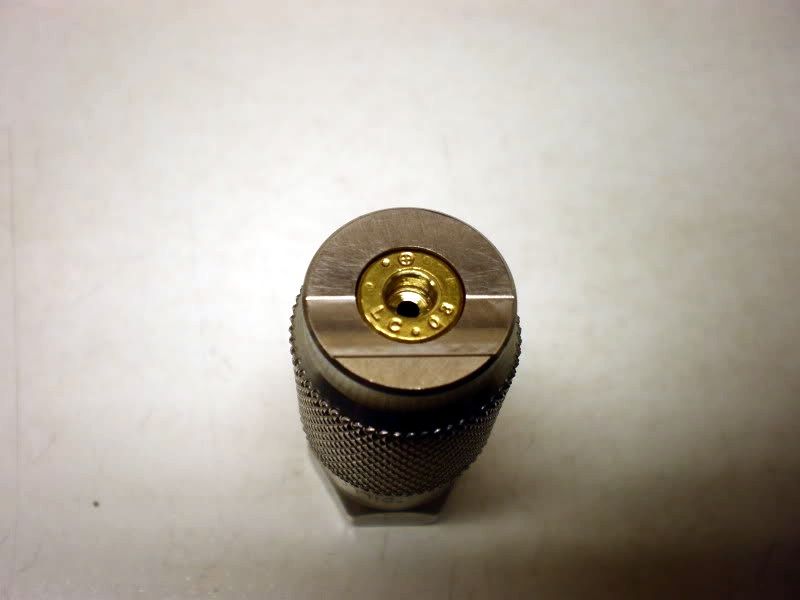
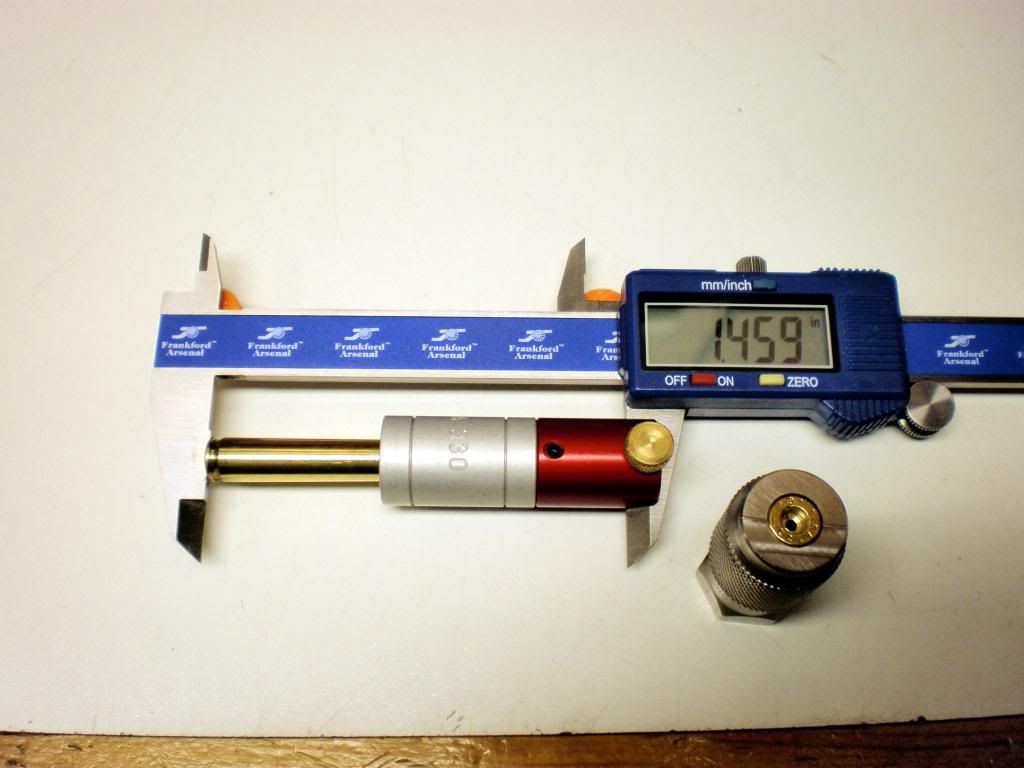

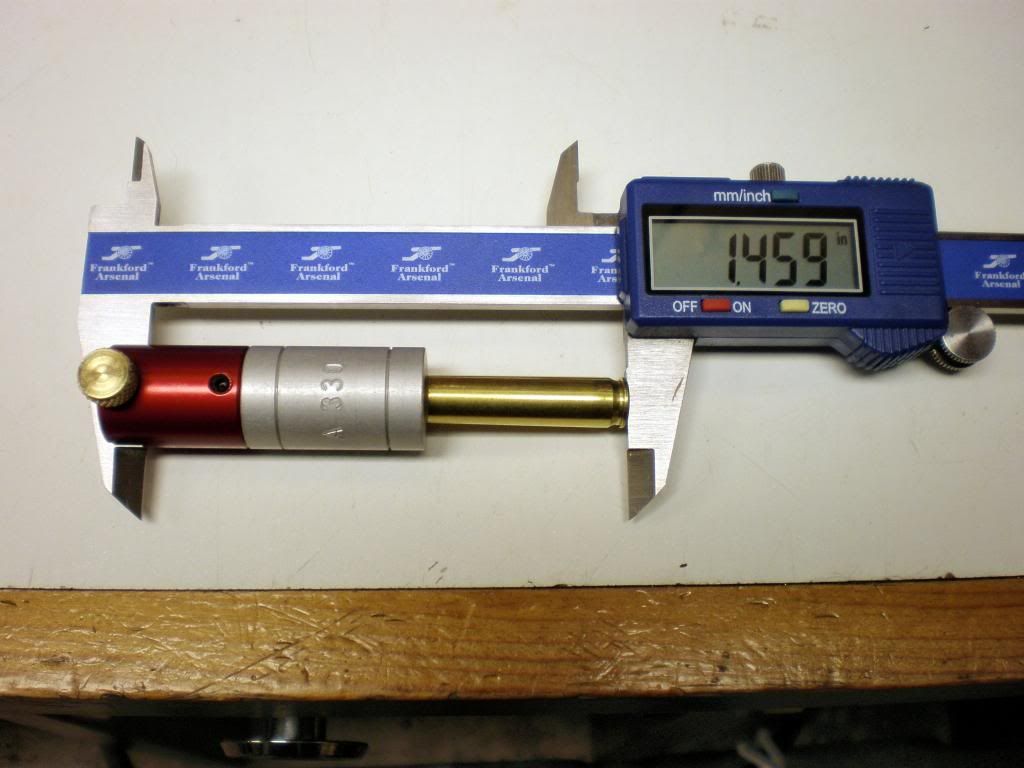
|
Dryflash, the XM 193 sit's just above the low mark = low step of the case gauge. My sized brass is flush with the top of the case gauge = high step of the case gauge.
So, here We go with pictures added. A fired case in the gauge.  </a>" /> </a>" />
A sized case in the gauge.  </a>" /> </a>" />
Case in the Dillon case gauge.  </a>" /> </a>" />
Case upside down in case gauge.  </a>" /> </a>" />
|
|
Quoted:
Not being able to get a properly sized case to enter one of these tubed gauges is not uncommon. Nine times out of nine, this is due to the head/rim of the fired case being dinged up during the cycling of the brass case through the action on an AR or other semi-auto. Take one of the offending cases and place it into the gauge headstamp first. If is doesn't fit, you will know that it is NOT a headspace issue, but a deformed, dented, mangled case rim. BTW, a deformed damaged rim should not affect the case entering your chamber. If I were one to use a tubed gauge, I ould purchase one of these. It will tell you much more than a Dillion gauge. http://www.sheridanengineering.com/images/SG223REM.jpg Quoted:
Quoted:
I'm having a problem getting My resized .223 brass to fit the case gauge. Using My Hornaday head space gauge, I have compared some LC XM 193, brass fired from My rifle, and My resized brass. The XM 193 sits just above the low mark, while I cannot get My brass to go below the high mark, it's perfectly flush with the top of the Dillon case gauge. I cannot get it to go down anymore. I set the press to an 1/8th turn past contact, and get good headspace, but it doesn't fit the case gauge. Turning the die down any further, just causes undo camover without setting the brass further into the case guage. So My brass is at the highmark of the case gauge with good headspace, fit's My rifle perfectly, but being that high on the case gauge makes Me a little nervous. I read some today about People having to send Their die in to have it milled down some. Hope this makes sense. Thanks, Dave. Not being able to get a properly sized case to enter one of these tubed gauges is not uncommon. Nine times out of nine, this is due to the head/rim of the fired case being dinged up during the cycling of the brass case through the action on an AR or other semi-auto. Take one of the offending cases and place it into the gauge headstamp first. If is doesn't fit, you will know that it is NOT a headspace issue, but a deformed, dented, mangled case rim. BTW, a deformed damaged rim should not affect the case entering your chamber. If I were one to use a tubed gauge, I ould purchase one of these. It will tell you much more than a Dillion gauge. http://www.sheridanengineering.com/images/SG223REM.jpg That's a great idea, really cool to be able to see the shoulder and all. |
|
Quoted:
Not being able to get a properly sized case to enter one of these tubed gauges is not uncommon. Nine times out of nine, this is due to the head/rim of the fired case being dinged up during the cycling of the brass case through the action on an AR or other semi-auto. Take one of the offending cases and place it into the gauge headstamp first. If is doesn't fit, you will know that it is NOT a headspace issue, but a deformed, dented, mangled case rim. BTW, a deformed damaged rim should not affect the case entering your chamber. If I were one to use a tubed gauge, I ould purchase one of these. It will tell you much more than a Dillion gauge. http://www.sheridanengineering.com/images/SG223REM.jpg Quoted:
Quoted:
I'm having a problem getting My resized .223 brass to fit the case gauge. Using My Hornaday head space gauge, I have compared some LC XM 193, brass fired from My rifle, and My resized brass. The XM 193 sits just above the low mark, while I cannot get My brass to go below the high mark, it's perfectly flush with the top of the Dillon case gauge. I cannot get it to go down anymore. I set the press to an 1/8th turn past contact, and get good headspace, but it doesn't fit the case gauge. Turning the die down any further, just causes undo camover without setting the brass further into the case guage. So My brass is at the highmark of the case gauge with good headspace, fit's My rifle perfectly, but being that high on the case gauge makes Me a little nervous. I read some today about People having to send Their die in to have it milled down some. Hope this makes sense. Thanks, Dave. Not being able to get a properly sized case to enter one of these tubed gauges is not uncommon. Nine times out of nine, this is due to the head/rim of the fired case being dinged up during the cycling of the brass case through the action on an AR or other semi-auto. Take one of the offending cases and place it into the gauge headstamp first. If is doesn't fit, you will know that it is NOT a headspace issue, but a deformed, dented, mangled case rim. BTW, a deformed damaged rim should not affect the case entering your chamber. If I were one to use a tubed gauge, I ould purchase one of these. It will tell you much more than a Dillion gauge. http://www.sheridanengineering.com/images/SG223REM.jpg That's a great idea, really cool to be able to see the shoulder and all. |
|
Quoted: Dryflash, the XM 193 sit's just above the low mark = low step of the case gauge. My sized brass is flush with the top of the case gauge = high step of the case gauge. So, here We go with pictures added. A fired case in the gauge. http://<a href=http://i1302.photobucket.com/albums/ag124/71metbu/reloading/dump004_zpsa632b5ba.jpg</a>" /> A sized case in the gauge. http://<a href=http://i1302.photobucket.com/albums/ag124/71metbu/reloading/dump005_zps02cde089.jpg</a>" /> Case in the Dillon case gauge. http://<a href=http://i1302.photobucket.com/albums/ag124/71metbu/reloading/dump006_zpsd3db66a6.jpg</a>" /> Case upside down in case gauge. http://<a href=http://i1302.photobucket.com/albums/ag124/71metbu/reloading/dump007_zpsea77f97c.jpg</a>" /> Are we using different terms to describe the same thing?
I'm going buy the tiny amount of silver (the case gauge) above the end of the case. The flash even made a sparkle (part of case gauge above the end of the case) on the far side of case. With your Hornady tool, case is sized perfect. Go by this tool over the case gauge. Especially if your loads function good. |
Dryflash, yes same thing different terms.
AeroE, this is what I'm finding out, multiple ways to drive oneself insane. 
I went to My LGS today and picked up a set of Lee dies to use in My Lee Classic. I find it MUCH easier to use when building ladders, then trying to use the progressive, or messing up My settings pulling the dies out. Just for giggles, I put the sizing die in and turned till it made contact, Then a half turn, sized one case and BOOM, the case fit the case gauge perfectly, and it matched the Datum of the XM 193. 
So, went back to the progressive, lubed up 500 cases and sized them all. 
I just find it a little odd that the Dillon XL650 and Dillon dies, won't go down any further then what I can get out of them. Turns out it is perfect for what I need, but what if Somebody wanted to make a XM 193 clone? IDK, I'll call Dillon, see what They say. Anyhow, problem solved for Me, thanks for the help. Dave |
|
Quoted: I went to My LGS today and picked up a set of Lee dies to use in My Lee Classic. I find it MUCH easier to use when building ladders, then trying to use the progressive, or messing up My settings pulling the dies out. Just for giggles, I put the sizing die in and turned till it made contact, Then a half turn, sized one case and BOOM, the case fit the case gauge perfectly, and it matched the Datum of the XM 193. So, went back to the progressive, lubed up 500 cases and sized them all. I just find it a little odd that the Dillon XL650 and Dillon dies, won't go down any further then what I can get out of them. Turns out it is perfect for what I need, but what if Somebody wanted to make a XM 193 clone? IDK, I'll call Dillon, see what They say. Anyhow, problem solved for Me, thanks for the help. Dave I found the same thing between my Dillon and Lee .223 resizing dies on both my 550B and XL650 back when I started handloading .223/5.56 some 10 yrs ago. After repeated attempts to adjust the Dillon resizing die down correctly, I came to the conclusion that Dillon made my die too long. So, I said, "screw this" and took the Dillon die to my grinder where I removed about .020" off the end of the die which allowed me to adjust it correctly. Problem solved and some 34,000rds later it still works just fine. (BTW, I use this combo in 30 WCF [30-30], 300 Savage, .308/M80 ball, and 30-06/M2 ball and I've never seen this problem with any of them.) BTW, I prefer Dillon's resizing die over Lee's because it has a carbide expander ball vs Lee's resizer with a steel expander cone. I don't have to lube the inside of the case to keep it from squeaking and so it doesn't stretch the neck. However, I prefer Lee's bullet seating and crimping dies because they are hand adjustable vs Dillon's requiring a wrench. So, I buy a Dillon resizer and a Lee Pacesetter die set as it is still cheaper than the Dillon set. |
Armory Sponsor