


Armory Sponsor

Posted: 9/9/2013 4:29:51 PM EDT
|
I tried throwing some charges for the first time today. I'm using a rcbs uniflow powder measure and 505 scale. The directions they provide aren't the greatest and I'm not getting consistent charges at all. Anyone have any tips?
|
|
Quoted: I only use spherical powder, I get a range of .1gr, just a hair above or a hair below but nothing near .1gr over or under. What powder are you using and how far off are you? Is your room still (no air movement)? |
|
It depends on what powder you are trying to throw. The Uniflow does not like stick powders.
I use mine for flake (Unique, Bullseye, etc) and ball type (H-335, W-760, etc.) If I use it for stick I throw light then trickle up to target weight with a powder trickler. |
|
Quoted: It depends on what powder you are trying to throw. The Uniflow does not like stick powders. I use mine for flake (Unique, Bullseye, etc) and ball type (H-335, W-760, etc.) If I use it for stick I throw light then trickle up to target weight with a powder trickler. I'm getting huge variations. One will be right near where I want it and the next will be way heavy or light. Could it be the 'technique' I'm using? I put the pan up to where it's touching and then a quick up stroke and then back down.
|
| I have a powder baffle in mine and it helps. I run several cycles of powder through before I start using it in cases. Run it with a sharp impact at the top of the stoke, wait, run it down with a sharp impact at the end of the stoke. Don't beat the hell out of it but enough to get a good sound. Also check the powder capacity screw, there is a ovid washer that is sapposed to keep tension on the adjustment screw to keep it from moving. I had to tighten the assembly up quite a bit and shim it to get enough tension to keep the assembly from moving. |
|
A powder baffle helps keep powder charges more consistent. Here's one site that has them in stock: http://www.midwayusa.com/product/493217/rcbs-uniflow-powder-measure-powder-baffle
I agree that you have to keep the operation of the handle the same each throw. Also, like mentioned a light peck at the top and bottom of the stroke helps fill the hopper with the same weight each time. Maybe try a double peck at the top where it fills the rotor with powder. Not a hard bang but just a solid peck. The powder baffle helps keep powder from settling and making charges slightly heavier. Make sure you're using the right rotor for the size of charge. |
|
+1 on powder baffle
Use the same motion and and speed every time. Are you "banging" the handle at either end of the stroke? If so, do it every time. If not, then don't do it. Consistency is the key. Same thing for the amount of time that the chamber sits under the powder. I always end with the lever "down". That way the chamber is dumping and not filling with powder. Thus, if it takes me longer to pour the powder into the case, or for the scale to weigh, or whatever, I'm still consistent with how long I allow the chamber to fill with powder. Having said all that, some powders will meter more consistently than others. Long, stick powders are the worst. Like others said, I throw them light and trickle to the weight. Wish you the best. I love reloading. |


|
After filling hopper with powder it has to settle to throw consistent charges. What the instructions don't tell you. You begin the process by tapping the side of the hopper and watch the powder settle about a half inch. Then throw several charges (returning them to the hopper). Leave pan under PM while doing this for all charges thrown. Now weigh a thrown charge. Lets say it's off. Adjust for more or less as needed. Now that you have adjusted PM, you need to throw 3 charges (to resettle powder) and return them to the hopper. Throw charge and weigh. Repeat above until PM is where you want it. Then to throw charges use the same motion (speed and force) with every charge you throw. This is the other secret. With practice and experience using good technique, ball powder should measure exact. Flake powder plus or minus .1 gr. Depending on which extruded powder, plus or minus .3 gr. Some of my PM's.
|
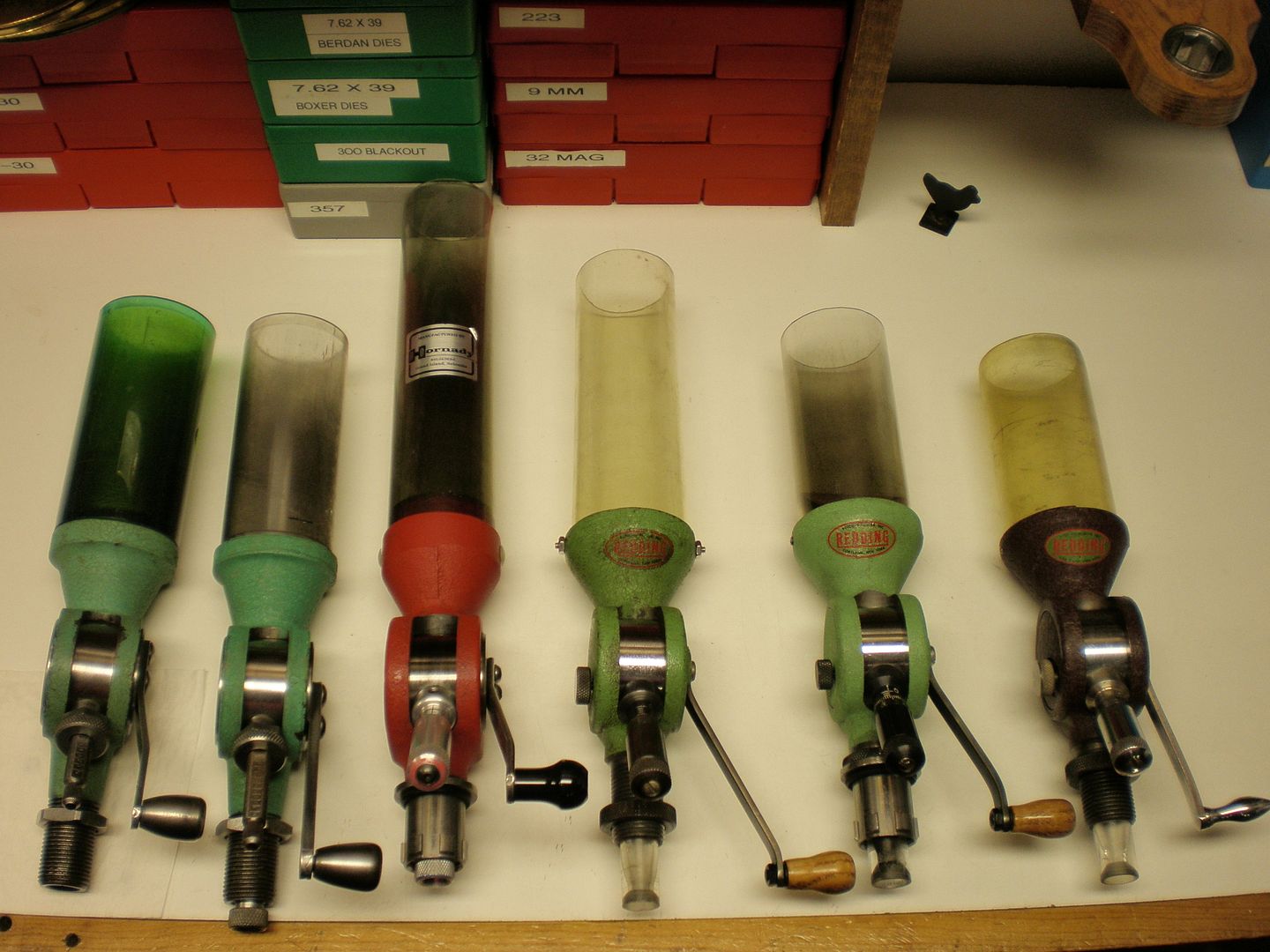
| If you haven't done it yet, take the measure apart and clean it. Next, use a dryer sheet to get rid of any static. Then, polish any metal. If you check after each step, you may not need anymore work. Eventually, you will find that the hopper gets seasoned and works more smoothly. |
|
New measures sometimes take a bit of powder exposure to make the inside slippery.
A way to speed this process up is to buy some graphite powder (the little tubes that are used for keyholes) and coat the inside of the hopper, rotor, baffle etc. I don't mean dump a few tubes of it in there, just enough to give everything a light dusting. Blow the excess out with canned air. Just bear in mind that feeding your measure lots of powder essentially does the same thing. Over time the inside will get a light coating of powder residue (graphite) and gradually become more slippery. Yeah, and rub a dryer sheet on the outside as well. |
|
Thanks for all the replies. I ended up just running a full hopper of powder. Eventually it started to be more consistent, but not exact every time. Maybe after I get the finesse down It'll be better. Another question. How often do you recommend checking your powder throw? For me I just did 10 cases and checked every one just to be sure(My first 10 reloads in my life
 ). ). |
|
Not that it is very important, but the video makes a common error when it assumes that the 241 grains divided by ten means that the charges are within 0.1 grains.
All that 241 grains means is that the sum of the ten charges is 1 grain high. To know how much variation there is in any one of the 10 charges, all 10 would need to be weighed and recorded. You could assume the scale has an uncertainty of about 0.1 grains. If you recorded all ten charges, you could then figure the standard deviation and multiply it by 6 and this would be the estimated total spread if you threw about 30 charges. If the OP is getting on the order of 0.5 grains spread over 30 or so charges, he is doing at least an average job. It takes great technique and some luck to do much better if you are really checking. In the end, that is good enough for most shooting. |
| Sounds like you are starting to get some accuracy. In addition to what others have suggested, make sure that you don't have air conditioning on or any noticeable air flow in the room, any little bit can throw off your scale enough to make it look like your powder charge is not accurate or consistent. |
|
2460 will measure extremely consistently, its just a matter of technique, remember it takes a couple of seconds for that powder to drop through that 22 cal hole in the case. If you watch that video, quite frankly that guy is running pretty fast. To get a good idea about how consistent you are, throw 10 charges in the pan and weigh them, then do the same thing over again, do that two or three times and compare results, that will tell you a lot. Throwing 10 charges and weighing them is a really good way to make sure exactly where your powder measure it set. Watching that powder dispense into the pan will give you a pretty good idea how long it takes for that powder to fill a case. |
|
Lots of good advice already.
If this is a new powder measure, clean the heck out of it. The Uniflow and Hornady PMs are pretty much identical, and at least the Hornady is shipped with some pretty nasty preservatives that can wreak havoc on consistency. After I thought I had cleaned my new PM 'damned well,' it still took another soaking in water + Dawn, followed by some graphite and 1# or so of powder run through it manually. After that, and the powder baffle, it's pretty much spot on. Note the comment about the dryer sheet, as well as throwing some 'starting' charges and discarding them(back in the hopper) at the beginning of any session to let any settling occur and adjust for it, if need be. Make sure your press is mounted and truly stable, not wiggling around or flexing your mounting surface (or moving the whole bench or table!), and your movements are consistent and repeatable...all of these will lead to more consistent throws.. |
|
Quoted: Lots of good advice already. If this is a new powder measure, clean the heck out of it. The Uniflow and Hornady PMs are pretty much identical, and at least the Hornady is shipped with some pretty nasty preservatives that can wreak havoc on consistency. After I thought I had cleaned my new PM 'damned well,' it still took another soaking in water + Dawn, followed by some graphite and 1# or so of powder run through it manually. After that, and the powder baffle, it's pretty much spot on. Note the comment about the dryer sheet, as well as throwing some 'starting' charges and discarding them(back in the hopper) at the beginning of any session to let any settling occur and adjust for it, if need be. Make sure your press is mounted and truly stable, not wiggling around or flexing your mounting surface (or moving the whole bench or table!), and your movements are consistent and repeatable...all of these will lead to more consistent throws.. |
|
Quoted: ...and use a can of air to blow out anything that doesn't obey gravity. Quoted: Quoted: Dump out old pour in new. ...and use a can of air to blow out anything that doesn't obey gravity. |
|
Quoted: I guess it's static cause when I dumped my hopper there was still some residual powder down near the drum. Quoted: Quoted: Quoted: Dump out old pour in new. ...and use a can of air to blow out anything that doesn't obey gravity. Static needs to be removed before throwing accurate charges. |
|
I found that the way the powder drop is secured to the bench can have an effect. My RCBS has a metal plate which I clamp to the bench, but if I clamp it a bit too far along the plate, leaving a longer cantilever, it jiggles more and that can shake up the powder more, altering the charge densities.
Just one more thing to think about. I have a light so I can see the powder dropping. It can take longer than you think for the powder to drop, and sometimes it can hang up, reducing the charge dispensed. |
|
Quoted: Use dryer sheets to remove static. Static needs to be removed before throwing accurate charges. Quoted: Quoted: Quoted: Quoted: Dump out old pour in new. ...and use a can of air to blow out anything that doesn't obey gravity. Static needs to be removed before throwing accurate charges. |
|
Quoted: I found that the way the powder drop is secured to the bench can have an effect. My RCBS has a metal plate which I clamp to the bench, but if I clamp it a bit too far along the plate, leaving a longer cantilever, it jiggles more and that can shake up the powder more, altering the charge densities. Just one more thing to think about. I have a light so I can see the powder dropping. It can take longer than you think for the powder to drop, and sometimes it can hang up, reducing the charge dispensed. |
|
Quoted:
Actually put pieces of them in it? Or just wipe down the measure? Quoted:
Quoted:
Quoted:
Quoted:
Quoted:
Dump out old pour in new. ...and use a can of air to blow out anything that doesn't obey gravity. Static needs to be removed before throwing accurate charges. I wipe down the measure, inside as well when empty, then leave a dryer sheet wrapped around the PM, can still see through it enough to see powder level easily. Note that it may not be static in this case - it may simply need the aforementioned thorough cleaning and some graphite and/or powder run through it manually first.. |
|
Wipe down with dryer sheet inside and out. Metal and plastic parts. I store my PM with 2 dryer sheets inside the hopper when not in use. Any "dust" from the dryer sheet will not effect the powder. Been doing this for about 15 years now. Notice PM securely bolted to my shelf at a comfortable level. 6 inches away from my scale. |

|
Quoted:
Not that it is very important, but the video makes a common error when it assumes that the 241 grains divided by ten means that the charges are within 0.1 grains. All that 241 grains means is that the sum of the ten charges is 1 grain high. To know how much variation there is in any one of the 10 charges, all 10 would need to be weighed and recorded. You could assume the scale has an uncertainty of about 0.1 grains. If you recorded all ten charges, you could then figure the standard deviation and multiply it by 6 and this would be the estimated total spread if you threw about 30 charges. If the OP is getting on the order of 0.5 grains spread over 30 or so charges, he is doing at least an average job. It takes great technique and some luck to do much better if you are really checking. In the end, that is good enough for most shooting. Agreed 100% |
|
Saw a dude here that taped a vibrator to his powder hopper. Seems like a damn good idea to me - especially combined with a powder baffle.
I use a Harrel's measure, it's TITS with spherical or short extruded powder. I just kind of double tap the upstroke to pack it in. |
| The tips about the graphite powder, cleaning it, and the dryer sheets worked for me when I had the same problem. I also bought a decent paintbrush to help with cleaning the powder out. I went with something a little more expensive to get softer bristles and not throw powder everywhere. You want to make sure there wasnt any of the residue from packing in there also as previously posted. I have the LnL, and even though I got it used, I still had to clean it a few times to get it to drop consistently, along with the graphite and such. |
Armory Sponsor