


Armory Sponsor

Posted: 2/5/2013 9:11:55 AM EDT
|
I have a few questions on applying roll crimps, please no 'don't apply them' they have a canelure, i want to roll them and understand this process before i decide on not doing it. otherwise how will i become a proficient reloader?
What i'm working with... LNL AP Hornady .223 dies ok so i understand adjusting my seat until i get to the OAL that either i want so it barely fits in mag, or by the load data what it's calling for, or....if i've checked my barrel doing it .001-.003 off the lands. So once you get that round tuned in, then you back off the seater and start tuning down the die for proper crimp, once there just dial your seater back down on the already proper set round until it touches and you should be good to go. right? So my questions. Anyone have a picture of a text book roll crimp? It appears if you keep turning the crimp down you eventually hit this magic spot where it buckles the cartridge. ugh....maybe the explantaion of getting perfect roll crimp will alleviate this. Also...once you get this figured out is there some method you use to mark your setup so you can quickly return to it? I ask because next time i might not want to set 55gr. perhaps it's 62 grain or 70+ grain rounds and i would think the dial would be different at least on the depth. When crimping, i understand all rounds must be sized the same to get like results. So my process will be bumping the shoulders back as little as i need to meet specs, but from what i can tell you will get some very slight variances like .1.455, 1.454, or 1.456 (just an example) so based on this if you giraud trim you should get 1.750, 1.751 or 1.7495. Any tips on appliying the crimp, getting it dialed it correctly and as quickly as possible? Thanks, |
|
Quoted:
I have a few questions on applying roll crimps, please no 'don't apply them' they have a canelure, i want to roll them and understand this process before i decide on not doing it. otherwise how will i become a proficient reloader? What i'm working with... LNL AP Hornady .223 dies ok so i understand adjusting my seat until i get to the OAL that either i want so it barely fits in mag, or by the load data what it's calling for, or....if i've checked my barrel doing it .001-.003 off the lands. So once you get that round tuned in, then you back off the seater and start tuning down the die for proper crimp, once there just dial your seater back down on the already proper set round until it touches and you should be good to go. right? So my questions. Anyone have a picture of a text book roll crimp? It appears if you keep turning the crimp down you eventually hit this magic spot where it buckles the cartridge. ugh....maybe the explantaion of getting perfect roll crimp will alleviate this. Also...once you get this figured out is there some method you use to mark your setup so you can quickly return to it? I ask because next time i might not want to set 55gr. perhaps it's 62 grain or 70+ grain rounds and i would think the dial would be different at least on the depth. When crimping, i understand all rounds must be sized the same to get like results. So my process will be bumping the shoulders back as little as i need to meet specs, but from what i can tell you will get some very slight variances like .1.455, 1.454, or 1.456 (just an example) so based on this if you giraud trim you should get 1.750, 1.751 or 1.7495. Any tips on appliying the crimp, getting it dialed it correctly and as quickly as possible? Thanks, this is factory ammo, but the concept is there I know it is difficult to see, but look at the way the light is reflecting off the casing. 
|
 Left case crimped with Lee FCD, right no crimp. OAL should be close to 2.20. Depends on trim length. Notice case on left, bullet is seated to mid cannelure. Forget loading to mag length with a short bullet w/cannelure you want to crimp. (like the 55 gr FMJ in .224) Any time you are going to crimp a bullet w/cannelure seat bullet to mid cannelure. The bullet maker put the cannelure in the correct location. Longer bullets can and should be loaded to mag length. 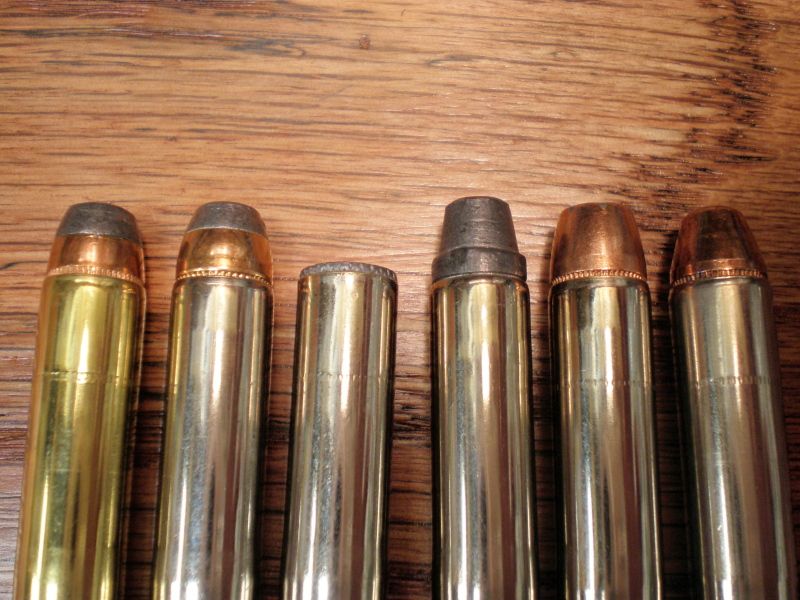 Roll crimp on 357's. 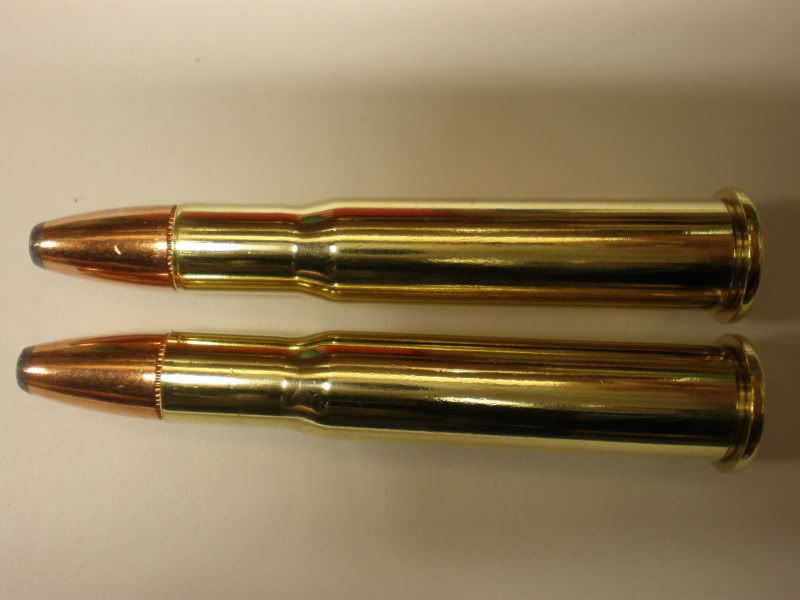 30-30 top round roll crimped, bottom not crimped yet. Remember case length (all cases trimmed to the same length) is the key to trouble free crimping. I know you are waiting for your trimmer, you should have very little problem with your 1.749 to 1.751 cases you are using. Good luck
|
|
ok thanks so much for the pictures, the 30-30 is exactly what I was thinking the roll crimp should look like, a obvious curvature, however I seemed never able to achieve that and even though I went down very very minute steps eventually I would hit case buckle...what is causing that?
One problem I 'might' have is the load data for 55gr FMJ BT using N-130 powder the COL they call for is something like 224 which is more than the call for COL from the hornady manual of course the hornady doesn't have test loads for N130. And when I seat the neck is just over the edge of the cannelure but it's not down to the middle of it. Is that some of the issue? if so, is that in essence saying forget what the COL is calling for always seat to the cannelure? |
|
To make your crimping life easier, use 1 die to seat bullets and another die to crimp. You can do both in one die, but exact case length is a must, and very careful die adjustment is needed. Just a hassle best to avoid. Again, seat bullet to mid cannelure, forget what data says. You don't have the same exact components, so you adjust safely. Deep seating is a problem with small volume pistol cases, but with the larger volume bottleneck rifle cases, not an issue. Seat to mid cannelure, if you are below that, you need to adjust seating die.  223 notice 3 dies. Top die is the seater, adjusted high so the crimp will never touch the case. Has the add on micrometer seater. Die on right is a FCD, for crimping the loads that I crimp. In 223 I only crimp 55 and 62 FMJBT's mid cannelure.  30-30 3 die set with a FCD added. 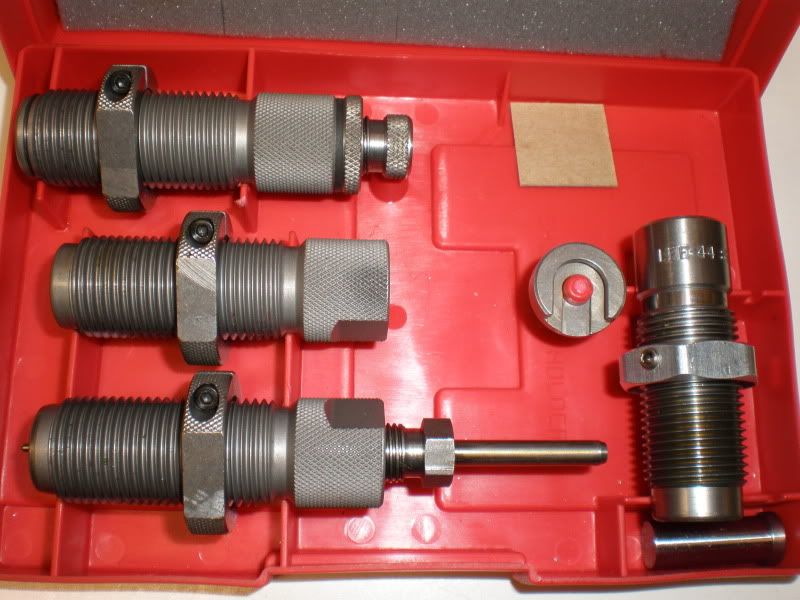 Same idea with 44 mag. 3 die set made into a 4 die set with FCD. My motto, always separate bullet seating and the crimping operation. Adds a step, but pays off with ammo I am proud of. |
|
Quoted:
To make your crimping life easier, use 1 die to seat bullets and another die to crimp. You can do both in one die, but exact case length is a must, and very careful die adjustment is needed. Just a hassle best to avoid. Again, seat bullet to mid cannelure, forget what data says. You don't have the same exact components, so you adjust safely. Deep seating is a problem with small volume pistol cases, but with the larger volume bottleneck rifle cases, not an issue. Seat to mid cannelure, if you are below that, you need to adjust seating die. 223 notice 3 dies. Top die is the seater, adjusted high so the crimp will never touch the case. Has the add on micrometer seater. Die on right is a FCD, for crimping the loads that I crimp. In 223 I only crimp 55 and 62 FMJBT's mid cannelure. 30-30 3 die set with a FCD added. Same idea with 44 mag. 3 die set made into a 4 die set with FCD. My motto, always separate bullet seating and the crimping operation. Adds a step, but pays off with ammo I am proud of. not to sound like i bucking advice, i'm not. But I see many people say seperate the crimping seating, is this simply because it's easier and does not require a mastery of the two combined? or does it just simply produce better results? |
|
Quoted: snip not to sound like i bucking advice, i'm not. But I see many people say seperate the crimping seating, is this simply because it's easier and does not require a mastery of the two combined? or does it just simply produce better results? Both. When using 1 die the bullet is being crimped and still being pushed down by the seater just before the ram comes to a stop. Notice the set up on LNL and Dillon progressives. 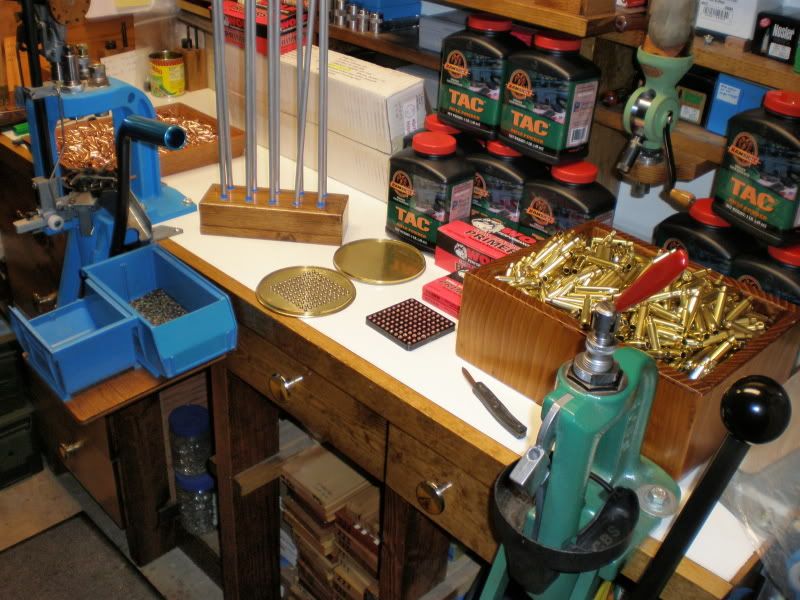 Bullet seating and crimping in separate dies. I rest my case.
 |
|
To set your roll crimp, back seating stem off. Index sized brass and fully extend ram. Run die down until touching brass, lower ram a bit, turn die quarter turn. Afterwards adjust in 1/8 turn increments after setting oal with seater stem.
This isn't rocket science or the dark beast reloaders make it out to be. dc. |
|
Quoted:
Quoted:
snip
not to sound like i bucking advice, i'm not. But I see many people say seperate the crimping seating, is this simply because it's easier and does not require a mastery of the two combined? or does it just simply produce better results? Both. When using 1 die the bullet is being crimped and still being pushed down by the seater just before the ram comes to a stop. Notice the set up on LNL and Dillon progressives. Bullet seating and crimping in separate dies. I rest my case. i'm salivating at your setup, especially all that TAC powder!!! (and brass, primers) So it seems everyone just loves those are FCD lee makes, but it's a 4 corner ugly pinch if you ask me.IMHO. i like uniformity |
|
Quoted:
To set your roll crimp, back seating stem off. Index sized brass and fully extend ram. Run die down until touching brass, lower ram a bit, turn die quarter turn. Afterwards adjust in 1/8 turn increments after setting oal with seater stem. This isn't rocket science or the dark beast reloaders make it out to be. dc. seems simple once you 'get' it...i think the key is all brass has to be the same size or at leat +/- .001 So if i understand you correctly in order. set brass, raise ram fully seated with round. Turn down stem to touch round, move ram down, probably at this point turn it down a few turns and keep seating, checking until your mid cannelure. once set back off seating stem. next same round fully up ram turn down until die touches, back off ram, die down 1/4 turn then fully extend ram, keep going until crimp is where you want it using 1/8th increments. Once set fully extend with round in die, turn seater back down to where it touches the round, you're now set. |
|
Quoted:
To set your roll crimp, back seating stem off. Index sized brass and fully extend ram. Run die down until touching brass, lower ram a bit, turn die quarter turn. Afterwards adjust in 1/8 turn increments after setting oal with seater stem. This isn't rocket science or the dark beast reloaders make it out to be. dc. ^^^^^^^^^^^^^^^ This. The trick is to do the seat / crimp in a sequential two step process. Do not try to seat and roll crimp on the same press stroke. Seat first carefully lining up the case neck edge with near the top of the cannelure (cannelure almost hidden). Now run the batch through again with the seater stem backed out and the die body screwed down carefully to enable the roll crimper feature. If you have a progressive press and want to roll crimp just buy two seater dies, set one for seating, set the other for roll crimping. The cannelure allows room for case brass bunching up in the inside bend radius of the crimp. |
|
I'm not being tracked very well at all.
First, I want to say there's more than a handful of extreemely experienced handloaders in this forum. But, they tend to develop methods that work, well and that's, that. I've never been one to leave well enough alone. I see something someone says works and I have to see for myself which accounts for Lee, Dillon and Hornady presses. Also my reasoning for having more than three die sets for half the calibers I load. Who's got .45acp dies in Redding, RCBS, Hornady, Lee and Texan ? Carbide and steel ? Curiosity didn't end with equipment because I had to understand and perfect every manner of seating and crimping imaginable. For instance, 1.) Seat, taper crimp, same die in one stroke of press with roll crimp die. 2.) Seat with roll crimp die, taper crimp with roll crimp die, two strokes of press. 3.) Seat with seater die, crimp with taper crimp die, seperately. 4.) Seat with seater die, crimp with fcd, seperately. 5.) Seat with seater die, crimp with taper crimp and use fcd in station as case gage. These, of course are examples of methods I use handloading .45acp. For .223, these are the steps necessary to tune one die to seat and roll crimp in one operation. This isn't popular method or accepted method in this forum. But, this is a tried and proven, old school method EVERYONE should know. If you were to be an invited student in my home this is one basic taught before we get to what you want to learn.
1.) Take sized brass, index in station, extend ram and run die to case mouth. 2.) Lower ram, measure case mouth. My target roll crimp diameter for .223 with cannelured bullets and LC brass is 0.246. 3. After crimp is set, snug lock ring and set seating stem to desired oal. 4.) Measure crimp diameter and adjust die in 1/8 turn increments. Remember as die is spun down for crimp, seating stem should be threaded up if wanting same oal. 5. Once die is tuned to target cartridge geometry, secure lock nut. Trim height must be consistent for consistent crimp diameter. This is seating and crimping in one pass, with one die explained, questions ? |
|
[quote
1.) Take sized brass, index in station, extend ram and run die to case mouth. 2.) Lower ram, measure case mouth. My target roll crimp diameter for .223 with cannelured bullets and LC brass is 0.246. 3. After crimp is set, snug lock ring and set seating stem to desired oal. 4.) Measure crimp diameter and adjust die in 1/8 turn increments. Remember as die is spun down for crimp, seating stem should be threaded up if wanting same oal. 5. Once die is tuned to target cartridge geometry, secure lock nut. Trim height must be consistent for consistent crimp diameter. This is seating and crimping in one pass, with one die explained, questions ? [/quote] i like the way you think i want to so much learn the right way if i'm going to do this. then i can learn the how and when to do shortcuts as long as they are acceptable to myself and my standards.
So my question is this....it appears you are setting the crip with brass only (no bullet). so two questions. 1. the .246 is measured on one edge only or are you accounting for BOTH edges combined total (i.e. i measure one side of the circle and get .123 crimp both sides crimping equal .246 total crimp, otherwise it would be .492 total crimp across the diameter (does that make sense my question?) 2. if your doing this brass only...how do you go about adding seating into the mix since you dont know how far down your seating should be at this point? so you know what i'm working with i do have the seating micrometer on the hornady 223 die. |
|
If you are very, very careful, you might be able to get away with a one ram stroke to seat bullet and do roll crimp. However, once you create a slight bulge in the knuckle between the .223 straight body and conical section, and that slight bulge overlooked, results in a FTF or FTE, then you will probably go back to the two step operation, or forget about roll crimping forever. After all, there is the taper crimp or the collet crimp, not so sensitive to bulging, and able to crimp the neck down on the body of a bullet without cannelure.
Can you spot the bulge? 
|
|
Quoted:
ok thanks so much for the pictures, the 30-30 is exactly what I was thinking the roll crimp should look like, a obvious curvature, however I seemed never able to achieve that and even though I went down very very minute steps eventually I would hit case buckle...what is causing that? One problem I 'might' have is the load data for 55gr FMJ BT using N-130 powder the COL they call for is something like 224 which is more than the call for COL from the hornady manual of course the hornady doesn't have test loads for N130. And when I seat the neck is just over the edge of the cannelure but it's not down to the middle of it. Is that some of the issue? if so, is that in essence saying forget what the COL is calling for always seat to the cannelure? I'm going to take a semi-educated guess at that bit in red. Roll crimping is not bending the brass toward the bullet, its actually forming the brass in a manner similar to the way casings are drawn from brass slugs. Under pressure metals will flow like extremely thick liquids, thats what allows us to resize casings to begin with and what causes them to "grow" when full length resizing. To reduce diameter at the crimp without causing wrinkles and creases in the metal the material must move in a fluid manner. When you are reducing diameter like that pressure will increase dramatically the further you go, especially when you are squeezing against the bullet jacket and lead core. Eventually the pressure it takes to reduce the diameter is greater than the force required to buckle the shoulder, which is unsupported in the seating/crimping die. Something has to give and since the shoulder is unsupported it is experiencing a linear force rather than even pressure so it buckles rather than flowing. I hope that made some sense, I can see the physics in my head, but the words aren't flowing as easily. |
|
0.246 is loaded case mouth measurement taken from loaded cartridge. Setting crimp using empty brass, when case mouth touches and die is turned the quarter turn die is very close to that measurement. Springback might not reflect die is set to target so its necessary to finesse crimp setting with bullet seated.
AeroE and CCW make points of a fine line using the one die and of course correct. In no way am I saying this is an optimum method. It's one method and an old school method at that. When finding fine line in adjustment I use case gage for verification. Your being new means you've got a learning curve to climb seating and crimping in one operation and suspect it will try your patience. I perfected this using Lee hand press and now use with progressive press. Matter fact, my AP is set this way after having done a big 75 grain hpbt run. All 600 loaded cartridges passed case gage. |
|
Quoted:
If you are very, very careful, you might be able to get away with a one ram stroke to seat bullet and do roll crimp. However, once you create a slight bulge in the knuckle between the .223 straight body and conical section, and that slight bulge overlooked, results in a FTF or FTE, then you will probably go back to the two step operation, or forget about roll crimping forever. After all, there is the taper crimp or the collet crimp, not so sensitive to bulging, and able to crimp the neck down on the body of a bullet without cannelure. Can you spot the bulge?http://i255.photobucket.com/albums/hh133/counterclockwisester/collapsedshoulder2.jpg both are bulged actually. the right one worse. |
|
ahhhhhhhhhhhhhhhhhhhhhhhhhhhhhh yes it tests your patience for sure....
so i first size, down to here. 
then i check OAL for 1.75 if not i file it down to meet it then my work...fist 3 great...(this is after dialing it in) then thinking i had it all dialed in....next 3 

|
|
Being a new to reloading I decided to use the Lee FCD for any crimping. It's one less thing to try to master during the learning process. Maybe later I'll try some of the tips in the informative posts above. For pistol I just use the FCD in the final station. For .223 I experimented with the "consistent crimp" and did it in a single stage.
If you get too frustrated, try moving your powder drop back to station 2 (I think you have it in 3), powder cop in 3, seat in 4 and use the FCD in 5. It might be easier to build your loading confidence, then try to learn the one step operation later when you have everything else right. |
|
Quoted:
Being a new to reloading I decided to use the Lee FCD for any crimping. It's one less thing to try to master during the learning process. Maybe later I'll try some of the tips in the informative posts above. For pistol I just use the FCD in the final station. For .223 I experimented with the "consistent crimp" and did it in a single stage. If you get too frustrated, try moving your powder drop back to station 2 (I think you have it in 3), powder cop in 3, seat in 4 and use the FCD in 5. It might be easier to build your loading confidence, then try to learn the one step operation later when you have everything else right. lol i might, but i'm determined to get this down as i consider it the basics. (read: Determined type A personality) lol |
|
ok here's my go at it, now keep in mind..this was my first load up which i later realized my headspace was too large (just barely over 1.557 sigh) so i've bumped it down....now before you ask, no, all range pickup, once i fire this and factory rounds this weekend i plan to gage everything and see what my rifle puts the headspace out to, then i'll set my die to bump it back .003. Until then I have to rely on the sammi (sp?) spec.
Now also keep in mind some of the lengths i attribute to pulling these darn things for the second time now (dry run first time, out of HS spec this time) so NOW....HS is within the bands so i should be good. how do the crimps look? anything else feel free to comment and assist on. i plan to do two more loads to take with me 23.0 and 23.4 (though i'm considering just skipping 23.4 all together...or if i do i might hand drop that one instead of machine) i did notice 2 rounds out of these that were over, one was .4 grains over the other was .3 all the rest were dead on. I did run about half the tube full of powder through it then threw about 10 charges to get it to settle each time i changed the settings. so not sure why those two loaded over. Anyhow.... VN130 start 21.8 max 23.5 (3136fps vs 3323fps not much eh) 


|
|
Looks like you have it down pat now. Good records are essential for process control. I worry about your trim lengths showing accuracy below .0005"? Are you measuring the trimmed lengths individually, or are the trim lengths just sorted into three groups? I have never been able to hold that well on my RCBS trim pro. Anyway, as probably has been stated in this thread, trying to roll crimp cases with varying trim lengths is problematic in batch processing, even using the two step process seating / crimping.
PS: Thanks for the photo of the Hornady inspection setup. The RCBS precision mike works about the same way. The main difference is that the RCBS precision mike supports the full circumference of the case head so the reading is not influenced by orientation of the head face on the caliper blade using the Hornady unit. |
|
Quoted:
Looks like you have it down pat now. Good records are essential for process control. I worry about your trim lengths showing accuracy below .0005"? Are you measuring the trimmed lengths individually, or are the trim lengths just sorted into three groups? I have never been able to hold that well on my RCBS trim pro. Anyway, as probably has been stated in this thread, trying to roll crimp cases with varying trim lengths is problematic in batch processing, even using the two step process seating / crimping. PS: Thanks for the photo of the Hornady inspection setup. The RCBS precision mike works about the same way. The main difference is that the RCBS precision mike supports the full circumference of the case head so the reading is not influenced by orientation of the head face on the caliper blade using the Hornady unit. not sure what you mean about the trim lengths, the accuracy is .001 which as i understand is acceptable, you're not likely to hit 1.75 every single time. But for my case i've started with range rounds and some of my own once fired mixed in. Don't have a trimmer (yet...giraud on the way end of month) so i basicly resized everything then sorted through looking for 1.750 natural lengths, started seeing 1.749, and 1.751 in tons of them and said hey...i'm needing 30 i better losen the specs up +/- .001 if i want to get 30 unless i want to handfill some down to 1.75 (which i did to a few :-) ) My only concerns with my loadups and I think i can explain why (hopefully someone can confirm my suspicions) is i see that gradually my HS and OAL was getting better along the way, by the third group things started looking very consistent. So for OAL my thoughts are, pulling these first two sets dented the round thus throwing off the OAL, by the third set i have now earned my black belt in kinetic hammer :-) two maybe three pops and i've dislodged it enough to where i don't make it drop it's powder, i can then remove it from the hammer and it easily pulls out the remainder of the way so i can dump straight to my scale to confirm load weight while i resize the round. For HS variances I suspect two items....since this is all random headstamp some just don't size right down to the setting like others do (maybe 1 in 10) though i checked and i see others that did of the same headstamp in my set or another set. So i'm thinking....perhaps this is just hardened brass and a sign that it could use annealing? keep in mind, if not +/- .001 I usually resize it a 2nd time to see if i can force it to spec, if not i accept and move on. The 2nd reason i think is learning curve, i thought that it appeared to do better with imperial wax just on the lower body of the case, well, seems to get way more consistent if i lube the neck as well. So by the third round (highest charge in pics above) i was lubing all bodies and necks) |
|
Selective sorting like you did with the trim length or lack thereof, is certainly an accepted method of sizing in industry.
I also like the way you are evaluating the process. Yes, consistent lube from case to case will certainly diminish dimensional variations The 5.56 case typically has relatively soft neck and shoulder and can be moved around a bit, causing dimensional variation, after forming, if there is variable friction between neck and neck sizer stem coming back out of the case. |
|
You can do both in one die, but exact case length is a must, and very careful die adjustment is needed. Just a hassle best to avoid.
While i do agree, If you like to understand all the processes involved i think it is wise to learn how to do both in the same operation. Just to have a reference about where people are coming from. All my revolver ammo is seated and crimped in one shot on a progressive press and really the only reason it is is thats the way i taught myself. I have only recently started using the Lee FCD's for my k31. Again its not a whats better IMO, but its nice to know HOW to do all the available processes. Some of us who have been doing it for a long time look past what we have progressed past or learned a faster way. Most here i would say have a decade or more on me so i am far from the OG Not a dig at anyone but he did say he wanted to learn the process. |
Armory Sponsor