


Armory Sponsor

Posted: 11/1/2012 1:17:01 PM EDT
|
So I am looking into starting casting and reloading, and currently in the intensive reading phase. I keep running into one thing I don't understand:
What exactly is swaging? I read on Corbin's site about how it is an alternative to casting, but every time I look up info on it, it appears to be people making jacketed hollow points out of brass and cast lead bullets. Is it an alternative to casting, or am I misunderstanding something? If it is possible to make a bullet by swaging alone, could someone point me to a clear resource that explains the process? Thanks! |
|
Quoted:
So I am looking into starting casting and reloading, and currently in the intensive reading phase. I keep running into one thing I don't understand: What exactly is swaging? I read on Corbin's site about how it is an alternative to casting, but every time I look up info on it, it appears to be people making jacketed hollow points out of brass and cast lead bullets. Is it an alternative to casting, or am I misunderstanding something? If it is possible to make a bullet by swaging alone, could someone point me to a clear resource that explains the process? Thanks! It is the way most commercial bullets are manufactured. Soft lead and a jacket are forced into a carbide shaping die (sometimes multiple dies). |

|
Bullet swaging is not where you start when learning to reload ammo. It uses expensive dies, a high quality press, copper for the jackets and lead wire for the bullet cores. Big $$ to get started. Much easier to buy bullets. Swaging away the crimp from military cases is run of the mill normal when loading 223, 308, 30-06 mil brass. 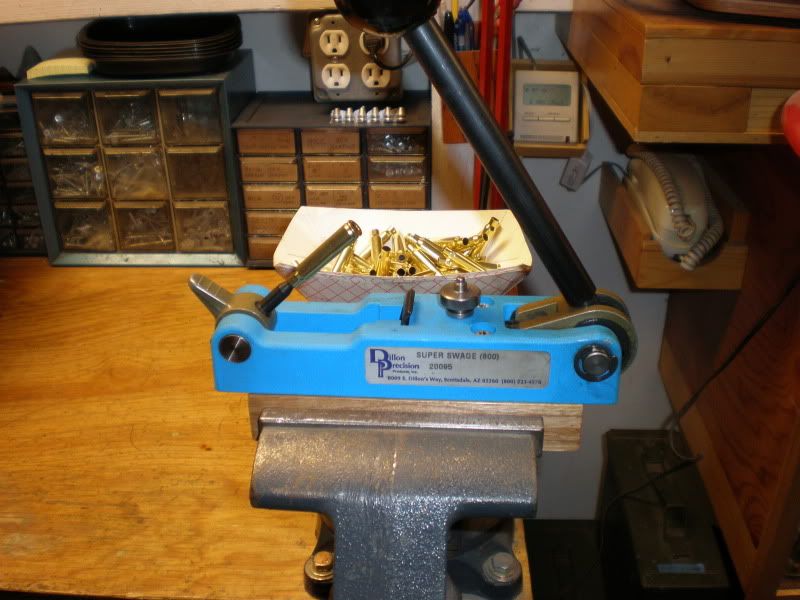 This is the Dillon primer pocket swager.  Hope you have a copy of ABC's, it explains the reloading process, the tools used to reload and the components.
|
Armory Sponsor