


Armory Sponsor

Posted: 9/25/2012 1:29:07 PM EDT
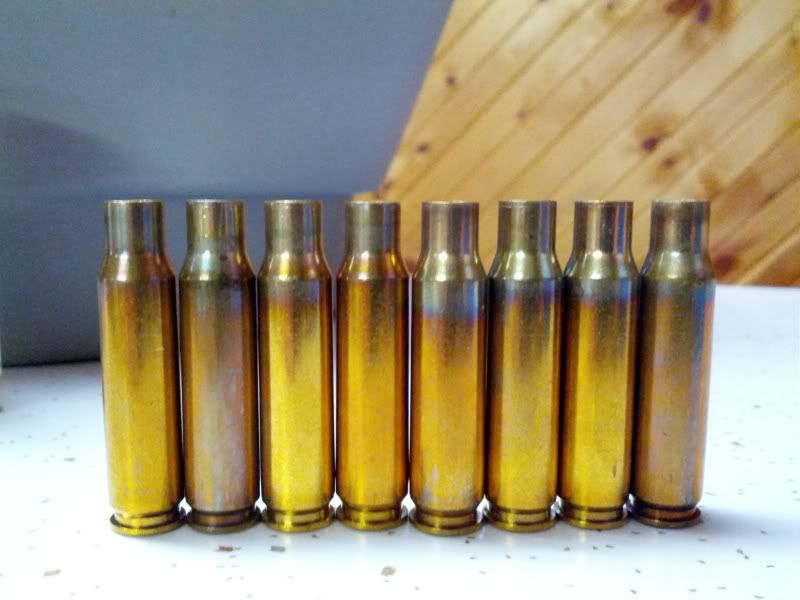
I am just trying on some old pieces of brass holding in the flame for 6-7 seconds. When I drop it out of the holder the case head is pretty warm almost too warm to hold. How does it look from the pictures? Am I doing something wrong or does it look fine. M]nd you a few of them were practice.
|
|
The Art and Science of Annealing.
http://www.6mmbr.com/annealing.html |
|
Annealing is a very precise process but it seems to me doing it precisely is really not that common and in my experience not that important for those of us who are simply looking to extend case life by preventing neck splits.
I agree your brass looks a little over done but not too bad. Besides the obvious "doing way too much" that can weaken the case head, there are 2 things that can result. 1) Not enough ,leaving the brass still brittle. 2) More than needed, which makes it softer than "virgin'. (2) Which I believe is more common than not, can be detrimental to neck tension and possibly make the shoulder week enough to deform during violent self loading. Personally I have not experienced either of these and I don't use temp sticks or anything else. I'm definitely not suggesting to anybody not too though. Any aid in getting better more consistent results is always a good thing. |
|
They are spares..... when you go into the kitchen, you break some eggs.....
Size a few, seat a bullet, do your neck tension test and you will probably find that they are just fine. A little discoloration at the shoulder junction isn't the warning sign. That happens when that gets down past the junction and well down onto the sides. By that point, you are probably distempering the heads. Too hot to hold just means somewhere above 150 F. Folks who wash lots of dishes may be able to take a little more, but certainly your hand is too sensitive to use for checking the heads. |
|
Seems to me that if you're going to bother to take the time to anneal brass, you might as well bother to take the time to utilize some form of objective measuring. They make stuff like Tempilaq for a reason.
Annealing until the brass looks right strikes me as almost as silly as seating bullets to a depth that looks right after filling cases with a volume of powder that looks right. 
|
|
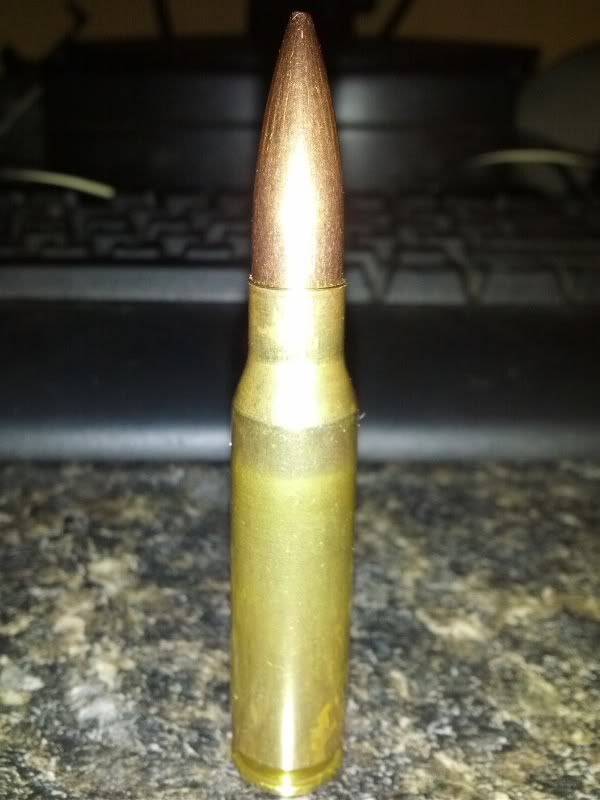
Have to agree the hue on this one is weak. But, that is why folks are saying you should try and use the indicator and not try and wing it.
If the projectile has enough neck tension, it will take a reasonable push on the bullet to break the neck friction. Push one on axis using a force gage and see how many pounds it takes to slide the bullet. |
|
Quoted:
Have to agree the hue on this one is weak. But, that is why folks are saying you should try and use the indicator and not try and wing it. If the projectile has enough neck tension, it will take a reasonable push on the bullet to break the neck friction. Push one on axis using a force gage and see how many pounds it takes to slide the bullet. I pushed the round as hard as I could on the table and it wouldn't budge. This 4-5 second range as seen in the second pic is when the templaq turned black/disappeared. |

|
Here is what you have to understand about annealing. There are two reasons to anneal. One is to soften the neck/shoulder of the brass to extend the life of your brass i.e. reduce splitting. The other is to improve accuracy/precision. If you are doing it for the first reason, you can use the 650 Tempilaq at the neck and shoulders and 400 degree Templiaq from the mid case to the base and make sure that when you heat the neck shoulder area you do not heat the base area hot enough to change the 400 degree Tempilaq. That way you don’t soften the base which would be a safety issue. Color change is not a good indicator since it is not only dependent on temperature but the cleanliness of the brass surface. The best you can do with hand annealing using Tempilaq and a drill and socket here is to soften the neck and shoulders a little and prevent the splits. The worse is you don’t actually end up annealing the brass. Now if you are annealing for precision/accuracy, you will find it almost impossible to do this with the hand method and an annealing machine is necessary. The reason being that to do it properly, you will have to use exactly the same flame temp, point the flame at exactly the same spot, have the flame at exactly the same distance, and heat the brass with exactly the same time period. I have tried this and with only two hands and one set of eyes, it is very very hard to do this for every piece of brass you are going to anneal and yes that is what you will need to do. The reason being is that annealing is an analog process and that is the degree of softness you get is proportional to the temperature and duration the brass is exposed to. So if you are off on the temperature and duration, it is going to be softer or harder. The reason this is a problem is because the hardness of the brass has a direct effect on the neck tension the brass put on the bullet and that has a direct effect on how variable your muzzle velocity will be. Consistent muzzle velocity will give you a consistent bullet drop at extended distances i.e. 600 plus yards. Inconsistent muzzle velocity will cause vertical stringing. |
| My plan is to use a glass pie pan with 1" of water in the bottom and then hit the necks with a torch until they have a dull glow. Once they hit that point I'll tip them into the water to cool them. This should keep the heat from transferring to the web and should keep the primer pocket from getting annealed. Since all I have at the moment is once fired brass that has already been annealed at the factory, I'll have some time to get this together. |
|
Quoted:
All this great information in this thread, and the last couple posts boil down to "ahh screw it, I'm just going to wing it" Typical ARFCOM I'm still paying attention. I cant afford an annealing machine at this time. I am still practicing and do not plan to load any cases until I get it right. |
|
Quoted: Quoted: All this great information in this thread, and the last couple posts boil down to "ahh screw it, I'm just going to wing it" Typical ARFCOM I'm still paying attention. I cant afford an annealing machine at this time. I am still practicing and do not plan to load any cases until I get it right. You may not think you are winging it but you really are – not being negative just trying to give you good advice.
When the brass goes to that dull glow, you have over annealed it. It won't be unsafe as in a KB due to softening of the base if you keep that part in water, but the neck and shoulders will be too soft to hold a bullet properly. It's really up to you but you came to the board for advice and so should think seriously about charging forward if you have no idea what you are doing. |
|
Quoted:
Quoted:
Quoted:
All this great information in this thread, and the last couple posts boil down to "ahh screw it, I'm just going to wing it" Typical ARFCOM I'm still paying attention. I cant afford an annealing machine at this time. I am still practicing and do not plan to load any cases until I get it right. You may not think you are winging it but you really are – not being negative just trying to give you good advice.
When the brass goes to that dull glow, you have over annealed it. It won't be unsafe as in a KB due to softening of the base if you keep that part in water, but the neck and shoulders will be too soft to hold a bullet properly. It's really up to you but you came to the board for advice and so should think seriously about charging forward if you have no idea what you are doing. I'm taking everyones advice seriously. I have a bit of extra 308 brass to play around with and I am going to try a few techniques till I know I get it right. Like I said in my earlier post I do not plan on loading any of these cases till I know its right. The one in the picture has no powder or primer. I just seated a bullet to see how it felt in the press. I am going to try a few of the cases with a vice grip test to check and see if my brass springs back. I am also going to order some 450 templaq for the side of the case. |
|
OP - Here is what I am trying and it addresses some of the things jlow mentioned. Understanding I probably won't get the consistency perfect, I tried to create a cheap way to at least imrpove on the drill/torch method.
I started with the Hornady system. I built a torch holder so I can keep the flame in the same place. I built a drill holder to keep the drill in the same place, but it has to keep the ability to dump the case and reload a new one while returning to a consistent placement in the flame. Once everything is adjusted and locked down, the drill rocks forward on the stop to dump the case in water. It rocks back on the rear stop to load a new case. When it sits flat, it returns to a consistent position with the neck at the same place in the flame. To control time, I am using a metronome app on the iphone. I timed a few using the Hornady supplied tempilaq (475) - 6 beats of the metronome just melts the tempilaq 1/4" below the shoulder (they look like your second picture, not the first set when done). Drill speed is set with a velcro tie to depress the trigger. So, load a case, set in flame, count six beats, dump forward. Up to load, set in flame.....repeat. Not perfect, but I think it controls some of the variances. I'm pretty confident I can extend case life (jlow's number 1) and if I happen to effect accuracy (jlow's number 2), great. Here are some pics - because it's ARFCOM. The set up: 
Dumping and back to flat:  
|
|
Quoted:
My plan is to use a glass pie pan with 1" of water in the bottom and then hit the necks with a torch until they have a dull glow. Once they hit that point I'll tip them into the water to cool them. This should keep the heat from transferring to the web and should keep the primer pocket from getting annealed. Since all I have at the moment is once fired brass that has already been annealed at the factory, I'll have some time to get this together. If you do till a glow, you've over tempered the brass, it will be soft. |
|
Quoted:
I went ahead and ordered the Giraud. I have several thousand rounds needing annealing and I didn't like the idea of doing each one individually. I'll just fill up the hopper, and let it do all the work.  You will love the Giraud, it's fantastic. Use the Templac to learn the timing. (bought mine at Perry this year) |
|
Quoted:
All this great information in this thread, and the last couple posts boil down to "ahh screw it, I'm just going to wing it" Typical ARFCOM LOL, But that is what it boils down to for most of us. The post above that lists the (2) main reasons for annealing, hits the nail on the head. I've always been in the "extend case life" block so yes I admit I wing it. Here is my procedure. I use either a Lee trimmer shell holder or a deep well socket mounted in a cordless drill. I work in low light and heat the neck until it is a dull red, which only takes a few seconds, then I remove the case and let it air cool. There really is no need to water quench. I used to use the standing in shallow pan of water method but it is really a PITA. The water draws away the heat too quickly and you end up heating a lot more than is needed. If you have you ever tried to solder a copper water pipe that had a little water still in it you know exactly what I'm saying. I always hated drying out the brass too. I don't know how you guys that wet tumble put up with it. |
|
I have just started annealing and my reason is case life.
i use a socket and drill hold in flame till it just turns orange then water quench. i just found a guy that made a homemade annealer on cast boolits and i am going to build one like his. he sells the hard part –– wheel with the holes. not doing the case feeder to start with but maybe down the road. homeade annealer 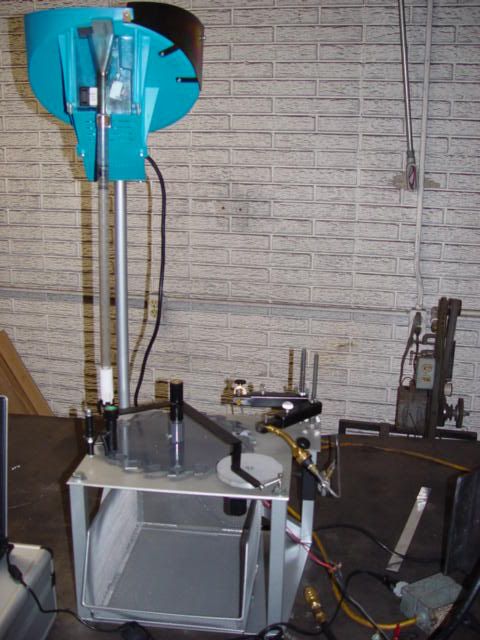
|
|
Quoted:
OP - Here is what I am trying and it addresses some of the things jlow mentioned. Understanding I probably won't get the consistency perfect, I tried to create a cheap way to at least imrpove on the drill/torch method. I started with the Hornady system. I built a torch holder so I can keep the flame in the same place. I built a drill holder to keep the drill in the same place, but it has to keep the ability to dump the case and reload a new one while returning to a consistent placement in the flame. Once everything is adjusted and locked down, the drill rocks forward on the stop to dump the case in water. It rocks back on the rear stop to load a new case. When it sits flat, it returns to a consistent position with the neck at the same place in the flame. To control time, I am using a metronome app on the iphone. I timed a few using the Hornady supplied tempilaq (475) - 6 beats of the metronome just melts the tempilaq 1/4" below the shoulder (they look like your second picture, not the first set when done). Drill speed is set with a velcro tie to depress the trigger. So, load a case, set in flame, count six beats, dump forward. Up to load, set in flame.....repeat. Not perfect, but I think it controls some of the variances. I'm pretty confident I can extend case life (jlow's number 1) and if I happen to effect accuracy (jlow's number 2), great. Here are some pics - because it's ARFCOM. The set up: http://i369.photobucket.com/albums/oo134/rlr350/anneal1_zpsbaba087b.jpg Dumping and back to flat: http://i369.photobucket.com/albums/oo134/rlr350/anneal2_zpse4da8adb.jpg http://i369.photobucket.com/albums/oo134/rlr350/anneal3_zps88aae961.jpg Excellent! That is what I am looking for! Thank you. |

|
I got the plate and drawing from JMorris about 3 - 4 years ago.
It works just fine, using the Templac to learn the heat timing. The only thing I didn't care for was the adjusting for the heights for different cals and timing of the torches, just didn't want to mess with it. It's easier just the move the torch on the Giraud. It cost me a total of $85 to make without the feeder (have wielding equip and metal). You could also make that home made case feeder to work with it that's on AFCOM 'Borg Quoted:
I have just started annealing and my reason is case life. i use a socket and drill hold in flame till it just turns orange then water quench. i just found a guy that made a homemade annealer on cast boolits and i am going to build one like his. he sells the hard part –– wheel with the holes. not doing the case feeder to start with but maybe down the road. homeade annealer http://i121.photobucket.com/albums/o213/jmorrismetal/annealer/DSC01810.jpg |
|
Case feeder is nice but considering how fast the machines are, unless you are really annealing a lot of brass, it is probably not needed. With my BenchSource, it take about 4 seconds to anneal and another to move the brass to the right spot, that is about 5 seconds and so for 200 pieces of brass that takes less than 17 min. That is not a lot of time when it comes to reloading. |
|
Quoted:
Case feeder is nice but considering how fast the machines are, unless you are really annealing a lot of brass, it is probably not needed. With my BenchSource, it take about 4 seconds to anneal and another to move the brass to the right spot, that is about 5 seconds and so for 200 pieces of brass that takes less than 17 min.
That is not a lot of time when it comes to reloading. I agree that is why i am not going to worry about one for now. |
Armory Sponsor