


Armory Sponsor

Posted: 5/27/2012 7:34:19 PM EDT
|
Has anyone tried this technique for reducing the powder charge weight variation in thrown charges?
I get a standard deviation of 0.14 gr (0.4%) when throwing single charges of roughly 36 gr of powder. If I reduce the thrown charge weight to 12 gr (maybe change to the pistol charge bar for the smaller charge), then throw three successive charges into the same case, the net standard deviation should go down. This should work for rifle reloads because there's no case in station #1 (being resized multiple times). The bullet would go on top of the case in the seating station (station #3) only before the third pull of the handle. I suppose you could spin the case in station #3 between pulls which might help reduce seating-induced runout. |

|
Quoted:
First tell us the caliber and name the powder. So we will know if it's ball or extruded. With ball powder my Dillon PM drops exact. With short extruded, + or _ .1 gr. (Re-15, IMR-8208 XBR) Mine is a general question and a general technique not restricted to a single caliber or powder. Still, if it helps with your thinking, consider Varget in a 223 case or IMR4895 in a 308 but there are many other permutations possible. No powder drops exact weight charges every time, not even ball powders. Still, thrown ball powder charges usually exhibit lower variation, so there's probably less reason to worry about them. I am mostly concerned with extruded powder types. |
|
Quoted:
I get a standard deviation of 0.14 gr (0.4%) when throwing single charges of roughly 36 gr of powder. If I reduce the thrown charge weight to 12 gr (maybe change to the pistol charge bar for the smaller charge), then throw three successive charges into the same case, the net standard deviation should go down. I don't know much about statistics so I am not going to try to meet statistical language criteria to describe a variation in powder charge. Popular powder measures are going to throw ±0.1 grains from the set charge. Lets use your numbers for example. If you set your measure to throw 36 grains, and the measure gives a range of ±0.1 grains, then you should be throwing 35.9 - 36.1 grains when you throw a charge. If you break that up into three pulls you are going to get 12 grains ±0.1 gr (11.9 - 12.1). Sigma something something (forgot the formula after being out of college for 15+ years) tells us 36 grains ±0.3 grains for a three pull charge. This is really just tolerance stacking. The problem comes from how a powder measure cuts kernels or grains of extruded or stick powders. Any of this mean a hill of beans? jonblack |
|
Quoted:
Quoted:
I get a standard deviation of 0.14 gr (0.4%) when throwing single charges of roughly 36 gr of powder. If I reduce the thrown charge weight to 12 gr (maybe change to the pistol charge bar for the smaller charge), then throw three successive charges into the same case, the net standard deviation should go down. I don't know much about statistics so I am not going to try to meet statistical language criteria to describe a variation in powder charge. Popular powder measures are going to throw ±0.1 grains from the set charge. Lets use your numbers for example. If you set your measure to throw 36 grains, and the measure gives a range of ±0.1 grains, then you should be throwing 35.9 - 36.1 grains when you throw a charge. If you break that up into three pulls you are going to get 12 grains ±0.1 gr (11.9 - 12.1). Sigma something something (forgot the formula after being out of college for 15+ years) tells us 36 grains ±0.3 grains for a three pull charge. This is really just tolerance stacking. The problem comes from how a powder measure cuts kernels or grains of extruded or stick powders. Any of this mean a hill of beans? jonblack I don't mean this question as a problem in statistic so much as an experiment with reloading technique(s). I was asking if anyone had actually tried this method? The example you cite is one where all charges are thrown with a positive variation. What happens on average? Some will be +0.1 gr and others will be -0.1 gr. |
|
Quoted: Quoted: First tell us the caliber and name the powder. So we will know if it's ball or extruded. With ball powder my Dillon PM drops exact. With short extruded, + or _ .1 gr. (Re-15, IMR-8208 XBR) Mine is a general question and a general technique not restricted to a single caliber or powder. Still, if it helps with your thinking, consider Varget in a 223 case or IMR4895 in a 308 but there are many other permutations possible. No powder drops exact weight charges every time, not even ball powders. Still, thrown ball powder charges usually exhibit lower variation, so there's probably less reason to worry about them. I am mostly concerned with extruded powder types. 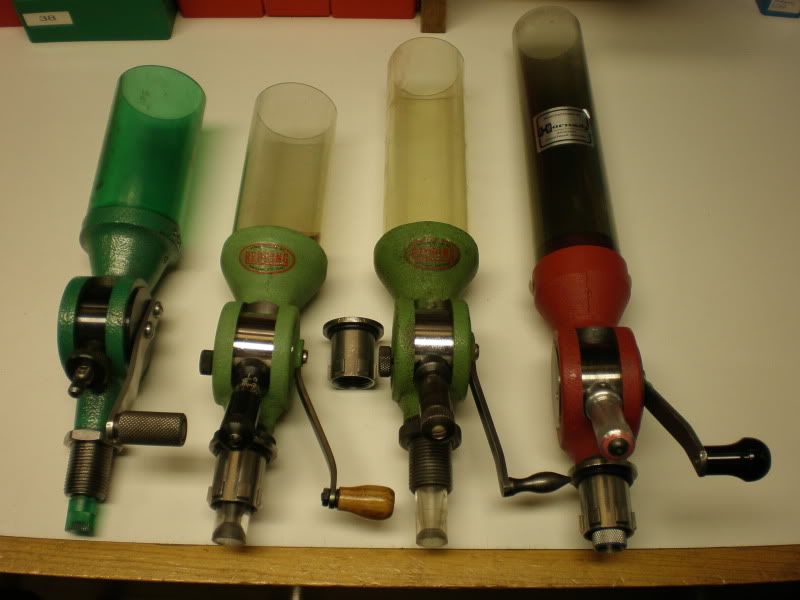 I can throw exact charges of ball powder from a Dillon, RCBS, Hornady and Redding powder measures. Tuning PM and technique is the key, as in "it's all in the wrist". People have posted using Varget in a Dillon measure with a vibrator attached to the powder hopper. I have not felt the need to try this technique, but posters claim it works.
|
|
Quoted:I was asking if anyone had actually tried this method?
Probably not many because of the tolerance stacking. Quoted:
The example you cite is one where all charges are thrown with a positive variation. Here is my opinion: Not really. I mentioned 36 ±0.3 grains. The max extreme would yield 36.3, the minimum extreme would yield 35.7, and a possible average is 36 grains. Just because you throw one positive doesn't mean you are going to throw one negative, and then one neutral. So, you can't say your average throw for three 12 grain throws is going to be 36. It is always going to be in the range of ±0.3 grains. The average throw doesn't mean anything, really. Yes the average should be 36 grains. It is the possibility of 36.3 and 35.7 grain charges that cause concern. Here is another way to look at it: If one throw is good, three throws is better, then 100 throws is best. Think of a ±10.0 grain difference at that point. It is the extremes that we, as reloaders, should be concerned with. If your powder measure throws ±0.1 grains per throw independent of weight thrown(more accurately volume thrown), then it should go to show you are going to get a lower standard deviation with fewer throws per desired final weight. I would be interested to hear if my opinion on the subject matches that of someone more experienced in this subject. Thanks for giving me the chance to brainstorm with you jonblack |
Armory Sponsor