


Armory Sponsor

Posted: 3/29/2012 2:37:08 PM EDT
| I reloaded some 55g FMJ and they came out dead on at 2.145 OAL. The bullet was seated right in the middle of the cannulere. I started reload some FMJ boat tails today and checked my OAL, it's fine but the cannulere is now inside the brass. Is this going to be a problem? |
|
Is this going to be a problem?
What kind of "problem" are you concerned about? OAL can affect accuracy and pressure. In a bottle necked rifle round like the 223/5.56 the deeper the bullet is seated the less the pressure. If you are concerned about your OAL being a little shorter thus increasing pressures, don't be. Just the opposite is true, shorter OAL + less pressure. Here is a chart of actual pressure test data with decreasing OAL. Note the shorter the OAL the less the pressure. 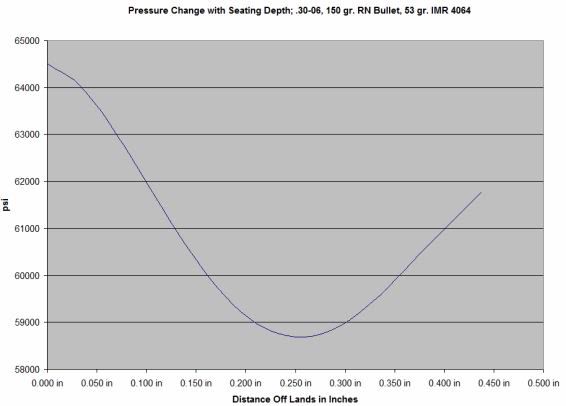
|
|
Quoted:
I was concerned about increasing pressure. I guess I'm a little confused as to why the difference. All things seem to be equal... This is from John Barsness from Handloader Magazine, this may help explain. It decreases peak pressure, for two reasons. The longer "jump" of the bullet to the rifling results in a lower peak pressure, since the bullet engraves more easily the faster it's going when it hits the rifling. Also involved is the "progressive" burning of almost all modern rifle powders. This means the pressure increases relatively slowly from the time of ignition. Thus peak pressure occurs when the bullet beyond the barrel throat, with very slow-burning powders as much as 3-4 inches. Link http://www.24hourcampfire.com/ubbthreads/ubbthreads.php/topics/5474598/1 |
|
Quoted: I reloaded some 55g FMJ and they came out dead on at 2.145 OAL. The bullet was seated right in the middle of the cannulere. I started reload some FMJ boat tails today and checked my OAL, it's fine but the cannulere is now inside the brass. Is this going to be a problem? Seat those bullets out to mid cannelure. 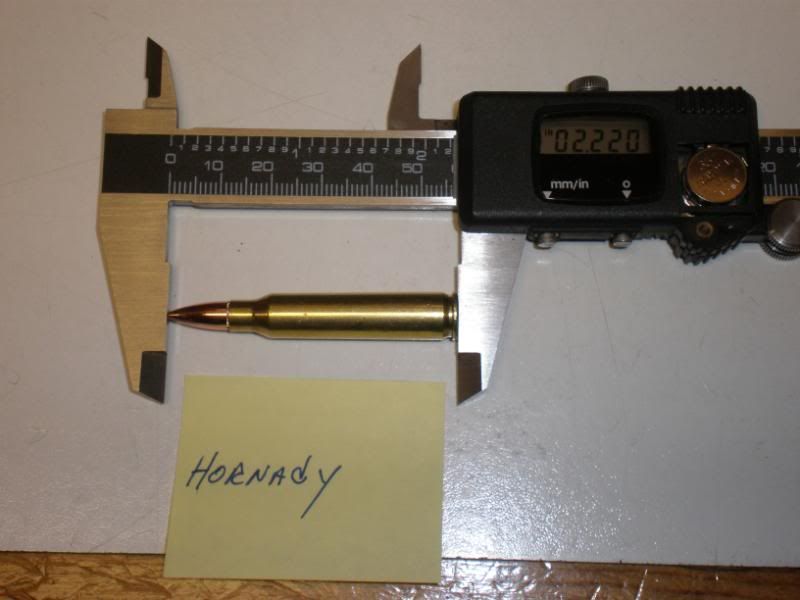 I'm guessing you mean 55 gr FMJ's, if so 2.220 is the OAL with a Hornady 55 gr FMJBT, case trimmed at 1.750. What OAL did your reloading data call for? Different brands of bullets will have the cannelure is slightly different places, which will change OAL if bullet is seated to mid cannelure. If you are not going to crimp, then where the cannelure is not a problem. |
| I meant I seated to 2.245, the minimum OAL called for 2.230 for the FMJ and the Hornady 55g V-Max. I did some measuring of the bullets and found there is quite a difference between all 3 different types. I just hope that all I'm losing is a little accuracy. My go to bullets will be the V-Max. Battle site zero with them and had a 5 shot group that was within 1/16 of dead center and could cover it with a dime...the other 4 were touching those. Love that bullet. |
|
Quoted:
I was concerned about increasing pressure. I guess I'm a little confused as to why the difference. All things seem to be equal... It is confusing because the curve shown above combines the effects of two phenomena, decreasing case vol. and increasing jump to land. The decreasing case vol. effect alone can probably be best seen in comparing .222 and .223. A good way to look at reduced case vol. effect without having the info clouded by changing jump-to-land is to go to the Hodgdon Online database and dial up .223, CFE223 powder, 55 sp bullet, then flip back and forth between .222 and .223 cal. Look at start load for .223 and max load for .222 and look at the measured chamber pressures. Quantity of powder is about the same 26 vs 25.9 gn. The case volume for the .222 is slightly smaller than the case volume for the .223. Same bullet, same chamber diameter, same shoulder angle; little shorter body and little longer neck for the .222. |
Armory Sponsor