


Armory Sponsor

Posted: 6/10/2011 11:13:27 PM EDT
|
I just started my first handloads tonight. I am starting with 9mm. Once I am somewhat proficient w/ handgun cartridges, I am going to start reloading .223.
I encountered one big issue (maybe it is not so big) with my reloads tonight. I am using once fired Winchester brass, Winchester WSP primers, a Lyman T-Mag II turret press, and Lee dies. The manuals recommend seating the primers .003-.005 below flush. My primers were seating at flush, but not below. After trying several different adjustments, I did some measuring. The primer pocket depth is equal to (+/- 0.001 inch) the thickness of the primers (not to include the primer anvil). In short, it is virtually impossible to seat these primers below flush in this brass unless I make the primer pockets deeper. I am sure that for plinking rounds, this is acceptable, but is this normal? What am I doing wrong? Thanks in advance for the help. |
|
I wouldnt worry about it unless you started getting some slam fires. I never in my life measure priming seating depth. I just seat the primer until it doesn't seat any more. The only way you can adjust the priming seating depth is to get a primer pocket uniformer tool. Something like this http://www.midwayusa.com/viewProduct/?productNumber=445053 That's from Possum Hollow but RCBS, Redding, Lyman, etc makes such a tool as well |
|
Are you hitting the primer pockets with a pocket correction tool before loading?
K&M sells one for about $20. ETA: Beat to it, that's what I was talking about. I think it's important to get it at least a bit below flush to avoid slamfires once you've "moved on" to .223. |
|
I've never uniformed a primer pocket in a pistol cartridge and don't expect I will. If there's a high primer, it's probably due to excess carbon build up and that needs to be corrected. A high primer in this case is one that protrudes above the case head.
When I hand prime, I run a finger tip across the primer as I go to detect whether a primer is high. I spot check cases coming off my Pro 2000 to check on the depth setting. |
|
I don't worry about the primers in my pistol rounds as long as they are flush or slighjtly recessed. (Never taken the time to try and actually measure the seating depth.) For 223, I make sure that they are recessed. Flush primers make me nervous. All my .223 is loaded for my AR, and I don't want a slamfire. |
| I use a primer pocket uniformer to make sure primers are flush or below especially for semi-auto AR's. I use a Possum Hollow primer pocket uniformer on all brass, pistol and rifle, just to make sure primer pockets are at the same exact depth. Plus the primer pocket uniformer is a great tool to clean the carbon deposits from the pocket. I prefer a primer pocket uniformer that the cutters are adjustable. I see som sites are out of the Possum Hollow uniformer. Flush is ok in your pistol but I like to see them like you said .003 deep in AR brass. I use a straight edge, my calipers, to lay it across the primer and hold it up to a light. You can see easily the slit of light under the straight edge. I like the Possum Hollow tool as it has both large and small cutters on one tool but it is a hand tool only and won't fit in most drill chucks as it's body is a 1/2" hex material. You don't want to crush or flatten your primers just to get them flush or below. They have to be seated firmly to the bottom of the pocket but shouldn't be deformed doing it. |

I check every round that I load for a high primer. This is how I do it. I tilt the ammo box and look at the sliver of brass above the primer. This is shown at the end of the barrel of the red pistol. Just above the primer, you can see a sliver of brass. that's what you want A high primer will not have that sliver of brass showing above the primer. All you will see is the primer. Takes about 5 seconds to check a box with a little practice. 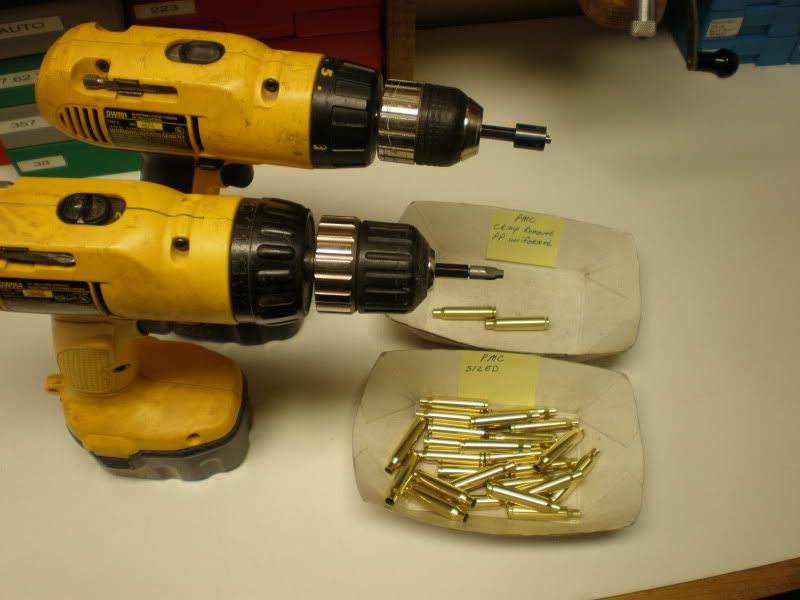
I also uniform every 223 case I load. Back drill, front one has a Hornady PP reamer to remove primer crimp. It's your ammo, you can choose to uniform or not. I would advise that you check for high primers either way you go. |
Armory Sponsor