


Armory Sponsor

Posted: 8/29/2010 10:32:47 AM EDT
|
I have been having problems with high primers using LC brass. Bought a primer pocket uniforming tool from Sinclair and processed 250 cases in around 30 munites. With approximately 30% the tool seated to the stop indicating the primer pocket was the right depth and diameter. I gave these a quick clean out with the drill. Around 50% didn't quite seat all the way. These I processed until they hit the stop. I could see day light between the stop and the case head with the remaining 20%. These required a few more turns on the drill.
I didn't realize primer pockets were so inconsistent. Is this unique to LC brass? Anyone have similar experience? Primer pocket uniforming has become one of my standard brass prep steps. |
| Primer pocket depths are all over the place with various brass and I find some that are so shallow I wonder how the manufacturer ever seated a primer flush. I also take the time to uniform with the Sinclair tool mainly because I hate fighting a primer to seat flush. |
The other variable in the fit-up is the primer cup depth, not the primer pocket, but the primer itself. There is a considerable variance in primer cup depths across the industry. Be sure and measure the primer cup depth of the population of specifc primers you plan to use. Otherwise, you can go too deep with the primer pocket uniformer and have a dud or hang fire situation with primer cup surface too far away from the firing pin.

|
| I started primer pocket uniforming when I encountered primer pocket depth at the minimum and primers at the maximum height for a loading I was doing. Primers protruded above base. Uniforming solved the problem. Until I started cleaning the brass using stainless steel tumbling I would uniform to clean the pocket. The uniformer I use has a fixed stop so you always get the proper depth. A caution is to be sure the uniformer is inserted into the brass correctly otherwise it may gouge the sides of the pocket losing the tension that holds the primer in place. |
|
I think the OP's issue is based on incomplete removal of the primer crimp. The Sinclair tool does not touch the crimp, only the primer pocket gets addressed.
Take a case and using a box cutter, skim the case mouth at a 45 degree angle for a full 360 degrees. Try to seat a primer now. I bet it seats just fine after you've cut the remaining crimp away. If so, buy a swager or one of the various tools being marketed. All once fired military brass must have the primer crimp removed or you will have issues like this. I use Dillon's super swage 600. |
|
Quoted:
I think the OP's issue is based on incomplete removal of the primer crimp. The Sinclair tool does not touch the crimp, only the primer pocket gets addressed.. You are correct the Sinclair tool does not remove the crimp. Incomplete removal of the crimp is a possible cause of high primers to be sure, but my Dillon Swager does an excellent job of removing the crimp. I shoot a lot of LC brass and my only problem has been occasional high primers. I first thought it was incomplete removal of the crimp, but even the Hornady crimp cutter didn't completely solve the problem. Hence, the attention to the primer pocket itself. The Sinclair tool also squares the bottom of the pocket which should improve ignition and consistency, although I have to admit I have never had a round fail to go bang except for the odd round which slips past QC missing the primer of course. The Sinclair tool does have a stop which get you to the same depth each time and avoids cutting too deep. Best $25 I ever spent. |
|
When I first started loading I used 223 Hornady brass.
Every primer was flush or the slightest bit high (Wolf SRM). But I wanted subflush. Enter the PPU. Problem solved. I use it on LC brass also. This is the tool I bought. http://www.midwayusa.com/viewproduct/?productnumber=764406 No messing around with a stop ring and it came with the drill adapter. A burst with the cordless, take off brass, tap it on the tool to shake out shavings from primer pocket and off cutter head (if you don't it'll load up and not cut as well), then another burst and done. A few require a third burst. |
|
On seeing the OP is using Wolf primers I would suggest a second snug up or even three to make sure they are fully seated. Wolf's are notorious for duds when not seated fully to the base of the primer pocket.
I use a RCBS benchmounted primer 90+% of the time and will turn the primed case 1/3 and reseat then a final 1/3 and final seat these primers. I have never had a hang fire or misfire with Wolf primers when using this method. My priming tool generates a lot of pressure if I want to lean on in. I'm being careful not to crush or otherwise damage the primer in this process. I think the Wolf's are very hard and slightly oversized. This combination calls for a little inginuity. |
| I use a Redding PP uniformer and uniform every primer pocket as deep as it will cut, so it cuts a little barley cleaning them out and others it takes a considerable amount of brass out but at least with the Redding you can't go to deep, as deep as it will cut is perfect every time and I do this to every piece of brass I prep weather match loads or range pick ups since it's just another step on the Trim Mate and only takes seconds to do. |
|
Quoted:
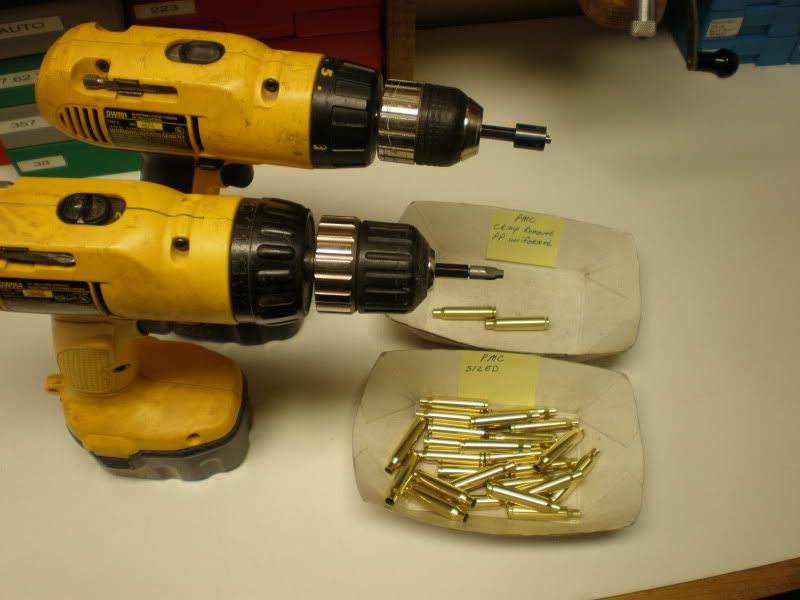
http://i250.photobucket.com/albums/gg272/dryflash3/Tools/P5310450.jpg Hornady primer pocket reamer (removes the crimp) near drill, PP uniformer in far drill. This is for all mil brass with crimped primer pockets, not just LC. You need a Trim Mate, pressing the button on that drill must get old, plus holding the drill straight and then holding the brass straight with it seems a little challenging at times as well. |
|
Quoted:
Primer pockets on LC brass seem to have a more generous radius on the bottom corner of the PP, making seating of some primers (CCI) more difficult as these have square lips. PP uniforming cuts this bottom square. Bingo. This describes what I am experiencing with LC brass. Problem solved. |
|
Quoted:
Quoted:
http://i250.photobucket.com/albums/gg272/dryflash3/Tools/P5310450.jpg Hornady primer pocket reamer (removes the crimp) near drill, PP uniformer in far drill. This is for all mil brass with crimped primer pockets, not just LC. You need a Trim Mate, pressing the button on that drill must get old, plus holding the drill straight and then holding the brass straight with it seems a little challenging at times as well. 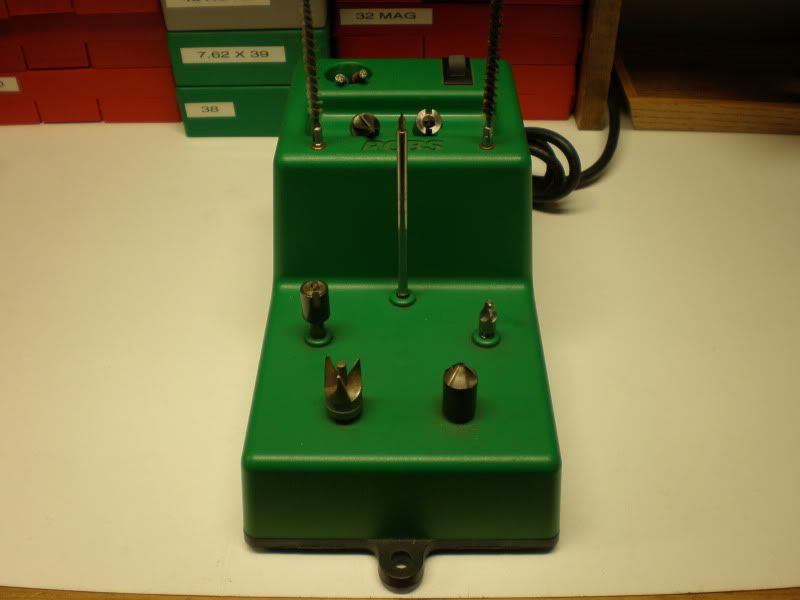
I have a Trim Mate. It turns too slow. The drills work just fine for small batches, and it's easy to hold the brass straight. |
|
Quoted:
Quoted:
I have a Trim Mate. It turns too slow. The drills work just fine for small batches, and it's easy to hold the brass straight. I have never used a Trim Mate but I think the device is a good concept. Any way to mod the Trim Mate to increase RPM? jonblack It runs slow but has good torque. Probalby a safety feature running slow. The way I increased RPM was easy, chuck tool in Dewalt Drill.  
|
Armory Sponsor