


Armory Sponsor

Posted: 6/11/2008 11:26:49 AM EDT
|
OK, so I know the benchrest guys say that you shouldn't switch primers, but how much does it matter in the real world, in .223??? I had started with some Winchester primers, but came into a wad of CCI primers cheap from a friend, and just had a couple questions... 1. Can switching primers effect what powder/load your barrel likes? 2. Can switching primers effect POI at 100-200 yrds? Anything else that could change? Comments? Thanks, Mike |
|
It can change the way your rifle and load shoot. Reduce the load you were shooting by 5% when switching components. Call Precision Shooting to see about buying a copy of German Salazar's article about primers in the current issue. It's very good, interesting, and I hope he follows up. |
|
It may be foolish, but I'm not worried about dropping the 5%, per standard procedure, when switching primers... I'm running 75g Hornady BTHP with 22g of 4895, so I'm well below the max load. Are Winchester and CCI primers all that different? For that matter, are different lots of primers of the same brand very different? Mike |

if you are going to disregard advice that you asked for then just load them ,shoot them and see what happens. I doubt you will see much of a difference, if so, re-zero your rifle |
Handloading involves some RISK. Anytime, you don't exactly follow what THE BOOK says.......you take a chance. And, you'll note that most books will specify what brand of: brass, primers, bullets, powder (and weight)......not to mention what brand of firearm they used........to OK their load data. Standard advice.....when starting a new load......start low and work your way up. And, bolt gun ammo or load data isn't always O.K. w/ a semi auto. Just making a "minor change" can have an unwanted affect.....maybe even to the point of being DANGEROUS. ___________________________________________________ Read: How do changing various components affect chamber pressure and velocity? www.frfrogspad.com/miscelld.htm#components __________________________________________________ Simple answer: "Changing components......changes things." Aloha, Mark |
I recommend you read the article I mentioned to see measured differences in chamber pressure with different primers. |
|
Kinda OT, but anyway... I recently ran into some frangible bullets (22 cal 42gr) at a really great price. In my research I found that it is recommended that one uses 55gr jacketed load data for these bullets. I started WAY below where I would start with jacketed bullets. When I got to about 2 grains below MAX I started to see primers flowing and all kinds of pressure signs all of the sudden. It was a good reminder that things can happen in a hurry. I ended up pulling some bullets (frangible bullets don't appreciate inertia bullet pullers very much). Anyway, work you way up slowly with any change in components, and be safe, not sorry. |
|
It's not that I don't "get it", but it's that the load I'm running is already a "starting load." 1/2 gr. less and the buffer doesn't hit the back of the tube when the bolt cycles. I'm running 2-1/2 grains of powder less than the safe max load in the new Hornady book (indicently, the "max" in the new book is about a grain less than the safe in the old hornady book, which seems to be on par with this book compared to the old one) and I'm doing it with .223 cases, which generally have a larger capacity than the 5.56 cases the load in the book is set up for... It's not like I've worked up to my own maximum, disregarding the book, and am switching components expecting it to be OK... I'm running a "starter load" as it is, and it's just enough to reliably fully cycle the bolt, because the weak link is me holding the rifle in a match, and I'm not even all that good, so the extra possible 0.1" off of the groups by running higher velocity and wearing more on the rifle is not what I'm after. I did read the linked article, and it's very interesting... thanks! Is "Precision Shooting" a magazine I guess? Thanks, Mike |
5.56 NATO cases have the same capacity as the most common .223 Rem cases. A few less common .223 Rem cases have less capacity. The death of this old wive's tale can start with you. You're using a starting load. Consider what that means in practical application; it's a place to start with the pile of components you have on your table. There are .223 Rem cases, small rifle primers, .224 diameter bullets weighing between 40 and 80 grains, and a gunpowder selected from the data for this cartridge from load manual. Notice I didn't mention any specific makes. One of the reasons for using start loads that are less than the maximum shown is to produce a safe starting place with component combinations that are not precisely identical to those shown in the load manual. Will you notice a difference in accuracy with your rifle? Some rack grade rifles have accuracy so poor it covers up the change with primers. The only way to know for sure is to shoot. Precision Shooting is a magazine available only through mail order. You can find information by searching on the internet. |
| I think you get it. Just use common sense. If you are not going from a non-magnun primer to a magnum primer and you already are using a minimum load, chances are that your POI is the only thing that will change. It is interesting that in the article mentioned above, in every test the speed and pressure went down when changing components. The only good data about that article is the 308 test and the seating depth data, everything else is speculation based on case weight with no test data to support it. |
Interesting... I'd heard that from several sources, but it makes sense that it could be false... Did it used to be true? As for accuracy, this thing's better than I am... Mega lower, J&T 1:8 24" bull barrel kit (5.56 chamber), Bushnell Dusk to Dawn Banner 4-12x40 scope, Promag mount, sent the trigger on Tuesday to Bill springfield for his 3# job... 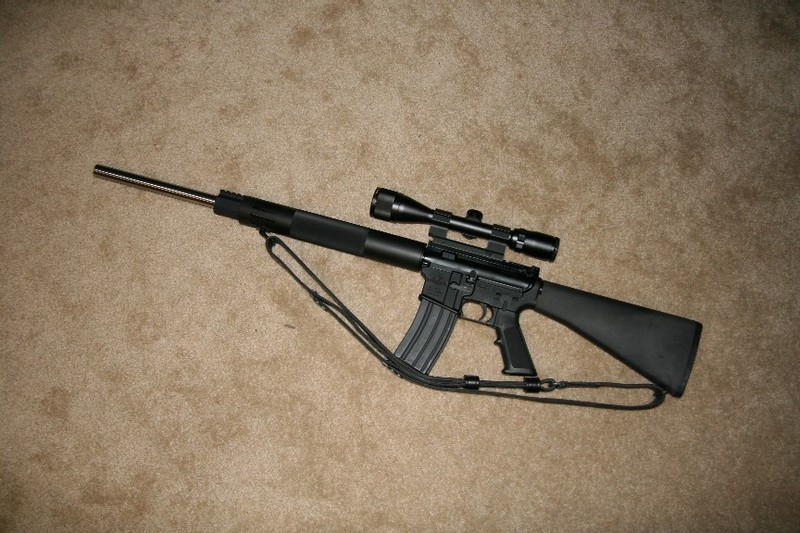 Mike |
|
Handloader magazine has done several articles on this over the past 20 years. The result are that you won't see one whit of difference with standard primers. Now going from standard to magnum you do have to work up your load. I deliberately fired a Service Rifle match using my HBAR. Same bullet, same load, same case, same OAL, mixed WW, CCI, and Federal primers. I didn't look at the cartridges as Iloaded them. Know what, I scored 10 more points than I had the day before. It is good to err for safety, but this is not one of them. That said, when I shoot for leg points I use BR primers cause I want every factor on my side. |
|
Evaluating the POI effects of different primers by shooting off hand is an inconclusive exercise. I have seen POI change by as much as 2" at 100 yards to the left, right, up, or down when shooting off the bench. When using a starting load, switch primers all you want. But work-up each load seperately. |
|
About that common quote: "Military cases weigh more than commercial cases." Well, maybe we should just say that it's SOMETIMES or GENERALLY TRUE. Then, the amount of variation (to make a difference) when talking about .223 Rem/5.56 vs. .308W/7.62 becomes an issue. Not to mention that to a BR shooter the difference may be GREAT. But, to a Hi-power shooter, they may not see it as SIGNIFICANT (for .223 Rem./5.56). _____________________________________________ Read the topic: How do changing various components affect chamber pressure and velocity? There is a chart that shows various cartridges and their case weights. www.frfrogspad.com/miscelld.htm#components Then, read the case weights given in this chart.......... www.6mmbr.com/223Rem.html Note: this author found very little variation. ______________________________________________ So.........YMWV. And, we KNOW that production lots vary. Aloha, Mark |
Armory Sponsor