


Armory Sponsor

Posted: 6/10/2008 12:06:24 PM EDT
|
Hey guys, I just picked up a Redding re-sizing bushing die. My question is, what is the recommended size or size tolerance for neck re-sizing on a .223? Thanks Rick |
|
You have to measure the brass you're going to use. Do this by seating a bullet, measuring the outside diameter of the case neck at the bullet, then calculate the bushing diameter recommended. There are directions with the die if it's new, otherwise Redding's web site has directions. After that, order a bushing or two. If you're using Winchester, WCC, or LC (and probably Lapua) brass with .224 diameter bullets for .223 Remington cartridges, a 0.245 diameter bushing will probably work for you. What do you plan to shoot these loads through? |
|
www.redding-reloading.com/techlinepages/bushingselection.htm I use 0.002 inches instead of 0.001 that Redding recommends. If this is a full length sizer die, press on, you'll like it. If it's a neck sizer only die, you should reconsider. Most of us recommend full length sizing for auto loaders. |
|
Here's some more info for you and my bushing confusion. I measured once fired brass (cleaned and prepped by supplier) it measured at .241 I then re-sized it with the .246 bushing in the die and it measured at .243 seated round and measured it at .246. My confusion is that i dont know if the bushing is doing it's thing? How do i know that the ball in the resizing die is opening the neck to much? |
|
Rickp1 - The manufacturing tolerance in most brass is not consistent enough to use bushing dies unless you are neck-turning. Neck thickness differences of 0.003"-0.004" are very common, even in the same case! I have seen neck thickness differences of 0.006" from side to side on the same piece of brass. This being the case, I do not recommend bushing dies unless you are neck-turning your cases to get uniform neck thickness. The only exceptions to this (sometimes) are with Lapua brass, and possibly Norma brass. Still, I would Mic the neck on each piece of brass to ensure they are close enough to your desired thickness to be useful. Even Lapua brass will have a high cull rate. Once you actually know the thickness of your case necks, and they are all close to the same thickness, the then you can successfully apply the formula given to figure the proper bushing size. Until then, all bets are off! For cases that are not neck-turned I recommend a good FL die with a carbide expander button (for semi-auto rifles) and a standard Neck die with a carbide expander for bolt guns. OK - I just looked at the Redding S-type dies on their web page. Redding has changed them in the last few years. Redding is now including expander buttons for their Type-S Bushing Style Dies, and this changes things. The advice I gave above is for dies that do NOT have a neck expander button. For bushing dies with an expander button: So long as the expander button is expanding the case neck to a consistent inside diameter to grip the bullet - AND - so long as the bushing does not size the neck too much ("overworking" the brass) - AND - so long as the bushing sizes the case neck enough... ...you're good to go. The expander button does its work as the case is pulled down out of the size die. Feel for this when you reload. If you do NOT feel the expander button do its work, then that case will not grip the bullet the same as other cases, or maybe not grip the bullet at all! BTW - to directly measure case neck thickness you need a tubing micrometer. Using a standard micrometer will not work at all, and using a standard 6" caliper will not give accurate readings for this kind of measurement - its not the right tool. Tubing Micrometer: 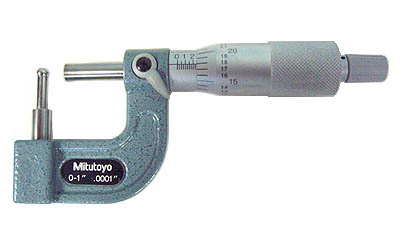 LINK |

Very true. Just because there's an easy-to-read digital output does NOT mean it is more accurate or more consistent. The mechanical-to-digital interface can often add inaccuracies while giving the user added confidence in the measurement. |
|
Hey guys, thanks for the input. You guys are killing me with the calipers!! LOLOL and I thought digital was the way to go!!! I called Redding today and they told me that its normal for the size bushings that i have to resize the neck .002" smaller than the actual bushing size. That's what was throwing me off. With my current setup and bushing size I still get the .003" neck tension that I want. I also checked the re-sizing die ball to make sure it's not working the brass to much and its not. From all my research and advise from the higher powers to be in reloading I should have things set up right. HBruns, That was great feedback thank you. That was in line with what I got from other people. R. |
If this is your opinion then please state it as your opinion. If not, then point us to a scientific study that would prove digitals are less accurate. My experience, therefore my opinion, is that this is not the case. |
|
Am I the only guy around here who's FL sizer brings neck dia. exactly .002" under loaded diameter? Ive been *Partial* Re-Sizing w/ that die for quite a while w/ no feeding/extraction problems, granted I do all the cycleing manualy...Im not sure if thats a credit to, or against the previous statement? |
Ask any machinist which one is more accurate and 99.99% of them will tell you mechanical! The .01% are young kids that don't know any better! Stang BTW, this is my opinion which happens to be fact! 
|
Once the case has been pushed all the way into the FL standard die, the neck has probably been sized down quite a bit smaller than it needs to be. As the case is pulled down out of the die, the expander button sizes the inside diameter of the neck to a consistent diameter, about 0.002" smaller than it will be after a bullet is seated. That 0.002" is about the elastic limit of annealed brass. |
It is a fact that I don't have a digital micrometer so I can't do these tests. I decided to spend my money on best tools I could afford... best being defined by people who know more about it than I do, and none of the options were digital. You can buy an inexpensive digital micrometer, or spend the same amount and get a better mechanical one. ETA:
|
Mechanical measurement relies on threads which give precision by an integer count of the threads over an easily measured distance. Because another threaded member engages these threads, a comparative tolerance can be determined, providing for full scale accuracy. Digital relies on spacing of magnetic/electrical elements along the length of the indicator. Resolution of such elements will always be less than threads as the measurment device can be assembled and used with less than precise element spacing. A mechanical measurement tool cannot be assembled and function with sloppy threads. In any case, calibration blocks over the entire tool's range will quickly show if there is a problem. |
Discussing the issue with a person doesn't know about and doesn't use them would be an exercise in futility. Discussing the issue with a person does know about and does use them would also be an exercise in futility, though in very different ways. Either way.... you must be feeling more tolerant than I lately! 
|
You just know someone, somewhere, has calibration curves for his calipers and scales hanging over his loading bench. I would bet money (or brass) on that. 
|
Armory Sponsor