


Armory Sponsor

Posted: 11/15/2014 10:31:08 AM EDT
| Anyone here ever had tube with an emission point that grew or got worse? |
|
Yes, most emission points will continue to grow - the heat causes more separation of the aluminium layer of the screen, which flakes and peels, causing more emission points... Generally they keep growing and get worse until the tube is beyond recovery. Though sometimes they can be repaired, and sometimes they do burn-out without causing further damage. Regards David
|
|
They are different than signal induced blemishes.
If you put the lenscap on and blot out all light, an emission point is still there usually, and it can be bright. With a sib, it may only show up under certain lighting conditions, be irregular, flicker on an off, etc. and usually won't show up with the lens cap on. They can sometimes repair an emission point. http://scientia-is.com/services.html |
|
Interesting. I've never heard about signal-induced blemishes before. I've had a couple tubes with really small bright spots that would come and go somewhat randomly. Not sure if they fit into the SIB or emission point category. They were in a fixed location and were typically still visible after covering up the objective, but were hardly noticeable in brighter conditions and would often disappear completely. Occasionally they would flare up really bright, but would go away if I switched the power off and back on. I used those tubes for several months without noticing any growth in size or new bright spots appearing.
David, your explanation makes sense to me, but I'm just wondering if that is the norm and, if so, is it something that would happen quickly or gradually over time? I'm curious because I just recently picked up another tube that has the same issue. I got a really nice deal on it, and aside from the bright spot/emission point, the tube is very clean. For the time being, I have covered it up with a small dot of black RTV silicone on the phosphor screen. Covering it up solves the problem cosmetically, since it is no longer distracting, but I am wondering whether I need to look into getting it fixed. AlmightyTallest, thank you for the link! Here's a picture of the tube after I covered the spot. I'm actually pretty proud of myself for successfully covering it up. Even a small spot on the phosphor screen will look huge through the eyepiece lens. 

I also would love to hear if anyone has any detailed information or first hand experience with shading or edge glow. I know the basic definitions and whatnot, but I am curious about how common it is and how quickly a tube goes from partial shading to completely dead. |
|
rich20730, it sounds like your bright spots fall under the SIB category. Emission points are a problem when they are bright and constant under all lightning conditions. That's a pretty ingenious fix by the way. I'd rather have a black spot than a flickering and distracting bright spot.
Here's the standard definition of an Emission Point: Emission Point: A steady or fluctuating pinpoint of bright light in the image area that does not go away when all light is blocked from the objective lens. The position of an emission point within the field of view will not move. If an emission point disappears or is only faintly visible when viewing under brighter nighttime conditions, it is not indicative of a problem. If the emission point remains bright under all lighting conditions, the system needs to be repaired. Do not confuse an emission point with a point light source in the scene being viewed. And a Bright Spot: Bright Spots. These are signal- induced blemishes in the image area caused by a flaw in the film on the MCP. A bright spot is small, non- uniform, bright area that may flicker or appear constant. Bright spots usually go away when the light is blocked out. Not all bright spots make the ANVIS unserviceable. A test can be performed as follows: Place a cupped hand over the lens to block out all light. Make sure any bright spot is not simply a bright area in the viewed scene. If the bright spot remains, an emission point exists and needs to be checked. |
|
Shading is a problem where you get a crescent shaped failure beginning at the edge. I've only ever seen shading once, and unfortunately, it was the first tube I ever bought. The symptoms are that the rest of the tube is fine, but will die within about a year. In my case, the shading was accompanied by power supply failure, making diagnosis more difficult. Here's a tube with advanced shading. 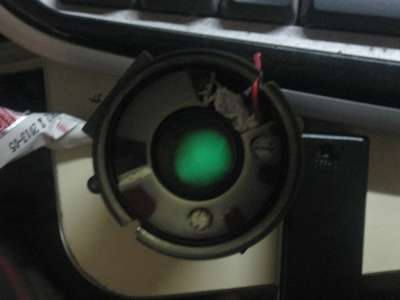 Regards David
|
|
Quoted:
rich20730, it sounds like your bright spots fall under the SIB category. Emission points are a problem when they are bright and constant under all lightning conditions. That's a pretty ingenious fix by the way. I'd rather have a black spot than a flickering and distracting bright spot. Here's the standard definition of an Emission Point: And a Bright Spot: Quoted:
rich20730, it sounds like your bright spots fall under the SIB category. Emission points are a problem when they are bright and constant under all lightning conditions. That's a pretty ingenious fix by the way. I'd rather have a black spot than a flickering and distracting bright spot. Here's the standard definition of an Emission Point: Emission Point: A steady or fluctuating pinpoint of bright light in the image area that does not go away when all light is blocked from the objective lens. The position of an emission point within the field of view will not move. If an emission point disappears or is only faintly visible when viewing under brighter nighttime conditions, it is not indicative of a problem. If the emission point remains bright under all lighting conditions, the system needs to be repaired. Do not confuse an emission point with a point light source in the scene being viewed. And a Bright Spot: Bright Spots. These are signal- induced blemishes in the image area caused by a flaw in the film on the MCP. A bright spot is small, non- uniform, bright area that may flicker or appear constant. Bright spots usually go away when the light is blocked out. Not all bright spots make the ANVIS unserviceable. A test can be performed as follows: Place a cupped hand over the lens to block out all light. Make sure any bright spot is not simply a bright area in the viewed scene. If the bright spot remains, an emission point exists and needs to be checked. Haha thanks, but I can't take credit for the idea as it is not mine. I think you're probably right, although the part highlighted in red concerns me a little. Any idea how much the laser treatment costs? Quoted:
Shading is a problem where you get a crescent shaped failure beginning at the edge. I've only ever seen shading once, and unfortunately, it was the first tube I ever bought. The symptoms are that the rest of the tube is fine, but will die within about a year. In my case, the shading was accompanied by power supply failure, making diagnosis more difficult. Here's a tube with advanced shading. http://aunv.blackice.com.au/userfiles/david-mtf-serious-shading.jpg Regards David That's a bummer. I hope you got some good use out of it before it kicked the bucket. I've had a couple tubes where the viewing area wasn't a perfect circle. I'm pretty sure it was due to other things, like an overhanging label or poorly finished edges on phosphor screen glass, but it still worried me a little. Here are a few examples: 


|
|
That's a combination of vignetting and lens issues - Nothing there that looks like shading - Pretty nice pics too - If you want to know if it's shading, look at a white wall with your eye through the monocular and see if there's a crescent shaped darkening - Sometimes it's only visible when the ocular is removed - but in your case, I wouldn't worry - doesn't look like anything to worry about to me... Ocular section is a bit warped from the twisting process and you'd have some distortion, but that's about all. Regards David
|
Armory Sponsor