


Armory Sponsor

Posted: 1/29/2016 1:35:52 PM EDT
| After fooling with it a while, I finally got a good consistent load figured out for my .50 caliber Renegade. After seeing what kind of accuracy it was capable of I decided I wanted to try out blackpowder cartridges. I got a pretty good deal on an H&R Buffalo Classic 45/70. I plan to start loading up some blackpowder loads for it in the near future. I had a few questions for some of you that load blackpowder metallic cartridges. Is there any specialty equipment needed other than what is needed for regular reloading? I use an RCBS press and will be picking up the 45/70 dies. Also, is there anything particular that you would suggest I study up on or read before I start loading? I want to read up on this as much as I can before I start so I know what I am doing and why I am doing it. |
|
One of the best investments you can make when you load BPCR are the Paul Mathews books He's written an entire book on the 45-70, and his book on paper patching is a must have. http://www.amazon.com/Paul-A-Matthews/e/B002FZVNN6 |
|
The three that I have are "Loading the BP Rifle Cartridge" which covers the basics of lubes, casting and loading. "How to's for the BP Cartridge Rifle Shooter" covers making your own lubes, bore cleaner and expands on shooting, annealing, long range etc. "The paper jacket" that might come into play for you down the road if you want to try new things. I would recommend starting with "Loading the BP Rifle Cartridge" and "Forty Years with the 45/70". |

| I load for an original .45-70 trapdoor springfield. I use the book by Spencer and Pat Wolf "Loading Cartridges for the Origional .45-70 Springfiels Rifle and Carbine". This book mostly tries to replicate the military BP loads from when the trapdoor was in use. Biggist deal I can mention is don't leave any airspace between the bullet and powder, to prevent damage to the barrel. I use 777, which is a BP substitute. I makes just as much smoke (and fouling) as real black powder. I'm still learning new things about loading BP cartridges. I have 3 trapdoors, a model 1884 rifle, a model 1884 carbine, and a model 1873 sporter that I built from parts. All of my loads are compressed in order to get as much powder into the case as possible and still seat the bullet. Its all lots of fun, but keep it safe and enjoy yourself. Smokeless loads are a whole different animal. |
| Thanks for the replies guys. I have a set of dies on the way. I need to order some brass. I also need to get some sights on the gun. It currently has a scope on it. I am going to put the factory Lyman globe on the front, and a Williams receiver peep on the rear. Our deer season just ended so this will be my off season project. |
| Loading BP cartridge is difficult it's just different. You will want a powder compression die if you didn't order one already. I also use a drop tube to help get more powder in the case. The bullets should be 1:20 to1:30 tin to lead ratio. (Fairly soft but not dead soft. I use 1:25) For maximum accuracy you will want real black powder only. The subs have high SDs that give vertical stringing at long range when your starting velocities are low. I really enjoyed Mike Venturino's "Shooting Buffalo Rifles of the Old West" as a good learning source. |
|
As mentioned above, there are a few essentials to get you started.
Drop Tube A drop tube is helpful with a "small" case like the .45-70 if you want to replicate 19th century ballistics as the modern .45-70 case has a much thicker web than the old balloon head cases. You'll be surprised how much more powder you can get in the case using a drop tube. I made one for under $10 out of some left over shelving, a 24" brass tube, and a powder funnel. It uses an o-ring around the tube as an adjustable stop. Conventional wisdom is to use a brass funnel to avoid the potential for a buildup of static electricity, and I eventually replaced mine with one, but it's really an issue with plastic hopper powder measures and more of a theoretical risk with just a plastic funnel that you're grounding out every time you lift it and the tube to index the next case in the block, but brass is still a good idea. 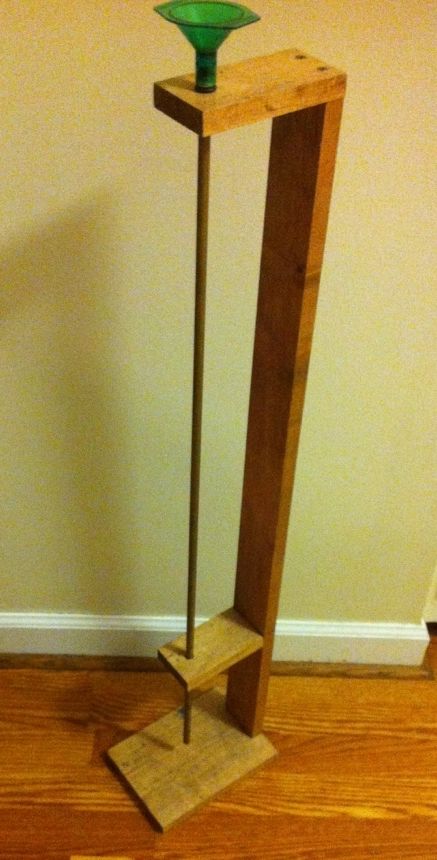
Powder Compression Die A powder compression die is very handy as it allows you tightly control the compression of the powder and also establish the bullet seating depth with zero air space. You can do this to some extent in the seating process, but it's less effective and powder compressed this way will often ease the bullet back out a bit. Don't go crazy on the compression as there is the potential for friction between powder grains that could produce an ignition source. I start with about 1/8" and increase to no more than 1/4" and see where the get the greatest consistency in velocity. Using the bullet to compress the powder is particularly a problem if you don't resize your brass. There really isn't much need to do that with BP 45-70 loads and if you don't resize them they last pretty much forever. I've been using the same 100 cases for my 1874 Sharps for about 15 years now, just washing them in warm soapy water and then letting them dry before loading them again. Without resizing you can also seat the bullet with finger pressure in the field, provided the powder charge isn't excessive and compression isn't used. So in a minimalist situation, a hand press, a hand priming tool and a means to measure the powder are all the equipment you need to feed a single shot. If you're using a lever action, then you'll want either some crimp, or at least adequate neck tension. You'll probably want to play with crimp in a single shot as well to see what works best for you in terms of consistency. A little crimp can help improve ignition by holding things in place a little longer, but the need for that will vary depending on the amount of powder compression, and any free bore in front of the bullet. You may find your throat is fairly long, allowing you to seat the bullet fairly far forward. In this case the bullet is just engaging the rifling, maximizing powder capacity in the case, but also eliminating any need for or advantage to using a crimp. 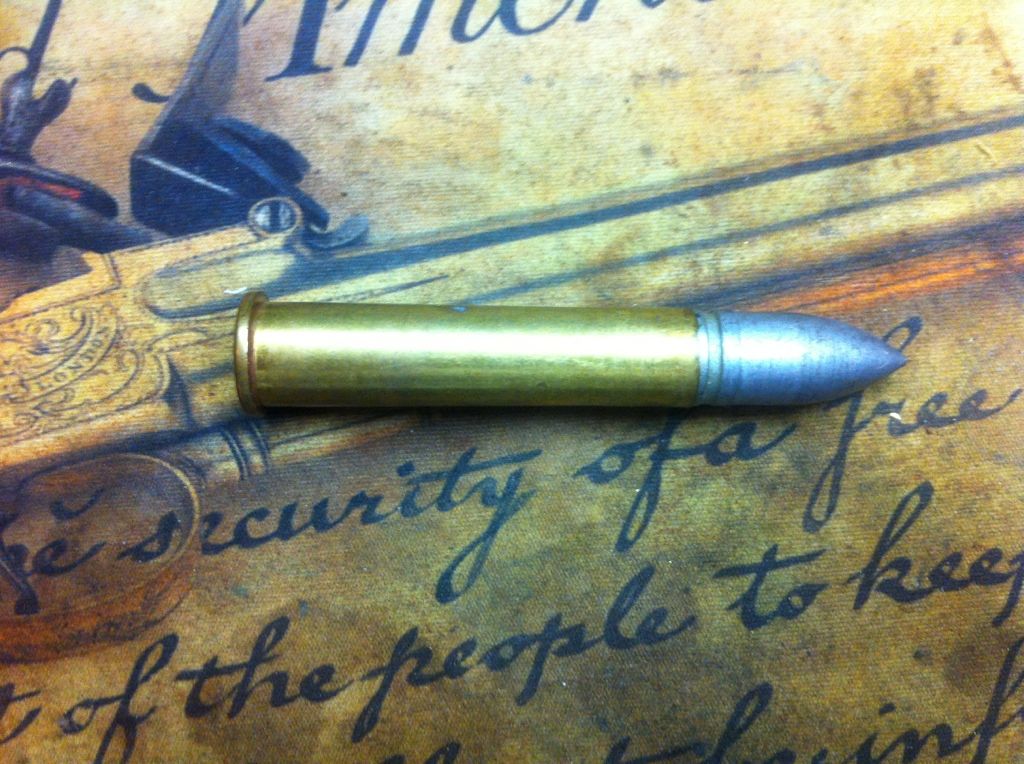
Now that I'm living in eastern NC, rather than in western SD, I don't often shoot at ranges over 300 yards with a Sharps, so I've also developed a less expensive and much less labor intensive load using 405 gr cast bullets. In this case, with a shorter bullet, and ample free bore in the long throat, crimp is essential for consistent ignition. 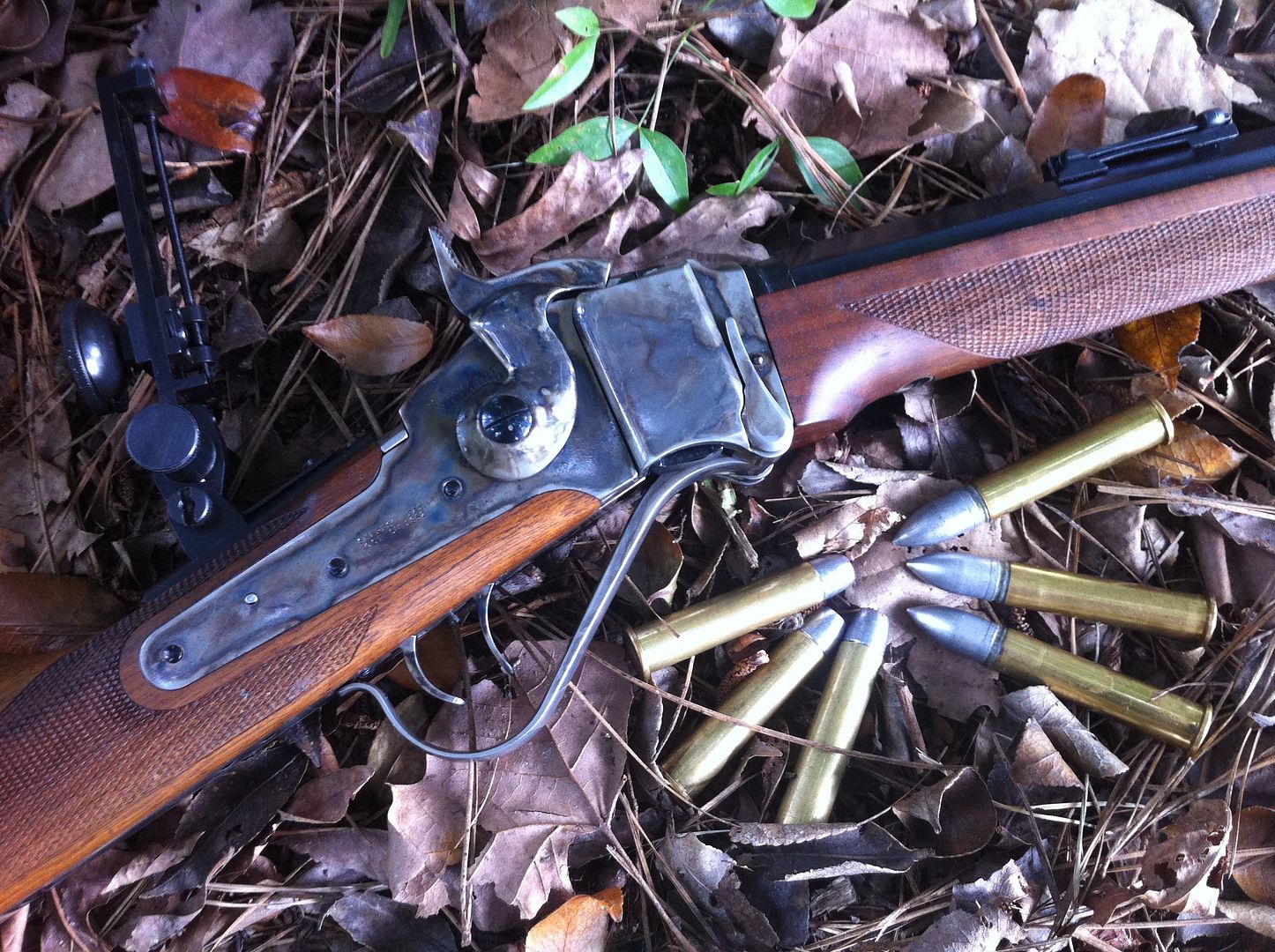
A Hand Press A hand press is also very convenient and on the range, I'll dry brush them and reload the cases at the bench. I've gotten some of my best groups and SDs in velocities of 5 fps using the same case for all five consecutive shots. A good black powder bullet lube Bullet lube is essential to BPCR accuracy and my preference is SPG, not so much because I've tried lots of alternatives, but because it's readily available, and has worked well for me. Lubes for smokeless powder won't work. A Blow Tube A blow tube is also vital as it keeps the fouling moist from shot to shot. I drilled a hole in the base of a .45-70 case, fitted the largest nipple I could fit, and attached a foot of plastic tubing to create by blow tube. Powder Black powder manufacture is actually a lost art and it's generally accepted that black powder in the 1880s produced less fouling than black powders of modern manufacture. The devil was in the details of the woods selected, their moisture content and minor details in converting them to charcoal and by the 1880s it had reached a high art form of closely held proprietary knowledge. That all became more or less useless when smokeless powder burst on the scene and most of those closely held details were lost when the people who knew them passed. Swiss seems to be highly regarded, but I'm less picky and I am satisfied with GOEX. Black powder in general is hard to find, as it is treated as an explosive by shippers and most fire codes require some fairly over the top storage methods for it, making it very unattractive for local shops to stock and sell. The end result is that you'll sooner or later find yourself ordering it in 25 or 50 pound lots to reduce the shipping charges to manageable levels and overall cutting your powder costs by about 1/2 to 2/3rds of what you'll pay by the pound in a local gun shop. Powder Inc and Buffalo arms both sell black powder in larger lots with a substantial price break. Wad Punch A wad punch is also handy to have. I use one to cut over powder card wads out of backs of notepads. Haven your own punch saves money, but also lets you experiment with different materials. Bullets Well made black powder bullets are insanely expensive for what they are, and it's the one area where I still cast my own bullets as I just won't participate in the price gouging that's done with black powder bullets. I think it's an artifact of too many post Quigley down under BPCR shooters who have more money than sense and who've never bothered to develop the skills to cast decent bullets. Before I left the area, it wasn't uncommon to see people from somewhere else shipping their rifles out to Wyoming or MT for a shoot, and show up with store bought everything to shoot them the few times a year they shot them. Nothing wrong with that really, except they pay way too much. I use the 480 gr Lyman 457658, a pointed Schmittzer design with a fairly high BC. I like it because it's very accurate and the tapered nose lets me get a bit more powder in the short 45-70 case. Most long range shooters however will use a Postell design like the 535 gr Lyman 457132. It's also very accurate and will retain a bit more velocity and buck wind slightly better at long range than the 457658 I've debated now and then over the years having my Sharps reamed to 45-90 or 45-110 and if I ever decide to do that, I'll probably move to a Postell bullet. However given that I'm not shooting at extreme ranges anymore, I doubt I'll go longer on the chamber. I'm getting 1 MOA accuracy as it is and the .45-70 with the 457658 offers all the range I need now. As noted above I also use commercial cast 405 gr bullets, although I order them without lube and lube them with SPG myself. Quality varies a lot and you'll want to experiment a bit but a good commercial 405 grain bullet will also produce 1 MOA accuracy in my Sharps out to 300 yards in no wind conditions and it's a great plinking load. I load them in both BP and A smokeless load (using Unique and a 1/4"X1"X1" polyfiber wad) when I don't want to bother with cleaning. -------- Something to consider as well is that with the longer 45-90, 45-110 and 45-120 cases, the velocity increases are no where linear as the powder charge increases. Once you go past the 45-70, you'll find you've passed the point of diminishing returns and you're burning a lot more powder for not a lot more velocity. As noted above, my reasons for going o a 45-90 would be to allow a longer, heavier bullet with a more rounded nose with a similar powder charge to what I'm using now. So unless you've got a specific reason and purpose, there's not much upside to moving away from the many advantages of the very widely popular and available .45-70. |
|
Man thanks for the info. I had read about using a drop tube. After seeing yours I am pretty sure I have enough scrap laying around to build one.
I got the gun, dies, some brass, and some bullets. This week I intend to install the front sight . I am still reading up on loading blackpowder and greatly appreciate all of the info up til now. Several years back Mississippi changed the rules for what they considered a primitive weapon as it pertains to deer hunting. Muzzleloaders fell to the wayside as straight walled, big bore, single shots became all the rage. It is getting harder to find blackpowder around here these days. Once I get the gun all lined out I will begin the hunt for some blackpowder locally. I also have some Trailboss powder that I use to load 308 subs with. I may work up a load with it just so I can get to shooting sooner. |
Armory Sponsor