


Armory Sponsor

Posted: 4/26/2012 4:49:39 PM EDT
|
Hey everybody,
I am about to purchase an Enfield M1917, 30.06 of ww1 era. I have read somewhere that ww1 rifles can be dangerous to fire due to poorly or unevenly heat treated receivers and barrels, making them unable to withstand the pressure of the round and resulting in explosion and serious injury/death to the shooter. I have tried searching for further info on this but have come up with no real relevant results. Does anyone have any knowledge/experience that could help shed some light onto whether or not I'm at risk if I wish to fire this rifle? Thanks very much! |

|
The M1917s are some of the most overbuilt, ridiculously strong actions ever made. They can easily handly stupid-level magnum cartridges like .577 Tyrannosaur. In fact, A-Square Hannibal rifles in such calibers are made on P14/M1917 actions.
There is absolutely no danger of an M1917 receiver exploding. |
|
I read that thread. The receiver held up just fine - it was an ammo failure.
The Eddystones had issues with developing cracks when they were rebarrelled. Apparently, as Eddystone was a former locomotive plant, they used some of the heavy locomotive machinery to torque the barrels on. When the rifles were rebarreled, the old barrels proved very difficult to remove, and sometimes the receiver would develop cracks if too much force was applied to the receiver during the removal. |
|
Quoted:
Mvolk is correct, lots of super mag loads were built on 1917 receivers. I did read something years ago about the Johnson Automatic barrels (J.A.) that were installed on WWII rebuilds but I don't remember the exact problem. The receiver ring had cracks in them. I can't remember why, maybe they over torqued the barrel. |
|
Quoted:
The 1917 Enfields are ok. It's believed by most that 1903 Springfields with s/n under 800,000 and Rock Islands under 285,507 may not be safe. These are the correct serial numbers on the 03's. With the 03's below 800k the heat treat temp was not check with instruments, but eye balled. On a bright day they were over the correct temps and were brittle. On a overcast day the temps were correct for a good heat treat. Not all '03's under 800k are unsafe to fire. The M1917's are among the strongest bolt rifle made. These have been wildcatted into some very large and powerful calibers. Some (very few) of the Eddiestones have been found with a cracked receiver at the receiver ring. This occurred only if it was re-barreled. A very few Eddiestones with a war2 clean and repair that received a new Johnson Automatics barrel should be inspected before firing. The story goes these had the original barrel to tight and they cracked when it was removed. Look for this marking on the barrel. 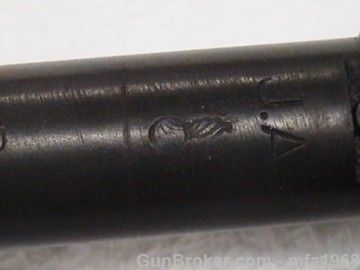
|
|
Quoted:
Quoted:
Mvolk is correct, lots of super mag loads were built on 1917 receivers. I did read something years ago about the Johnson Automatic barrels (J.A.) that were installed on WWII rebuilds but I don't remember the exact problem. The receiver ring had cracks in them. I can't remember why, maybe they over torqued the barrel. Yes, Barrels were over torqued when put on and the receiver cracked when they were taken off, due the amount of force required to remove them. Making a relief cut in the barrel before removal allow it to be removed without damage to the receiver. For this reason, barrel changes on a M1917 should be done my a smith who has experience with the rifle. |

|
Quoted:
The M1917s are some of the most overbuilt, ridiculously strong actions ever made. They can easily handly stupid-level magnum cartridges like .577 Tyrannosaur. In fact, A-Square Hannibal rifles in such calibers are made on P14/M1917 actions. There is absolutely no danger of an M1917 receiver exploding. The 1917s have NEVER experienced this heat-treating issue. ALL of the heat treating was done right on the 1917s. It is only CERTAIN 1903s that have issues. The rebarrelling issue is easy to spot and RARE. |
|
Quoted:
There was just a thread in GD about a Eddystone 1917 kaboom. Supposedly there is a history of this happening with the Eddystone made ones. That case was 100% ammo-related. It was lake City ammo too. Not gonna use lake city??? Of course not. No issue with 1917s. |
Armory Sponsor