


Posted: 7/21/2012 5:26:19 PM EDT
|
I thought I would ask this here to avoid all the Glockaholics, but why is the half cocked position not considered to be safe or a carry option by most 1911 afficionados that I have asked.
It seems extremely safe and I have checked in on all 4 of my 1911s and my Ballester-Rigaud. Seems like a very safe way to carry it. So, what am I missing? This is not about cocked and locked as I have gotten used to that, but I am curious about this. BTW, I bought my first 1911, a Norinco, about 15 years ago and could not get used to cocked and locked. Got rid of it. Big mistake. It seems that now I can't get enough 1911s. 
|
|
As a carry option, when you draw it, you're going to either have to thumb the hammer back to a full cock position, or rack the slide, discarding a round if it was in condition 3/4 before you can fire, neither is a good choice. From a safety perspective, if you look at a series 70 hammer, you'll see the little ledge on the hammer that holds it on half cock is very minimal, to drop the weapon, chances are it will discharge, and lowering the hammer manually to safe isn't the best practice with a 1911. just my .02 |
|
Just my opinion, but the only ways to carry a 1911 would be "Cocked and Locked" or "Hammer down on an empty chamber". The half cock notch is just a backup safety for the sear slipping from the fully cocked notch.
The fully cocked notch and the sear are cut to fit perfectly together some customs are even hand fit. The half cock notch is mostly just a cutout in the hammer. The fine machining on the sear resting in the not so fine machined half cock notch could put wear on the tip of the sear causing the sear-to-fully-cocked notch fit, not to fit so well. This worn sear tip would lead to hammer follow where the sear falls to half cock after cycling or slippage of the sear. I actually had the hammer follow problem before caused by the trigger overtravel not being set properly. There was just slightly not enough overtravel and this caused the tip of the sear to barely graze the half cock notch. over a period of time this just changed the tip of the sear enough to keep it from setting on the fully cocked notch. Again just my opinion, your carry preference should be what you feel the safest with. If you breakdown you 1911 to its smallest parts and see how everything worked together, thumb safety grip safety, firing pin safety if 80S, you and probably every one else will probably change your mind about cocked and locked. |

|
For one thing, some hammers don't have a captive notch, meaning the hammer can slip off the half-cock notch.
Also remember that when the thumb safety is engaged, the sear is immobilized, meaning the hammer can't drop unless the sear disintegrates. No such condition exists when the hammer's in half-cock. |
|
Quoted:
For one thing, some hammers don't have a captive notch, meaning the hammer can slip off the half-cock notch. Also remember that when the thumb safety is engaged, the sear is immobilized, meaning the hammer can't drop unless the sear disintegrates. No such condition exists when the hammer's in half-cock. I'm getting all kinds of good info in this thread. Thanks. |
|
IMO, it's one of the most dangerous ways to carry a 1911. Not because of the half cock position but what you have to do to put it there.
If you have a loaded chamber, you have to actually grip the pistol and pull the trigger and ease the hammer forward, then pull it back to half cock. On some you can time it right and ride the hammer forward until it rests on the half cock position but get it wrong and let go....BOOM. I would rather see people carry condition three than this. I always carry cocked and locked, once you know how the gun works, it only makes sens to carry this way. I have tried to explain this to people that I know that carry half cocked, but they think the way I carry is the most dangerous.... 
|
|
You might want to read M1911.org's threads on the subject. They are very interesting.
The 1911 was originally designed without a thumb safety and with a captive half cock notch. Those, along with a larger hammer spur, suppose that a half cock carry option was designed into the gun. Basically, it is a valid carry option. Apperantly the cavalry division of the army requested the thumb safety and that it lock the slide to prevent accedental slide movement when holstering on horseback. I would only do so if the hammer has a proper half cock notch. However, I think the potential for ND during a decock, far outweigh any benefit. I wouldn't do it because I don't want to thumb down the hammer and risk it. |
|
Quoted:
You might want to read M1911.org's threads on the subject. They are very interesting. The 1911 was originally designed without a thumb safety and with a captive half cock notch. Those, along with a larger hammer spur, suppose that a half cock carry option was designed into the gun. Basically, it is a valid carry option. Apperantly the cavalry division of the army requested the thumb safety and that it lock the slide to prevent accedental slide movement when holstering on horseback. I would only do so if the hammer has a proper half cock notch. However, I think the potential for ND during a decock, far outweigh any benefit. I wouldn't do it because I don't want to thumb down the hammer and risk it. Umm... Not really. The 1911 was originally designed without a GRIP safety. Cavalry wanted a grip safety to make it safer for holding in their hand while riding a horse. The half-cock notch was added as a safety feature in the event of sear failure. The weapon ALWAYS had the thumb safety. And half-cock carry was (and is) NEVER a safe carry option. Like others have said, the best way to carry a 1911 is Condition 1. If you must, Condition 3 and even Condition 4 are safe carry conditions. Condition 0 and Condition 2 are UNSAFE carry conditions. |
|
Quoted:
Quoted:
You might want to read M1911.org's threads on the subject. They are very interesting. The 1911 was originally designed without a thumb safety and with a captive half cock notch. Those, along with a larger hammer spur, suppose that a half cock carry option was designed into the gun. Basically, it is a valid carry option. Apperantly the cavalry division of the army requested the thumb safety and that it lock the slide to prevent accedental slide movement when holstering on horseback. I would only do so if the hammer has a proper half cock notch. However, I think the potential for ND during a decock, far outweigh any benefit. I wouldn't do it because I don't want to thumb down the hammer and risk it. Umm... Not really. The 1911 was originally designed without a GRIP safety. Cavalry wanted a grip safety to make it safer for holding in their hand while riding a horse. The half-cock notch was added as a safety feature in the event of sear failure. The weapon ALWAYS had the thumb safety. And half-cock carry was (and is) NEVER a safe carry option. Like others have said, the best way to carry a 1911 is Condition 1. If you must, Condition 3 and even Condition 4 are safe carry conditions. Condition 0 and Condition 2 are UNSAFE carry conditions. The cavalry requests got us the large radius FPS too. Ever since I tried the original design EVERY 1911 I get automatically gets an EGW oversized FPS now with no raudius, just a sharp edge break. |
|
Quoted:
Umm... Not really. The 1911 was originally designed without a GRIP safety. Cavalry wanted a grip safety to make it safer for holding in their hand while riding a horse. The half-cock notch was added as a safety feature in the event of sear failure. The weapon ALWAYS had the thumb safety. We are talking about different points in time. The Military asked for the grip safety early on. If you look at the model 1905, it had nothing, no grip or thumb safety. The grip safety was added shortly thereafter, and the thumb safety added rather late. http://www.sightm1911.com/lib/history/hist_dev.htm Browning, in turn, continued to introduce refinements to the Colt pistol. A grip safety was added in 1908, followed by a major development in 1909, which brought the pistol to the brink of final success. The two-link system relied upon the slide block key to hold the entire pistol together. If this block should happen to fail, or if a careless shooter should happen to fire the weapon while the block was not in place, the slide could blow off, right into the shooter’s face! To solve this potentially deadly hazard Browning devised the single link recoil system. The new configuration replaced the front link with the barrel bushing, which encircled the barrel. The bushing was locked into the front of the slide, and it was held in place by the recoil spring plug. This system resulted in much greater safety and reliability, and the competitive pistols soon fell by the wayside, unable to match the performance of the Colt.
M1911 Final Prototype In 1910 the final prototype for the Model 1911 pistol, incorporating the addition of the manual safety lever, was put through an exhaustive test regimen. At one point, six thousand rounds were fired through a single pistol without a single jam or failure. 1905: 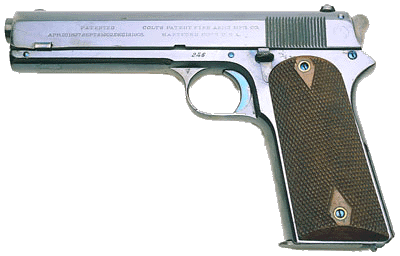
1907: 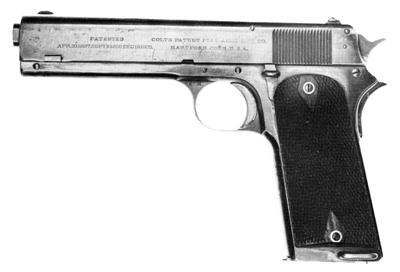
1909: 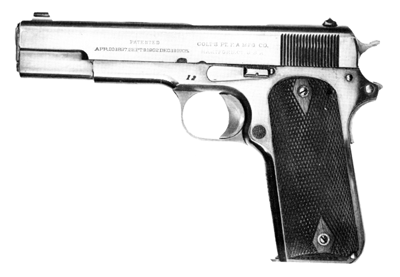
1910: 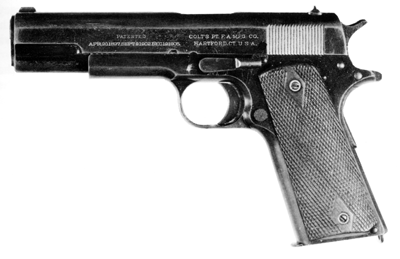
1911: 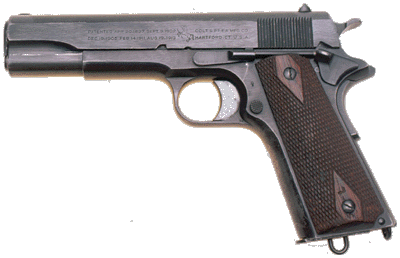
http://www.gunworld.com/buyers-guides/guns/the-first-100-years-of-the-1911-automatic-pistol-caliber-45-model-of-1911/ REFINING THE 1911
Even though the 1911 Special Army pistol functioned flawlessly during the 6,000-round endurance test, John M. Browning saw a need to make the gun even better, reducing the number of parts from 61 to 53 for simplicity. More importantly, added a thumb safety to allow the pistol to be carried fully loaded, with a round in the chamber, a full magazine, and the hammer pulled back, enabling the user to shoot instantly, even one-handed. These and other ideas are in the text of the final patent (U.S. Patent 1070582, granted on August 19, 1913). http://forum.m1911.org/showthread.php?t=98446&page=3&pp=10 http://www.cylinder-slide.com/hammerless.shtml (Check out the Model Prototypes on the right side) http://pistolsmith.com/m1911-pistols/22303-cocked-locked-like-who-intended.html And, last but not least, the JMB Patent for Model 1910 
No thumb safety. And half-cock carry was (and is) NEVER a safe carry option. Like others have said, the best way to carry a 1911 is Condition 1. If you must, Condition 3 and even Condition 4 are safe carry conditions. Condition 0 and Condition 2 are UNSAFE carry conditions.
Please explain why it is less safe to carry in half cock (assuming notch, not shelf). I'm not talking about the practicality (or the possibility of an ND, as I've already mentioned) of thumbing down and back, just the carry at half cock once there. The sear is captured by the half cock notch and cannot move. Even if it did, the hammer would not generate enough momentum to pop a primer. |
|
Half cock is safe, but its not real safe getting there.
If you do get your hammer into the half cock notch without an AD, it will be quite safe. Unless you drop it from a height, and it lands muzzle down on a hard surface. But, that is dangerous no matter where your hammer is, even if your safety lock is engaged. Remember, many of the early users of the M1911 were trained in the 19th century, and many 19th century weapons had a half cock position for the hammer. |
|
Quoted:
For one thing, some hammers don't have a captive notch, meaning the hammer can slip off the half-cock notch. Also remember that when the thumb safety is engaged, the sear is immobilized, meaning the hammer can't drop unless the sear disintegrates. No such condition exists when the hammer's in half-cock. I had this happen long ago. A gentle jar of the gun sent a rou d through the TV |
|
Quoted:
Remember, many of the early users of the M1911 were trained in the 19th century, and many 19th century weapons had a half cock position for the hammer. and likewise, many of Brownings designs from that time period had a half cock notch that was designed to be used as a carry option. This is shown in the images above where no grip or thumb safety existed and where the 1910 patent had the half cock notch and no thumb safety. If you think about it, if the Original design sear notch was only to be used as a fail safe for sear failure, it would be been sufficient to use a flat shelf instead of a capture notch. It would have saved money and machining time. The fact that his previous designs were designed to allow half cocked carry and that the 1910 and 1911's all had notches, show that it was a valid carry option. Again, I'm talking technically, not practically here. |
|
If you are are cocking the pistol and your thumb slips off the hammer the hammer will stop at half cock,on some searies 70 's the half cock with a pull of the trigger
will get you a 1,000 dollar new window! My friend that bought my 70 Combat Comander owened a stripmall and found that out! My Series 80 Colt Goverment Mod won't do that. Half cock is for wet fingers ,cocked annd locked is the way the 1911 is designed to carry. Bob |