


Posted: 7/6/2016 7:21:51 PM EDT
| What is the difference between a p1 and p38 pistols? |
|
The P.38 and P1 pistols come in three major flavors:
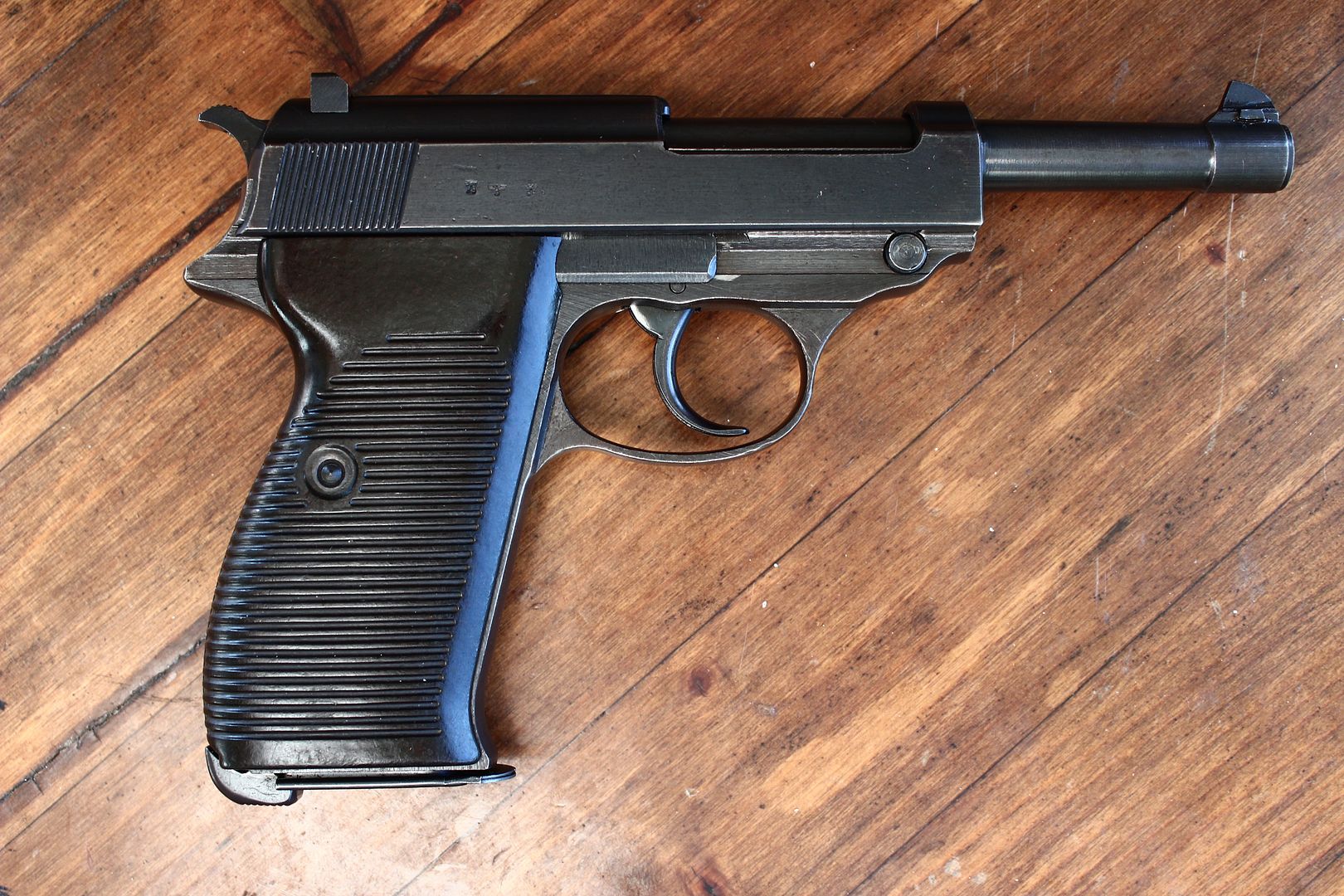
1. Wartime produced pistols were marked P.38 and had steel frames. 2. Post war commercial models were labeled P.38 but had aluminum frames. 3. Post war military models were labeled P1 and had aluminum frames. The notable exceptions here are: a) The first batch of new build post war German military pistols (made in 1957-58) which had aluminum frames but were labeled P.38. The rest of the post war German military pistols were produced from 1963 onward and both had aluminum frames and were marked P1; b) the small number of post war steel frame pistols made under French occupation marked P.38 (these pistols often have sheet metal grips); c) the small number of steel framed, short barreled P.38Ks made for a few years from about 1973; and d) parts guns assembled from a variety of P.38 and P1 parts with non matching slide and frame numbers. ----- You'll potentially encounter wartime P.38s that were used by the West German military and West German police. These pistols were P.38s that were refinished and had the swastikas stamped out to comply with laws in Germany banning the swastika. Both the refinish and the defacing of the swastika reduces the value of the pistol as a collector, but it's an interesting key to it's history and they make superb shooters. Matching numbers add value to a wartime P.38, but in addition the grips have to match. There are also variations in the grip design that are associated with the manufacturer and time period of the pistol and while not numbered to the pistol the grip still has to be correct for the date and manufacture of the pistol. ---- There are also some mechanical differences in the aluminum framed versions; Around 1970 Walther started refurbishing P1s with some updates and improvements. The slide is slightly fatter and has a stronger de-cocking lever. The frame has a steel hex pin in the frame and both the slide and frame changes are designed to prevent cracking. The newer slides can be identified by the presence of serrations ahead of the de-cocking lever. Some of these upgraded P1s were refurbished older P1s while others were new build pistols and will be found with all the improvements but no re-work mark. You'll also find refurbished P1s that don't have the improvements, largely depending on whether the new parts were on hand at the time of the re-work or not. Most reworked P1s will have a W followed by a date in a month year format as such - W 11/85. --- In general you don't want to pay more than $400-500 on a post war model or $700-$800 for a wartime model, unless it really is something pretty special. If you're shooting a matching number P.38, be aware that like the P08 the matching numbers add value. The good news for the P1 is that while the aluminum frame won;t tolerate full power loads as well as the steel framed P.38, there are still loads of parts out there, and if you've got a parts guns with mis matched numbers, there's no loss in value if you break something and replace it with another surplus part. Below is a CYQ (Spreewerke, manufactured in Czechoslovakia) P.38 made about mid to late 1943 based on the serial number block and the "41" resin compound used in the Posselt style grips. I paid $650 for it about a year ago with a spare magazine and a West German Police holster, leaving the price of the P.38 itself at about $570. That's a decent price for a matching serial number P.38 with the correct grips in very good condition. The Spreewerke manufactured P.38s were not date stamped so dating them has to be done by the serial number block based on the timeframe of production and the number produced. Like the P.08, the P.38 used serial number blocks of 0-9,999 with a new letter suffix (a,b c, d, e, etc) used for each successive block of 10,000 pistols. 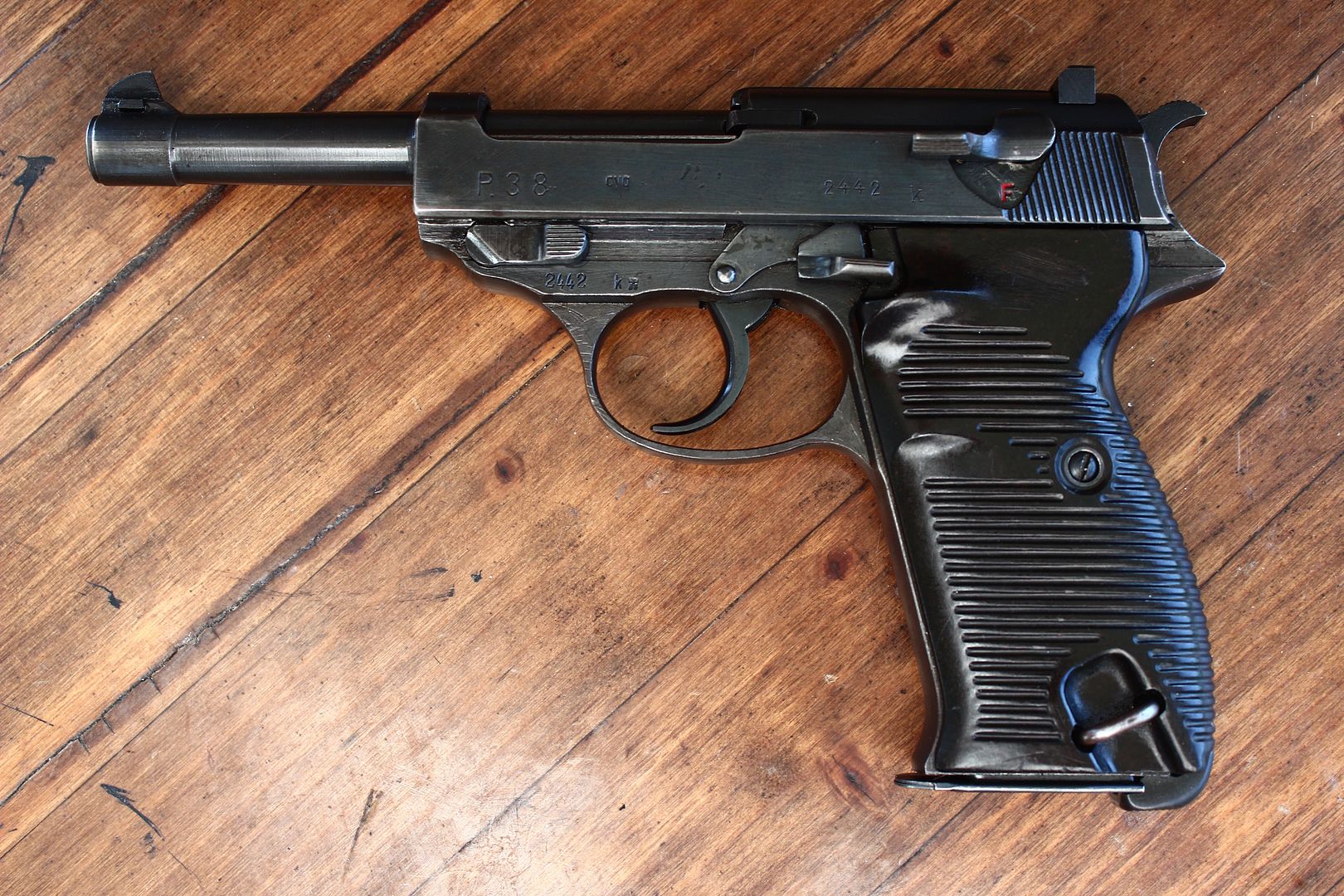
|
|
What I have is a steel frame and slide p38 with byf 44 on slide with all nu bers matching (25xx) it still has the swastika all in tact. It has brown-redish plastic grips
I am trying figure out what I have and how safe to shoot full power 9mm rounds. I know this was made by mauser from the byf markings |
|
Until about mid 1944, Mauser made P.38s had AEG grips. These were superseded by jet black Polyamide-6 grips on the later Mauser made pistols.
Mauser made about 300,000 byf marked P.38s, so it's not just the 4 digit serial number that matters, but also the lower case letter suffix that follows it. Note the k suffix on my P.38 above. If you supply a suffix, we can narrow it down a bit more within 1944 and figure out what grips you should have on it. If you include pictures of both sides of the pistol with the grips attached, and include a picture of the inside of the grips, or describe what is in the small circles on the inside of the grips, we an tell you what grips it has. If it is the late style AEG grip, the upper circle should have a stylized MBPD marking and the lower circle should contain the marking P 1528/29. ---- Regardless of the grips it has, your P.38 is a wartime (1944) Mauser made P.38 with a steel frame and steel slide. You should not have any problems using full power (standard pressure) 9mm ammo in it. The P08 Luger was initially designed to use a 123.5 gr truncated cone bullet with a velocity of 1048 fps. This was replaced in service in 1916 by a 124 gr round nose bullet at similar velocity. The WWII German 9mm ammo initially used the same 124 gr lead core, copper jacketed FMJ round nose bullet at about 1050 fps. However, about 1941, in order to conserve lead, the Germans adopted the 08mE bullet which used an iron core encased by lead and a copper jacket. The "mE" stood for Mit Eienkern, which means "with iron core". These were initially made with a black colored bullet jacket to differentiate them from the standard 124 gr FMJ round, but that was dropped in 1944 when the 08mE became the standard 9mm pistol round. There was also a Czech made version of the 08mE with a nickel jacket. These bullets only weighed about 95 grains, but I'm not sure what their velocity was in a P. 38. The 08SE bullet was also introduced in1943 and it was a solid sintered iron bullet. The SE stood for "Sintereisen" which means "sintered iron". I've never discovered what this bullet actually weighed but I suspect it was around the same 95 gr weight as the 08mE bullet. This is basically background information for the popular belief that the P.38 should only be shot with lighter weight bullets not exceeding 115 grains. However, that ignores that the P.38 pistol was in fact designed to use the same 124 gr round as the P08 and functions just fine with near maximum load standard pressure 9mm ball ammo. Unlike the P08 Luger however it also functions just fine with lighter loads as well. In any event, if you plan to shoot it, replace the recoil springs in it with standard factory weight springs from Wolff. |
|
There are two ways to remove each of the recoil springs.
You can use a small flat blade screw driver to press the rear of the spring forward and then bend it slightly and work it out through the round hole at the rear of the recess. It can be a little hard on the spring making the bend out the hole, so it's not something you want to do with a spring you plan to re-use. The other method is to use a small bladed flat screw driver to get between the spring and the head of the guide pin, and then press the spring back far enough to allow you to lift the guide pin over the ledge in the frame rail and remove the pin. It's not all that easy as you'll have to pull the snug fitting spring away from the head of the guide pin and compress the spring quite a bit. I use the latter method with the help of a small pair of straight jawed forceps. I hold the frame of the pistol in my lap, bracing the grip against my leg, then clamp the forceps onto the head of the guide pin. The I depress the spring about an inch and use the flat blade screw driver to hold the spring in place while I pull out the pin. ---- Getting the new one in is almost as much fun. Once again you can push them in the hole at the rear but the last inch or so is a real bear and risks bend a coil on the spring. Again, I install them from the front. I push the spring in until it starts to try to bend, then hold it in place in the middle with the small flat blade screw driver, and then compress it some more, using the guide pin, reversed so it is head first, along with the screw driver blade to compress the spring. Once the spring is compressed past the end f the groove about 3/4", I hold it in place with the guide pin while I reposition the screwdriver to hold the entire spring in compression. Then I reverse the guide pin, making sure it is behind the ledge on the frame and slowly release the tension on the spring. You get good at it after a couple tries. |


|
No your gun is a WII all steel P.38 captured by the Russians and was dipped by them for preservation and probably stored in the Ukraine unto the late 90's when thy began showing up over here. You can tell them by a black jelly bean luster and the missing paint in the S and F also the locking block will be blued or look dipped to as well as the locking block pin. Why would you wasn't to replace the springs? Shoot it first before you do that also if you bend the any part of the spring guides you have ruined the gun. I would recommend Winchester white box 115 grain ammo to start with. Stay away from the Remington 115 HP. After that only use standard pressure. ammo.
DO NOT USE +P ammo. |
|
Quoted:
How do you know it is Russian capture? By it's luster and without seeing the internals and the F and S are also covered with the dip sometimes an "X" can be found stamped on the slide or the front of the barrel block but not in all cases. See the second sentence on my other post. I went into some further detail there. You also mentioned yours is a four digit serial number. All WII had 4 digit serials plus a letter suffix with an annual production quota of 10,000, the quota was never reached except by Walther and there is only one 10,000 serialized pistol known and its in the collection of a person I know. |
|
I have the barrel off the locking block is silver, the locking pin is blue same as the barrel.
The batrel, locking block, the slide and frame have the same s/n the letter looks like a V. I can not find a single German mark x out. I am shooting 115/124 gr reloads in the upper- mid loading range. (Not maxed out loads.) This a safe place for this p38 What is a proper price range for this pistol? Not trying to sell it just see how bad I was taken advantage of. |
|
Quoted:
I have the barrel off the locking block is silver, the locking pin is blue same as the barrel. The batrel, locking block, the slide and frame have the same s/n the letter looks like a V. I can not find a single German mark x out. I am shooting 115/124 gr reloads in the upper- mid loading range. (Not maxed out loads.) This a safe place for this p38 What is a proper price range for this pistol? Not trying to sell it just see how bad I was taken advantage of. The locking block pin should be in the white on an original Wll P.38. that is a dead giveaway that the gun was either dipped or refinished. The "X" would have been applied by the Russians not the Germans. Like I said before the Russian "X" is not always there. The fact it was imported and all point I have made still points to a RC gun. The make fine shooters though. The 124 grain is fine and so is the 115 grain you are shooting. Keep a way from +P pressures and it will last you many years. The price for this pistol should be between $300 to $500. |

|
Nice... another K block Spreewerke P38. My SN isn't too far away from yours. |