


Posted: 4/18/2009 10:52:37 AM EDT
| Can't decide if I like the X300 or Insight Procyon better. Second opinion? Not interested in the TLR1. |
| My department issues the X200 (X300 was not made at the time) with the DG switch on our Sig P226R's to every officer. We love them. As the Armorer I have only had to Lock Tight (sp?) one screw on one light. They are very well made and can take the punishment of day to day patrol. |

|
The TLR1s and M3Xs are a problem out of my .40 Glocks, even with the new recoil spring, mag springs. I have had several problems with the round not making it up into the pipe and had to make an immediate tap, rack, and roll during several strings of fire during quals. I got my rounds off, but not what I was wanting. Ammo was factory CCI Gold dots 165 jhp, CCI 165 fmj. I know how to shoot, so none of this limp wrist crap. Yes, marksman14, I to had that same problem with one, the store I bought it from, swapped it out.
I have an extra X300 and just picked up a Procyon. One of them is going on an XDm 9mm as a bedside gun I just got. I prefer the X300s, but might try something new. I do like the strobe feature on the Procyon and its 125 lumens versus the X300's 110 lumens. Just trying to find out if anyone else has any feedback on those lights. |
|
Quoted:
The TLR1s and M3Xs are a problem out of my .40 Glocks, even with the new recoil spring, mag springs. I have had several problems with the round not making it up into the pipe and had to make an immediate tap, rack, and roll during several strings of fire during quals. I got my rounds off, but not what I was wanting. Ammo was factory CCI Gold dots 165 jhp, CCI 165 fmj. I know how to shoot, so none of this limp wrist crap. Yes, marksman14, I to had that same problem with one, the store I bought it from, swapped it out. I have an extra X300 and just picked up a Procyon. One of them is going on an XDm 9mm as a bedside gun I just got. I prefer the X300s, but might try something new. I do like the strobe feature on the Procyon and its 125 lumens versus the X300's 110 lumens. Just trying to find out if anyone else has any feedback on those lights. Have you used your X300 on your .40 Glocks with success? I ask this because your problems could be attributed to your gun and not the light nor the operator. Glock .40's with a light are notorious for having problems, namely the model 22. There's an ongoing thread in general discussion outlining issues that the Milwaukee Police Department is currently having with their G22's. http://www.ar15.com/forums/topic.html?b=1&f=5&t=861873 There is also several other threads outlining issues with light mounted .40 Glocks on other forums. 10-8 forums, lightfighter, etc.. |
|
I've had success w/ x200, x300, and M3. Didn't know about MPD having issues. OKCPD has dumped the Glocks for the same problem. Since then I exchanged my 22 for a 23, no problems aside from my issued gun, and personal gun blowing up. Crossing fingers it doesn't happen again. Again all factory ammo. I have two 23s that have three sets of serial numbers (i.e. one for slide, barrel, and frame).
Personally, I don't like the .40s. I love my Glocks in 9mm and .45. Never had a need for .40, just that the Bureau went to that and everyone followed suit. |
|
Quoted:
Can't decide if I like the X300 or Insight Procyon better. Second opinion? Not interested in the TLR1. I did a little writeup of the Procyon on another site: Insight Technologies XTI-Procyon review: Last week ToddG sent me an e-mail wondering if I would be interested in doing some T&E on an Insight Technologies Procyon weapon light and writing up my results. I considered the question for about 12.3 nanoseconds and decided to give it a whirl. A couple of days later the gear fairy dropped the package off at the front door. 
The XTI-Procyon is the latest offering from Insight Technologies, who’s one time ubiquity in the weapon light market has been diminished by strong competitors like the TLR-1 from Streamlight or the X series weapon lights from Surefire. Insight lists the following specifications for the unit: Dimensions: 3.2” x 1.6” x 1.5” Weight: 4.0 ounces w/ 2 CR123A batteries installed Lamp Element: LED Output: 125 Lumens Run Time: 90 Minutes Dimensions: 3.2” x 1.6” x 1.5” For the sake of comparison, here are the specs of the Surefire X300: Dimensions: 3.53” x 1.39” x 1.43” Weight: 3.7 Ounces w/ 2 CR123A batteries installed Lamp Element: LED Output: 110 Lumens Run Time: 2.4 hours (Surefire’s spec page for the X300 seems to indicate that some dimming will happen in this 2.4 hour period, so do not get overly excited by the longer run time.) The specs confirm my initial impressions of the Procyon…namely that it’s a tad wider and heavier than the Surefire X300, but it’s also shorter than the X300. The extra width makes comfortable concealment (especially if you are using an inside-the-waistband holster) more difficult. The shorter overall length of the Procyon, however, is welcome as it seems to cut down on the amount of carbon fouling that collects on the lens of the light, at least compared to the X200B. This is a welcome benefit if you’re doing a lot of shooting during a training course. Over the course of the Vickers/Hackathorn low light classes I had to remember to wipe the lens of my X200B clear of the residue frequently or the light would dim. If you go through an extended range session without periodically wiping the lens of the X200B down, you end up with a light that looks like this: 
The shorter overall length of the Procyon and recessing the lens into the barrel of the light seems to cut down on the need to keep track of how much schmutz is accumulating on the lens. In a real life situation it’s unlikely that you’ll be shooting enough rounds for the carbon deposits to hinder the performance of the light, but if you are a SWAT officer who has been on the range all day and you get called out at night before you have the chance to clean your gear, more room for error might be appreciated. 

The Procyon’s body is made out of aluminum like the X200/X300. LED lights generate quite a bit of heat and generally speaking aluminum construction helps dissipate that heat better than polymer does. After leaving the Procyon on for 20 minutes the unit was uncomfortable to touch, but this didn’t seem to result in any function issues. The X series lights also get too hot to hold after being continuously left on for that much time. 


The light put out by the Procyon is unique. I’ve tried to capture some pictures comparing it to the X200B so you can see for yourself. Note that because I am a lousy photographer the pictures are not true to life, but they do give you an idea of what the differences are. The Procyon’s unique reflector assembly causes the light to have a bright central hotspot with bright saw-tooth like edges radiating from the center. Immediately outside of the hotspot there is a thin, dark halo. Immediately outside that there is a brighter, wider halo. 
Procyon reflector 
X200B 
Procyon You can see that the X200B has a softer hot spot and a continuous, consistent halo that is not quite as bright as the Procyon’s halo. The Procyon’s light is also “whiter” than the slightly bluish-looking X200B’s light. 
The X200B in a living room 
Procyon in a living room I ran some indoor and outdoor tests to find out what these differences would mean for the end user. Indoors the X200B’s softer hotspot and wider halo allows you to see a little bit more of the room than the more concentrated beam of the Procyon. Outdoors, however, the Procyon’s tighter hotspot lets you see more definition and detail at longer distances. 
X200B at 35 yards 
Procyon at 35 yards The Procyon’s 125 lumen output is, quite frankly, brighter than I’d like on a handgun light. If a light is too bright it can “flashbulb” the user and essentially white out their night vision. This can leave you literally blind for a fraction of a second when the light goes off as the rod cells in your eyes frantically try to reproduce enough rhodopsin to allow some level of night vision again. The brighter the light you use, the more rhodopsin you bleach out when you use it. You have to keep in mind that the amount of rhodopsin your rods can produce in a given time frame is fixed, which is why it can take as long as 30 minutes after exposure to white light to regain your peak night vision. The more rhodopsin you can keep from being broken down by light the better your vision will be when you turn the white light back off. This flashbulb effect is pronounced indoors where most walls are painted bright reflective colors and are decorated with lots of reflective materials like glass panels in picture frames or even mirrors. If you hit a white wall or door at fairly close range with a direct burst of 125 lumen light, your night vision REALLY takes a hit. I find that the X200B’s softer bluer light is easier on my night vision than the Procyon’s brighter and whiter light. I found the same to be true with the X300, which is why I got rid of the X300 and still run an X200B on my handgun. Outdoors I actually prefer the Procyon to the X200B because there isn’t as much reflected light and because the extra definition you can see at longer distances could prove valuable. The controls of the Procyon are unique. Pressing down on the rocker levers engages the momentary-on function of the light. The momentary position is spring loaded and doesn’t allow you to lock the light on. Pressing up engages the constant-on function and locks the switch in the on position until you manually flip the lever back to the off or momentary position. The levers actually function independently of each other instead of in tandem like the rocker switches on the X200/X300 and TLR-1 do. 
I greatly prefer the momentary switch system of the Procyon to the Surefire X series lights. Surefire’s X series lights allows you to press the end of the lever forward to get momentary function, but I’ve always found the switches to be really stiff and hard to use. I find it difficult to get my hands positioned properly to deliver enough pressure to make the momentary switch function on the X series. It is much easier for me to press down with the end of my thumb and engage the momentary switch on the Procyon. A few minutes after having the unit out of the box I was already in love with this feature. It would be even better if you could press the switch forward like the Surefire system OR press it down into the spring loaded momentary position to engage the momentary-on function, but I think Surefire patented the push-forward feature. The independent operation of the two arms of the rocker switch also has a down side. If you use the left arm to turn the light on, the right arm of the rocker switch becomes useless. After spending a bunch of training time on the in-tandem style rocker switches my SOP if I accidentally engaged the constant-on function of the light was to sweep the opposite side in the opposite direction to correct it. That doesn’t work on the Procyon. It’s not an insurmountable problem, but it’s annoying none the less. The overwhelming majority of the time users are going to stick to the momentary function so this issue really is fairly minor, in my opinion. One of the major selling points of the Procyon is the strobe function that is built into the light. When combined with movement a strobing light can make it very difficult for an opponent to pin down exactly where you are, which makes it harder to shoot you. Measures that make life more difficult for the other guy are always welcome for the defense minded individual. To engage the strobe function on the Procyon you engage the switch (either momentary or constant-on) twice within ½ of a second. That sounds pretty simple when you’re reading it in black and white…in practice, however, I found it very difficult to engage the strobe function at will. Invariably I end up engaging the strobe when I don’t want it or failing to engage it when I do want it. If you use quick bursts of light to navigate or to clear a room, for instance, you may need to use two quick bursts of light in fairly rapid succession. Just when practicing a clear of my house I found that I was often engaging the strobe function when looking for a second burst of steady light. Strobes can have a disorienting effect especially when you’ve got 125 lumens of rapidly strobing light bouncing off the white walls of a hallway. It’s worse still if there are mirrors or other reflective surfaces in that hallway. During the recent Low Light II class, NCPatrolAR mentioned that he used the Procyon when taking down a car during a bust and accidentally engaged the strobe function when trying to light up a vehicle. He said that the strobing light bouncing off the reflective surfaces of the car did as much to disorient him as it did the occupants of the vehicle. I did a “takedown” on my own cars (which is difficult to explain to the neighbors, by the way) and I saw exactly what he was talking about. Back inside the house, when I located a threat (in my case an IDPA target I had a buddy set up in the house) and I wanted to use the strobe on the “bad guy” I almost always ended up with a steady light. This is really more of a limitation of the controls than a design flaw. There’s only so much you can do with a rocker switch. If Insight hired me to help them improve the Procyon my suggestion would be to first come up with a tape switch similar to the DG tape switch used by the Surefire X series lights that controls the momentary-on function of the light. The DG switch retains the rocker switch but adds a tape switch that can also control the function of the light. Once they have that I would suggest letting the tape switch control the steady light momentary function and switching the rocker’s momentary position to engage the strobe function by default. If you have a two handed grip on the weapon and want the steady light, simply squeeze the tape switch. If you want the strobe function, simply press down with your weak-hand thumb. I’ve mocked that up with my Surefire X200B using the DG switch and I think it would work splendidly on the Procyon. 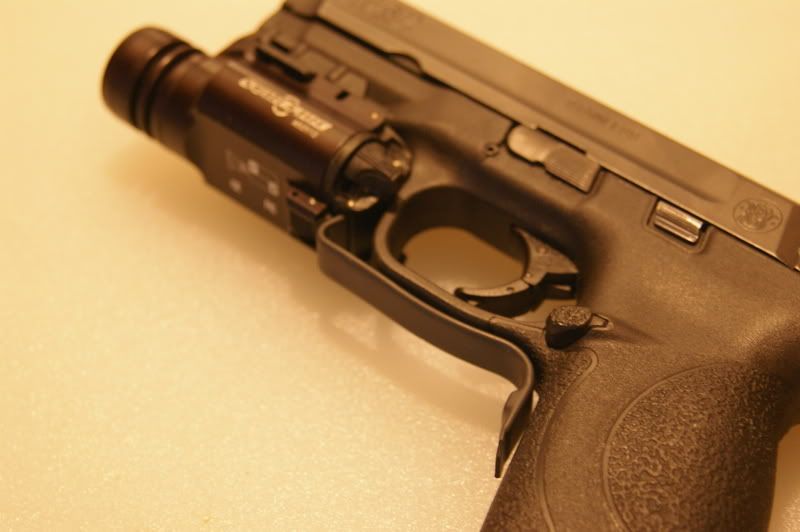
One other weird little tidbit came up in my testing. I noticed that if the light sits unused for about 30 minutes when you turn the light on there is a slight delay before the light actually turns on. The delay is only a fraction of a second, but if you are clearing a room it is just long enough for you to think “What the heck is wr…” before the light comes on. Subsequent manipulations of the switch result in instant light. I don’t know if this is just an issue with the switch on my particular unit or what. So what’s the bottom line here? After playing with the light for a while, I think it’s a good little light and that it has the potential to be even better with a few engineering changes. You can find the Procyon lights for anywhere from $120-170 dollars. (Note: The 120 figure is from Botach which means you probably can’t actually buy it for that price.) Several online retailers sell it in the $150 dollar range. That’s about $100 less than a Surefire X series. If money was no object, I’d rather have the Surefire with a DG tape switch. If money is an object or if you have a lot of money invested in carry gear that is compatible with the Insight M3/X3 series of lights, the Procyon is certainly worth a look. Because of the excellent momentary function on this light, if I couldn’t have a DG switch on my Surefire X series light I would actually prefer the Procyon to the X on a handgun. I'm not going to dump my X series lights and carry gear for the Procyon, but neither am I in a hurry to box it up and send it back to ToddG. I'm thinking it would be well suited to the G17 I use with G18 magazines when I can't have a carbine handy by the bedside. The open question I have on the Procyon is durability. The X series Surefires and the TLR-1's have proven to be very durable lights. The Procyon is new and hasn't suffered as much abuse as the others have. |
|
I have used Surefire products as long as they have been out. I have 2 X200B's plus a whole list of different lights for my rifles and shotguns.
I have never had a problem with any of them. Never tried the TLR-1, held it at a gun shop and was not impressed with it. I am waiting for the X400 with the light/laser combo on it that I ordered to arrive. Will post the results once I test it out at the range. |