


Best Defensive Handgun Caliber? (Page 1 of 2)

Posted: 9/13/2026 1:40:00 AM EDT
[Last Edit: NN300BLK][Edited]
|
Yes, this is a caliber debate thread, but I want this to be relatively scientific and data driven rather than "Two World Wars!" So, I've read about this a little and I've noticed some things... Penetration: You need adequate penetration-- most 9mm, .45 ACP, .40 Cal, 10mm should achieve adequate penetration. Expansion: More expansion is better, but a minimum of .40" expanded diameter. .40, 10mm, and .45 ACP with the correct ammo will often outperform 9mm in this regard for example based on my reading of Ammotogo's data here. Defensive Gun Uses: Most defensive gun uses involve no shots fired. High round counts expended by a civilian CCW holder are relatively rare. Armed Attorney's did a video on the 3-3-3 a while back based on real self defense data that they had access to and with the outliers removed the average was 3.75 shots fired.  New Data: 3-3-3 Civilian Gunfight Rule Attorney Breakdown Obviously, excessive recoil can affect shot times. But based on this data or what you've found in your research on this topic, what would your go to CCW caliber be? I carry a 9mm probably 75% of time, but I'm honestly leaning towards Edit: Concur that .40 is an edge case and probably not a good choice over 9mm due to snappier recoil and the lack of meaningful improvement over 9mm in terminal ballistics. |

A day without a buzz is like a day that never was
Joined:
Jan 2011
Posts:
13891
EE: 100% (54)
 AZ, USA

|
9mm You need to train with it and you’ll need to buy ammo for it. 10mm of course performs the best (with magazine capacity factored in) but who’s buying the ammo? If it were all free, would you want to handle that recoil every shot? (I would, but it’s not for everyone.) |

Modern ammo has come close to making most calibers pretty close in performance. Shoot what you like and are proficient with. Way too many variables to pin down what to carry and what ammo to keep in it. Besides. Chances are you will never need it. Internet lore and Hollywood scenes are not real life. No handgun caliber stops baddies like a rifle or shotgun in its range. Don't overthink it and you will be good. 
|

|
9mm. In HST or Gold dot 124gr There is a difference between 9,40,45 but there’s not enough of a difference to make a difference. It’s a handgun it’s already behind the lethality curve compared to long arms no matter if it’s 9,40,45. I’ll take capacity, less recoil and size/weight for a CCW over the minimal difference I’d get out of a 40 or 45. |
|
Originally Posted By LV1976: 9mm. The difference in expansion of 9mm 147 grain HST and .40S&W 180 grain HST is 1/10th of an inch, or 2.54mm. I don't consider that additional amount of expansion to be worth the tradeoff of lower capacity and higher recoil. Agencies jumped on that last caliber test that said effective one shot stops was basically the same across the major cartridges and it all depended on shot placement. Looking at the numbers is showed the same 24% rate except for .45 acp which was around 26% thus proving that 45 is superior. But my agency jumped on the report and ditched .40 and .45 for new hires. I continued carrying my 21SF until I retired. They were planning on issuing G45s as funding allowed. I'm sure everyone carrying other than 9mm like myself would have been the first targeted for the transition. |
|
Originally Posted By urbanredneck: Agencies jumped on that last caliber test that said effective one shot stops was basically the same across the major cartridges and it all depended on shot placement. Looking at the numbers is showed the same 24% rate except for .45 acp which was around 26% thus proving that 45 is superior. But my agency jumped on the report and ditched .40 and .45 for new hires. I continued carrying my 21SF until I retired. They were planning on issuing G45s as funding allowed. I'm sure everyone carrying other than 9mm like myself would have been the first targeted for the transition. Originally Posted By urbanredneck: Originally Posted By LV1976: 9mm. The difference in expansion of 9mm 147 grain HST and .40S&W 180 grain HST is 1/10th of an inch, or 2.54mm. I don't consider that additional amount of expansion to be worth the tradeoff of lower capacity and higher recoil. Agencies jumped on that last caliber test that said effective one shot stops was basically the same across the major cartridges and it all depended on shot placement. Looking at the numbers is showed the same 24% rate except for .45 acp which was around 26% thus proving that 45 is superior. But my agency jumped on the report and ditched .40 and .45 for new hires. I continued carrying my 21SF until I retired. They were planning on issuing G45s as funding allowed. I'm sure everyone carrying other than 9mm like myself would have been the first targeted for the transition. What caliber test gave effective one shot stops? |

I'm not lazy, I just really enjoy doing nothing.
Joined:
Mar 2019
Posts:
15310
EE: 100% (17)
USA
|
The number one rule is to have a gun. Rule number two is to be able to use it under stress and to practice regularly. Many ammunition manufacturers are using FBI ballistic protocol for expansion/penetration/defeating barriers. Using the FBI protocol tends to make all the service caliber performance very similar. Federal/Vista Law Enforcement website has test results on their Law Enforcement ammunition. Good situational awareness, being able to assess the situation to lawfully take appropriate action is critical. Shot placement with a handgun probably makes as much difference as the actual cartridge. Where you live and where you go can have a huge effect on your likelihood of being in a dangerous encounter. The law of averages on the number of rounds expended is irrelevant when you actually get involved in a life and death event because every situation is unique. You have to use whatever tools you have available to survive the encounter. Using good common sense and the will to survive are critical in high stress encounters. Knowing when to intervene or retreat will be scrutinized after the event. Here is a link to Vista Outdoors LE ballistic data. https://le.vistaoutdoor.com/wound_ballistics/load_comparison/load_comparison.aspx |

|
Originally Posted By backbencher: What caliber test gave effective one shot stops? I believe the focus of the study was on real life cases. They pulled out examples where the suspect was hit once and it ended the gun fight. There were no scenarios and there was no specific ammo selection, it was whatever the people had in their guns at the time of the incident. I believe that was their criteria for the study. But you can read it yourself because I believe the study can be found online. |
|
Originally Posted By GSPatton: Interesting topic. I don't think we've ever discussed this before. Attached File |
|
Vascar 2 and aim at deer make good points. Some of my unscientific observations: 1) every caliber will demonstrate impressive effects or spectacular failures if you review enough incidents - hanging your hat on one or the other is very biased. 2) i took a class with Ken Hackathorn years ago - his statement when referring to gear was “ any gun will do if you will do” and I mostly believe the same about caliber. Mindset and marksmanship are far more important than choice of gun caliber capacity aiming system carry method etc. 3) lots of people talk junk like split times ,gun shoot flat, etc - none of which will change any outcome. The first hit delivered that strikes something vital that stops the threat is the deciding factor regardless of caliber, bullet weight/ design or platform it is fired out of. A personal prediction: after the fbi said 9mm was the answer ( about 30 years after proclaiming it was not and birthing the 40) at some point we will have a high profile incident where a bad guy soaks up multiple 9’s without stopping. This will most likely be a marksmanship failure ( not hitting a vital area) than a caliber failure, but suddenly the 9mm will be declared inadequate and the pendulum will swing back to a larger caliber yet again. My carry gun 90% of the time is either a ruger LCPII 380 or S&W J frame 38 in a pocket holster. The internet commandos will find multiple faults with this system. Low power low capacity what no appendix carry “ for speed” ? I practice regularly with these guns ( in the case of my ruger, I imagine I have exceeded the intended design service life for rounds fired multiple times over) and hitting close range targets at speed ( silver dollar size groups at 7-10 yards) and placing hits on steel targets regularly out to 50 plus yards is something I do on autopilot - most people simply can’t make a carry gun perform maximally on demand. This is not a brag - with practice this is well within anyone’s ability. But people often go to the range and shoot full size guns and think this translates to the micro carry they ccw or simply don’t practice enough. A lot of us here are outliers but the typical gun carrier doesn’t practice once a month, let alone once a week ( the latter being where you need to be to maximize proficiency) |

|
9mm is all you need. From a cost vs performance standpoint it's the best option. There's a reason the FBI went back to it. https://www.thefirearmblog.com/blog/fbi-ballistics-expert-explains-why-9mm-beat-40-s-w-44825194 |
The 2nd is not about hunting, it never was. It was put in place for one reason and one reason only. You can't have them, we won't give them up, so get over it.
|
Originally Posted By backbencher: An average with outliers removed isn't an average. It's a number you want. Maybe you should look at the median instead. The average with the outlier was like 4.40 (it’s in the video), but what the Armed Attorneys said was that the high round count is often associated with background (LEO or mil) if I recall correctly. |
|
Originally Posted By Wolfhound76: 9mm is all you need. From a cost vs performance standpoint it's the best option. There's a reason the FBI went back to it. https://www.thefirearmblog.com/blog/fbi-ballistics-expert-explains-why-9mm-beat-40-s-w-44825194 The FBI has a different problem than individuals— they need the caliber that has good barrier penetration, stops the threat, and has recoil that the people of different sizes and hand strengths can handle. A 6’2” guy can handle a different amount of recoil than a 5’ woman. |
|
Originally Posted By urbanredneck: Agencies jumped on that last caliber test that said effective one shot stops was basically the same across the major cartridges and it all depended on shot placement. Looking at the numbers is showed the same 24% rate except for .45 acp which was around 26% thus proving that 45 is superior. But my agency jumped on the report and ditched .40 and .45 for new hires. I continued carrying my 21SF until I retired. They were planning on issuing G45s as funding allowed. I'm sure everyone carrying other than 9mm like myself would have been the first targeted for the transition. Originally Posted By urbanredneck: Originally Posted By LV1976: 9mm. The difference in expansion of 9mm 147 grain HST and .40S&W 180 grain HST is 1/10th of an inch, or 2.54mm. I don't consider that additional amount of expansion to be worth the tradeoff of lower capacity and higher recoil. Agencies jumped on that last caliber test that said effective one shot stops was basically the same across the major cartridges and it all depended on shot placement. Looking at the numbers is showed the same 24% rate except for .45 acp which was around 26% thus proving that 45 is superior. But my agency jumped on the report and ditched .40 and .45 for new hires. I continued carrying my 21SF until I retired. They were planning on issuing G45s as funding allowed. I'm sure everyone carrying other than 9mm like myself would have been the first targeted for the transition. This is a really good point— bigger expansion isn’t yielding better results in this data set; except 45 ACP. But with the 45, is the 2% rate increase worth the lower capacity, more recoil, and extra cost? |
|
Originally Posted By NN300BLK: The FBI has a different problem than individuals— they need the caliber that has good barrier penetration, stops the threat, and has recoil that the people of different sizes and hand strengths can handle. A 6’2” guy can handle a different amount of recoil than a 5’ woman. I'm sure the FBI as a whole shoot a lot more people annually than you or I ever will. That makes their recommendations good enough for the vast majority of people. Most important is shot placement and actually spending time practicing with your weapon. |
The 2nd is not about hunting, it never was. It was put in place for one reason and one reason only. You can't have them, we won't give them up, so get over it.

|
Originally Posted By NN300BLK: This is a really good point— bigger expansion isn’t yielding better results in this data set; except 45 ACP. But with the 45, is the 2% rate increase worth the lower capacity, more recoil, and extra cost? From my experiences, .45 is softer than .40 in the recoil dept. |
5th. generation Texan
|
Originally Posted By bigthicket: From my experiences, .45 is softer than .40 in the recoil dept. Originally Posted By bigthicket: Originally Posted By NN300BLK: This is a really good point— bigger expansion isn’t yielding better results in this data set; except 45 ACP. But with the 45, is the 2% rate increase worth the lower capacity, more recoil, and extra cost? From my experiences, .45 is softer than .40 in the recoil dept. I personally don't consider .45 to be "high recoil" either. I even prefer .45 ACP 1911's to 9mm 1911's just because of the impulse (slow push vs snap). |
|
Originally Posted By Wolfhound76: I'm sure the FBI as a whole shoot a lot more people annually than you or I ever will. That makes their recommendations good enough for the vast majority of people. Most important is shot placement and actually spending time practicing with your weapon. Originally Posted By Wolfhound76: Originally Posted By NN300BLK: The FBI has a different problem than individuals— they need the caliber that has good barrier penetration, stops the threat, and has recoil that the people of different sizes and hand strengths can handle. A 6’2” guy can handle a different amount of recoil than a 5’ woman. I'm sure the FBI as a whole shoot a lot more people annually than you or I ever will. That makes their recommendations good enough for the vast majority of people. Most important is shot placement and actually spending time practicing with your weapon. And I think they're right about 9mm vs .40-- there's little to no meaningful performance difference. But I'm just pointing out that some of their logic is based on looking at organizational needs, which inherently has to accommodate a wide range of people with different abilities and recoil tolerances; whereas a CCW holder that practices often and is proficient, may not have the same considerations, but rather is more focused on what works for him or her. |


|
Originally Posted By urbanredneck: I believe the focus of the study was on real life cases. They pulled out examples where the suspect was hit once and it ended the gun fight. There were no scenarios and there was no specific ammo selection, it was whatever the people had in their guns at the time of the incident. I believe that was their criteria for the study. But you can read it yourself because I believe the study can be found online. Originally Posted By urbanredneck: Originally Posted By backbencher: What caliber test gave effective one shot stops? I believe the focus of the study was on real life cases. They pulled out examples where the suspect was hit once and it ended the gun fight. There were no scenarios and there was no specific ammo selection, it was whatever the people had in their guns at the time of the incident. I believe that was their criteria for the study. But you can read it yourself because I believe the study can be found online. Good, what's the name of the study? |
|
Originally Posted By Colt653: Posting big bore propaganda with a Glock19 on my hip 45ACP https://i.imgur.com/G9Zg7DU.jpg https://i.imgur.com/XBKwwAX.png I mean I’m doing close to the same thing with an Echelon 4.0c on mine.
|


|
I carry a 9mm every day. A CC9 weekdays and a M&P 2.0C on weekends or if I go out at night. That said, if I had to go up against my own gun collection, I’d be most worried about facing my G41. 18 rounds of 45 Gold Dots thumping out of a 5.5” barrel is pretty intimidating. |
|
9mm won the popularity contest no question. It's powerful enough to get the job done. Easy to shoot, easy to carry, cheap ammo for practice. 10mm won the lethality contest for me. Very powerful, but still easy enough to handle. Glock 20 offers 15 rounds of 10mm. My FN 45 Tactical with 15 rounds of 45acp would be a close second. |
|
Originally Posted By Colt653: Posting big bore propaganda with a Glock19 on my hip 45ACP https://i.imgur.com/G9Zg7DU.jpg https://i.imgur.com/XBKwwAX.png Elmer Keith, or Jeff Cooper? |
|
Originally Posted By GunDisaster: 9mm won the popularity contest no question. It's powerful enough to get the job done. Easy to shoot, easy to carry, cheap ammo for practice. 10mm won the lethality contest for me. Very powerful, but still easy enough to handle. Glock 20 offers 15 rounds of 10mm. My FN 45 Tactical with 15 rounds of 45acp would be a close second. No kidding on 9mm winning the popularity contest. I stopped in at Scheels and Sportsman’s recently and a few things surprised me. 1) There were hardly any .45 ACP handguns (mostly 1911s) compared to 9mm and I was shocked by the number of 1911s and 2011s compared to striker fired polymer guns with the majority of the 1911/2011’s being in 9mm. There were still more polymer striker guns than 1911’s, but 1911’s seem to be enjoying a comeback or something— at least based on what I saw. |

We are the Knights who say Fuuuuu!
Joined:
Sep 2004
Posts:
58943
EE: 100% (665)
TX, USA
|
Originally Posted By GunDisaster: 9mm won the popularity contest no question. It's powerful enough to get the job done. Easy to shoot, easy to carry, cheap ammo for practice. 10mm won the lethality contest for me. Very powerful, but still easy enough to handle. Glock 20 offers 15 rounds of 10mm. My FN 45 Tactical with 15 rounds of 45acp would be a close second. I've enjoyed the affordability of surplus.40 S&W pistols & ammo. All my pocket pistols (Shields or Shield Plus) are 9mm, but I certainly don't feel inappropriately armed with 15+1 of 180 HST .40 S&W. Especially after killing several large tough Texas hogs . Statistics are pretty much 9=40=45 if the shooter does their part with placement. Bigger_Hammer 
|
LIFE'S JOURNEY IS NOT TO ARRIVE AT THE GRAVE SAFELY IN A WELL PRESERVED BODY,
BUT RATHER TO SKID IN SIDEWAYS, TOTALLY WORN OUT SHOUTING "HOLY $H!T...WHAT A RIDE"!!
BUT RATHER TO SKID IN SIDEWAYS, TOTALLY WORN OUT SHOUTING "HOLY $H!T...WHAT A RIDE"!!


| Aren't all handgun calibers a compromise of some sort? Also, I seem to recall Darryl Bolke citing some studies which pointed to the 357 as having the highest recorded instances of one stop shots. Am I misremembering that? |
I can’t stand it to think my life is going so fast and I’m not really living it.
|
The best? .40 S&W. You get 90% the power of a 10mm in a 9mm sized gun. It slaps way harder than the 9mm, I've got them all and shot them all. It slaps harder than most 357 Mag too. Anyone saying that there's no difference between them either hasn't shot much or is taking large does of copium on a daily basis. |


|
Originally Posted By backbencher: Good, what's the name of the study? @backbencher FBI 9MM Justification, FBI Training Division This has been making its way around the Internet and we thought it was worth sharing. May 6, 2014 FBI Training Division: FBI Academy, Quantico, VA Executive Summary of Justification for Law Enforcement Partners Caliber debates have existed in law enforcement for decades Most of what is “common knowledge” with ammunition and its effects on the human target are rooted in myth and folklore Projectiles are what ultimately wound our adversaries and the projectile needs to be the basis for the discussion on what “caliber” is best In all the major law enforcement calibers there exist projectiles which have a high likelihood of failing LEO’s in a shooting incident and there are projectiles which have a high ting incident likelihood of succeeding for LEO’s in a shooting incident Handgun stopping power is simply a myth The single most important factor in effectively wounding a human target is to have penetration to a scientifically valid depth (FBI uses 12” – 18”) LEO’s miss between 70 – 80 percent of the shots fired during a shooting incident Contemporary projectiles (since 2007) have dramatically increased the terminal effectiveness of many premium line law enforcement projectiles (emphasis on the 9mm Luger offerings) 9mm Luger now offers select projectiles which are, under identical testing conditions, I outperforming most of the premium line .40 S&W and .45 Auto projectiles tested by the FBI 9mm Luger offers higher magazine capacities, less recoil, lower cost (both in ammunition and wear on the weapons) and higher functional reliability rates (in FBI weapons) The majority of FBI shooters are both FASTER in shot strings fired and more ACCURATE with shooting a 9mm Luger vs shooting a .40 S&W (similar sized weapons) There is little to no noticeable difference in the wound tracks between premium line law Auto enforcement projectiles from 9mm Luger through the .45 Auto Given contemporary bullet construction, LEO’s can field (with proper bullet selection) 9mm Lugers with all of the terminal performance potential of any other law enforcement pistol caliber with none of the disadvantages present with the “larger” calibers Justification for Law Enforcement Partners Rarely in law enforcement does a topic stir a more passionate debate than the choice of handgun caliber made by a law enforcement organization. Many voice their opinions by repeating the old adage “bigger is better” while others have “heard of this one time” where a smaller caliber failed and a larger caliber “would have performed much better.” Some even subscribe to the belief that a caliber exists which will provide a “one shot stop.” It has been stated, “Decisions on ammunition selection are particularly difficult because many of the pertinent issues related to handguns and ammunition are firmly rooted in myth and folklore.” This still holds as true today as it did when originally stated 20 years ago. Caliber, when considered alone, brings about a unique set of factors to consider such as magazine capacity for a given weapon size, ammunition availability, felt recoil, weight and cost. What is rarely discussed, but most relevant to the caliber debate is what projectile is being considered for use and its terminal performance potential. One should never debate on a gun make or caliber alone. The projectile is what wounds and ultimately this is where the debate/discussion should focus. In each of the three most common law enforcement handgun calibers (9mm Luger, .40 Smith & Wesson and .45 AUTO) there are projectiles which have a high likelihood of failing law enforcement officers and in each of these three calibers there are projectiles which have a high likelihood of succeeding for law enforcement officers during a shooting incident. The choice of a service projectile must undergo intense scrutiny and scientific evaluation in order to select the best available option. Understanding Handgun Caliber Terminal Ballistic Realities Many so?called “studies” have been performed and many analyses of statistical data have been undertaken regarding this issue. Studies simply involving shooting deaths are irrelevant since the goal of law enforcement is to stop a threat during a deadly force encounter as quickly as possible. Whether or not death occurs is of no consequence as long as the threat of death or serious injury to law enforcement personnel and innocent third parties is eliminated. “The concept of immediate incapacitation is the only goal of any law enforcement shooting and is the underlying rationale for decisions regarding weapons, ammunition, calibers and training.”1 Studies of “stopping power” are irrelevant because no one has ever been able to define how much power, force, or kinetic energy, in and of itself, is required to effectively stop a violent and determined adversary quickly, and even the largest of handgun calibers are not capable of delivering such force. Handgun stopping power is simply a myth. Studies of so?called “one shot stops” being used as a tool to define the effectiveness of one handgun cartridge, as opposed to another, are irrelevant due to the inability to account for psychological influences and due to the lack of reporting specific shot placement. In short, extensive studies have been done over the years to “prove” a certain cartridge is better than another by using grossly flawed methodology and or bias as a precursor to manipulating statistics. In order to have a meaningful understanding of handgun terminal ballistics, one must only deal with facts that are not in dispute within the medical community, i.e. medical realities, and those which are also generally accepted within law enforcement, i.e. tactical realities. Medical Realities Shots to the Central Nervous System (CNS) at the level of the cervical spine (neck) or above, are the only means to reliably cause immediate incapacitation. In this case, any of the calibers commonly used in law enforcement, regardless of expansion, would suffice for obvious reasons. Other than shots to the CNS, the most reliable means for affecting rapid incapacitation is by placing shots to large vital organs thus causing rapid blood loss. Simply stated, shot placement is the most critical component to achieving either method of incapacitation. Wounding factors between rifle and handgun projectiles differ greatly due to the dramatic differences in velocity, which will be discussed in more detail herein. The wounding factors, in order of importance, are as follows: A. Penetration: A projectile must penetrate deeply enough into the body to reach the large vital organs, namely heart, lungs, aorta, vena cava and to a lesser extent liver and spleen, in order to cause rapid blood loss. It has long been established by expert medical professionals, experienced in evaluating gunshot wounds, that this equates to a range of penetration of 12?18 inches, depending on the size of the individual and the angle of the bullet path (e.g., through arm, shoulder, etc.). With modern properly designed, expanding handgun bullets, this objective is realized, albeit more consistently with some law enforcement projectiles than others. 1 Handgun Wounding Factors and Effectiveness: Firearms Training Unit, Ballistic Research Facility, 1989. B. Permanent Cavity: The extent to which a projectile expands determines the diameter of the permanent cavity which, simply put, is that tissue which is in direct contact with the projectile and is therefore destroyed. Coupled with the distance of the path of the projectile (penetration), the total permanent cavity is realized. Due to the elastic nature of most human tissue and the low velocity of handgun projectiles relative to rifle projectiles, it has long been established by medical professionals, experienced in evaluating gunshot wounds, that the damage along a wound path visible at autopsy or during surgery cannot be distinguished between the common handgun calibers used in law enforcement. That is to say an operating room surgeon or Medical Examiner cannot distinguish the difference between wounds caused by .35 to .45 caliber projectiles. C. Temporary Cavity: The temporary cavity is caused by tissue being stretched away from the permanent cavity. If the temporary cavity is produced rapidly enough in elastic tissues, the tensile strength of the tissue can be exceeded resulting in tearing of the tissue. This effect is seen with very high velocity projectiles such as in rifle calibers, but is not seen with handgun calibers. For the temporary cavity of most handgun projectiles to have an effect on wounding, the velocity of the projectile needs to exceed roughly 2,000 fps. At the lower velocities of handgun rounds, the temporary cavity is not produced with sufficient velocity to have any wounding effect; therefore any difference in temporary cavity noted between handgun calibers is irrelevant. “In order to cause significant injuries to a structure, a pistol bullet must strike that structure directly.”2 2 DiMaio, V.J.M.: Gunshot Wounds, Elsevier Science Publishing Company, New York, NY, 1987, page 42. D. Fragmentation: Fragmentation can be defined as “projectile pieces or secondary fragments of bone which are impelled outward from the permanent cavity and may sever muscle tissues, blood vessels, etc., apart from the permanent cavity”3. Fragmentation does not reliably occur in soft tissue handgun wounds due to the low velocities of handgun bullets. When fragmentation does occur, fragments are usually found within one centimeter (.39”) of the permanent cavity.4 Due to the fact that most modern premium law enforcement ammunition now commonly uses bonded projectiles (copper jacket bonded to lead core), the likelihood of fragmentation is very low. For these reasons, wounding effects secondary to any handgun caliber bullet fragmentation are considered inconsequential. 3 Fackler, M.L., Malinowski, J.A.: “The Wound Profile: A Visual Method for Quantifying Gunshot Wound Components”, Journal of Trauma 25: 522?529, 1958. 4 Handgun Wounding Factors and Effectiveness: Firearms Training Unit, Ballistic Research Facility, 1989. Psychology Any discussion of stopping armed adversaries with a handgun has to include the psychological state of the adversary. Psychological factors are probably the most important relative to achieving rapid incapacitation from a gunshot wound to the torso.5 First and foremost, the psychological effects of being shot can never be counted on to stop an individual from continuing conscious voluntary action. Those who do stop commonly do so because they decide to, not because they have to. The effects of pain are often delayed due to survival patterns secondary to “fight or flight” reactions within the body, drug/alcohol influences and in the case of extreme anger or aggression, pain can simply be ignored. Those subjects who decide to stop immediately after being shot in the torso do so commonly because they know they have been shot and are afraid of injury or death, regardless of caliber, velocity, or bullet design. It should also be noted that psychological factors can be a leading cause of incapacitation failures and as such, proper shot placement, adequate penetration, and multiple shots on target cannot be over emphasized. 5 Ibid. Tactical Realities Shot placement is paramount and law enforcement officers on average strike an adversary with only 20 – 30 percent of the shots fired during a shooting incident. Given the reality that shot placement is paramount (and difficult to achieve given the myriad of variables present in a deadly force encounter) in obtaining effective incapacitation, the caliber used must maximize the likelihood of hitting vital organs. Typical law enforcement shootings result in only one or two solid torso hits on the adversary. This requires that any projectile which strikes the torso has as high a probability as possible of penetrating deeply enough to disrupt a vital organ. The Ballistic Research Facility has conducted a test which compares similar sized Glock pistols in both .40 S&W and 9mm calibers, to determine if more accurate and faster hits are achievable with one versus the other. To date, the majority of the study participants have shot more quickly and more accurately with 9mm caliber Glock pistols. The 9mm provides struggling shooters the best chance of success while improving the speed and accuracy of the most skilled shooters. CONCLUSION While some law enforcement agencies have transitioned to larger calibers from the 9mm Luger in recent years, they do so at the expense of reduced magazine capacity, more felt recoil, and given adequate projectile selection, no discernible increase in terminal performance. Other law enforcement organizations seem to be making the move back to 9mm Luger taking advantage of the new technologies which are being applied to 9mm Luger projectiles. These organizations are providing their armed personnel the best chance of surviving a deadly force encounter since they can expect faster and more accurate shot strings, higher magazine capacities (similar sized weapons) and all of the terminal performance which can be expected from any law enforcement caliber projectile. Given the above realities and the fact that numerous ammunition manufacturers now make 9mm Luger service ammunition with outstanding premium line law enforcement projectiles, the move to 9mm Luger can now be viewed as a decided advantage for our armed law enforcement personnel. Tags: FBI |
|
Originally Posted By Dissident: Aren't all handgun calibers a compromise of some sort? Also, I seem to recall Darryl Bolke citing some studies which pointed to the 357 as having the highest recorded instances of one stop shots. Am I misremembering that? The study cited was the Marshall Sanow study. It has largely been discredited due to it's methodology now. Yes, handgun's are a compromise. Do you want to be Lucas McCain and carry a rifle everywhere? |
[NO TEXT]
|
Originally Posted By Dissident: Aren't all handgun calibers a compromise of some sort? Also, I seem to recall Darryl Bolke citing some studies which pointed to the 357 as having the highest recorded instances of one stop shots. Am I misremembering that? He may have said that, and Marshall and Sanow claimed all sorts of things about one shot stops. On the publication of their second book, some statisticians pointed out their statistics were impossible, and Marshall and Sanow would never publish their data - so anything they published should be regarded as junk science. Greg Ellifritz has claimed to conduct a handgun caliber effectiveness study. He has also not published his data, so we have no idea if his conclusions are correct or not. I'll have to look into the FBI study cited above. |
|
Originally Posted By Ewald: The study cited was the Marshall Sanow study. It has largely been discredited due to it's methodology now. Yes, handgun's are a compromise. Do you want to be Lucas McCain and carry a rifle everywhere? Originally Posted By Ewald: Originally Posted By Dissident: Aren't all handgun calibers a compromise of some sort? Also, I seem to recall Darryl Bolke citing some studies which pointed to the 357 as having the highest recorded instances of one stop shots. Am I misremembering that? The study cited was the Marshall Sanow study. It has largely been discredited due to it's methodology now. Yes, handgun's are a compromise. Do you want to be Lucas McCain and carry a rifle everywhere? I mean, the Fold AR, S&W FPC in 5.7, & the SUB 2000 in 5.7 all exist. 
|
|
Originally Posted By urbanredneck: @backbencher FBI 9MM Justification, FBI Training Division This has been making its way around the Internet and we thought it was worth sharing. May 6, 2014 FBI Training Division: FBI Academy, Quantico, VA Executive Summary of Justification for Law Enforcement Partners Caliber debates have existed in law enforcement for decades Most of what is “common knowledge” with ammunition and its effects on the human target are rooted in myth and folklore Projectiles are what ultimately wound our adversaries and the projectile needs to be the basis for the discussion on what “caliber” is best In all the major law enforcement calibers there exist projectiles which have a high likelihood of failing LEO’s in a shooting incident and there are projectiles which have a high ting incident likelihood of succeeding for LEO’s in a shooting incident Handgun stopping power is simply a myth The single most important factor in effectively wounding a human target is to have penetration to a scientifically valid depth (FBI uses 12” – 18”) LEO’s miss between 70 – 80 percent of the shots fired during a shooting incident Contemporary projectiles (since 2007) have dramatically increased the terminal effectiveness of many premium line law enforcement projectiles (emphasis on the 9mm Luger offerings) 9mm Luger now offers select projectiles which are, under identical testing conditions, I outperforming most of the premium line .40 S&W and .45 Auto projectiles tested by the FBI 9mm Luger offers higher magazine capacities, less recoil, lower cost (both in ammunition and wear on the weapons) and higher functional reliability rates (in FBI weapons) The majority of FBI shooters are both FASTER in shot strings fired and more ACCURATE with shooting a 9mm Luger vs shooting a .40 S&W (similar sized weapons) There is little to no noticeable difference in the wound tracks between premium line law Auto enforcement projectiles from 9mm Luger through the .45 Auto Given contemporary bullet construction, LEO’s can field (with proper bullet selection) 9mm Lugers with all of the terminal performance potential of any other law enforcement pistol caliber with none of the disadvantages present with the “larger” calibers Justification for Law Enforcement Partners Rarely in law enforcement does a topic stir a more passionate debate than the choice of handgun caliber made by a law enforcement organization. Many voice their opinions by repeating the old adage “bigger is better” while others have “heard of this one time” where a smaller caliber failed and a larger caliber “would have performed much better.” Some even subscribe to the belief that a caliber exists which will provide a “one shot stop.” It has been stated, “Decisions on ammunition selection are particularly difficult because many of the pertinent issues related to handguns and ammunition are firmly rooted in myth and folklore.” This still holds as true today as it did when originally stated 20 years ago. Caliber, when considered alone, brings about a unique set of factors to consider such as magazine capacity for a given weapon size, ammunition availability, felt recoil, weight and cost. What is rarely discussed, but most relevant to the caliber debate is what projectile is being considered for use and its terminal performance potential. One should never debate on a gun make or caliber alone. The projectile is what wounds and ultimately this is where the debate/discussion should focus. In each of the three most common law enforcement handgun calibers (9mm Luger, .40 Smith & Wesson and .45 AUTO) there are projectiles which have a high likelihood of failing law enforcement officers and in each of these three calibers there are projectiles which have a high likelihood of succeeding for law enforcement officers during a shooting incident. The choice of a service projectile must undergo intense scrutiny and scientific evaluation in order to select the best available option. Understanding Handgun Caliber Terminal Ballistic Realities Many so?called “studies” have been performed and many analyses of statistical data have been undertaken regarding this issue. Studies simply involving shooting deaths are irrelevant since the goal of law enforcement is to stop a threat during a deadly force encounter as quickly as possible. Whether or not death occurs is of no consequence as long as the threat of death or serious injury to law enforcement personnel and innocent third parties is eliminated. “The concept of immediate incapacitation is the only goal of any law enforcement shooting and is the underlying rationale for decisions regarding weapons, ammunition, calibers and training.”1 Studies of “stopping power” are irrelevant because no one has ever been able to define how much power, force, or kinetic energy, in and of itself, is required to effectively stop a violent and determined adversary quickly, and even the largest of handgun calibers are not capable of delivering such force. Handgun stopping power is simply a myth. Studies of so?called “one shot stops” being used as a tool to define the effectiveness of one handgun cartridge, as opposed to another, are irrelevant due to the inability to account for psychological influences and due to the lack of reporting specific shot placement. In short, extensive studies have been done over the years to “prove” a certain cartridge is better than another by using grossly flawed methodology and or bias as a precursor to manipulating statistics. In order to have a meaningful understanding of handgun terminal ballistics, one must only deal with facts that are not in dispute within the medical community, i.e. medical realities, and those which are also generally accepted within law enforcement, i.e. tactical realities. Medical Realities Shots to the Central Nervous System (CNS) at the level of the cervical spine (neck) or above, are the only means to reliably cause immediate incapacitation. In this case, any of the calibers commonly used in law enforcement, regardless of expansion, would suffice for obvious reasons. Other than shots to the CNS, the most reliable means for affecting rapid incapacitation is by placing shots to large vital organs thus causing rapid blood loss. Simply stated, shot placement is the most critical component to achieving either method of incapacitation. Wounding factors between rifle and handgun projectiles differ greatly due to the dramatic differences in velocity, which will be discussed in more detail herein. The wounding factors, in order of importance, are as follows: A. Penetration: A projectile must penetrate deeply enough into the body to reach the large vital organs, namely heart, lungs, aorta, vena cava and to a lesser extent liver and spleen, in order to cause rapid blood loss. It has long been established by expert medical professionals, experienced in evaluating gunshot wounds, that this equates to a range of penetration of 12?18 inches, depending on the size of the individual and the angle of the bullet path (e.g., through arm, shoulder, etc.). With modern properly designed, expanding handgun bullets, this objective is realized, albeit more consistently with some law enforcement projectiles than others. 1 Handgun Wounding Factors and Effectiveness: Firearms Training Unit, Ballistic Research Facility, 1989. B. Permanent Cavity: The extent to which a projectile expands determines the diameter of the permanent cavity which, simply put, is that tissue which is in direct contact with the projectile and is therefore destroyed. Coupled with the distance of the path of the projectile (penetration), the total permanent cavity is realized. Due to the elastic nature of most human tissue and the low velocity of handgun projectiles relative to rifle projectiles, it has long been established by medical professionals, experienced in evaluating gunshot wounds, that the damage along a wound path visible at autopsy or during surgery cannot be distinguished between the common handgun calibers used in law enforcement. That is to say an operating room surgeon or Medical Examiner cannot distinguish the difference between wounds caused by .35 to .45 caliber projectiles. C. Temporary Cavity: The temporary cavity is caused by tissue being stretched away from the permanent cavity. If the temporary cavity is produced rapidly enough in elastic tissues, the tensile strength of the tissue can be exceeded resulting in tearing of the tissue. This effect is seen with very high velocity projectiles such as in rifle calibers, but is not seen with handgun calibers. For the temporary cavity of most handgun projectiles to have an effect on wounding, the velocity of the projectile needs to exceed roughly 2,000 fps. At the lower velocities of handgun rounds, the temporary cavity is not produced with sufficient velocity to have any wounding effect; therefore any difference in temporary cavity noted between handgun calibers is irrelevant. “In order to cause significant injuries to a structure, a pistol bullet must strike that structure directly.”2 2 DiMaio, V.J.M.: Gunshot Wounds, Elsevier Science Publishing Company, New York, NY, 1987, page 42. D. Fragmentation: Fragmentation can be defined as “projectile pieces or secondary fragments of bone which are impelled outward from the permanent cavity and may sever muscle tissues, blood vessels, etc., apart from the permanent cavity”3. Fragmentation does not reliably occur in soft tissue handgun wounds due to the low velocities of handgun bullets. When fragmentation does occur, fragments are usually found within one centimeter (.39”) of the permanent cavity.4 Due to the fact that most modern premium law enforcement ammunition now commonly uses bonded projectiles (copper jacket bonded to lead core), the likelihood of fragmentation is very low. For these reasons, wounding effects secondary to any handgun caliber bullet fragmentation are considered inconsequential. 3 Fackler, M.L., Malinowski, J.A.: “The Wound Profile: A Visual Method for Quantifying Gunshot Wound Components”, Journal of Trauma 25: 522?529, 1958. 4 Handgun Wounding Factors and Effectiveness: Firearms Training Unit, Ballistic Research Facility, 1989. Psychology Any discussion of stopping armed adversaries with a handgun has to include the psychological state of the adversary. Psychological factors are probably the most important relative to achieving rapid incapacitation from a gunshot wound to the torso.5 First and foremost, the psychological effects of being shot can never be counted on to stop an individual from continuing conscious voluntary action. Those who do stop commonly do so because they decide to, not because they have to. The effects of pain are often delayed due to survival patterns secondary to “fight or flight” reactions within the body, drug/alcohol influences and in the case of extreme anger or aggression, pain can simply be ignored. Those subjects who decide to stop immediately after being shot in the torso do so commonly because they know they have been shot and are afraid of injury or death, regardless of caliber, velocity, or bullet design. It should also be noted that psychological factors can be a leading cause of incapacitation failures and as such, proper shot placement, adequate penetration, and multiple shots on target cannot be over emphasized. 5 Ibid. Tactical Realities Shot placement is paramount and law enforcement officers on average strike an adversary with only 20 – 30 percent of the shots fired during a shooting incident. Given the reality that shot placement is paramount (and difficult to achieve given the myriad of variables present in a deadly force encounter) in obtaining effective incapacitation, the caliber used must maximize the likelihood of hitting vital organs. Typical law enforcement shootings result in only one or two solid torso hits on the adversary. This requires that any projectile which strikes the torso has as high a probability as possible of penetrating deeply enough to disrupt a vital organ. The Ballistic Research Facility has conducted a test which compares similar sized Glock pistols in both .40 S&W and 9mm calibers, to determine if more accurate and faster hits are achievable with one versus the other. To date, the majority of the study participants have shot more quickly and more accurately with 9mm caliber Glock pistols. The 9mm provides struggling shooters the best chance of success while improving the speed and accuracy of the most skilled shooters. CONCLUSION While some law enforcement agencies have transitioned to larger calibers from the 9mm Luger in recent years, they do so at the expense of reduced magazine capacity, more felt recoil, and given adequate projectile selection, no discernible increase in terminal performance. Other law enforcement organizations seem to be making the move back to 9mm Luger taking advantage of the new technologies which are being applied to 9mm Luger projectiles. These organizations are providing their armed personnel the best chance of surviving a deadly force encounter since they can expect faster and more accurate shot strings, higher magazine capacities (similar sized weapons) and all of the terminal performance which can be expected from any law enforcement caliber projectile. Given the above realities and the fact that numerous ammunition manufacturers now make 9mm Luger service ammunition with outstanding premium line law enforcement projectiles, the move to 9mm Luger can now be viewed as a decided advantage for our armed law enforcement personnel. Tags: FBI Originally Posted By urbanredneck: Originally Posted By backbencher: Good, what's the name of the study? @backbencher FBI 9MM Justification, FBI Training Division This has been making its way around the Internet and we thought it was worth sharing. May 6, 2014 FBI Training Division: FBI Academy, Quantico, VA Executive Summary of Justification for Law Enforcement Partners Caliber debates have existed in law enforcement for decades Most of what is “common knowledge” with ammunition and its effects on the human target are rooted in myth and folklore Projectiles are what ultimately wound our adversaries and the projectile needs to be the basis for the discussion on what “caliber” is best In all the major law enforcement calibers there exist projectiles which have a high likelihood of failing LEO’s in a shooting incident and there are projectiles which have a high ting incident likelihood of succeeding for LEO’s in a shooting incident Handgun stopping power is simply a myth The single most important factor in effectively wounding a human target is to have penetration to a scientifically valid depth (FBI uses 12” – 18”) LEO’s miss between 70 – 80 percent of the shots fired during a shooting incident Contemporary projectiles (since 2007) have dramatically increased the terminal effectiveness of many premium line law enforcement projectiles (emphasis on the 9mm Luger offerings) 9mm Luger now offers select projectiles which are, under identical testing conditions, I outperforming most of the premium line .40 S&W and .45 Auto projectiles tested by the FBI 9mm Luger offers higher magazine capacities, less recoil, lower cost (both in ammunition and wear on the weapons) and higher functional reliability rates (in FBI weapons) The majority of FBI shooters are both FASTER in shot strings fired and more ACCURATE with shooting a 9mm Luger vs shooting a .40 S&W (similar sized weapons) There is little to no noticeable difference in the wound tracks between premium line law Auto enforcement projectiles from 9mm Luger through the .45 Auto Given contemporary bullet construction, LEO’s can field (with proper bullet selection) 9mm Lugers with all of the terminal performance potential of any other law enforcement pistol caliber with none of the disadvantages present with the “larger” calibers Justification for Law Enforcement Partners Rarely in law enforcement does a topic stir a more passionate debate than the choice of handgun caliber made by a law enforcement organization. Many voice their opinions by repeating the old adage “bigger is better” while others have “heard of this one time” where a smaller caliber failed and a larger caliber “would have performed much better.” Some even subscribe to the belief that a caliber exists which will provide a “one shot stop.” It has been stated, “Decisions on ammunition selection are particularly difficult because many of the pertinent issues related to handguns and ammunition are firmly rooted in myth and folklore.” This still holds as true today as it did when originally stated 20 years ago. Caliber, when considered alone, brings about a unique set of factors to consider such as magazine capacity for a given weapon size, ammunition availability, felt recoil, weight and cost. What is rarely discussed, but most relevant to the caliber debate is what projectile is being considered for use and its terminal performance potential. One should never debate on a gun make or caliber alone. The projectile is what wounds and ultimately this is where the debate/discussion should focus. In each of the three most common law enforcement handgun calibers (9mm Luger, .40 Smith & Wesson and .45 AUTO) there are projectiles which have a high likelihood of failing law enforcement officers and in each of these three calibers there are projectiles which have a high likelihood of succeeding for law enforcement officers during a shooting incident. The choice of a service projectile must undergo intense scrutiny and scientific evaluation in order to select the best available option. Understanding Handgun Caliber Terminal Ballistic Realities Many so?called “studies” have been performed and many analyses of statistical data have been undertaken regarding this issue. Studies simply involving shooting deaths are irrelevant since the goal of law enforcement is to stop a threat during a deadly force encounter as quickly as possible. Whether or not death occurs is of no consequence as long as the threat of death or serious injury to law enforcement personnel and innocent third parties is eliminated. “The concept of immediate incapacitation is the only goal of any law enforcement shooting and is the underlying rationale for decisions regarding weapons, ammunition, calibers and training.”1 Studies of “stopping power” are irrelevant because no one has ever been able to define how much power, force, or kinetic energy, in and of itself, is required to effectively stop a violent and determined adversary quickly, and even the largest of handgun calibers are not capable of delivering such force. Handgun stopping power is simply a myth. Studies of so?called “one shot stops” being used as a tool to define the effectiveness of one handgun cartridge, as opposed to another, are irrelevant due to the inability to account for psychological influences and due to the lack of reporting specific shot placement. In short, extensive studies have been done over the years to “prove” a certain cartridge is better than another by using grossly flawed methodology and or bias as a precursor to manipulating statistics. In order to have a meaningful understanding of handgun terminal ballistics, one must only deal with facts that are not in dispute within the medical community, i.e. medical realities, and those which are also generally accepted within law enforcement, i.e. tactical realities. Medical Realities Shots to the Central Nervous System (CNS) at the level of the cervical spine (neck) or above, are the only means to reliably cause immediate incapacitation. In this case, any of the calibers commonly used in law enforcement, regardless of expansion, would suffice for obvious reasons. Other than shots to the CNS, the most reliable means for affecting rapid incapacitation is by placing shots to large vital organs thus causing rapid blood loss. Simply stated, shot placement is the most critical component to achieving either method of incapacitation. Wounding factors between rifle and handgun projectiles differ greatly due to the dramatic differences in velocity, which will be discussed in more detail herein. The wounding factors, in order of importance, are as follows: A. Penetration: A projectile must penetrate deeply enough into the body to reach the large vital organs, namely heart, lungs, aorta, vena cava and to a lesser extent liver and spleen, in order to cause rapid blood loss. It has long been established by expert medical professionals, experienced in evaluating gunshot wounds, that this equates to a range of penetration of 12?18 inches, depending on the size of the individual and the angle of the bullet path (e.g., through arm, shoulder, etc.). With modern properly designed, expanding handgun bullets, this objective is realized, albeit more consistently with some law enforcement projectiles than others. 1 Handgun Wounding Factors and Effectiveness: Firearms Training Unit, Ballistic Research Facility, 1989. B. Permanent Cavity: The extent to which a projectile expands determines the diameter of the permanent cavity which, simply put, is that tissue which is in direct contact with the projectile and is therefore destroyed. Coupled with the distance of the path of the projectile (penetration), the total permanent cavity is realized. Due to the elastic nature of most human tissue and the low velocity of handgun projectiles relative to rifle projectiles, it has long been established by medical professionals, experienced in evaluating gunshot wounds, that the damage along a wound path visible at autopsy or during surgery cannot be distinguished between the common handgun calibers used in law enforcement. That is to say an operating room surgeon or Medical Examiner cannot distinguish the difference between wounds caused by .35 to .45 caliber projectiles. C. Temporary Cavity: The temporary cavity is caused by tissue being stretched away from the permanent cavity. If the temporary cavity is produced rapidly enough in elastic tissues, the tensile strength of the tissue can be exceeded resulting in tearing of the tissue. This effect is seen with very high velocity projectiles such as in rifle calibers, but is not seen with handgun calibers. For the temporary cavity of most handgun projectiles to have an effect on wounding, the velocity of the projectile needs to exceed roughly 2,000 fps. At the lower velocities of handgun rounds, the temporary cavity is not produced with sufficient velocity to have any wounding effect; therefore any difference in temporary cavity noted between handgun calibers is irrelevant. “In order to cause significant injuries to a structure, a pistol bullet must strike that structure directly.”2 2 DiMaio, V.J.M.: Gunshot Wounds, Elsevier Science Publishing Company, New York, NY, 1987, page 42. D. Fragmentation: Fragmentation can be defined as “projectile pieces or secondary fragments of bone which are impelled outward from the permanent cavity and may sever muscle tissues, blood vessels, etc., apart from the permanent cavity”3. Fragmentation does not reliably occur in soft tissue handgun wounds due to the low velocities of handgun bullets. When fragmentation does occur, fragments are usually found within one centimeter (.39”) of the permanent cavity.4 Due to the fact that most modern premium law enforcement ammunition now commonly uses bonded projectiles (copper jacket bonded to lead core), the likelihood of fragmentation is very low. For these reasons, wounding effects secondary to any handgun caliber bullet fragmentation are considered inconsequential. 3 Fackler, M.L., Malinowski, J.A.: “The Wound Profile: A Visual Method for Quantifying Gunshot Wound Components”, Journal of Trauma 25: 522?529, 1958. 4 Handgun Wounding Factors and Effectiveness: Firearms Training Unit, Ballistic Research Facility, 1989. Psychology Any discussion of stopping armed adversaries with a handgun has to include the psychological state of the adversary. Psychological factors are probably the most important relative to achieving rapid incapacitation from a gunshot wound to the torso.5 First and foremost, the psychological effects of being shot can never be counted on to stop an individual from continuing conscious voluntary action. Those who do stop commonly do so because they decide to, not because they have to. The effects of pain are often delayed due to survival patterns secondary to “fight or flight” reactions within the body, drug/alcohol influences and in the case of extreme anger or aggression, pain can simply be ignored. Those subjects who decide to stop immediately after being shot in the torso do so commonly because they know they have been shot and are afraid of injury or death, regardless of caliber, velocity, or bullet design. It should also be noted that psychological factors can be a leading cause of incapacitation failures and as such, proper shot placement, adequate penetration, and multiple shots on target cannot be over emphasized. 5 Ibid. Tactical Realities Shot placement is paramount and law enforcement officers on average strike an adversary with only 20 – 30 percent of the shots fired during a shooting incident. Given the reality that shot placement is paramount (and difficult to achieve given the myriad of variables present in a deadly force encounter) in obtaining effective incapacitation, the caliber used must maximize the likelihood of hitting vital organs. Typical law enforcement shootings result in only one or two solid torso hits on the adversary. This requires that any projectile which strikes the torso has as high a probability as possible of penetrating deeply enough to disrupt a vital organ. The Ballistic Research Facility has conducted a test which compares similar sized Glock pistols in both .40 S&W and 9mm calibers, to determine if more accurate and faster hits are achievable with one versus the other. To date, the majority of the study participants have shot more quickly and more accurately with 9mm caliber Glock pistols. The 9mm provides struggling shooters the best chance of success while improving the speed and accuracy of the most skilled shooters. CONCLUSION While some law enforcement agencies have transitioned to larger calibers from the 9mm Luger in recent years, they do so at the expense of reduced magazine capacity, more felt recoil, and given adequate projectile selection, no discernible increase in terminal performance. Other law enforcement organizations seem to be making the move back to 9mm Luger taking advantage of the new technologies which are being applied to 9mm Luger projectiles. These organizations are providing their armed personnel the best chance of surviving a deadly force encounter since they can expect faster and more accurate shot strings, higher magazine capacities (similar sized weapons) and all of the terminal performance which can be expected from any law enforcement caliber projectile. Given the above realities and the fact that numerous ammunition manufacturers now make 9mm Luger service ammunition with outstanding premium line law enforcement projectiles, the move to 9mm Luger can now be viewed as a decided advantage for our armed law enforcement personnel. Tags: FBI Originally Posted By urbanredneck: Agencies jumped on that last caliber test that said effective one shot stops was basically the same across the major cartridges and it all depended on shot placement. Looking at the numbers is showed the same 24% rate except for .45 acp which was around 26% thus proving that 45 is superior. But my agency jumped on the report and ditched .40 and .45 for new hires. I continued carrying my 21SF until I retired. They were planning on issuing G45s as funding allowed. I'm sure everyone carrying other than 9mm like myself would have been the first targeted for the transition. Your 24% & 26% numbers appear nowhere in the document above. In fact, I have highlighted the sentence below, in the document you quoted above: Studies of so?called “one shot stops” being used as a tool to define the effectiveness of one handgun cartridge, as opposed to another, are irrelevant due to the inability to account for psychological influences and due to the lack of reporting specific shot placement. I suspect you are conflating the FBI Executive Summary and either Marshall & Sanow or Greg Elliffritz, neither of which have published data and must be regarded w/ suspicion in the case of Ellifritz, or outright ridicule in the case of Marshall & Sanow. This is the link I found: https://www.scribd.com/document/355927271/Executive-Summary-of-Justification-for-Law-Enforcement-Partners Does anyone have a link to the complete document, rather than the executive summary? Or has the FBI not released the complete document to the public? |
|
Originally Posted By backbencher: Does anyone have a link to the complete document, rather than the executive summary? Or has the FBI not released the complete document to the public? I asked Google to find it, and Google says: The document you are looking for does not publicly exist beyond the leaked text titled "Executive Summary." When the FBI Training Division internal white paper was originally leaked online in 2014, the text circulating through law enforcement networks and media outlets—which includes sections titled Executive Summary, Understanding Handgun Caliber Terminal Ballistic Realities, Medical Realities, Psychology, and Tactical Realities—was actually the full text of the internal briefing memorandum. The FBI never formally published a massive research volume under that specific name for public consumption. The data supporting their decision came from years of ongoing internal testing by the FBI Defensive Systems Unit and the Ballistic Research Facility (BRF). SoldierSystems seems to have been the first to leak the executive summary in 2014: https://soldiersystems.net/2014/09/25/fbi-9mm-justification-fbi-training-division/ Google also found this much older (but related) January 1995 LE Bulletin published by the FBI: https://leb.fbi.gov/file-repository/archives/january-1995.pdf |


|
Originally Posted By MARINE-ORDIE: I'm carrying a 5.7 right now. I'd love to have a 5.7x28mm PDW to carry concealed. Can't holster an FN P90!  EDIT: Or maybe I've been doing it wrong... 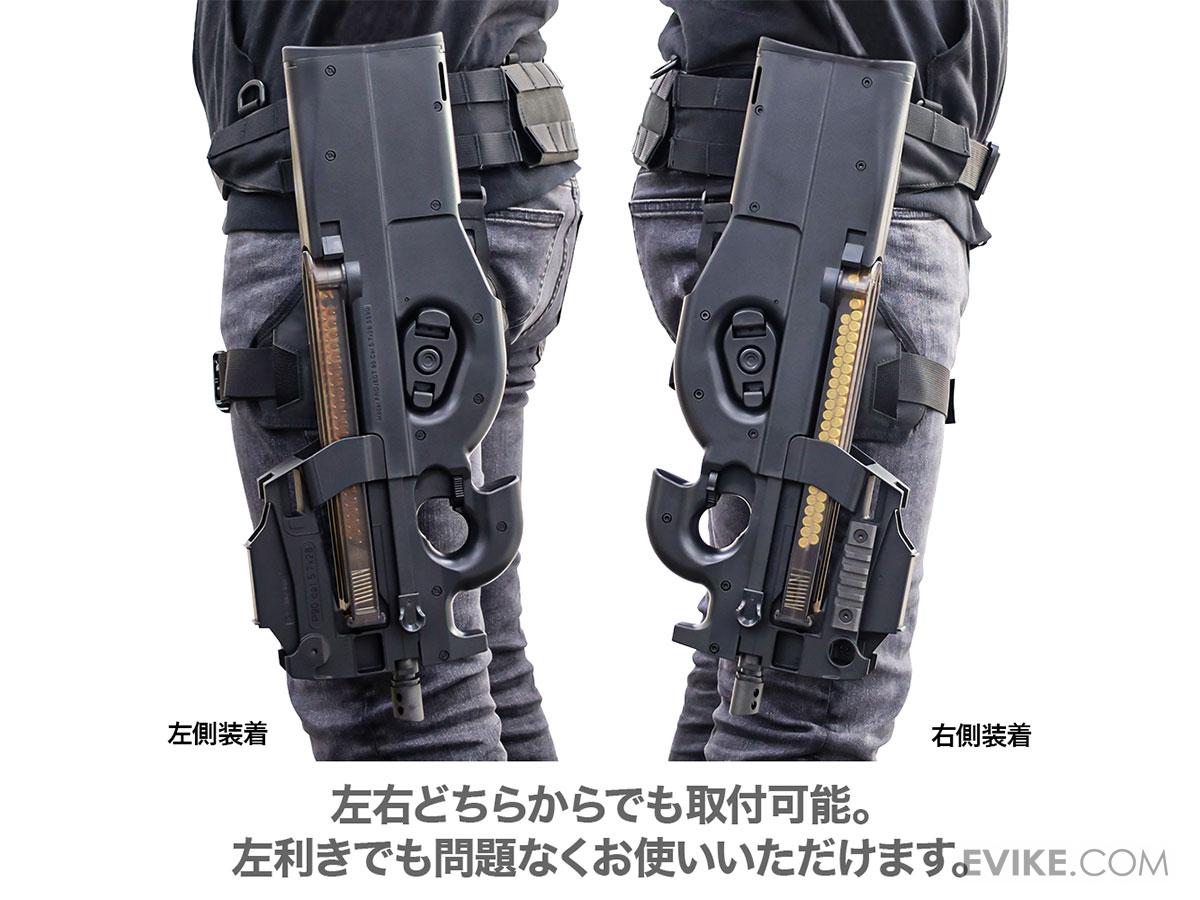 Handguns are much better at this. lol |