



|
Originally Posted By spydercomonkey: I think an interesting angle is that the P365 - striker, no trigger dingus, modular, sig, sold in the millions as well, likely carried in shittier holsters - is not reporting these same issues. Well the 365 has a simpler less convoluted striker safety (much like Glock) and by all accounts is a safe and very reliable handgun. That said it is not your typical “duty” weapon and exposed to the same conditions that “duty” forearms are. Would that make a difference in the 365? IDK, but doubt it due to design. That SIG can make a good handgun is not in question…but it seems they have painted themselves into a corner with the 320 as far as reputation and liability goes. |
“You either know and understand history or you trust the government. You can’t do both”

|
Originally Posted By scottrh2: Well the 365 has a simpler less convoluted striker safety (much like Glock) and by all accounts is a safe and very reliable handgun. That said it is not your typical “duty” weapon and exposed to the same conditions that “duty” forearms are. Would that make a difference in the 365? IDK, but doubt it due to design. That SIG can make a good handgun is not in question…but it seems they have painted themselves into a corner with the 320 as far as reputation and liability goes. To be perfectly honest, even if a trusted independent expert comes out and manages to unquestionably prove that it was all user error and the P320 is a perfect design... SIGs response so far on the 320 and the apparent peculiarities with how SIG has dominated the .mil contracts has already damaged their brand for me. This from someone who has loved SIG products for quite a while now. |
"Always consider the possibility that you may be wrong. Especially when you are absolutely certain you are right."

|
ALL of this, IMHO, is related to the pretensioned striker that Sig uses to produce the "better trigger pull" compared to Glock that Sig was touting. So we all know with a striker pistol, the cycle (generically) of firing it by pulling the trigger is such that the first part of that pull is the striker being pulled rearward, building spring tension so when the sear releases the firing pin is pushed forward into the primer. Glock at rest does not have enough tension to hit the primer even if you released all the safeties and let it sit like a series 70 1911. With the p320, Sig put that striker under spring tension to reduce the effort to pull the spring into full firing position. If you released all the internal passive safeties, that firing pin can hit the primer and cause a discharge. Therefore, the theory I roll with on this one is that there is some kind of mechanical failure with the passive safety system COMBINED with the pre-tensioned striker spring causing the firing pin to move without the user deciding to pull the trigger. |
|
Originally Posted By fla556guy: ALL of this, IMHO, is related to the pretensioned striker that Sig uses to produce the "better trigger pull" compared to Glock that Sig was touting. So we all know with a striker pistol, the cycle (generically) of firing it by pulling the trigger is such that the first part of that pull is the striker being pulled rearward, building spring tension so when the sear releases the firing pin is pushed forward into the primer. Glock at rest does not have enough tension to hit the primer even if you released all the safeties and let it sit like a series 70 1911. With the p320, Sig put that striker under spring tension to reduce the effort to pull the spring into full firing position. If you released all the internal passive safeties, that firing pin can hit the primer and cause a discharge. Therefore, the theory I roll with on this one is that there is some kind of mechanical failure with the passive safety system COMBINED with the pre-tensioned striker spring causing the firing pin to move without the user deciding to pull the trigger. Glocks have a lighter trigger pull than a P320, fwiw. |

|
Originally Posted By darkpaladin1: even if a trusted independent expert comes out and manages to unquestionably prove that it was all user error and the P320 is a perfect design... Then they still have a design prone to UD. Imagine if 1911 did not have a manual safety, and folks carried it cocked. There would be a lot of UDs. This is where the P320 is if there is if Sig is correct and there is no mechanical failure. |

|
Originally Posted By Oldgold: Title says there is no root cause. I think it is basically a single action pistol (striker is pre-cocked), and the AF was carrying it safety off, as if it was a double action pistol. Most 320s don't have a safety. FBI report is a sample of 1 and so likely doesn't reflect the .1%, or less, of Sig 320s or M18s for which sear engagement is insufficient. Meaning it isn't a surprise that they don't have a conclusion. Sounds like sear engagement needs to be increased by a pretty huge degree to account for tolerance issues. Probably in Sig's min/max tolerance calculation, there is still enough sear engagement, but a dead Airman disagrees with their engineers. |

|
Originally Posted By Middlelength: I think it is basically a single action pistol (striker is pre-cocked), and the AF was carrying it safety off, as if it was a double action pistol. Most 320s don't have a safety. FBI report is a sample of 1 and so likely doesn't reflect the .1%, or less, of Sig 320s or M18s for which sear engagement is insufficient. Meaning it isn't a surprise that they don't have a conclusion. Sounds like sear engagement needs to be increased by a pretty huge degree to account for tolerance issues. Probably in Sig's min/max tolerance calculation, there is still enough sear engagement, but a dead Airman disagrees with their engineers. That makes a tremendous amount of sense. The simplest answer is usually the most correct (Occam's Razor). And yet, other than for 320's that are assembled with incorrect parts, this has not been the case. Even the FBI example has not demonstrated insufficient sear engagement. And thus the root cause of this mess continues to be elusive. |
|
Originally Posted By Middlelength: I think it is basically a single action pistol (striker is pre-cocked), and the AF was carrying it safety off, as if it was a double action pistol. Most 320s don't have a safety. FBI report is a sample of 1 and so likely doesn't reflect the .1%, or less, of Sig 320s or M18s for which sear engagement is insufficient. Meaning it isn't a surprise that they don't have a conclusion. Sounds like sear engagement needs to be increased by a pretty huge degree to account for tolerance issues. Probably in Sig's min/max tolerance calculation, there is still enough sear engagement, but a dead Airman disagrees with their engineers. 1. How do you know the AF carried or rather this particular airman had the safety off? Fact or assumption? 2. Being the safety does not block the sear or striker stop, why would the safety be in question? 3. The statement put out said the weapon was inside a retention holster (Safariland) and was not removed prior to discharge, which then killed the airman. 4. The FBI actually tested 2 M18s, per the report, and were able to get the same results with both handguns. |
“You either know and understand history or you trust the government. You can’t do both”
|
Originally Posted By scottrh2: 1. How do you know the AF carried or rather this particular airman had the safety off? Fact or assumption? 2. Being the safety does not block the sear or striker stop, why would the safety be in question? 3. The statement put out said the weapon was inside a retention holster (Safariland) and was not removed prior to discharge, which then killed the airman. 4. The FBI actually tested 2 M18s, per the report, and were able to get the same results with both handguns. Originally Posted By scottrh2: Originally Posted By Middlelength: I think it is basically a single action pistol (striker is pre-cocked), and the AF was carrying it safety off, as if it was a double action pistol. Most 320s don't have a safety. FBI report is a sample of 1 and so likely doesn't reflect the .1%, or less, of Sig 320s or M18s for which sear engagement is insufficient. Meaning it isn't a surprise that they don't have a conclusion. Sounds like sear engagement needs to be increased by a pretty huge degree to account for tolerance issues. Probably in Sig's min/max tolerance calculation, there is still enough sear engagement, but a dead Airman disagrees with their engineers. 1. How do you know the AF carried or rather this particular airman had the safety off? Fact or assumption? 2. Being the safety does not block the sear or striker stop, why would the safety be in question? 3. The statement put out said the weapon was inside a retention holster (Safariland) and was not removed prior to discharge, which then killed the airman. 4. The FBI actually tested 2 M18s, per the report, and were able to get the same results with both handguns. IRT #1 and #3: 1. The Air Force arming condition for a handgun is mag in, round in the chamber, weapon on fire. 3. The holster kit for the M18 comes with QLS forks and plates that let you pull the holstered pistol off the belt/thigh holster. |
|
Originally Posted By Sheepdog324: IRT #1 and #3: 1. The Air Force arming condition for a handgun is mag in, round in the chamber, weapon on fire. 3. The holster kit for the M18 comes with QLS forks and plates that let you pull the holstered pistol off the belt/thigh holster. 3. Pistol was in holster. Holster was removed. Gun was not. Gun should not fire inside or outside with safety off or on. Your attempt at answering someone else’s question is lacking. If you feel you need to answer for him, address all 4. |
“You either know and understand history or you trust the government. You can’t do both”
Joined:
Dec 2022
Posts:
1310
EE: 100% (42)
 TX, USA
|
Originally Posted By aa777888-2: So we all know that the primary "conclusion" of the FBI report is: "However, testing did indicate with movements representing those common to a law enforcement officer it is possible to render the Striker Safety Lock inoperable and ineffective at preventing the striker from impacting a chambered round if complete sear engagement is lost." Where "movements..." are defined in the report as: "The weapon was pressed together and pulled apart (at the slide and frame)." (Per the report these manipulations were done while the weapon was holstered.) and "the sear was (then) released from the primary notch." I'm assuming this was done using a punch tool as previously described in the report. For crying out loud, this report is hopelessly incomplete. It does not identify any root cause(s), nor does it explain how any of this could happen. 1. In normal service, how does the sear get released without manipulating the trigger? People do not walk around poking their 320's in the ass with tools  2. While movement between the frame and slide is certainly going to happen all the time in normal service, how does this work to inactivate the Striker Safety Lock? For f*ck's sake, why did you stop the investigation at that point, FBI?  I've got no skin in this game. There's exactly one Sig pistol in the house, a P365 that belongs to my wife. But as an engineer and a pilot, in both cases expecting rigorous and complete investigations, the partial job that the FBI did is just bugging the crap out of me. Therefore, rather than post this is GD, I'm posting it here with the hope that perhaps some of you Sig armorer types might weigh in on how the two holes in the Swiss cheese could a) appear and b) line up. I don't believe it should be ANYONE'S JOB OTHER THAN SIG to determine the root cause of their own garbage pistol shooting on it's own and now killing someone too. My guess is they already know exactly what the problem(s) is and more than likely exactly how to fix it. The issue now is that they've backed themselves into a corner by claiming for years now that absolutely nothing is wrong with the guns. They'd have to admit they were full of shit that whole time for them to now come out and say they know what's wrong and/or have a fix. |
Joined:
Jul 2025
Posts:
8
EE: 0% (0)
USA
| In the end, it doesn't matter.....Folks are jumping-ship like crazy. All I have read of late is how horrible the Sig P320 series is and that no one trusts them anymore. That is very bad PR in anyone's book. Its all the talk at various local gunshops and online. Not a good look. |
Joined:
May 2025
Posts:
6
EE: 0% (0)
PA, USA
I wonder if these guys just figured it out. SIG P320 Un Commanded Discharge and its Repeatable |
|
Originally Posted By Franklin_18103: I wonder if these guys just figured it out.  https://www.youtube.com/watch?v=jOMQOtOQoPk https://www.youtube.com/watch?v=jOMQOtOQoPkThat is a lot of slide play. None of my guns (any Brand) have that much. |
|
Originally Posted By Franklin_18103: I wonder if these guys just figured it out. That video is very interesting. Far more interesting than the FBI report. But, sadly, it still doesn't "figure it out". Consider that that much slide-to-frame movement is not at all unusual for a Glock, and perhaps other designs as well. I just measured mine, a Gen 2 G23, and its got 1mm of movement at the front, and about 0.5 at the back. And the design does pull the slide down at the rear when the trigger is pressed, just like the 320. Also, when the trigger pre-travel is taken out of any striker fired pistol I can think of, at that point all striker blocks are disabled. This is certainly true of Glocks and Sigs. So neither of those issues is particularly noteworthy. However, the fact that movement of the slide relative to the frame can cause sear release when sear engagement is reduced in the manner shown in the video, that IS concerning. I just tried this with a couple of Glocks and couldn't get them to behave that way. Nevertheless... Even stipulating that this is a poor and/or marginal design, and it certainly is, it still requires significant trigger movement to cause a discharge. Therefore that hardly qualifies as an "uncommanded discharge". If we assume that the various "unwanted discharges" are caused by the scenario and conditions shown in the video, this begs the question: How did the trigger become pressed to the rear so far as to make normal (and it is totally normal) slide-to-frame movement cause the discharge? If the trigger is protected by a proper holster, and by "proper" I mean the trigger remains in a fully forward condition, even this "shitty design" should not be subject to "uncommanded discharges". Thus the Sig P320 debacle continues to be unsolved.
|
Joined:
Dec 2022
Posts:
1318
EE: 100% (42)
TX, USA
|
Originally Posted By RenegadeX: That is a lot of slide play. None of my guns (any Brand) have that much. lol I’ve handled plenty of P320’s that have that much slop. The guns are garbage. I’ve always been of that mindset since the guns were released well before everyone jumped on the hate train. |

Moderate-Length Barrel Evangelist
Joined:
Jun 2022
Posts:
4491
EE: 100% (11)
USA
|
Originally Posted By TactiCoolBro: lol I’ve handled plenty of P320’s that have that much slop. The guns are garbage. I’ve always been of that mindset since the guns were released well before everyone jumped on the hate train. |

|
The Michigan State Police are the ones that prompted the FBI report. They sent the gun to the FBI for testing. As of 7/16/25 [last week]: SIG SAUER P320/M18 and P365 Fielded by the Michigan State Police SIG SAUER, Inc. is proud to announce the Michigan State Police has fully transitioned their agency to the SIG SAUER P320/M18 pistol with a SIG ROMEO-M17 optic and FOXTROT2R light as their issued primary handgun system and the SIG SAUER P365 as their secondary firearm. “We are proud the Michigan State Police chose SIG SAUER as its primary and secondary sidearm,” began Tom Jankiewicz, Executive Vice President, Law Enforcement Sales for SIG SAUER, Inc. “The Michigan State Police conducted an exhaustive testing process to determine the selection of SIG SAUER pistols.” |
Some people shouldn't own boats. -Hollister
Here's an excellent roll-up of the various possible failure modes. There's mention of the swiss cheese safety model, too  Obviously, the first, and largest "hole" in the swiss cheese is: 1. The basic design of the fire control system, which makes it vulnerable to the remaining "holes". FWIW, I'm hypothesizing that the vast majority, if not all, of the actual un-commanded discharges are due to lack of cleaning, thereby causing the following additional holes to appear: 2. The striker block lever being stuck in the deactivated position. 3. Fouling and debris accumulating in the sear/striker hook engagement area. Combine those with normal slide-to-frame movement when the pistol is being carried or handled and it's a time-bomb with a random timer.  All of the Sig P320 problems, collected Disclaimers: tolerance stacking may be a distant 4th factor, and I am not counting the use of the wrong takedown lever. eta: spelling mistake |
|
Originally Posted By roninsan: I keep reading about SIGs and it reminds me of when Glocks came out. How many people shot themselves with those? I also remember after the Army adopted the Beretta all I heard about was the slide failures killing the shooter. I own samples of all the pistols mentioned and no, I've never had any of them discharge on their own. I've never seen slides come apart, or any of the other failures people were claiming. I have seen people pull the trigger on a Glock and low and behold it went bang. And damn if they didn't throw the thing down and swear it went off on its own. I'm not saying shit don't happen, nor am I saying anyone here making an argument is wrong. I'm just saying when humans interact with inanimate objects, shit happens. I remember in Camp Speicher the rules were when you rolled in the front gate, everyone had to download their weapons, point the thing into a barrel and PULL THE TRIGGER so the hammer would be down. Go ahead, guess how many ADs I saw. Every. Single. Day. Conversely at Marine bases they carried weapons hot on the base and guess how many ADs I saw there? Is there an issue with the SIG? IDK. I don't trust the word of the FBI on the color of the sky so I don't care about their report. Nor would I trust SIGs report. Nor the Army. It's the independent testing group that doesn't have an interest in the case, and MAYBE I'll believe them. In the meantime, I'm going to keep shooting all my "inherently dangerous" Beretta, Glock and SIG and continue safe weapons handling practices. Hopefully none of my guns will shoot me when I'm not looking. The big difference between SIG and how Beretta and Glock handled is was the attitude. Beretta and Glock both said something to the effect of, "that should not have happened, let's figure out why it did and find a solution." In Glock's case it was 100% a user problem, but they developed the NY trigger anyways and offered free retrofits. For Beretta it was a double factor of a weak batch of steel in the slides and testing done with +P+ ammo the gun was not designed to handle at all. Tossed the suspect steel and made a small change to the slid to retain the rear in case of a complete fracture. SIG is behaving like a company that knows exactly what's gone wrong and is trying to avoid the endless train of liability lawsuits because they don't really have an economical way to fix the problem. Even if that's not true, they're giving people the perception that it is. It should be remembered that Remington was run into bankruptcy over the model 700's trigger with far fewer documented cases and many fewer injuries. |
Vintage Ain't Retro.
|
Originally Posted By Z09SS: The big difference between SIG and how Beretta and Glock handled is was the attitude. Beretta and Glock both said something to the effect of, "that should not have happened, let's figure out why it did and find a solution." In Glock's case it was 100% a user problem, but they developed the NY trigger anyways and offered free retrofits. For Beretta it was a double factor of a weak batch of steel in the slides and testing done with +P+ ammo the gun was not designed to handle at all. Tossed the suspect steel and made a small change to the slid to retain the rear in case of a complete fracture. SIG is behaving like a company that knows exactly what's gone wrong and is trying to avoid the endless train of liability lawsuits because they don't really have an economical way to fix the problem. Even if that's not true, they're giving people the perception that it is. It should be remembered that Remington was run into bankruptcy over the model 700's trigger with far fewer documented cases and many fewer injuries. Originally Posted By Z09SS: Originally Posted By roninsan: I keep reading about SIGs and it reminds me of when Glocks came out. How many people shot themselves with those? I also remember after the Army adopted the Beretta all I heard about was the slide failures killing the shooter. I own samples of all the pistols mentioned and no, I've never had any of them discharge on their own. I've never seen slides come apart, or any of the other failures people were claiming. I have seen people pull the trigger on a Glock and low and behold it went bang. And damn if they didn't throw the thing down and swear it went off on its own. I'm not saying shit don't happen, nor am I saying anyone here making an argument is wrong. I'm just saying when humans interact with inanimate objects, shit happens. I remember in Camp Speicher the rules were when you rolled in the front gate, everyone had to download their weapons, point the thing into a barrel and PULL THE TRIGGER so the hammer would be down. Go ahead, guess how many ADs I saw. Every. Single. Day. Conversely at Marine bases they carried weapons hot on the base and guess how many ADs I saw there? Is there an issue with the SIG? IDK. I don't trust the word of the FBI on the color of the sky so I don't care about their report. Nor would I trust SIGs report. Nor the Army. It's the independent testing group that doesn't have an interest in the case, and MAYBE I'll believe them. In the meantime, I'm going to keep shooting all my "inherently dangerous" Beretta, Glock and SIG and continue safe weapons handling practices. Hopefully none of my guns will shoot me when I'm not looking. The big difference between SIG and how Beretta and Glock handled is was the attitude. Beretta and Glock both said something to the effect of, "that should not have happened, let's figure out why it did and find a solution." In Glock's case it was 100% a user problem, but they developed the NY trigger anyways and offered free retrofits. For Beretta it was a double factor of a weak batch of steel in the slides and testing done with +P+ ammo the gun was not designed to handle at all. Tossed the suspect steel and made a small change to the slid to retain the rear in case of a complete fracture. SIG is behaving like a company that knows exactly what's gone wrong and is trying to avoid the endless train of liability lawsuits because they don't really have an economical way to fix the problem. Even if that's not true, they're giving people the perception that it is. It should be remembered that Remington was run into bankruptcy over the model 700's trigger with far fewer documented cases and many fewer injuries. I think the 700 and .17HMR recalls contributed to Remington's bankruptcy, but wasn't the direct cause. |
I sell firearms produced by the finest child labor in the world, be it Filipino, Muslim, Mormon, Arizonan, or Texan.
|
Originally Posted By Z09SS: SNIP SIG is behaving like a company that knows exactly what's gone wrong and is trying to avoid the endless train of liability lawsuits because they don't really have an economical way to fix the problem. Even if that's not true, they're giving people the perception that it is. SNIP. The above right there. I love my SIG products and have a P320 myself. How they have reacted to all of this makes me suspicious and makes me relook at a lot of things I would have normally just trusted them over. As I had said further up, someone could come out and conclusively prove that the gun is flawless and it was all user error, but the damage is already done; much of which was by their own behavior. Speculation on my part: I don't think they even know what is causing the issue, but there is clearly some kind of issue that they should have been taking more seriously. |
"Always consider the possibility that you may be wrong. Especially when you are absolutely certain you are right."

|
Originally Posted By Screwball: Striker block is superior in the P365 than the P320. P365 is more common, similar to Glock and other designs. The P320… not as much. Yeah, the P365 is what the P320 should have been all along. I just wish it had an ambidextrous slide catch and it would be perfect. Granted, that level of modularity isn't important for a military issue pistol. The only modularity a standard issue military sidearm needs is to take a flashlight, with separate slides available for highly trained people and units who want red dots. |
|
Originally Posted By Sundowner08L: I am not that familiar with the 320, but my son has one and I am concerned. I think they do not come with a mechanical safety, does adding a mechanical safety prevent these NCD events from occurring? The standard P320 does not (except for maybe some variants). The M18 does. Since nobody is certain what is causing these incidents yet any answer to your last question would unfortunately be speculation at this time. |
"Always consider the possibility that you may be wrong. Especially when you are absolutely certain you are right."

|
Originally Posted By Sundowner08L: I am not that familiar with the 320, but my son has one and I am concerned. I think they do not come with a mechanical safety, does adding a mechanical safety prevent these NCD events from occurring? Dont keep a round in the chamber and it wont go off. As of right now thats about the only sure fix to the UD issues. |
"Life is Hard, its Harder if You're Stupid" - John Wayne
|
Originally Posted By Sundowner08L: I am not that familiar with the 320, but my son has one and I am concerned. I think they do not come with a mechanical safety, does adding a mechanical safety prevent these NCD events from occurring? No. The manual safety on the 320/M17/18 only locks the trigger, not the sear. If you look at the Marine Corps report on the Japanese contract guard, there's a UD from a holstered gun on safe. |
I sell firearms produced by the finest child labor in the world, be it Filipino, Muslim, Mormon, Arizonan, or Texan.

I saw this earlier today. I think it actually helps the convo along in a positive manner. 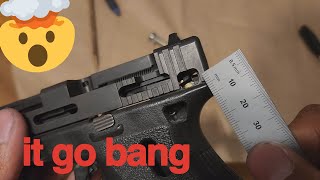 Glock "Uncommanded Discharge" w/ Cutaway Demonstration @IvanPrintsGuns (Sig P320 Pt 1) |
|
Originally Posted By NaCl: I saw this earlier today. I think it actually helps the convo along in a positive manner. https://www.youtube.com/watch?v=OaV32HarnRYBrilliant! All honor to that dude! I had thought about doing this myself with the many Glocks I have around here, but I simply didn't have the time since the Wyoming dude's video came out (many excuses like business travel followed almost immediately by vacation travel  ) )Bottom line: Poking a 320 in the ass with a tool proves NOTHING. Pulling the trigger back until the sear practically releases proves NOTHING. All my Glocks have substantial slide-to-frame movement. Slide-to-frame movement proves NOTHING. HOWEVER...before you all attack me, I've already posted above what I think the problem is, and it has to do with how vulnerable the 320 design is to lack of cleaning. When dirt and fouling starts to prevent the movement of things that should move (striker safety lever), and produce movement in things that shouldn't move (sear engagement), that is a real issue. Properly design weapons that are dirty beyond acceptable levels should fail by NOT firing, as opposed to fail by FIRING. |
Joined:
Dec 2022
Posts:
1331
EE: 100% (42)
TX, USA
|
Originally Posted By aa777888-2: Brilliant! All honor to that dude! I had thought about doing this myself with the many Glocks I have around here, but I simply didn't have the time since the Wyoming dude's video came out (many excuses like business travel followed almost immediately by vacation travel )Bottom line: Poking a 320 in the ass with a tool proves NOTHING. Pulling the trigger back until the sear practically releases proves NOTHING. All my Glocks have substantial slide-to-frame movement. Slide-to-frame movement proves NOTHING. HOWEVER...before you all attack me, I've already posted above what I think the problem is, and it has to do with how vulnerable the 320 design is to lack of cleaning. When dirt and fouling starts to prevent the movement of things that should move (striker safety lever), and produce movement in things that shouldn't move (sear engagement), that is a real issue. Properly design weapons that are dirty beyond acceptable levels should fail by NOT firing, as opposed to fail by FIRING. C O P E |

|
ETA: not gd. Edited. Originally Posted By aa777888-2: Brilliant! All honor to that dude! I had thought about doing this myself with the many Glocks I have around here, but I simply didn't have the time since the Wyoming dude's video came out (many excuses like business travel followed almost immediately by vacation travel )Bottom line: Poking a 320 in the ass with a tool proves NOTHING. Originally Posted By aa777888-2: Originally Posted By NaCl: I saw this earlier today. I think it actually helps the convo along in a positive manner. https://www.youtube.com/watch?v=OaV32HarnRY)Bottom line: Poking a 320 in the ass with a tool proves NOTHING. Originally Posted By aa777888-2: Pulling the trigger back until the sear practically releases proves NOTHING. Does the timing of mechanical events matter? Originally Posted By aa777888-2: All my Glocks have substantial slide-to-frame movement. Slide-to-frame movement proves NOTHING. Does it matter if the slide to body fit allows enough movement of the striker to make it disconnect from the sear totally? Should we find out under what conditions those tolerances matter? Originally Posted By aa777888-2: HOWEVER...before you all attack me, I've already posted above what I think the problem is, and it has to do with how vulnerable the 320 design is to lack of cleaning. When dirt and fouling starts to prevent the movement of things that should move (striker safety lever), and produce movement in things that shouldn't move (sear engagement), that is a real issue. Properly design weapons that are dirty beyond acceptable levels should fail by NOT firing, as opposed to fail by FIRING. Properly designed weapons shouldn't go off with their guts full of mud and one in the chamber and you move the slide around. It is good that you do realize that the sear and striker leg being an open V to the back of the gun and surrounded by "walls" that can hold crud and junk in there is a bad thing. |
|
Another scientific test. https://www.youtube.com/watch?v=z_vu2xEN7kA |

|
Uh huh. and "that's not graphite on the roof, you are mistaken, that's concrete." Point being, they are going off. we've seen ot too many times. Explanation already given a million times - safety sear not engaging reliably. Main sear has very little engagement surface, and when fouled can accumulation vibrate walk, and then release. The repitability of that under controlled conditions is always going to be spotty. What combination of whar age of gummed oils and powdered donut sugar and lint and vibrations will cause that sear face engagement to walk and stay slipped and slip a little more from there and BAM! (?) At what temperature and vibration behavior? Most people would think that couldn't happen, but with weak enough springs, enough fouling, enough suurface wear changing thr engagement angle, and sloppy enough tolerances, here we are. Who knows the case, at this point, the burden of proof is no longer on WHY the gun is doing it, to deem it unsafe. The burden of proof is now on WHY it can't do that anymore from what changes, for it to be deemed safe again. We already have proven the safety sear doesn't always engage, why is it so fantastic to think the main sear will also have issue? Just look at the frame compone ts of the FCU, the relevant parts are tiny. |
|
If the sear is floating, then why isnt the sear staying engaged when the slide moves up or down a little? My sear is pushing my slide UPWARDS with decent pressure. No mag inserted. The striker leg doesnt have any up/down play. So all play comes from the floating sear and how well its linked to the trigger bar. The only way pulling the slide upwards would cause the sear to let go is if the sear was FULLY up in its range and the striker leg was short. It is certainly possible but mine doesnt not exhibit that. My striker leg looks plenty long and like I said it looks like it interfaces strongly with the sear. So much it is pushing the slide UP to its limit. Hence when I pull the trigger, the slide gets pulled down before the sear starts moving off the striker leg. If the sear was directly and permanently fixed to the trigger bar, you may not get any sear compensation. But its not because the OOB mechanism disconnects the trigger bar from the sear. So there is some play to allow this to happen. But like I said, if the striker leg is on the short side, the sear is fully maxed in it's upward position, and this has reduced the engineered sear to striker distance, you could get the striker to slip. Maybe you could grind down the striker leg to illustrate it. |

|
Originally Posted By aa777888-2: Brilliant! All honor to that dude! I had thought about doing this myself with the many Glocks I have around here, but I simply didn't have the time since the Wyoming dude's video came out (many excuses like business travel followed almost immediately by vacation travel )Bottom line: Poking a 320 in the ass with a tool proves NOTHING. Pulling the trigger back until the sear practically releases proves NOTHING. All my Glocks have substantial slide-to-frame movement. Slide-to-frame movement proves NOTHING. HOWEVER...before you all attack me, I've already posted above what I think the problem is, and it has to do with how vulnerable the 320 design is to lack of cleaning. When dirt and fouling starts to prevent the movement of things that should move (striker safety lever), and produce movement in things that shouldn't move (sear engagement), that is a real issue. Properly design weapons that are dirty beyond acceptable levels should fail by NOT firing, as opposed to fail by FIRING. Originally Posted By aa777888-2: Originally Posted By NaCl: I saw this earlier today. I think it actually helps the convo along in a positive manner. https://www.youtube.com/watch?v=OaV32HarnRYBrilliant! All honor to that dude! I had thought about doing this myself with the many Glocks I have around here, but I simply didn't have the time since the Wyoming dude's video came out (many excuses like business travel followed almost immediately by vacation travel )Bottom line: Poking a 320 in the ass with a tool proves NOTHING. Pulling the trigger back until the sear practically releases proves NOTHING. All my Glocks have substantial slide-to-frame movement. Slide-to-frame movement proves NOTHING. HOWEVER...before you all attack me, I've already posted above what I think the problem is, and it has to do with how vulnerable the 320 design is to lack of cleaning. When dirt and fouling starts to prevent the movement of things that should move (striker safety lever), and produce movement in things that shouldn't move (sear engagement), that is a real issue. Properly design weapons that are dirty beyond acceptable levels should fail by NOT firing, as opposed to fail by FIRING. The lowest common denominator is always the end user. Banking on the fact that most users are not going to clean their P-320 should be a given. Reputation is everything in the gun world and no amount of PR is going to save the P-320. I just don’t see how Sig can overcome this. |
“Evil is powerless if the good are unafraid.” Ronald Reagan
|
Originally Posted By FlashMan-7k: ETA: not gd. Edited. Originally Posted By FlashMan-7k: ETA: not gd. Edited.  As the OP, I had intended for this topic to be highly technical in nature, which is why I posted it here and not in GD, but that's hard to do even in a tech forum with emotions running so high. Disconnecting the sear with the trigger not moving and not pulled at all to see if the striker safety lever works shows you if the striker saftey lever works or not. Except for showing when the striker safety lever is disengaged during the pull and showing how, if you have pulled the trigger 1mm past the wall, and you bump the slide, the gun can go off. Does the timing of mechanical events matter? The striker is located in the slide, and up and down movement of the slide related to the grip and body of the gun can (design dependent) pull the striker leg away from the sear in striker guns. Does it matter if the slide to body fit allows enough movement of the striker to make it disconnect from the sear totally? Should we find out under what conditions those tolerances matter? Where the 320 design is weak is: a) The sear surface can be physically moved (by poking it with a tool) even when the trigger is fully forward (effectively impossible in the Glock design due to the design of the drop safety feature). b) The sear/hook engagement area is not physically protected from dirt and debris to the degree it is on other pistol designs, thereby providing an opportunity for dirt and debris to interfere with proper sear engagement even with the trigger fully forward. I.e. it's not a slide-to-frame tolerancing issue, and it's not a tolerance stacking issue in the FCS components, although at certain tolerance stack-ups the problem would require less contamination of FCS surfaces. It's the vulnerability of the 320 FCS design to dirt, debris, fouling, etc. Properly designed weapons won't go off because the slide moves when you're reholstering them and you haven't cleaned them in forever. Properly designed weapons shouldn't go off with their guts full of mud and one in the chamber and you move the slide around. It is good that you do realize that the sear and striker leg being an open V to the back of the gun and surrounded by "walls" that can hold crud and junk in there is a bad thing. As written in by me in Post #1 of this thread, I was looking for the engineering and scientific root cause of the problem, not a bunch of hand waving. At this point the root cause that seems most likely is the FCS vulnerability to contamination, both in the striker safety lever area and the sear engagement area. It might be worth noting that adding a trigger safety a la Glock (aka "dingus") will not fix this problem. Sig would have to add features to, at a minimum, the trigger bar and sear, whereby any sear movement is completely prevented with the trigger fully forward. |
| Air Force makes arrest in airman’s shooting death involving M18 pistol |
President’s Hundred Rifle (2022-2024)
U.S Army Distinguished Rifle (2024)
U.S. Army Distinguished Pistol Shot (2015)
"No man is entitled to the blessings of freedom unless he be vigilant in its preservation." ~ General Douglas MacArthur
U.S Army Distinguished Rifle (2024)
U.S. Army Distinguished Pistol Shot (2015)
"No man is entitled to the blessings of freedom unless he be vigilant in its preservation." ~ General Douglas MacArthur
|
Originally Posted By eaglecp: Air Force makes arrest in airman’s shooting death involving M18 pistol Attached File Not 100% surprised that someone lied after someone died. Does that mean there is not some situations where an AD/UD could not have happened else where? Not completely convinced one way or another. Smarter folks with more skills are still looking for answers to that question. |
|
Just checking in. No more updates for a root cause? New sear/disco/striker design or anything at all from Sig or any one else? I have two 320's that I've taken out of rotation until there's something I can check or there are parts to swap. Last I looked into it, it was a thought to pull the slide all the way back when installing the takedown, not just the partial pull back to align the hole and put it in. Not sure if that was a myth or not. |
|
Originally Posted By BravoSierra: Just checking in. No more updates for a root cause? New sear/disco/striker design or anything at all from Sig or any one else? I have two 320's that I've taken out of rotation until there's something I can check or there are parts to swap. Last I looked into it, it was a thought to pull the slide all the way back when installing the takedown, not just the partial pull back to align the hole and put it in. Not sure if that was a myth or not. I haven't personally looked all that hard, but the from casual observation a lot of the screeching stopped as soon as it came out that the Airman died due to dumbassery rather than hardware failure. I'm still on the fence, but as of yet I've seen no new news. |
"Always consider the possibility that you may be wrong. Especially when you are absolutely certain you are right."
|
Originally Posted By aa777888-2: Where the 320 design is weak is: a) The sear surface can be physically moved (by poking it with a tool) even when the trigger is fully forward (effectively impossible in the Glock design due to the design of the drop safety feature). b) The sear/hook engagement area is not physically protected from dirt and debris to the degree it is on other pistol designs, thereby providing an opportunity for dirt and debris to interfere with proper sear engagement even with the trigger fully forward. I.e. it's not a slide-to-frame tolerancing issue, and it's not a tolerance stacking issue in the FCS components, although at certain tolerance stack-ups the problem would require less contamination of FCS surfaces. It's the vulnerability of the 320 FCS design to dirt, debris, fouling, etc. I think what I've already written shows we are in sync on those topics. At this point the root cause that seems most likely is the FCS vulnerability to contamination, both in the striker safety lever area and the sear engagement area. It might be worth noting that adding a trigger safety a la Glock (aka "dingus") will not fix this problem. Sig would have to add features to, at a minimum, the trigger bar and sear, whereby any sear movement is completely prevented with the trigger fully forward. Originally Posted By aa777888-2: Where the 320 design is weak is: a) The sear surface can be physically moved (by poking it with a tool) even when the trigger is fully forward (effectively impossible in the Glock design due to the design of the drop safety feature). b) The sear/hook engagement area is not physically protected from dirt and debris to the degree it is on other pistol designs, thereby providing an opportunity for dirt and debris to interfere with proper sear engagement even with the trigger fully forward. I.e. it's not a slide-to-frame tolerancing issue, and it's not a tolerance stacking issue in the FCS components, although at certain tolerance stack-ups the problem would require less contamination of FCS surfaces. It's the vulnerability of the 320 FCS design to dirt, debris, fouling, etc. Properly designed weapons won't go off because the slide moves when you're reholstering them and you haven't cleaned them in forever. Properly designed weapons shouldn't go off with their guts full of mud and one in the chamber and you move the slide around. It is good that you do realize that the sear and striker leg being an open V to the back of the gun and surrounded by "walls" that can hold crud and junk in there is a bad thing. At this point the root cause that seems most likely is the FCS vulnerability to contamination, both in the striker safety lever area and the sear engagement area. It might be worth noting that adding a trigger safety a la Glock (aka "dingus") will not fix this problem. Sig would have to add features to, at a minimum, the trigger bar and sear, whereby any sear movement is completely prevented with the trigger fully forward. |
"Cogito, ergo armatum sum."
|
Originally Posted By aa777888-2: The 320 FCS is vulnerable to contamination and probably also to parts wear. If a 320 is kept scrupulously clean, in good repair, and in a holster that fits properly, it's fine. If not, then all bets are off. This should be the case for ANY firearm. |

|
Originally Posted By BravoSierra: Last I looked into it, it was a thought to pull the slide all the way back when installing the takedown, not just the partial pull back to align the hole and put it in. Not sure if that was a myth or not. I'm guessing you know this and just misspoke, but the takedown lever is installed in the frame, through the FCU, before you put on the slide. Then you pull the slide back and rotate the lever 90 degrees back to horizontal. The difference between pulling the slide back enough to rotate the takedown lever and pulling it all the way back is about 1/16", maybe 3/32", and doesn't contact any part of the internal mechanism differently. I see reference to assembly steps like this (pulling the slide all the way back, raising the slide catch lever) that are supposedly connected with possible mechanical issues, and I don't understand most of them. It strikes me that some of the people commenting about these things (not you) haven't actually disassembled or reassembled a P320. When you reassemble the P320, you have to pull the slide all the way back (except for that 1/16") and lift the slide release lever to allow the take down safety lever to snap forward. If you don't do that step, the take down safety lever blocks the magazine well so you can't insert a magazine enough to seat it. |
|
Originally Posted By 3ACR_Scout: I'm guessing you know this and just misspoke, but the takedown lever is installed in the frame, through the FCU, before you put on the slide. Then you pull the slide back and rotate the lever 90 degrees back to horizontal. The difference between pulling the slide back enough to rotate the takedown lever and pulling it all the way back is about 1/16", maybe 3/32", and doesn't contact any part of the internal mechanism differently. I see reference to assembly steps like this (pulling the slide all the way back, raising the slide catch lever) that are supposedly connected with possible mechanical issues, and I don't understand most of them. It strikes me that some of the people commenting about these things (not you) haven't actually disassembled or reassembled a P320. When you reassemble the P320, you have to pull the slide all the way back (except for that 1/16") and lift the slide release lever to allow the take down safety lever to snap forward. If you don't do that step, the take down safety lever blocks the magazine well so you can't insert a magazine enough to seat it. Originally Posted By 3ACR_Scout: Originally Posted By BravoSierra: Last I looked into it, it was a thought to pull the slide all the way back when installing the takedown, not just the partial pull back to align the hole and put it in. Not sure if that was a myth or not. I'm guessing you know this and just misspoke, but the takedown lever is installed in the frame, through the FCU, before you put on the slide. Then you pull the slide back and rotate the lever 90 degrees back to horizontal. The difference between pulling the slide back enough to rotate the takedown lever and pulling it all the way back is about 1/16", maybe 3/32", and doesn't contact any part of the internal mechanism differently. I see reference to assembly steps like this (pulling the slide all the way back, raising the slide catch lever) that are supposedly connected with possible mechanical issues, and I don't understand most of them. It strikes me that some of the people commenting about these things (not you) haven't actually disassembled or reassembled a P320. When you reassemble the P320, you have to pull the slide all the way back (except for that 1/16") and lift the slide release lever to allow the take down safety lever to snap forward. If you don't do that step, the take down safety lever blocks the magazine well so you can't insert a magazine enough to seat it. The concern stems from the possibility the wrong caliber takedown safety lever can be installed in a 9mm FCU, allowing a 9mm magazine to be seated despite following a non-SIG specified reassembly procedure, leaving the striker set on a false sear, IIRC. |
I sell firearms produced by the finest child labor in the world, be it Filipino, Muslim, Mormon, Arizonan, or Texan.