


Posted: 8/26/2012 5:14:21 PM EDT
|
So I just recently bought a Glock 23 3rd Gen. As I field stripped it, I noticed that the trigger pull is a little longer and tougher to pull as compared to my Glock 19. Is there supposed to be a noticeable difference between the two trigger pulls within the two guns? Keep in mind, that this glock 23 was a police trade-in. There doesn't seem to be any trigger job done to it. If needed by, I can take pictures of the internals if anyone would like? And should I take it a gunsmith to check it out & will it cost any money for them to look at it? Any help is appreciated! Thanks!
NEW QUESTION. READ MY LAST POST! |
|
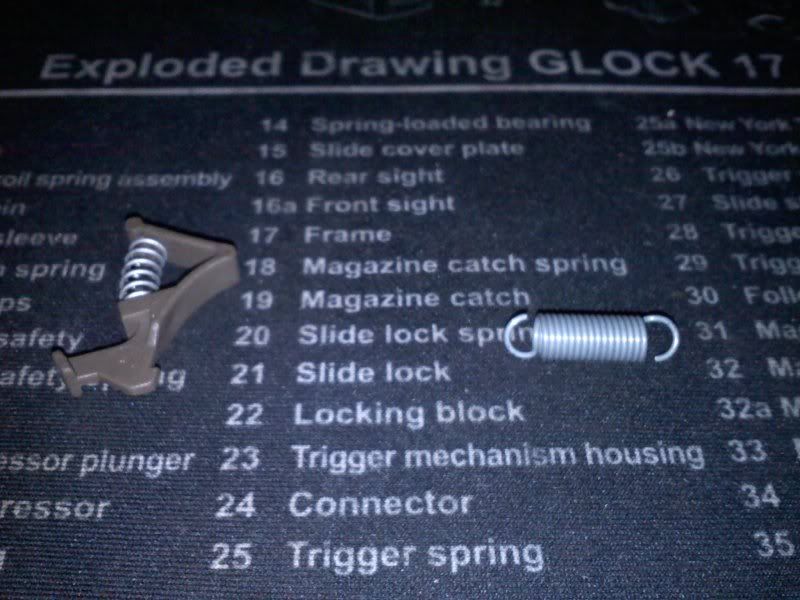
Look near the rear of the frame, from the top down. Underneath the "cruciform" should be a small spring. If you don't see a spring, you likely have a NY1 or NY2 trigger spring (actually a green or orange colored, wishbone-shaped piece of plastic), which will create a longer, heavier trigger pull (more like a DA revolver). The spring can be replaced with a stock Glock spring in about 5 minutes. Youtube has dozens of videos of how to disassemble a Glock frame and change springs/connectors.
OTOH, it could just be years of lint, dirt, and grime has collected in there. In either case, disassemble and clean everything, and then lube it. While you've got everything disassembled, you could also install an 3.5 lb. or 4.5 lb. connector (for a lighter pull weight) and/or polish the contact surfaces (i.e., the "25 cent trigger job"). I polished my internals and installed a Ranger 4.5 lb. connector, and it makes a nice difference in trigger pull weight and feel. |
|
Quoted:
Look near the rear of the frame, from the top down. Underneath the "cruciform" should be a small spring. If you don't see a spring, you likely have a NY1 or NY2 trigger spring (actually a green or orange colored, wishbone-shaped piece of plastic), which will create a longer, heavier trigger pull (more like a DA revolver). The spring can be replaced with a stock Glock spring in about 5 minutes. Youtube has dozens of videos of how to disassemble a Glock frame and change springs/connectors. OTOH, it could just be years of lint, dirt, and grime has collected in there. In either case, disassemble and clean everything, and then lube it. While you've got everything disassembled, you could also install an 3.5 lb. or 4.5 lb. connector (for a lighter pull weight) and/or polish the contact surfaces (i.e., the "25 cent trigger job"). I polished my internals and installed a Ranger 4.5 lb. connector, and it makes a nice difference in trigger pull weight and feel. http://i48.tinypic.com/290xwsz.jpg that's the spring right? So I should just clean it? I saw this youtube video posted up on here, should I follow what he does? http://www.youtube.com/watch?v=5czjj2-stYI&feature=plcp |
|
Quoted:
ARJJ is right on. If you see the green plastic spring (like on the left) replace it with the standard spring which is on the right. http://img.photobucket.com/albums/v338/schenninge/GUN%20STUFF/20101224094754.jpg in my picture that i posted up, it looks like that i already have the one on the right, so now that that's settled, it seems i would just need to clean the spring some, and that should ease up my trigger pull? |
|
UPDATE: So I just got done cleaning and polishing it. I put it back together. I try to dry fire it, and the trigger pull still is longer, and tougher.
I'll try to explain this the best way I can. For the first few milimeters into the squeeze, it's real light but when it gets to the very end of the trigger pull before it fires, there's a lot of tension and it just stops and it feels as if you need to add in a few extra pounds of force just to get it to pull all the way. The trigger pull at the end before it fires, actually feels like a double action of my old Sig which has a >10 lbs trigger pull. You guys think I need to buy a brand new spring? Or you guys think it might have to do with my striker and that I should disassemble my slide as well? |
|
Might make sense to give the striker channel a cleaning.
However, some new Glocks seem to have heavier trigger pulls than the old ones used to have. I got a newer one that had a heavier than regular pull. I replaced the standard connector with a seemingly identical standard connector and the trigger pull then felt like every other Glock I've got. I'm not saying that the problem is absolutely the connector as I've heard that some people have changed their trigger bars to fix their trigger pull. It seems, though, that there is something either different, or out of spec, between the mating of the trigger bar and the connector causing some Glocks to have heavier than normal trigger pulls. |
|
Quoted:
Might make sense to give the striker channel a cleaning. However, some new Glocks seem to have heavier trigger pulls than the old ones used to have. I got a newer one that had a heavier than regular pull. I replaced the standard connector with a seemingly identical standard connector and the trigger pull then felt like every other Glock I've got. I'm not saying that the problem is absolutely the connector as I've heard that some people have changed their trigger bars to fix their trigger pull. It seems, though, that there is something either different, or out of spec, between the mating of the trigger bar and the connector causing some Glocks to have heavier than normal trigger pulls. That's what I hear too, that the new ones have a heavier trigger pull. What I'm comparing my glock 23 is that the glock 23 is a 3rd Gen with a tough trigger pull. My glock 19 is ALSO a 3rd Gen. But that trigger pull is not near as heavy as the glock 23. But you're right, I should try disassembling the slide and clean that out, and then see if the trigger has any changes. If that doesn't work, what do you guys recommend I do? Take it to a gunsmith? |
|
I can't think of any reason to ever take a Glock to a gunsmith, unless you're having the slide milled or something that requires special talents and tools. I invested in a trigger pull scale many moons ago. I use aftermarket connectors in all my Glocks. I also polish all the mating surfaces in the firing mechanism. My Glocks' triggers pull from 2.75# to just under 4#.
Make sure that a drop of oil is on the mating surface of the connector and trigger bar, and make sure that you don't have a + connector. If I had to use any of the factory Glock connectors, I probably wouldn't own a Glock. I hate the factory Glock trigger pull. |
|
OP, the first few millimeters of trigger travel is gonna be lighter, as you are merely taking up the slack in the trigger. It should be stiffer toward the trigger break, but not uncomfortably so.
I can tell on my duty G22 (all stock/no polish) the trigger pull is quite a bit stiffer than my CCW G19 (4.5 connector/polish/Gen3 G17 trigger & trigger bar). It just takes a little more trigger control. If you'd like to experiment with different setups, you can buy a few connectors, springs, and a maybe a smooth G17 trigger and swap parts out 'til you find one you like. The Glock is easy enough to work on that you could do everything at the range, and shoot each combo as you swap things. 
|
|
Quoted:
I actually prefer the NY1 trigger spring and a 3.5lb connector on my Glocks. It does produce a smooth, consistent pull and has a strong reset.(Many folks liken it to a DA revolver trigger.) I personally thought the reset was a bit too strong. I might give it another shot, though.
|
|
Quoted:
OP, the first few millimeters of trigger travel is gonna be lighter, as you are merely taking up the slack in the trigger. It should be stiffer toward the trigger break, but not uncomfortably so. I can tell on my duty G22 (all stock/no polish) the trigger pull is quite a bit stiffer than my CCW G19 (4.5 connector/polish/Gen3 G17 trigger & trigger bar). It just takes a little more trigger control. If you'd like to experiment with different setups, you can buy a few connectors, springs, and a maybe a smooth G17 trigger and swap parts out 'til you find one you like. The Glock is easy enough to work on that you could do everything at the range, and shoot each combo as you swap things. This I understand, I have that exact feeling when I use my Glock 19 but my Glock 23, it is noticeably a lot stiffer of a pull. I don't know if it's just because it's a bigger caliber gun that my Glock 23 has such a hard pull; like you said "uncomfortably so". It pulls so hard that it almost feels like it's jammed or that it'll never fire but it does after at least 10 lbs or extra force is applied. It really just feels like it's stuck. My Glock 19 does feel tighter toward the end but not to where it's uncomfortable. The Glock 23 is just ridiculous. I even cleaned up the slide disassemble along with the frame disassemble and there's not much of a difference in trigger pull. 
|
|
Quoted:
I can't think of any reason to ever take a Glock to a gunsmith, unless you're having the slide milled or something that requires special talents and tools. I invested in a trigger pull scale many moons ago. I use aftermarket connectors in all my Glocks. I also polish all the mating surfaces in the firing mechanism. My Glocks' triggers pull from 2.75# to just under 4#. Make sure that a drop of oil is on the mating surface of the connector and trigger bar, and make sure that you don't have a + connector. If I had to use any of the factory Glock connectors, I probably wouldn't own a Glock. I hate the factory Glock trigger pull. Okay, so it's all right to add oil to those parts in the disassemble of the frame? I know that you aren't supposed to use any oil when it comes to the slide disassemble because you don't want any oil in the striker pin or any of the section. |
| Absolutely. If you oil nothing else on a Glock, oil the mating surface between the trigger bar and the connector. And no, don't take it to a gunsmith, we can fix this. It may cost you a couple bucks buying a spare trigger bar and spare connector to swap out and eliminate variables. That is, if you want to stick with the factory 5.5 lb trigger set-up (I do). If not, then you may be going with aftermarket stuff, or polishing stuff, anyway. |
|
Quoted: Quoted: I actually prefer the NY1 trigger spring and a 3.5lb connector on my Glocks. It does produce a smooth, consistent pull and has a strong reset.(Many folks liken it to a DA revolver trigger.) I personally thought the reset was a bit too strong. I might give it another shot, though. I did this too but I removed the metallic spring from the NY1 trigger.  I haven't and won't use this combination for carry, just the range. I won't consider it for carry for another year either. I have been using this combination for 11 months with no problems - yet. I'm not willing to risk my life on a untested trigger modification. I haven't and won't use this combination for carry, just the range. I won't consider it for carry for another year either. I have been using this combination for 11 months with no problems - yet. I'm not willing to risk my life on a untested trigger modification.  |
I'm sure there are some lube instructions somewhere. On a Glock, you don't just slather oil around like you might on some other pistols. You really only need four-five small drops of oil to properly oil a Glock. If the OP didn't put a drop of oil at the mating surface of the trigger bar and connector, then I'd suggest that he start there. I wouldn't want a revolver-like trigger pull on a Glock. To each his own, though. There's a reason it's called a "NY" spring! 
|
|
Quoted:
Absolutely. If you oil nothing else on a Glock, oil the mating surface between the trigger bar and the connector. And no, don't take it to a gunsmith, we can fix this. It may cost you a couple bucks buying a spare trigger bar and spare connector to swap out and eliminate variables. That is, if you want to stick with the factory 5.5 lb trigger set-up (I do). If not, then you may be going with aftermarket stuff, or polishing stuff, anyway. Awesome! Thanks, I definitely added a couple drops of oil here and there on the connector and other parts of the whole trigger contraption. I did feel a smoother pull after the first few dry fires but it kinda gets back to where it was intially. Quoted:
I'm sure there are some lube instructions somewhere. On a Glock, you don't just slather oil around like you might on some other pistols. You really only need four-five small drops of oil to properly oil a Glock. If the OP didn't put a drop of oil at the mating surface of the trigger bar and connector, then I'd suggest that he start there. I wouldn't want a revolver-like trigger pull on a Glock. To each his own, though. There's a reason it's called a "NY" spring! Yeah, I just applied some and tried it out. It helped somewhat. Also what someone else said on here, I researched it and they were right, usually some police trade in guns have heavier trigger pulls because their dept requires them too so that could also be a reason as to why my trigger pull is so damn stiff. But I try to compare my G23 and my G19 connectors and they look identical to me. Hmmmph. But since that whole 'police trade ins are usually heavier' I'll accept that. I've done the $.25 trigger job, I've meticulously cleaned out the slide disassemble, so it should all be down hill from there! Thank you all very much! I appreciate everything. Whenever I decide to go on ahead and buy the 3.5 lbs connector, I'll let you guys know! |

|
Quoted:
Quoted:
Quoted:
Make sure you don't have a + connector!! I use - connectors on all my Glocks. What's the difference in appearance so I could tell them apart? http://i47.tinypic.com/288w4d2.jpg Ahhhhhhhh... I see now. Thanks a lot man! That really clarified everything up. I don't recall seeing any + or - on the connector when I broke it down but I'll check it again to make sure. I couldn't thank y'all enough! |
|
Okay guys! I broke my G19 down, and I noticed it has the "-" connector so I decided I needed to get it for my G23!
I'm looking into lone wolf so I was going to buy THIS BUT as I was scrolling down, I saw this Now, do I have to get the kit? or can I just change out the connector and be fine? It already has that S spring in the G23. I wanna swap out the "+" connector and put a 3.5 on there. And another thing, I was at the range and I told a fellow range office about the 8 lbs trigger connector and that I was going to change it to a 3.5 and buy a new connector but he kept on insisting that I take it to a gun shop and get it done professionally because it's "cheaper" than doing it myself, and that if he screws up, it's on his dime whereas if I screw up, it's on my dime. Should I listen to him? I saw a youtube video of someone swapping out connectors and it didn't seem that hard at all, and I highly doubt that getting it done at a gunsmith is much cheaper than me just buying the parts myself and doing it myself. What do you guys think? |
| Do it yourself. With no previous Glock experience (other than shooting them) and the aid of the unofficial Glock armorer's manual (Google it) and some YouTube videos, I completely stripped and rebuilt the Gen 2 G19 I bought from Aim. I went with a standard trigger spring and dot connector, smooth G17 trigger, Vickers magazine release and slide stop lever, along with all of the other miscellaneous springs. |
|
Quoted:
Do it yourself. With no previous Glock experience (other than shooting them) and the aid of the unofficial Glock armorer's manual (Google it) and some YouTube videos, I completely stripped and rebuilt the Gen 2 G19 I bought from Aim. I went with a standard trigger spring and dot connector, smooth G17 trigger, Vickers magazine release and slide stop lever, along with all of the other miscellaneous springs. I was thinking I would do it myself, I saw the youtube video of how to switch out the connectors. It's pretty simple. I've done the .25 trigger job on it anyway, it's only one step farther from that trigger job. As for buying the connector though, should I still buy only the LW 3.5 connector, or buy the kit that comes with the extra springs??? I'm also buying the extended slide release and slide lock What do y'all prefer? Ghost or Lone Wolf for trigger connectors? I was set on Lone Wolf but Ghost has so many more buyers on here. Lone Wolf Package Ghost Package OR should I just not worry about that extra springs and buy the connector for around $10 |