


AR Sponsor
Posted: 8/21/2016 10:37:13 PM EDT
Had two case head separations in same magazine while shooting on Saturday. 5.56 chamber, shooting .223, rifle is overgassed and is likely over 10K rounds. Chamber passes field gauge but I do not have go/no-go. Ammunition is suspect (not naming mfg yet) though we have fired this stuff for years with no issues. At this point, should I bother spending $100 on go/no-go?

|
|
Generally when we see this it can be attributed to the headspace is too long, or fatigued casings from reloads. Life of a barrel could be 5-10K, but that depends upon a lot of variables like barrel material, finish (chrome, parkerized, nitrided, etc), slow fire vs rapid fire, ammunition used, cleaning methods (tools, solvents, and procedures used). When checking headspace, make sure your barrel and chamber are clean and free of lubrication & solvents, and remove the extractor & ejector for best feel. If you have access to a borescope, it wouldn't hurt to get a close up look at the inside of the chamber & barrel.
CY6 Greg Sullivan "Sully" SLR15 Rifles TheDefensiveEdge.com (763) 712-0123 |
| Thanks Sully, the bolt was stripped and wiped down prior to passing the field gauge, I don't have access to a borescope. The ammunition is factory reman, and is known for issues with other users here at arfcom. I just found it surprising that we experienced no issues for several thousand rounds and then had two failures back to back. I suppose I could have the chamber evaluated by a professional, but it would be less of a hassle to just replace barrel/bolt & dump the reman ammo. |
|
Since the ammunition is reloads, and the rifle passed when you gauged the rifle for Field on the headspace, it would probably be an ammunition problem where the casings are fatigued. There is a big difference between using a once fired casing for reloads, and a casing that you have no idea of its history. If nobody got hurt, and the rifle isn't damaged, then I would say stop using the ammunition and move on. You may wish to contact the ammunition manufacturer and let them know, and ask if they would replace or refund you for what ammunition you may have left.
CY6 Greg Sullivan "Sully" SLR15 Rifles TheDefensiveEdge.com (763) 712-0123 |
|
Factory reloads, not the end of the world.
Hence brass could have begun its life being shot out of a range M-249 with a worn out chamber (read wide as hell in the side wall dimension, but the armor has not got around to changing the barrel on it yet) to expand the side walls of the once fired brass way over them normal to begin with, then it was cleaned in a chemical solvent that makes the brass brittler, and by the time is was sized back down and reloaded again, the brass is going to separate/split when its fired again. If you get the ammo manufacturer on the phone to let them know of the problem (with the lot number of their reloaded rounds that did seperate), chance are they may do a recall on the lot if the problems are high enough, or if just a isolated instances, send you replacement ammo instead. But to weed out if if the rifle and not the ammo the problem as hand, mic a few spent case fired out of your rifle to make sure that your chamber does not have too long of head space, nor it side walls too wide isntead. Here is the spec's for factor 223 ammo, so measure up a couple spent case shot of your rifle and post what the differences are. Hence your spent case should only be a few thousands larger when they where fire formed to your chamber, and if you are in the .010" or larger dimensions on the spent cases, then your rifle (chamber) has the problems instead. 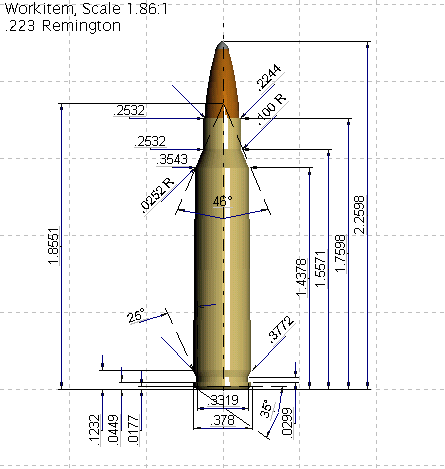
Note, pay close attention to the .3772 at the web section of the case just above the rim, to the .3543" at the start of the shoulder of the case. The web section should not expand, but the .3543" will. Hence you looking for the expansion of the case from the rim web section to the shoulder to still be tapered, and not a huge budge section at the middle of the case from your chamber (read someone tried to polish the chamber for some reason, and ending up with the middle of the chamber side walls belled isntead).. To add, a no go gauge will only tell you if the head spacing is correct (distances from bolt face to chamber shoulders) it too long. What is needed isntead if the head space is correct, if to check the side wall dimensions of the chamber next. I have a made a few gauges to check this in regards to standard and SBR chambers, but if you chamber is budge isntead, then something like a casting of the chamber may be needed isntead. |
|
Dano, of the two measurements you pointed out:
Base of fired cases (7 measured) average 0.3725 with no more than .003 deviation. Just below shoulder averages 0.3536 with no more than 0.0025 deviation. No excessive measurements noted with the two split casings, though the one is deformed just below the shoulder. We'll see what the mfg has to say about the lot. |
|
Remanufactured ammo uses recycles brass, none of which comes with a pedigree. There is no sure way for the company to insure against brass with 10+ reloadings entering their manufacturing stream.
The only brass I ever leave at my gun club is brass I consider toast. That means if someone else picks it up and reloads, sells or scraps it the end user has zero idea that I considered it junk. You probably got a couple rounds that were of that variety or the cases were resized way more than needed creating excessive ammunition headspace through the reloading operation. I use gauges when resizing brass and now know that die settings are not one size fits all. Some brass resizes more than other brands using identical die settings. Some resize less. I adjust accordingly. Remanufactured ammo companies do not have the ability to separate and check every brand of brass that goes through the plant. They set the die up to insure that every case gets sized enough even if some get resized too much. |
|
Quoted:
Had two case head separations in same magazine while shooting on Saturday. 5.56 chamber, shooting .223, rifle is overgassed and is likely over 10K rounds. Chamber passes field gauge but I do not have go/no-go. Ammunition is suspect (not naming mfg yet) though we have fired this stuff for years with no issues. At this point, should I bother spending $100 on go/no-go? http://i.imgur.com/aktIynO.jpg Military armorers only get a FIELD gauge in their kit. |
AR Sponsor