


AR Sponsor

Posted: 1/8/2015 6:28:10 PM EDT
|
Question...The two allen screws for my bolt carrier key keep coming loose. I took the BCG to a gunsmith and he attempted to "stake" them, but his work didn't fix the problem. How do I keep these from coming loose? If I crank down on them, the rifle will run fine for about 200 rounds, then they start coming loose again and the rifle starts jamming. Do you guys recommend red loc tite? Should I replace the BCG with screws that are properly staked from the factory?
Any help would be much appreciated. Thanks! |
|
Quoted:
Question...The two allen screws for my bolt carrier key keep coming loose. I took the BCG to a gunsmith and he attempted to "stake" them, but his work didn't fix the problem. How do I keep these from coming loose? If I crank down on them, the rifle will run fine for about 200 rounds, then they start coming loose again and the rifle starts jamming. Do you guys recommend red loc tite? Should I replace the BCG with screws that are properly staked from the factory? Any help would be much appreciated. Thanks! The ONLY Loctite that will stand up to the heat is Loctite 2620 which is rated at 650 degrees continuous. IF its PROPERLY torqued and PROPERLY staked it won't come loose. You MUST use new screws (ASTM A574 Rated) Sometimes you need to replace the key (depending on the condition of the area that is staked) One alternative is to go with the Field Staking method. |
|
Quoted:
The ONLY Loctite that will stand up to the heat is Loctite 2620 which is rated at 650 degrees continuous. IF its PROPERLY torqued and PROPERLY staked it won't come loose. You MUST use new screws (ASTM A574 Rated) Sometimes you need to replace the key (depending on the condition of the area that is staked) One alternative is to go with the Field Staking method. Quoted:
Quoted:
Question...The two allen screws for my bolt carrier key keep coming loose. I took the BCG to a gunsmith and he attempted to "stake" them, but his work didn't fix the problem. How do I keep these from coming loose? If I crank down on them, the rifle will run fine for about 200 rounds, then they start coming loose again and the rifle starts jamming. Do you guys recommend red loc tite? Should I replace the BCG with screws that are properly staked from the factory? Any help would be much appreciated. Thanks! The ONLY Loctite that will stand up to the heat is Loctite 2620 which is rated at 650 degrees continuous. IF its PROPERLY torqued and PROPERLY staked it won't come loose. You MUST use new screws (ASTM A574 Rated) Sometimes you need to replace the key (depending on the condition of the area that is staked) One alternative is to go with the Field Staking method. +1 Proper torque 50-58 in/lbs. |
|
Existing Key bolts have already started to stretch (from being over torqued), and a loosing battle re-tighitng them (will just keep stretching until they finally snap).
Remove the old key bolts, chuck then in the trash, then get a new set of key bolts to install the carrier key to the carrier. Clean the top of the carrier, and the bottom of the key with acetone until both surfaces are clear and debris free (yes, even old loctite). Apply a drop of loctite to the bottom of the carrier key, use your finger to lather it to bottom of the key surface, then place the key on top of the carrier. The loctite being used here is only as a gasket material between the two once it dries, and not to lock the bolts in place. Tighten the key bolts to 37 inch lbs (3ftlbs) only, and no more. Now you want to use a sharp point punch, and peen metal from the key material to the side spines of the bolt. DO NOT STRIKE THE KEY BOLT SURFACES AT ALL!!!! Again, you want to flow the softer key metal into the side spines of the hardened bolt heads to prevent the key bolts from backing out. If you strike the bolts with the punch, then you will just streak them/lose the torque, and back in the same bolt. Note, in the below link, the bolts have been struck with the punch before, and although they are being reused, best to start with new bolts instead!!! http://www.ar15.com/content/page.html?id=122 Once you have the bolts torqued and key metal staked/flowed into the side spines of the bolt, blow down the front of the key to blow any loctite that may be in the gas passages, and use some Acetone (finger nail polish remover will work as well) to remove the excess loctite that has seep out front around the bottom of the key and in the gas chamber section of the carrier. Lastly, with just the carrier with key in hand (no bolt), dry fit it into the upper receiver with charging handle installed to make sure that the key sides are not binding in the upper receiver and charging handle slot, and the the gas tube is correctly aligned with the carrier key. |
|
Quoted:
+1 Proper torque 50-58 in/lbs. Only if you are dam sure that you have you have have Grade 8 USA Key bolts, and a USA produced key that is correctly heat treated as well. If you have any question on the source of the bolts or key (read may be imported, and the key not correctly heat treated), then torque to the old spec of 37inlbs only!!!!! This will prevent you from stretching the bolts, or torquing the bolts through a light surface heat treating of the incorrectly treated key. |
|
Quoted:
Only if you are dam sure that you have you have have Grade 8 USA Key bolts, and a USA produced key that is correctly heat treated as well. If you have any question on the source of the bolts or key (read may be imported, and the key not correctly heat treated), then torque to the old spec of 37inlbs only!!!!! This will prevent you from stretching the bolts, or torquing the bolts through a light surface heat treating of the incorrectly treated key. Quoted:
Quoted:
+1 Proper torque 50-58 in/lbs. Only if you are dam sure that you have you have have Grade 8 USA Key bolts, and a USA produced key that is correctly heat treated as well. If you have any question on the source of the bolts or key (read may be imported, and the key not correctly heat treated), then torque to the old spec of 37inlbs only!!!!! This will prevent you from stretching the bolts, or torquing the bolts through a light surface heat treating of the incorrectly treated key. You damn well better be using ASTM A574 socket head cap screws or you are getting "offshore" screws. ASTM is STRONGER than the OLD Grade 8 criteria. There is NO Grade 8 standard for socket head cap screws and there hasn't been for over two decades. |
|
Something we teach in armorer courses is to stake and counter stake. A good tool for gas key staking that we put into armorer tool kits is a MOACKS, available from M-Guns.com, as it takes the guess work out of staking.
MOACKS Tool 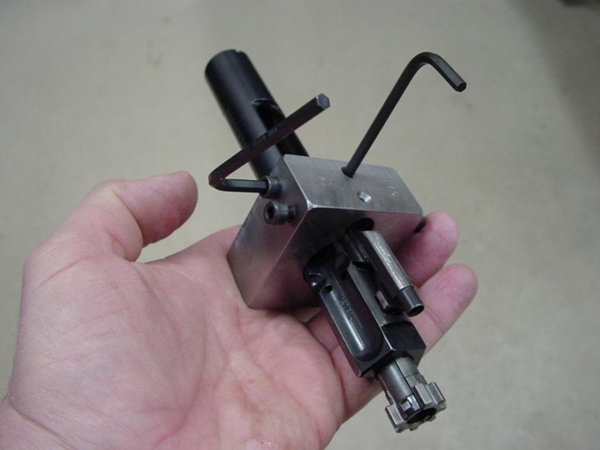
Pic of MOACKS staking, and counter staking 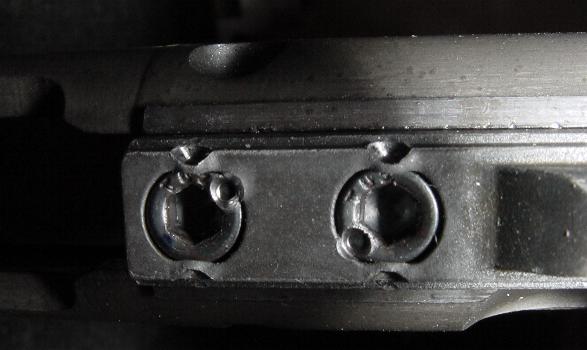
Be careful with using high temp thread locking agents, they do work well, but could be a pain if you have to replace something down the road. CY6 Greg Sullivan "Sully" SLR15 Rifles TheDefensiveEdge.com (763) 712-0123 |
AR Sponsor