


AR Sponsor

Posted: 6/2/2010 10:41:04 AM EDT
| The big brown truck of joy has delivered my LMT bolt carrier group. The gas key staking is so deep that it split the metal. It doesn't look like it is split so badly that any small fragments will come loose, but I was just wondering if this is normal/acceptable. I would post pics but it probably would not show up very well. |
|
Quoted:
Yes, there is a circle on top of the gas key between the bolt heads. What is a MIM key? Is this something I should be concerned about? I will try to get some pics up tonight. Metal Injection Molded It was LMT that caught hell. YMMV ETA: I have a Kimber that is supposed to be MIM in places. Never a problem, but I haven't run it hard either. IMO it may well be like switching from beer in bottles to beer in cans. It took a bit for public approval, but it came. |
| I've done some searching on MIM gas keys and haven't found any hard evidence that suggest it would be inferior to gas keys manufactured by other methods. Obviously it is more brittle or it would not have split when staked, but I don't think the gas key is a high stress part of the rifle. I can't imagine that a company like LMT would use inferior parts or manufacturing processes when building their rifles. If they continue to use the MIM keys after all the crap they got from "experts" then they must feel that it is a better part. I don't think they are doing it to cut cost. It couldn't cost that much more to make a gas key any other way. |
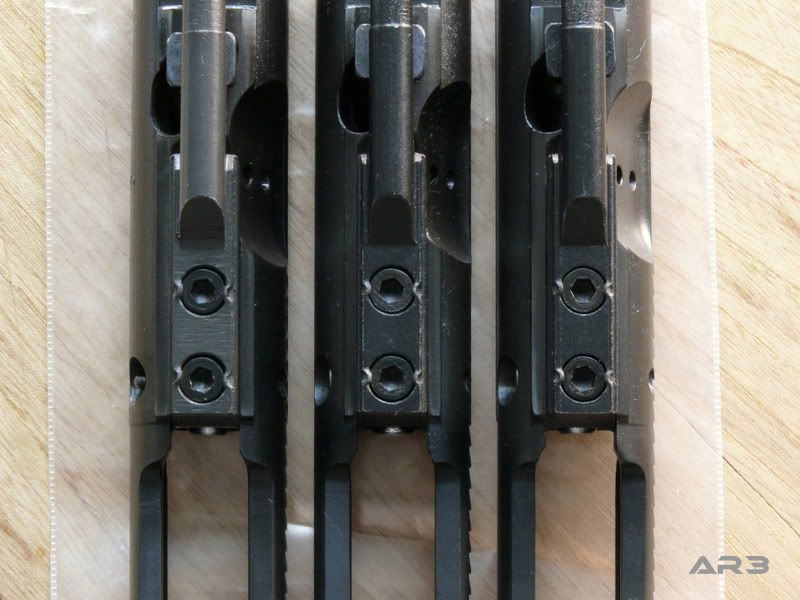
Proper gas key staking example by Colt at left, the rest are pre MIM LMT, all are vintage year 2005 My older AR have Colt and pre MIM LMT BCG and they're good to go, but now Colt are too expensive and LMT are using the MIM gas keys, so I switched to BCM and (next time) Denny's Guns new premium Thunder Bolt BCGs, they have all the desirable features of a mil-spec BCG, high quality at an affordable price. BCM Bolt Carrier Group (MPI) - Auto - link Thunder Bolt - My New Premium Bolt Carrier Group For The Price of a Cheapie - link |
|
Quoted:
I've done some searching on MIM gas keys and haven't found any hard evidence that suggest it would be inferior to gas keys manufactured by other methods. Obviously it is more brittle or it would not have split when staked, but I don't think the gas key is a high stress part of the rifle. I can't imagine that a company like LMT would use inferior parts or manufacturing processes when building their rifles. If they continue to use the MIM keys after all the crap they got from "experts" then they must feel that it is a better part. I don't think they are doing it to cut cost. It couldn't cost that much more to make a gas key any other way. I believe this area is what cycles the action . Its not recoil operated or piston , its direct impingement & that "Key "is a major part . |
|
Quoted:
Quoted:
I've done some searching on MIM gas keys and haven't found any hard evidence that suggest it would be inferior to gas keys manufactured by other methods. Obviously it is more brittle or it would not have split when staked, but I don't think the gas key is a high stress part of the rifle. I can't imagine that a company like LMT would use inferior parts or manufacturing processes when building their rifles. If they continue to use the MIM keys after all the crap they got from "experts" then they must feel that it is a better part. I don't think they are doing it to cut cost. It couldn't cost that much more to make a gas key any other way. I believe this area is what cycles the action . Its not recoil operated or piston , its direct impingement & that "Key "is a major part . All it does is funnel a high pessure blast of air. It dosn't even make contact with another part of the rifle. Still have found no reports of a broken MIM gas key. |
|
Quoted:
Quoted:
Quoted:
I've done some searching on MIM gas keys and haven't found any hard evidence that suggest it would be inferior to gas keys manufactured by other methods. Obviously it is more brittle or it would not have split when staked, but I don't think the gas key is a high stress part of the rifle. I can't imagine that a company like LMT would use inferior parts or manufacturing processes when building their rifles. If they continue to use the MIM keys after all the crap they got from "experts" then they must feel that it is a better part. I don't think they are doing it to cut cost. It couldn't cost that much more to make a gas key any other way. I believe this area is what cycles the action . Its not recoil operated or piston , its direct impingement & that "Key "is a major part . All it does is funnel a high pessure blast of air. It dosn't even make contact with another part of the rifle. Still have found no reports of a broken MIM gas key. I highly doubt that you ever will. LMT put in a ton of research before releasing these to the market. |
|
Quoted:
Quoted:
Quoted:
Quoted:
I've done some searching on MIM gas keys and haven't found any hard evidence that suggest it would be inferior to gas keys manufactured by other methods. Obviously it is more brittle or it would not have split when staked, but I don't think the gas key is a high stress part of the rifle. I can't imagine that a company like LMT would use inferior parts or manufacturing processes when building their rifles. If they continue to use the MIM keys after all the crap they got from "experts" then they must feel that it is a better part. I don't think they are doing it to cut cost. It couldn't cost that much more to make a gas key any other way. I believe this area is what cycles the action . Its not recoil operated or piston , its direct impingement & that "Key "is a major part . All it does is funnel a high pessure blast of air. It dosn't even make contact with another part of the rifle. Still have found no reports of a broken MIM gas key. I highly doubt that you ever will. LMT put in a ton of research before releasing these to the market. I have to agree LMT wasn't going to risk their stellar reputation on substandard components. Honestly - though MIM is a "dirty word," if I understand the process correctly, properly done MIM is just as strong as the part it replaces. |
|
Quoted:
Quoted:
Quoted:
I've done some searching on MIM gas keys and haven't found any hard evidence that suggest it would be inferior to gas keys manufactured by other methods. Obviously it is more brittle or it would not have split when staked, but I don't think the gas key is a high stress part of the rifle. I can't imagine that a company like LMT would use inferior parts or manufacturing processes when building their rifles. If they continue to use the MIM keys after all the crap they got from "experts" then they must feel that it is a better part. I don't think they are doing it to cut cost. It couldn't cost that much more to make a gas key any other way. I believe this area is what cycles the action . Its not recoil operated or piston , its direct impingement & that "Key "is a major part . All it does is funnel a high pessure blast of air. It dosn't even make contact with another part of the rifle. Still have found no reports of a broken MIM gas key. For sure its more than just air. Its very high pressure gas from the burnt gun powder & what is the CUP of a .223/5.56( I assume its a .223/ 5.56) ? I would not think that LMT would use junk parts ,but you can always get one that slips through the cracks . Speaking of cracks , I would not care to have any thing cracked in that area of the rifle. |
|
Quoted:
MIM is crap and it has cracked already. Call LMT, insist on a call tag and to have it replaced with a non cracked, and non MIM, all steel gas key. You paid a good price so don't accept cheap injection molded crap from them....<><....:) Please enlighten me on your metallurgy background and expertise 
|
AR Sponsor