


AR Sponsor

Posted: 7/22/2008 12:07:25 AM EDT
|
First off, let me say that I’ve searched relentlessly to no avail. I’m pretty sure that a detailed discussion of buffers has taken place here (at some time) – but unfortunately, I’m only able to search back 30-days of posts. That said, I’m SORRY that I couldn’t dig up more information. I would kindly ask that (if such a discussion has been wrought out) that I could be directed to a link (that works) in lieu of flaming my post. Either way, I’ve got my asbestos “flame suit” donned and zipped – so if my post offends – then go ahead and let me “have it”.. hinking.gif Anyways, enough “sorrow fluff”………… I’ve recorded that buffers are as follows: Carbine – 2.8oz H buffer – 3.6oz H2 Buffer – 4.4oz H3 Buffer – 5.4oz Rifle Buffer – 5.0oz 9mm Buffer – 5.2oz That all said, I’d really like to open and engage in a well thought-out discussion of the various buffer weights and where each buffer “shines” and lacks.. I reload, for all my guns and suspect that bullet weights and powder charges play a definitive role in the selection of the “perfect” buffer. Again, I apologize if this is a subject that has been covered (and I’d think it must have) due to the expertise I see from folks on this forum. I’m sorry that I’ve not been able to retrieve any information that applies to the subject of each of the buffers that I’ve listed. Any and all help is greatly appreciated. I even welcome “flames” – so long as there’s a link or suggestion to assist. Thanks in advance to any and all who reply! hatworks come hell or high-water. Can you help? ~~~~~~~~~~~~~~~~~ Should I just order a collection of one of each buffer? It seems like a logical approach to a "bottomless question". |
|
It seems you left out the other types of buffers like the hydraulic and pneumatics types just to name a few. From reading about Colt's Military M4 carbines some say they have a 9 mm buffer while others have the H2 buffer it just depends on the source where the info comes from ? But I have a ? that regards to my M4 that has the standard lit wight buffer, and it does have the heavy bolt carrier group a plus to me ,But the ? Witch is the better buffer for a carbine type rifle ? Would the H2 buffer be better then the standard lit carbine buffer that I now have in regards to slowing things down, so not to over work the receiver, and save on the wear and tare down the line including recoil perceived. Seeing that if I had a fixed stock it would have a standard rifle heavy buffer anyway to me this would seem to be right tit for tat. What's your though's Best, yls |
|
i have an enidine in my carbine... and it REALLY reduces recoil... combine the enidine w/ a decent compensator and there is as much recoil from 223 as there is out of a 22lr... and i'm not exaggerating... now that i have my SPR assembled, i'm contemplating getting a rifle length enidine for quicker followup shots... and a good compensator... Then i'll actually use it in my 3 gun matches =) It is harder to lock back the bolt manually with the enidine, but i have not had a failure to lock back on empty... |
I actually did so intentionally. I'm still at the point of needing to figure out the "appropriate place" where each of the standard buffers would be best used. Once I have a better idea of the how's and why's of the standard buffers - I figure that I'll be in a better position to compare some of the more exotic buffers against a "known standard". I've drawn this conclusion because I've read too many threads where someone is having some sort of problem with using an exotic buffer - where the stock one works OK. I think that at times people tend to get so caught-up in making improvements, that they try and solve a problem that does not exist. |
|
Buffers are one of many factors. I am a 'heavier is better' guy, but I think my lower does not care which type of buffer is there, it just runs. If you bought a carbine buffer and an H3 buffer, you could swap weights to make an H1, H2 and the ones you already have. From a sales standpoint, heavier costs more money, so thats why most stock guns don't have them. Carbine buffers have 3 weights, some have steel and some have tungsten. The carbine to H3 is just different weights. There are also rubber spacers-- which could be removed if you want. The trade offs: heavier buffers, slow down the carrier and increase dwell time, which lowers pressure at extraction. The heavier buffers are often recommended in short barrel/pistol weapons. This prolongs the recoil cycle, which can make it seem lighter. A heavier buffer is the same as Tubb CWS. The light buffer crowd tend to be 3-gun shooters and the like. They want minimum reciprocating mass, which makes the recoil cycle very quick, and follow up shots quick. JP Low mass system Most of us are in the middle some where. I have an H2 in my SBR. The 9mm is a blowback system, and the extra mass is require for that. Looking at whats inside a buffer, you get the idea how you can change the weights for testing. 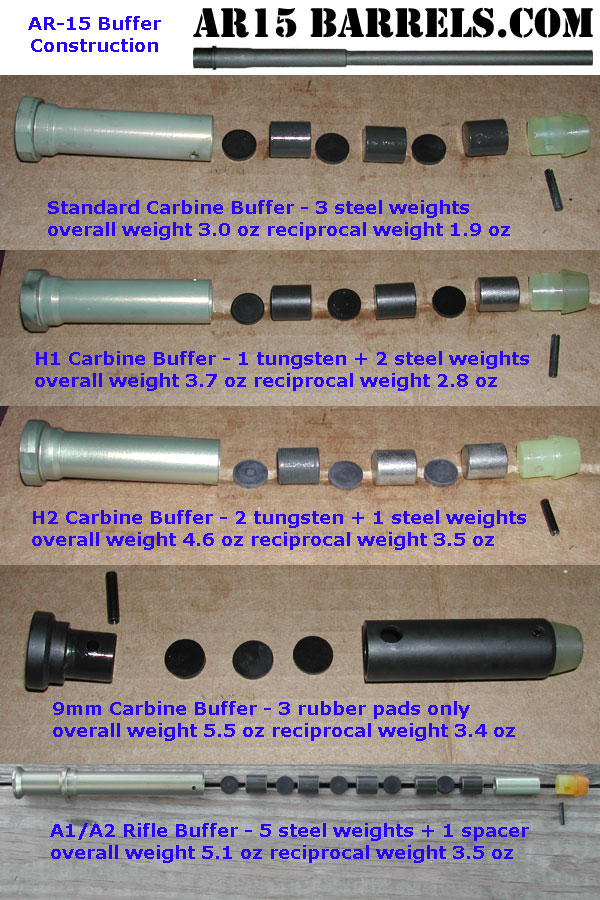 |

Thanks for the input and posting the photo cav_scout_tj !
On my uses, I have two STAG lowers - one with an Ace short collapsable stock and the other an Ace fixed full-length rifle stock. Upper #1 is a 14.5 inch Noveske N4 w/carbine-lenth gas tube. Upper #2 is a 20-inch Olympic Arms heavy bull-barrel w/full length gas tube. Upper #3 (planned) is an 18-inch DPMS mini SASS and I am not certain what the gas tube length is.. So essentially I've got my two lowers and am planning to get the 18-inch upper and started wondering about buffers and what would (or should) work best for each combination since I'll wind up with more uppers than lowers. I'm also mulling over getting a "big-bore" upper, but am kind of waiting to see which caliber winds up becoming most popular. I reload, so that usually spells having the best selection of components and lowest per-round cost for finished ammo. To be honest, I'm kind of "late to the AR game" - since I live in CA and was never interested in owning an AR with a sealed mag-well as I plan to relocate out of CA sometime in the next year or two. |
|
Well, the rifle length buffer tube lower is a give in, the rifle length buffer that is already in it, will suit you fine. I'm assuming it already has. That's with any upper you currently have attached to it. I implore you to try the 14.5 inch upper on the lower with the rifle length tube(if you haven't already). You will get an idea of how a 9mm buffer will feel if you use it in your lower with the carbine tube. The 9mm buffer and rifle length buffer are very close to the same weight. It shouldn't have any problems cycling with decent ammo(I cannot speak for Wolf, I do not use it) and you will notice a difference with softer recoil and less muzzle jump. The heavier the buffer the slower the cycling rate. A 14.5" barreled upper should cycle reliably with any weight buffer, standard to 9mm/rifle, with any decent ammo. The longer barreled upper you have or are getting should work reliably with any lower combination you use, rifle tube or carbine tube with any weight buffer. Once you drop below 14.5 inches in barrel length, different weight buffers may start to help or hurt with reliability issues. Different buffer weight usage will usually end up coming down to personal preference. You'll need to shoot more to find out what you like and don't like. How would you like the rifle to feel and act when you shoot it. |
Thanks - I guess that's really what I needed to know (and hoped for). The buffer that came with my Ace carbine stock is unmarked, so I'd guess it's a "regular" carbine buffer. I also searched Noveske's website for their complete 14.5-inch N4 Light - and they list it using an H-buffer, so I'd probably be safe picking one of those up and running it since that's what they're using.. More than anything, I just want to put this gun together for maximum reliability and durability. |
AR Sponsor