


AR Sponsor

Posted: 8/1/2016 10:32:18 AM EDT
|
This might be helpful to someone new to optics and someone considering an acog.
I am "new"ish to guns and rifles but when I get into something I take it serious and I train and I dont go the cheap route. My first AR was a Colt Socom then I realized what I wanted in a rifle and got a Daniel Defense M4A1 and a DD Mk18 along w other guns. My first optic was an eotech which I loved but I sent it in for a refund and went with an aimpoint for my mk18. But I got an acog for the m4a1 setup. I struggled with zeoring but now I realize that its because I dont have a sufficient range to work at. The outdoor one is never empty and I cant setup properly and then walk out to confirm anything and keep going back and forth. If I could, it would be easy. I especially didnt have a range to go out to 100-300 yards to confirm my zero anyways. But I knew I was close... Anyways, I finally took a Carbine course at Alliance Police Training which is a top notch facility and great crew. We started with a meeting and then zeoring. I struggled with what rifle I wanted to use because I took my m4a1 and mk18 but I decided on the m4a1 and acog. Everyone was zeoring red dots at 50 yards and I didnt know my POI at 50 yards with a 300 zero optic and everyone kept telling me different holdover/unders. At brake I googled it and realized that I was too high so I adjusted during drills and got a good zero. Most of our work with within 50 yards and I was hitting targets with little issue. Remember that I am new to this besides going to a range and shooting so to be drawing and shooting and hitting targets is a good feeling. Its amazing how easy it was for me to use BAC with 1 eye and hit my target. This was also easy at 25 yards and 15 yards. But once you got in closer, the ACOG started giving me issues. It was hard to use both eyes and see the target and pick up a focused red dot/chevron. Its kind of hard to explain but it was defiantly slower than using an aimpoint. I would think that with more practice it would be easier. Honestly, because we were so close and using a rifle it was almost impossible to miss anything with or without an optic. Where the ACOG posed the biggest issues was the multiple target drills. Drawing, shooting the first target, then scanning and acquiring the 2nd target was very slow and bulky. Sometimes I just relied on a glimpse of red and fired because you couldnt acquire a good sight picture with 4x at 5-7-10 yards. Where the ACOG shinned was on the long range. Having a built in drop on the optics was SO nice to have but people using aimpoints were still hitting steel out to 300 yards without much issue. We shot at 50, 100, 150, 200, 250, 300. Once we got past 100 we shot all prone. I was amazed at how accurate you could be with little work/effort and just solid fundamentals. I would struggle at my range hitting something at 75 yards and doubted I could hit anything at 300 but I did consistently. It was nice to have a 4x and see with you were shooting at downrange. I even picked small 4" targets from 300 yards to try and hit (I missed) but it is nice to see them. The only complaints at distance with the ACOG is that the chevron takes up the whole target and it is too bright and over illuminated. Its obviously not for percisce work and you would have a hard time seeing detail on your target. But you would know and cover your target at 300. I would have loved to go further out but the range didnt allow it yesterday. It would be nice to try 400 because there isnt a chevron to cover your target. The built in range estimator is nice to have too. I could see that coming in handy at some point. |
|
I have 6 TA11J-Gs. To say I love ACOGs, is an understatement.
You hit the nail on the head on the limitations of an ACOG - multiple targets up close. When they are moving, it is even worse. There is one more big limitation - up close targets in low light. The solution is to add an Aimpoint T1 in a Larue offset LT-724 mount. This completely eliminates these problems. Here is the way I use my ACOG / T1 rifle - when shooting offhand, I use the T1. When using support, I use the ACOG. Simple. No decisions about which optic to choose. |
|
Quoted:
I struggled with zeoring but now I realize that its because I dont have a sufficient range to work at. The outdoor one is never empty and I cant setup properly and then walk out to confirm anything and keep going back and forth. If I could, it would be easy. I especially didnt have a range to go out to 100-300 yards to confirm my zero anyways. But I knew I was close... That's what spotting scopes are for and a cheap one will work fine for 100-300 yards. Quoted:
Most of our work with within 50 yards and And this is where a RD excels. |
|
I was there this weekend as well Cap. We had the same issues with ACOGs in the military- really close targets, moving targets. Honestly, we did not get to shoot those courses enough- maybe 5-8 range days a year (non-infantry). IMO if you train enough with a certain setup, you can excel with it regardless of the setup.
The SBR I ran has had numerous optic setups over the past few years. ACOG, Elcan, Vortex Razor HD, ACOG and offset micro, and finally with just the micro. The micro makes the most sense and runs the best for me with that rifle. Its the fastest up close, and is more than capable of hitting man-size targets at 300 yards or longer. We shot man size targets at 500 yards with iron sights on an M16- it really just requires the correct elevation and windage adjustments. with the red dot, it comes down to understanding your zero and the general distance of the target. The largest benefits for military units running a simple magnified combat optic like the ACOG are target identification and a BDC. If you understand your holdovers, it negates the need for a BDC on a 300-and-in setup. Having an extremely light optic is cool too. |

|
Quoted:
The offset option is a better solution than mounting the red dot on top of the ACOG. The ACOG with an offset T1 is the single best optic setup you can have on a fighting rifle. All your bases are covered. Agree with offset red dot and not mount above the ACOG. Would respectfully suggest the duty grade Leupold DeltaPoint Pro would be a better choice for the offset dot. It only weighs 2 ounces and about 4 with mount. It is motion activated, so it is always ready, like Aimpoint,, and has a superior (IMHO) "delta" aiming point that is 7.5 MOA at the base of the triangle, but a fine point at the top, permitting very fast target acquisition while having a fine aiming point if time permits. It is very well protected with spring steel. It has a much more open field of view with a wider screen by far compared to the Aimpoint micros and no protruding knobs, turrets or other things to interfere with your peripheral vision around the optic. It can be full noon sunlight bright if needed. Price is comparable to the T-1. 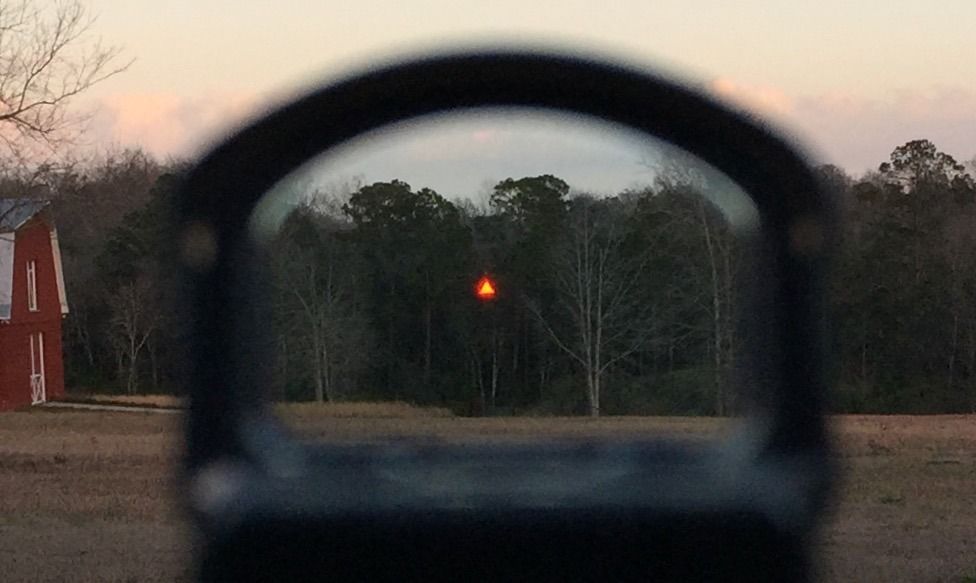
|
AR Sponsor