


AR Sponsor

Posted: 4/2/2012 5:26:57 PM EDT
|
I need to locate Figure 5-2 in MacPherson, Duncan (1994). Bullet Penetration: Modeling the Dynamics and the Incapacitation Resulting from Wound Trauma. El Segundo, CA: Ballistic Publications. It is referenced as a means to correct for BB penetration in ballistic gel. My local library doesn't have it and neither does my university library. I can't afford to buy the book on Amazon and my limited Googlefu has been unsuccessful. Any idea on where I can get hold of just the figure in question? While I'd love to read the whole book, right now I'm just interested in the correction method. Any help would be appreciated.
ETA: another user found the figure but now I need to know how to actually do the compensation. 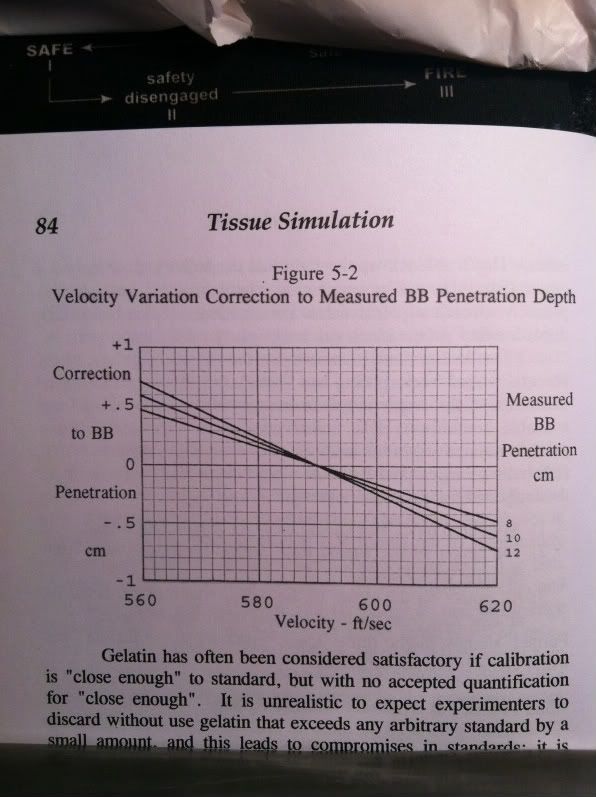
|
|
The three lines represent 8, 10 and 12% Kind and Knox technical gelatin. The "calibration" is done by a standard BB (they really are quite precise) driven to 590 ft/second, measured between the muzzle and the block being tested at about 10 feet. Impact velocity will be a tiny bit less. Calibrated penetration is 8.9 cm, the graph shows variance in penetration based on BB velocity. The graph allows calibration if your air rifle cannot attain 590 ft/second every shot which most will not. The most common air rifle used is the multi-pump pneumatic and variations in pumping, humidity, temperature all contribute to this variance. The low cost of this air rifle is why it is still used. Now, once you have corrected for velocity variation, you can apply a linear relationship to calibrated blocks. So if the velocity corrected penetration is greater than 8.9 cm, then the calibrated penetration will be less by this ratio. |
|
Remember, these blocks are 90% water and the viscosity/density changes with respect to temperature are GREAT. Also, thermal conductivity is rather poor so equilibration of temperature is a must, otherwise the BB calibration test means nothing. Evaporation from the surface (an issue in Arizona) is also an issue. Wrapping blocks with plastic film is a must. Temperature equilibration is best done in a large picnic cooler, you cannot force it because the gelatin will melt if heated. |
|
Quoted:
You're sure the 8, 10, and 12 lines aren't measured BB penetration? If my BB penetrates 4.5" at an impact velocity of 585fps, what is the correction? In which media? You add .1 cm in 8, .11 cm in 10, and .12 cm in 12 or there about. The chart states how to use it. The lateral numbers are the velocity of the bb while the vertical is how much penetration you add or subtract due to the velocity. |
AR Sponsor