


AR Sponsor

Posted: 4/3/2015 9:51:16 PM EDT
|
Battle Arms Development BAD556-LW Receiver Set
*** Click on THIS LINK for ordering info and pricing *** Description: Battle Arms Development, Model BAD556-LW Lightweight Billet Receiver Set in 7075-T6 Aircraft Grade Aluminum Lower Receiver Specifications: • Precision CNC from Billet 7075-T6 Aerospace Aluminum • Patent Pending Lightweight Design • Laser Engraved Logo • MIL-A-8625F, Type III, Class 2, Hard Anodized Flat Black Finish • Compatible with TDP/Mil Standard AR Lower Receiver Parts • Dimensional Accuracy Inspection • All Sharp Edges De-Burred Sharp by Hand • Pictograph Selector Markings Properly Marked for 90° Safety or BAD-ASS-ST / BAD-CASS-ST Short Throw Ambidextrous Safety Selectors • Receiver Safety Selector Hole Machined with Relief Cut for Battle Arms Development "SHORT THROW" Ambidextrous Safety Selectors • Multi Caliber Marking for Build Versatility • Flared, Deep Beveled Magwell • Easy in Install Set Screw Bolt Catch Pin (Pin Included) • Captured Takedown Pin Detent Spring (Set Screw Included) • Integrated trigger guard • All Components, material, and packaging made in the USA • Weight: 6.84 oz Upper Receiver Specifications: • Precision CNC from Billet 7075-T6 Aerospace Aluminum • Patent Pending Lightweight Design • M4 Feed Ramp • Machined T-Marks • Laser Engraved Logo • MIL-A-8625F, Type III, Class 2, Hard Anodized Flat Black Finish • Compatible with TDP/Mil Standard AR Upper Receiver Parts • All Components, material, and packaging made in the USA • Weight: 6.31 oz 


|
|
A lot of great LW sets coming out. Would love to see a torture test video comparing these (and the 2A set) to a standard Mil-Spec set. Some of the ways that the LWs are achieved (e.g., the cut-ins on the side of the mag-well) might actually strengthen these in a way that forged receivers can't match (obviously, a non-LW billet set could.)
|
|
Quoted:
You'll have to post pics once you get her built up!  Quoted:
got mine just back from engraving. Now I am waiting for that form 1 to come back for a new 300 blkout SBR build on the BAD lower  . Its a very pretty billet set! I love it! . Its a very pretty billet set! I love it!You'll have to post pics once you get her built up! Will do! 
|
|
Quoted:
What?!? How? Quoted:
Quoted:
... Some of the ways that the LWs are achieved (e.g., the cut-ins on the side of the mag-well) might actually strengthen these in a way that forged receivers can't match (obviously, a non-LW billet set could.) What?!? How? Depends on the material thickness. If they started with Mil-Spec and just removed thickness, then no, but if they increased the thickness of the raised portions some, than it could be stronger. Like a thin sheet stretch across a rigid frame vs. just a thicker flat sheet. |
|
Quoted:
You'll have to post pics once you get her built up! Quoted:
Quoted:
got mine just back from engraving. Now I am waiting for that form 1 to come back for a new 300 blkout SBR build on the BAD lower . Its a very pretty billet set! I love it!You'll have to post pics once you get her built up! Here she is as requested. I love this SBR build 
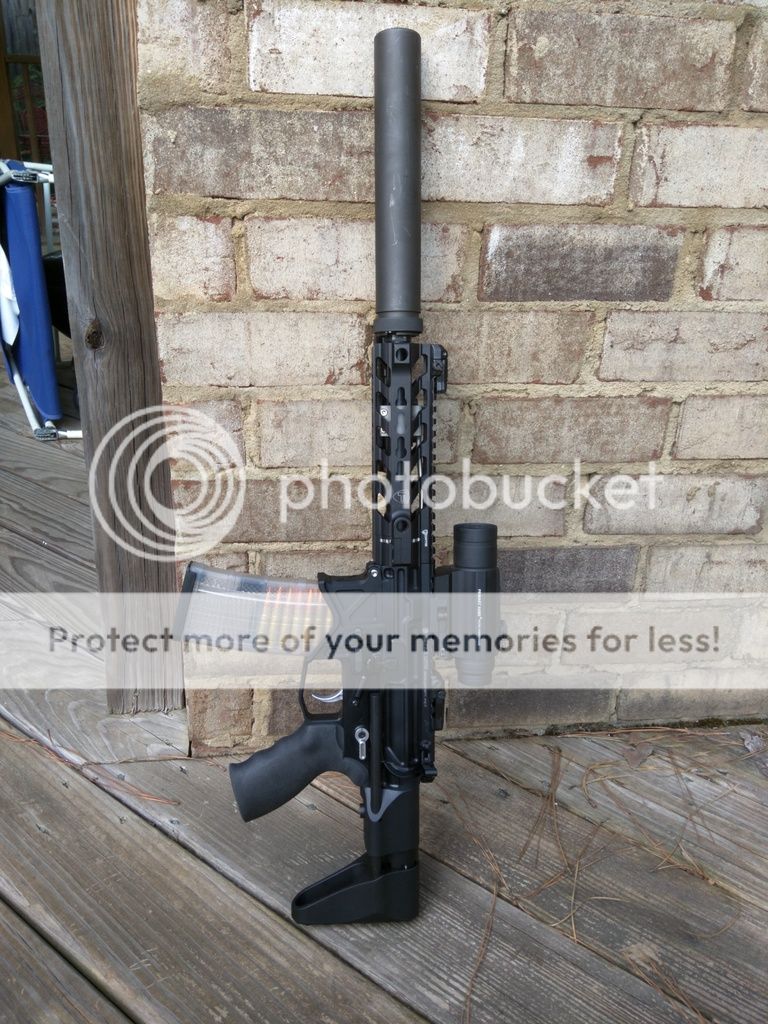
|
|
I second the call for torture testing. I don't just mean toss it out of a truck. I would like to see what 3 or 4 thousand rounds would do with thermal expansion, deformation and distortion of the body. As far as strength goes nothing makes up for material. The webbing and buttressing do little to help thermally induced strain, It's all about having enough material to absorb the heat dissipate it all the while returning back to the original shape without deformation. Its called elastic strain. The guys that designed the original mil-spec forgings were pretty smart guys. They didn't arbitrarily decide upon thicknesses of materials. Based upon service life, heat cycles and costs they came up with the shapes we have today.
I'm not saying it can't be improved upon and there is a difference in military, sporting and civilian use. But we can't expect this work of machining art to last as long as a basic mil-spec forging. Our best bet to into studies on new materials. While I keep lusting over this beauty I can't see it being worthwhile. I would be afraid to shoot it too often forget taking it to a three day class. I know I've seen some really nice looking rifles break, not just have the gas key come loose but fractures at the mag well or buffer tube attachment point. I thinks that's why we have seen the mil-spec gain weight here and there. So in the end would you buy one? I sure would as a toy but not my go to range or class gun, and I would never use it as my squad car trunk gun. |
|
Quoted:
I second the call for torture testing. I don't just mean toss it out of a truck. I would like to see what 3 or 4 thousand rounds would do with thermal expansion, deformation and distortion of the body. As far as strength goes nothing makes up for material. The webbing and buttressing do little to help thermally induced strain, It's all about having enough material to absorb the heat dissipate it all the while returning back to the original shape without deformation. Its called elastic strain. The guys that designed the original mil-spec forgings were pretty smart guys. They didn't arbitrarily decide upon thicknesses of materials. Based upon service life, heat cycles and costs they came up with the shapes we have today. I'm not saying it can't be improved upon and there is a difference in military, sporting and civilian use. But we can't expect this work of machining art to last as long as a basic mil-spec forging. Our best bet to into studies on new materials. While I keep lusting over this beauty I can't see it being worthwhile. I would be afraid to shoot it too often forget taking it to a three day class. I know I've seen some really nice looking rifles break, not just have the gas key come loose but fractures at the mag well or buffer tube attachment point. I thinks that's why we have seen the mil-spec gain weight here and there. So in the end would you buy one? I sure would as a toy but not my go to range or class gun, and I would never use it as my squad car trunk gun. I'd be willing to put it thru some duty use without hesitation |
|
Quoted:
I'd be willing to put it thru some duty use without hesitation Agreed. The metals today are much stronger than when they first decided what was Mil-spec, because of this it is possible to use less metal to save weight. I believe Rainier is not a company to take something like this lightly. |
|
Quoted:
I second the call for torture testing. I don't just mean toss it out of a truck. I would like to see what 3 or 4 thousand rounds would do with thermal expansion, deformation and distortion of the body. As far as strength goes nothing makes up for material. The webbing and buttressing do little to help thermally induced strain, It's all about having enough material to absorb the heat dissipate it all the while returning back to the original shape without deformation. Its called elastic strain. The guys that designed the original mil-spec forgings were pretty smart guys. They didn't arbitrarily decide upon thicknesses of materials. Based upon service life, heat cycles and costs they came up with the shapes we have today. I'm not saying it can't be improved upon and there is a difference in military, sporting and civilian use. But we can't expect this work of machining art to last as long as a basic mil-spec forging. Our best bet to into studies on new materials. While I keep lusting over this beauty I can't see it being worthwhile. I would be afraid to shoot it too often forget taking it to a three day class. I know I've seen some really nice looking rifles break, not just have the gas key come loose but fractures at the mag well or buffer tube attachment point. I thinks that's why we have seen the mil-spec gain weight here and there. So in the end would you buy one? I sure would as a toy but not my go to range or class gun, and I would never use it as my squad car trunk gun. I think what you meant to say was modulus of elasticity, and coefficient of thermal expansion, neither of which have much to do with the AR15 receiver set. The barrel, barrel extension, and bolt are critical parts that we look at when discussing these things, in addition to other steel components, but the aluminum frame isn't really in that consideration. There is very little stress placed on the receivers of the AR15 by design, and they last for life, even under extreme full auto fire at a machine gun rental range. AK receivers crack and need repair, whereas AR15 receivers never die unless damaged by some other mechanism other than firing, minus catastrophic failure. The original AR15 receiver set was weaker in the extension tube boss area than these receivers, and they have lasted still to this day. 7075 T6 aluminum maintains dimensional tolerances much better than steel across a wide range of temp shifts, and performs extremely well in arctic conditions, as well as desert. Steel frame guns experience more problems, especially in extreme cold. The weight removed from these is not enough to cause concern in my opinion. I don't see any reason why these receivers wouldn't last as long as any other set, although they would maintain dimensions longer than some of the 6061 sets you see out there still. These should last for life, even high volume on a regular basis. The barrel and bolt will go many times before you will have issues with 7075 T6 receivers made with correct dims for the BCG raceway and cam pin recess, as well as the LPK. This would make an excellent foundation for either a lightweight HD/PDW carbine, or a hunting set-up in 6.5 Grendel. |
AR Sponsor