


AR Sponsor

Posted: 12/5/2011 9:27:49 AM EDT
|
Teflon coating the receiver and bolt,does it eliminate the need for lubrication,what was the coating on the original AR-10 rifle?
"Made largely of non-corrodible aluminum and titaniym alloys,with a minimum of steel parts, the soft gray-colored AR-10s will not rust.In the rain,when we fired them,they received a liberal baptism.Any other guns would have been striped to the last nut and bolt to be cleaned after firing,but the aluminum and staineless surfaces of the AR-10s gradually warmed to room temperature,the water evapurated,and they were dry." "The A.I.(Artillerie Inrichtingen) started in august 1957 to prepare the production of the rifle and all sorts of difficulties arose,drawings had to be converted from inch to metric,tooling had to be designed and made,subcontracters had to be found and educated to work with new materials like the aluminium 7075-T6 for the upper and lower receiver and epoxy for the butt stock and hand guard. Not to forget they had to work with new techniques like hard anodising the aluminium parts and the use of a dry lubricant film of M0S2 on diferent parts of the rifle." Thank you. |
|
Quoted:
Teflon coating the receiver and bolt,does it eliminate the need for lubrication,what was the coating on the original AR-10 rifle? "Made largely of non-corrodible aluminum and titaniym alloys,with a minimum of steel parts, the soft gray-colored AR-10s will not rust.In the rain,when we fired them,they received a liberal baptism.Any other guns would have been striped to the last nut and bolt to be cleaned after firing,but the aluminum and staineless surfaces of the AR-10s gradually warmed to room temperature,the water evapurated,and they were dry." "The A.I.(Artillerie Inrichtingen) started in august 1957 to prepare the production of the rifle and all sorts of difficulties arose,drawings had to be converted from inch to metric,tooling had to be designed and made,subcontracters had to be found and educated to work with new materials like the aluminium 7075-T6 for the upper and lower receiver and epoxy for the butt stock and hand guard. Not to forget they had to work with new techniques like hard anodising the aluminium parts and the use of a dry lubricant film of M0S2 on diferent parts of the rifle." Thank you. i don't think teflon was around that early. there was a dry film lube they used. it was what was used on the magazines. i think they did spray the inside of the uppers with a greyish film as well as you sometimes see overspray on the uppers. |
|
Quoted:
Quoted:
Teflon coating the receiver and bolt,does it eliminate the need for lubrication,what was the coating on the original AR-10 rifle? "Made largely of non-corrodible aluminum and titaniym alloys,with a minimum of steel parts, the soft gray-colored AR-10s will not rust.In the rain,when we fired them,they received a liberal baptism.Any other guns would have been striped to the last nut and bolt to be cleaned after firing,but the aluminum and staineless surfaces of the AR-10s gradually warmed to room temperature,the water evapurated,and they were dry." "The A.I.(Artillerie Inrichtingen) started in august 1957 to prepare the production of the rifle and all sorts of difficulties arose,drawings had to be converted from inch to metric,tooling had to be designed and made,subcontracters had to be found and educated to work with new materials like the aluminium 7075-T6 for the upper and lower receiver and epoxy for the butt stock and hand guard. Not to forget they had to work with new techniques like hard anodising the aluminium parts and the use of a dry lubricant film of M0S2 on diferent parts of the rifle." Thank you. i don't think teflon was around that early. there was a dry film lube they used. it was what was used on the magazines. i think they did spray the inside of the uppers with a greyish film as well as you sometimes see overspray on the uppers. DuPont, which founded Kinetic Chemicals in partnership with General Motors, was producing over two million pounds (900 tons) of Teflon per year in Parkersburg, West Virginia, by 1948. http://en.wikipedia.org/wiki/Polytetrafluoroethylene Polytetrafluoroethylene (PTFE) "History PTFE was accidentally invented by Roy Plunkett of Kinetic Chemicals in New Jersey in 1938. While Plunkett was attempting to make a new CFC refrigerant, the tetrafluoroethylene gas in its pressure bottle stopped flowing before the bottle's weight had dropped to the point signaling "empty." Since Plunkett was measuring the amount of gas used by weighing the bottle, he became curious as to the source of the weight, and finally resorted to sawing the bottle apart. Inside, he found it coated with a waxy white material which was oddly slippery. Analysis of the material showed that it was polymerized perfluoroethylene, with the iron from the inside of the container having acted as a catalyst at high pressure. Kinetic Chemicals patented the new fluorinated plastic (analogous to known polyethylene) in 1941[2] and registered the Teflon trademark in 1945. An early advanced use was in the Manhattan Project as a material to coat valves and seals in the pipes holding highly reactive uranium hexafluoride at the vast K-25 uranium enrichment plant at Oak Ridge, Tennessee. DuPont, which founded Kinetic Chemicals in partnership with General Motors, was producing over two million pounds (900 tons) of Teflon per year in Parkersburg, West Virginia, by 1948. In 1954, French engineer Marc Grégoire created the first pan coated with Teflon non-stick resin under the brand name of Tefal after his wife urged him to try the material he had been using on fishing tackle on her cooking pans. In the United States, Kansas City, Missouri resident Marion A. Trozzolo, who had been using the substance on scientific utensils, marketed the first US-made Teflon coated frying pan, "The Happy Pan," in 1961." |
Thus the Fail Zero uppers & bolt carriers. I still plan on lubricating my bolt thank you. You know AR's are 'self-cleaning' right?   Seriously though, I believe Fail Zero will coat your components for you for a price, which means you could have a Fail Zero AR10. OOf course, if you did this to an original we'd have to hunt you down and give you a hiding.... Seriously though, I believe Fail Zero will coat your components for you for a price, which means you could have a Fail Zero AR10. OOf course, if you did this to an original we'd have to hunt you down and give you a hiding....
|
|
Quoted:
Quoted:
Quoted:
Teflon coating the receiver and bolt,does it eliminate the need for lubrication,what was the coating on the original AR-10 rifle? "Made largely of non-corrodible aluminum and titaniym alloys,with a minimum of steel parts, the soft gray-colored AR-10s will not rust.In the rain,when we fired them,they received a liberal baptism.Any other guns would have been striped to the last nut and bolt to be cleaned after firing,but the aluminum and staineless surfaces of the AR-10s gradually warmed to room temperature,the water evapurated,and they were dry." "The A.I.(Artillerie Inrichtingen) started in august 1957 to prepare the production of the rifle and all sorts of difficulties arose,drawings had to be converted from inch to metric,tooling had to be designed and made,subcontracters had to be found and educated to work with new materials like the aluminium 7075-T6 for the upper and lower receiver and epoxy for the butt stock and hand guard. Not to forget they had to work with new techniques like hard anodising the aluminium parts and the use of a dry lubricant film of M0S2 on diferent parts of the rifle." Thank you. i don't think teflon was around that early. there was a dry film lube they used. it was what was used on the magazines. i think they did spray the inside of the uppers with a greyish film as well as you sometimes see overspray on the uppers. DuPont, which founded Kinetic Chemicals in partnership with General Motors, was producing over two million pounds (900 tons) of Teflon per year in Parkersburg, West Virginia, by 1948. http://en.wikipedia.org/wiki/Polytetrafluoroethylene Polytetrafluoroethylene (PTFE) "History PTFE was accidentally invented by Roy Plunkett of Kinetic Chemicals in New Jersey in 1938. While Plunkett was attempting to make a new CFC refrigerant, the tetrafluoroethylene gas in its pressure bottle stopped flowing before the bottle's weight had dropped to the point signaling "empty." Since Plunkett was measuring the amount of gas used by weighing the bottle, he became curious as to the source of the weight, and finally resorted to sawing the bottle apart. Inside, he found it coated with a waxy white material which was oddly slippery. Analysis of the material showed that it was polymerized perfluoroethylene, with the iron from the inside of the container having acted as a catalyst at high pressure. Kinetic Chemicals patented the new fluorinated plastic (analogous to known polyethylene) in 1941[2] and registered the Teflon trademark in 1945. An early advanced use was in the Manhattan Project as a material to coat valves and seals in the pipes holding highly reactive uranium hexafluoride at the vast K-25 uranium enrichment plant at Oak Ridge, Tennessee. DuPont, which founded Kinetic Chemicals in partnership with General Motors, was producing over two million pounds (900 tons) of Teflon per year in Parkersburg, West Virginia, by 1948. In 1954, French engineer Marc Grégoire created the first pan coated with Teflon non-stick resin under the brand name of Tefal after his wife urged him to try the material he had been using on fishing tackle on her cooking pans. In the United States, Kansas City, Missouri resident Marion A. Trozzolo, who had been using the substance on scientific utensils, marketed the first US-made Teflon coated frying pan, "The Happy Pan," in 1961." cool didn't know that. i'm thinking that teflon in firearm usage wasn't that common until later. i remember during the ban, the teflon coated aluminum mags were the bees knees. can anyone else think of earlier teflon applications in firearms? |
|
Quoted:
Thus the Fail Zero uppers & bolt carriers. I still plan on lubricating my bolt thank you. You know AR's are 'self-cleaning' right? Seriously though, I believe Fail Zero will coat your components for you for a price, which means you could have a Fail Zero AR10. OOf course, if you did this to an original we'd have to hunt you down and give you a hiding...."self-cleaning",why they used it for advertising,no oiling can be achieved (as long as the coating lasts on the surface) but self cleaning,even with the burned filt that comes from the barrel and gas tube (not to speak of the filt that comes from outside),especially with the Hollywood model and inside the bolt gas chamber in AR-10s and Ar-15s. 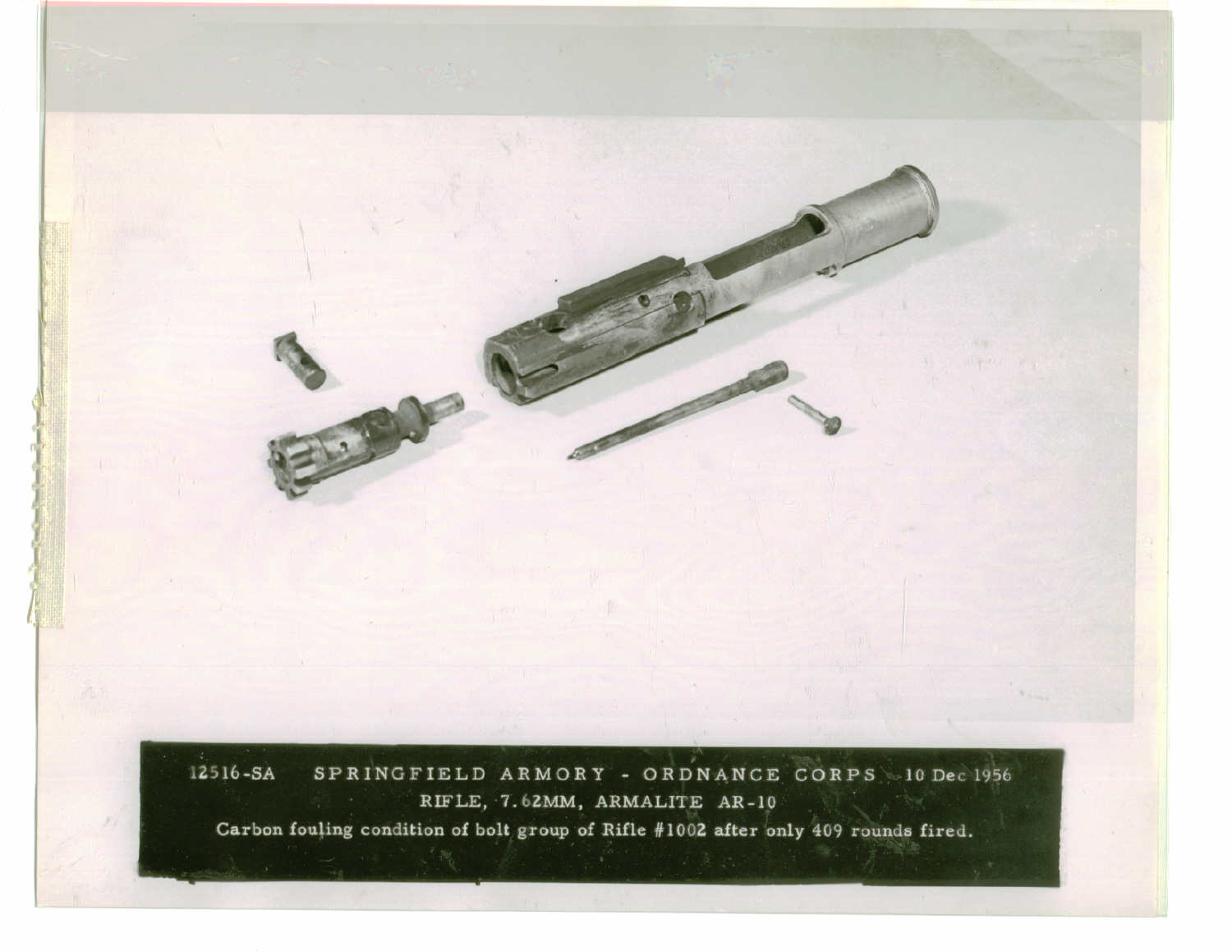
7.62mm Armalite AR10 - Carbon Fouling Condition of Bolt Group 


http://vuurwapenblog.com/2010/08/27/cleaning-your-ar-15-is-pretty-much-a-waste-of-time/ |
|
Quoted:
Anderson Machine uses this process on their AR 15's. My department and the one in the next county carry them and they run dry( no lube) http://www.rf85.com/ http://www.atdmachineshop.com/rf85.htm Thank you.  
http://www.rf85.com/ "In the video, which was made at Oak Ridge National Laboratories, the untreated rifle took 23% longer to cycle than the RF85 treated rifle during testing. Oil attracts dirt, sand, grit and other harmful particles. By using the RF85 treatment not only will the gun operate almost a quarter precent faster but will also last longer due to less drag and wear. And accumulation of harmful elements is greatly reduced." http://www.atdmachineshop.com/rf85.htm "In addition to the rigid quality controls of manufacturing, the feature that sets the Anderson AM15 Rifles apart from the masses is the proprietary RF85 treatment allowing Anderson weapon systems to operate efficiently without “Wet” lubricant. In a coefficient friction test performed by Oak Ridge National Laboratory, the reduction of friction on all steel surfaces was reduced by 85% — without traditional “wet” lubricant, hence the name RF85. An RF-85 treated weapon cycles faster and more reliably, operates at cool er temperatures, experiences significantly less wear and, without traditional “WET” lubricant, doesn’t experience failures due to excess dirt and carbon fouling in the action." Anderson Manufacturing RF-85 coating http://www.youtube.com/watch?v=HFr4SXIa6bQ |
|
Your rifle doesn't have to swim in gun oil to work (Anderson Manufacturing rifles)
http://www.youtube.com/watch?v=8nksyuW3V6Q |
|
Soap, water and a couple minutes of your time
http://www.youtube.com/watch?v=soc8Yid9ym4 |
|
Why is RF85 called a treatment and not a coating?
It becomes a part of the metal and wears with the metal, not off of it like a coating. http://www.rf85.com/index.php?option=com_content&view=article&id=61:why-is-rf85-called-a-treatment-and-not-a-coating&catid=31:general&Itemid=64 |
AR Sponsor