


AR Sponsor

Posted: 6/28/2010 6:50:50 PM EDT
| What's the skinny? How did they work? Why were they replaced? Are these, http://www.ashbymfg.com/ring_springs.html similar to the original innards? |
|
Linky no work.
ETA: Try this one Yes those look similar. There is a picture floating around somewhere of the internals of an EW buffer. Some one will post it........... |
| I tried one in a semi and an M16. The semi would not cycle reliably and the full auto didn't work reliably either. Thats as I recall anyway. It's been 3 years or so and my memory isn't that good anymore. Once I replaced the buffer with the newer one all was right with the world. The M16 chugged along nicely and the semi cycled fine too. Maybe it was just the buffer I had that didn't work all that well anymore. this was also during the time that I was experiementing with an original firing pin too so maybe my memory is clouded by that detail. |
|
Quoted:
Linky no work. ETA: Try this one Yes those look similar. There is a picture floating around somewhere of the internals of an EW buffer. Some one will post it........... here are the pics I have of the guts 


|
|
The edgewater buffer used beveled springs (pictured above) and the idea that the springs would impact each other, give elightly and absorb engery when pressed together during the recoil and counter recoil strokes. This was supposed to manage the cyclic rate (on the recoil stroke) and reduce the bolt bounce (on the counter stroke).
The problem was that the degree to which it worked varied depending on the lubrication and worse, under field conditions in Vietnam, they tended to just get stuck together in one solid mass, and at that point the buffer functioned like a solid piece of aluminum creating both high cyclic rate issues and bolt bounce/light strike issues. So a new buffer was designed. It had the very convenient but totally coincidental effect of reducing the cyclic rate and thus solving the on-going M16 acceptance problem of high cyclic rates caused by the M193 specs and the switch to WC846 ball powder. It's one of the 4 major issues that proper field trials in wet environments would have uncovered. Replacemet of the edgewater buffer at the pre-production phase along with proper ammunition testing, acceptance testing using ammunition with WC846 powder, and recognition of the need for proper cleaning, would have virtually elminated the failure to extract and light strike issues in Vietnam and saved a lot of lives in the process. As it was, they did not begin to replace the edgewater buffers until December 1966 and it took a full year to replace them on all the rifles in use in Vietnam. |

|
OK, one question on this...
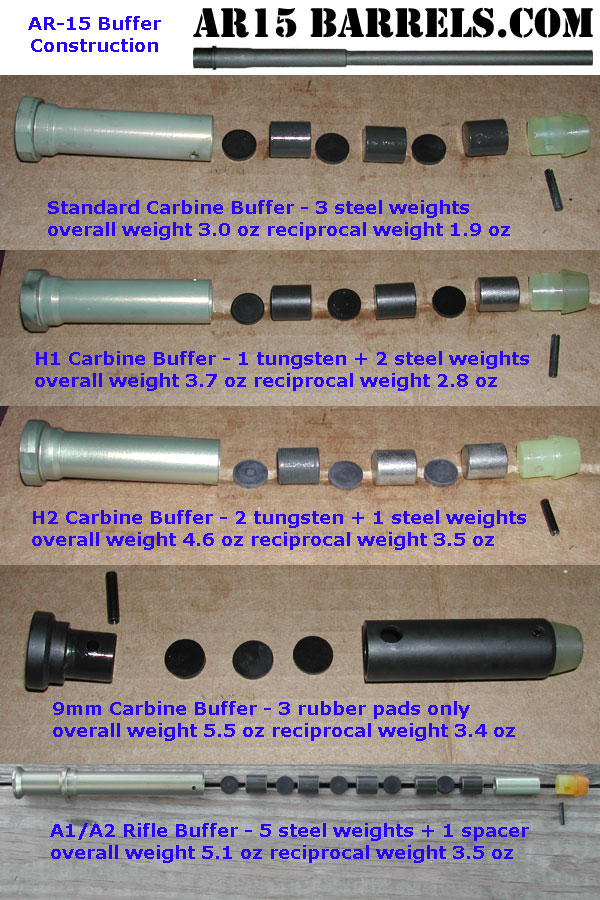
To refresh my memory, can somebody post the specs for the weights of the various buffers all in one place? Here we have the JP enterprises low mass rifle buffer. Total weight of 3 ounces. I don't know why this would be desirable unless you wanted to attempt to maybe imitate the Edgewater buffer? 
Also for giggles, a Spike's tungsten powder filled carbine buffer is supposed to be 4.3 ounces. I can't find any good info on the weight of the standard rifle buffer, any of the carbine, H1,2,or 3 buffers, etc. |
|
Quoted:
OK, one question on this... To refresh my memory, can somebody post the specs for the weights of the various buffers all in one place? Here we have the JP enterprises low mass rifle buffer. Total weight of 3 ounces. I don't know why this would be desirable unless you wanted to attempt to maybe imitate the Edgewater buffer? http://www.bravocompanyusa.com/v/vspfiles/photos/JPLMB%20buffer-2.jpg Also for giggles, a Spike's tungsten powder filled carbine buffer is supposed to be 4.3 ounces. I can't find any good info on the weight of the standard rifle buffer, any of the carbine, H1,2,or 3 buffers, etc. those low mass buffers are to be used with lightweight carriers in competition guns...supposed to reduce felt recoil and muzzle rise by having lighter inertia parts bouncing back and forth 
|
|
I made my own tungsten powder filled carbine buffer for my AR pistol. I was getting tired of hearing the weights rattling round for one thing, and wanted to up the buffer weight a smidge to retard the unlock stroke a smidge [pistol length gas system]. As it stands, when I changed the pistol to my super short buffer design, I dropped it into the carbine lower I have my dissy upper on. Works great and no buffer rattle.
You can get the tungsten powder from Pinewood Derby supply places. |
|
Quoted:
Somehow I have a hard time picturing how a lighter bolt carrier and buffer could reduce recoil and muzzle rise. If anything, I would expect that slowing down the system with heavier parts would have the desired effect? Maybe. Velocity is a bigger factor in kinetic energy than mass, KE = 1/2 m * v^2. However, if both the light and heavy buffers and BCGs travel at nearly the same velocity, the lighter set will have less KE. The spring may keep their velocities close. Dustin |
|
Quoted:
Somehow I have a hard time picturing how a lighter bolt carrier and buffer could reduce recoil and muzzle rise. If anything, I would expect that slowing down the system with heavier parts would have the desired effect? They are probably using a smaller-than-normal gas port, to go along with the lower mass reciprocating assembly. |
|
the lighter weight is a good thing..rifle jumps around less if you don't have a lot weight slamming back and forth inside the receiver extension..the only downside to the low mass stuff is the reliability goes down slightly, hence the "competition" stuff
this from JP's site: JP Low Mass Operating System We have our own purpose designed operating systems. For the no-compromise competition rifle, the LMOS™ offers the most significant improvement in the felt impulse of the rifle as compared to any modification other than the addition of a compensator. The complete system consists of our low mass bolt carrier and lightweight buffer conversion kit. By reducing the reciprocating mass, the overall impulse as felt by the shooter is further reduced, and bolt velocity is increased without significantly affecting reliability. JP LMOS™ equipped rifles have virtually no reciprocating mass feel. Reliability with these parts is excellent for competition use. We've been using this system for three years without a malfunction at a match. Most shooters that use and maintain this operating system feel that it is a great performance improvement. Some shooters have even reported fewer unexplained flyers in their groups with the JP LMOS™ system. |
|
Does anyone have dimensions for one of these?
I think it may be possible to produce a decent replica. If we can get it all squared away, I can send an email to the place making the edgewater springs and see what bad or good news they may give. Going from there we could decide on the best course of action. There's one on gunbroker but, I have a feeling it'll be way more than it is now by the time the auction ends. |
|
I got an Edgewater buffer with a buttstock set, that thing is half the weight of the standard A1/A2 style buffer, I can see why it didn't work with the high cyclic rate of fire.
Quoted:
If it's too light, why not just fill the back end with weight? There seems to be plenty of room going from the pictures. |
|
That low mass buffer works great, I had put one in a match grade rifle, was a smooth operator, I just hope the guy I ended up selling the rifle too can appreciate it along with the young engineering NM bolt carrier group.
Quoted:
OK, one question on this... To refresh my memory, can somebody post the specs for the weights of the various buffers all in one place? Here we have the JP enterprises low mass rifle buffer. Total weight of 3 ounces. I don't know why this would be desirable unless you wanted to attempt to maybe imitate the Edgewater buffer? http://www.bravocompanyusa.com/v/vspfiles/photos/JPLMB%20buffer-2.jpg Also for giggles, a Spike's tungsten powder filled carbine buffer is supposed to be 4.3 ounces. I can't find any good info on the weight of the standard rifle buffer, any of the carbine, H1,2,or 3 buffers, etc. |
|
Quoted:
Replacemet of the edgewater buffer at the pre-production phase along with proper ammunition testing, acceptance testing using ammunition with WC846 powder, and recognition of the need for proper cleaning, would have virtually elminated the failure to extract and light strike issues in Vietnam and saved a lot of lives in the process. That's different than any information I have seen. The buffer has nothing to do with extraction and I never heard of light strikes as being one of the Vietnam issues. Replacing the buffer is generally observed to have fixed two problems: a persistent failure of the bolt to lock back after the last shot, and rifles being rejected by the Army because they had excessively high cyclic rates. |

|
Quoted:
Does anyone have dimensions for one of these? I think it may be possible to produce a decent replica. If we can get it all squared away, I can send an email to the place making the edgewater springs and see what bad or good news they may give. Going from there we could decide on the best course of action. There's one on gunbroker but, I have a feeling it'll be way more than it is now by the time the auction ends. I like the way you think, and I'd like to subscribe to your newsletter. 
|
| I'll work on some plans tonight. The lower half seems to be roughly the same size and contour as a standard rifle buffer. I can resize some photos and stuff to get the size of the upper portion. I'd be great to get a hold of one or find blue prints or something but, that's unlikely. Of course, any and all information is welcome. |
|
Quoted:
Thats a nice looking gun. Is that real green furniture? Also, on the subject of the buffers, is the top cap made from steel or aluminum? Do the roll pin go all the way through? Yes, authentic furniture, took me a few years to get it all together. The top cap is not steel. |
AR Sponsor