


AR Sponsor

Posted: 12/29/2009 6:55:59 PM EDT
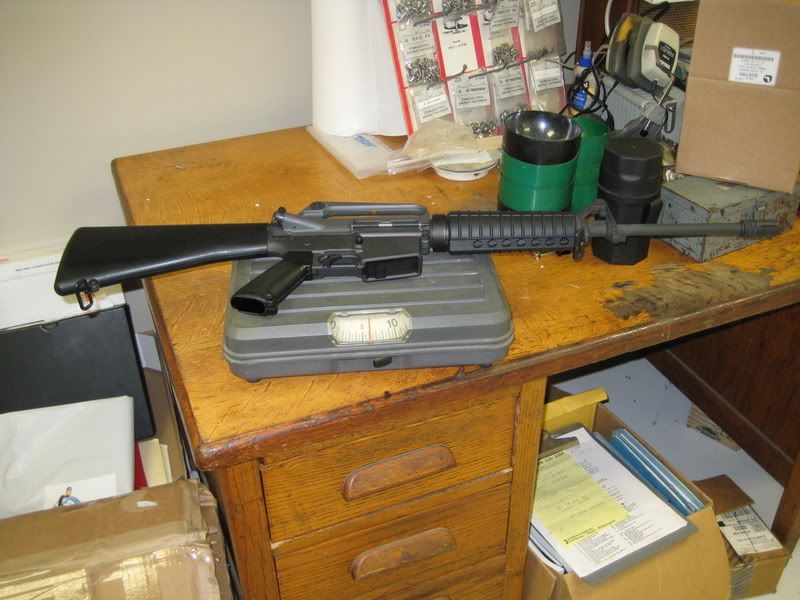
| Interesting to see how much the old-style ARs weigh, what with them being so simple and all. |
|
Quoted:
My 1965 SP-1 weight 6 lbs 10 oz with a sling, unloaded. EDIT: Strange, my 1980 SP-1 weighs 7 lbs 8 oz with a sling, unloaded. Where did the extra 14 oz come from? I have been thinking about similar conundrums for a while regarding AR15/M16 weights. I remember reading early articles about the guns and some weights mentioned were in the upper 5 pound range. I think I know where some of that weight came from. Are the weights you mention actual weighed by you? Or are these from a stat sheet? While sorting through parts in my basement, I noticed that an early set of triangular handguards were far lighter than a newer set, and also felt more brittle or "plasticy". And FWIW, the 601 type stocks and some other early models did not have foam filling inside the hollow space, along with being molded of thinner material. It would be an interesting thing for someone with an accurate scale, time and access to original and newer parts to do a side-by-side mass comparison of individual components and assemblies. Oh yeah, don't forget that a change from an Edgewater buffer to the modern one will add some weight too! Brings up a question I have heard before: What is the lightest weight you can make an AR (assuming carbine) without being an NFA registered SBR? The only qualifications being it must have a set of iron sights and be as reliable as any other well built AR carbine. I would assume 16 inch pencil barrel or perhaps 14.5 inch pencil with permenently attached lightweight flash suppressor, plastic gen. one (or two?) collapsing stock, the rest being typical SP1 or similar parts. Or might a flat top upper with attached iron sights be lighter? I don't know but personally I prefer the carry handle upper for many reasons. |
|
Quoted:
My 603 (M16A1) knockoff weighs about 7.5 lbs without magazine, sling, or cleaning kit. ETA: My M16A2 knockoff (Unsure of Colt model number) weighs right about 8lbs in the same condition. I never know the correct model numbers of the newer stuff either. I always need to look it up, then confusion sets in....... That's why I like the retro stuff. GVS |
|
Quoted:
Quoted:
My 1965 SP-1 weight 6 lbs 10 oz with a sling, unloaded. EDIT: Strange, my 1980 SP-1 weighs 7 lbs 8 oz with a sling, unloaded. Where did the extra 14 oz come from? I have been thinking about similar conundrums for a while regarding AR15/M16 weights. I remember reading early articles about the guns and some weights mentioned were in the upper 5 pound range. I think I know where some of that weight came from. Are the weights you mention actual weighed by you? Or are these from a stat sheet? While sorting through parts in my basement, I noticed that an early set of triangular handguards were far lighter than a newer set, and also felt more brittle or "plasticy". And FWIW, the 601 type stocks and some other early models did not have foam filling inside the hollow space, along with being molded of thinner material. It would be an interesting thing for someone with an accurate scale, time and access to original and newer parts to do a side-by-side mass comparison of individual components and assemblies. Oh yeah, don't forget that a change from an Edgewater buffer to the modern one will add some weight too! Brings up a question I have heard before: What is the lightest weight you can make an AR (assuming carbine) without being an NFA registered SBR? The only qualifications being it must have a set of iron sights and be as reliable as any other well built AR carbine. I would assume 16 inch pencil barrel or perhaps 14.5 inch pencil with permenently attached lightweight flash suppressor, plastic gen. one (or two?) collapsing stock, the rest being typical SP1 or similar parts. Or might a flat top upper with attached iron sights be lighter? I don't know but personally I prefer the carry handle upper for many reasons. My GUU-5 clone is actual weight at 5.6 no mag. It does not have a FA and is a 16" barrel cut to 14.7 and perm att FH. I don't know how much lighter it can get. |
|
Quoted:
Quoted:
My 1965 SP-1 weight 6 lbs 10 oz with a sling, unloaded. EDIT: Strange, my 1980 SP-1 weighs 7 lbs 8 oz with a sling, unloaded. Where did the extra 14 oz come from? I know the trapdoor buttstock adds a little weight, but not sure how much. Also, don't forget the edgewater buffer in the '65 SP1 is about 3.25 - 3.5 ounces lighter than the standard rifle buffer in the 1980 SP1. |
|
Quoted:
Quoted:
My 1965 SP-1 weight 6 lbs 10 oz with a sling, unloaded. EDIT: Strange, my 1980 SP-1 weighs 7 lbs 8 oz with a sling, unloaded. Where did the extra 14 oz come from? I have been thinking about similar conundrums for a while regarding AR15/M16 weights. I remember reading early articles about the guns and some weights mentioned were in the upper 5 pound range. I think I know where some of that weight came from. Are the weights you mention actual weighed by you? Or are these from a stat sheet? While sorting through parts in my basement, I noticed that an early set of triangular handguards were far lighter than a newer set, and also felt more brittle or "plasticy". And FWIW, the 601 type stocks and some other early models did not have foam filling inside the hollow space, along with being molded of thinner material. It would be an interesting thing for someone with an accurate scale, time and access to original and newer parts to do a side-by-side mass comparison of individual components and assemblies. Oh yeah, don't forget that a change from an Edgewater buffer to the modern one will add some weight too! Brings up a question I have heard before: What is the lightest weight you can make an AR (assuming carbine) without being an NFA registered SBR? The only qualifications being it must have a set of iron sights and be as reliable as any other well built AR carbine. I would assume 16 inch pencil barrel or perhaps 14.5 inch pencil with permenently attached lightweight flash suppressor, plastic gen. one (or two?) collapsing stock, the rest being typical SP1 or similar parts. Or might a flat top upper with attached iron sights be lighter? I don't know but personally I prefer the carry handle upper for many reasons. I did the weights myself using a digital fish scale. I did find an error though, I forgot that the 1980 SP-1 had a cleaning kit in the butstock. So without the kit it weighs 7 lbs 0 oz. So there is only 6 oz difference between 1965 and 1980. |
|
Quoted:
I did the weights myself using a digital fish scale. I did find an error though, I forgot that the 1980 SP-1 had a cleaning kit in the butstock. So without the kit it weighs 7 lbs 0 oz. So there is only 6 oz difference between 1965 and 1980. Isn't the barrel on the later rifles slightly thicker? |
|
Quoted:
Isn't the barrel on the later rifles slightly thicker? You, sir, have remembered something I knew but didn't think of! You are, in fact, correct! According to: http://www.ar15.com/forums/topic.html?b=3&f=123&t=241681 (I'll excerpt the good bits below) Colt had no rifle barrel manufacturing capability at the time that the Colt/ArmaLite Model 601 into production in December of 1959. Model 601 barrels were made by Winchester, six groove, 1/14, and broach cut. These barrels were originally turned down to app. .565" in front of the front sight base.
Colt increased the diameter of the AR-15 barrel beyond ArmaLite's original specs during production of the Model 601. Diameter was increased from app. .565" to app. .575" in front of the front sight base. This barrel profile was carried over into 602/603/604 production. These later 601 barrels have not been observed with the counter bored gas port.
Warning: I'm about to go off on a tangent! [tangent] Sadly, I think that in some ways current barrel production is inferior to older production. I suspect the gas port was counter bored to reduce issues with imperfect alignment of the FSB, but this might not be that important or even desirable, I honestly don't know. Were I to begin production of new AR-15 type rifles, I would build them with phosphate bolt carriers, chrome plated bolts, and chrome plate the barrels in bore, chamber, and in the barrel extension. Since chrome seems to clean up more easily, why not chrome all the hard to reach spots? [/tangent] |

AR Sponsor