


AR Sponsor

Posted: 2/20/2013 6:54:28 AM EDT
|
Long time handloader but I am new to AR thus my handle. I have read a few articles here but this is my first post. Great information BTW. I recently purchased and fired for the first time my newest AR. Rock River LAR-15 Elite Tactical Operator II with a chromed bolt carrier group. (I also have a couple of Colts that have been safe queens for many years.) While sighting in and getting the feel for this weekend I noticed that all of my cases have noticeable dents at the midway point of the body of the case. I was firing 55gr. factory UMC (Union Metallic Cartridge Co.) ammo, .223 Remington that chronographed at 2830 fps. (I was expecting the velocity to be higher.)
After a few rounds I noticed brass collecting on the leading edge of the brass deflector so I'm thinking that the carrier is coming back so fast that the ejector does not have time to toss the brass hard enough to clear the exterior of the gun so the brass is slapping it. Later, I removed and weighed the buffer weight...3.0 oz. and compaired it to a buffer in one of the Colts ...5 1/8 oz. Would more buffer weight in the RR stop the case dents that i am seeing or am I looking in the wrong place to eleviate this problem? I'm afraid that the cases are spoiled for handloading and I would really like to understand and find out how to fix this. If anyone could share their thoughts I would greatly appreciate it. |
|
Well, it sounds to me like the AR is running great, and that the brass deflector is doing it's job. Can you show us a picture of the dents? I'm new to reloading, but from my understanding small dents in the body of the brass is not a concern (it will pop out the next time you fire). As for the comparison of the Colts and your RRA, do the Colts have A1/A2 stocks? Versus a collapsible stock like that on your RRA.
I personally carry a couple different buffers in my range box, however I've found my ARs run great using H buffers (My Colt shipped with a H). In the range box, I carry a standard Carbine (which it sounds like that's what your RRA has), and a H2. Get some photos up of the cases if you can, but unless it's a huge dent, I think they'll be just fine. |
| The brass deflector was put there to deflect the brass - it's designed to be hit with the cases, which is going to leave some brass marks. The cases aren't spoiled for handloading. Once they're reloaded, firing them off with 50,000 psi will iron out those dents. |
|
Quoted:
Long time handloader but I am new to AR thus my handle. I have read a few articles here but this is my first post. Great information BTW. I recently purchased and fired for the first time my newest AR. Rock River LAR-15 Elite Tactical Operator II with a chromed bolt carrier group. (I also have a couple of Colts that have been safe queens for many years.) While sighting in and getting the feel for this weekend I noticed that all of my cases have noticeable dents at the midway point of the body of the case. I was firing 55gr. factory UMC (Union Metallic Cartridge Co.) ammo, .223 Remington that chronographed at 2830 fps. (I was expecting the velocity to be higher.) After a few rounds I noticed brass collecting on the leading edge of the brass deflector so I'm thinking that the carrier is coming back so fast that the ejector does not have time to toss the brass hard enough to clear the exterior of the gun so the brass is slapping it. Later, I removed and weighed the buffer weight...3.0 oz. and compaired it to a buffer in one of the Colts ...5 1/8 oz. Would more buffer weight in the RR stop the case dents that i am seeing or am I looking in the wrong place to eleviate this problem? I'm afraid that the cases are spoiled for handloading and I would really like to understand and find out how to fix this. If anyone could share their thoughts I would greatly appreciate it. .223 civvie ammo is loaded to lower pressures than 5.56, hence the slower velocity. OK to fire .223 in a 5.56 chamber, not OK to fire full power 5.56 in a .223 chamber. There are two buttstock systems for the AR____Carbine (telestock, collapsible) and Rifle (A1,A2) NONE of the parts, starting from the back of the receiver, interchange within the two systems. Sounds like you are comparing a Standard (CAR) buffer with a Rifle buffer...two different animals. If you want to slow down your action and you are running the Carbine system, you can try some heavier buffers. Owning a Carbine buffer and an H3 buffer you can make up any weight in between if you want to economize. H3 is not pictured and has 3 tungsten slugs.... 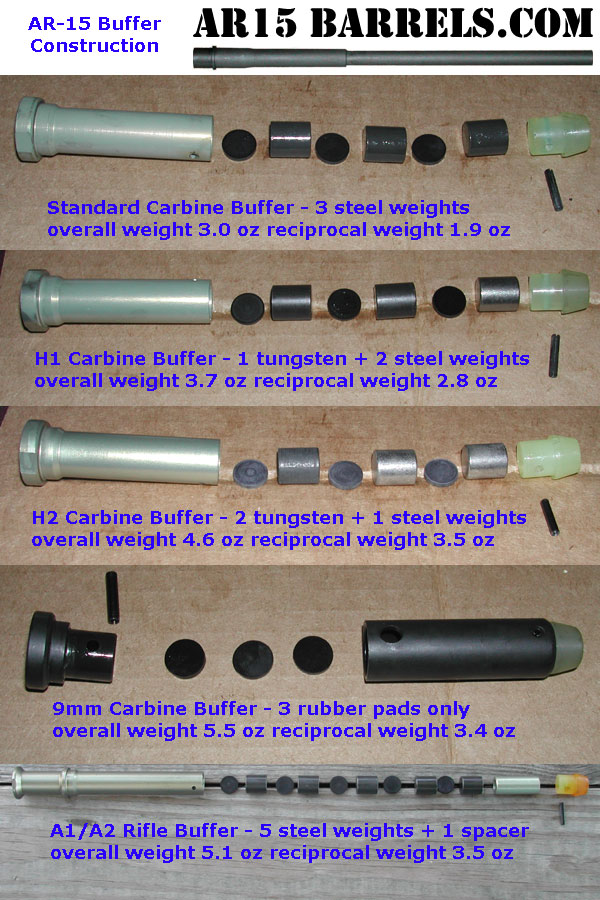
|
|
ARnewby: You didnt mention what barrel and gas system length you have or if you have a rifle or carbine length reciever extension tube. Generally speaking, all the ARs are way over gassed and that's the way it is. Precision ARs and their shooters tune the gas system to a typical load so the rifle shoots much more smoothly and it reduces the kick impulse and the brass comes out with no dents. The gun also runs cleaner with less gas and may have a little more velocity. Without knowing much about your rifle configuration or usage, it's hard to make the call on an adjustable gas block. However, it's pretty easy to recommend a JP Rifles silent captured spring (SCS) ($150) and spring kit ($40). This works in a carbine or rifle length reciever extension and allows you to tune (generally slow down rearward motion) the action with the proper spring so the BCG dosent slam fully rearward under the fully open gas system. It makes a nice improvement. It completely eliminates the original buffer and spring. I would start there and get an adjustable gas block later. Edit - Direct Drives post above mentions going heavier to slow down the action. That was the thinking in the recent past and is still correct for a full auto weapon. However, nowdays there are measured rate springs and adjustable gas blocks. All 3gun and high end precision ARs use lightweight BCGs and buffers. These lightweight parts make a big difference in the AR, but you almost have to use an adjustable gas block with them. |
|
Quoted: ARnewby: You didnt mention what barrel and gas system length you have or if you have a rifle or carbine length reciever extension tube. Generally speaking, all the ARs are way over gassed and that's the way it is. Precision ARs and their shooters tune the gas system to a typical load so the rifle shoots much more smoothly and it reduces the kick impulse and the brass comes out with no dents. The gun also runs cleaner with less gas and may have a little more velocity. Without knowing much about your rifle configuration or usage, it's hard to make the call on an adjustable gas block. However, it's pretty easy to recommend a JP Rifles silent captured spring (SCS) ($150) and spring kit ($40). This works in a carbine or rifle length reciever extension and allows you to tune (generally slow down rearward motion) the action with the proper spring so the BCG dosent slam fully rearward under the fully open gas system. It makes a nice improvement. It completely eliminates the original buffer and spring. I would start there and get an adjustable gas block later. He said it's a Rock River LAR-15 Elite Tactical Operator II. Which from my understanding uses a 16" mid-length gas system, 1/9 twist barrel. ETA: JeffinVAB, I think you are getting too complicated here. His rifle is fine, he doesn't need to change anything. If he wants to reduce his brass being dented, he can swap in a heavier buffer and it might help reduce the dents due to a change in ejection path. ETA2: OP, does your brass look like this??  That's what one of my Rock River rifles was doing to brass, and it was fine. |
|
Muad...That is exactly what my fired brass looks like! Right down to the very small scratches on the case necks which are located in the same spot relative to the case body dent. Good to know that it is not a problem if I wish to reload them. Thanks... you saved me from having to figure out how to upload a photo.
As you stated, my barrel length is 16" (add 1 1/2 inches for the factory brake). Twist is 1:9. Stock is collapsible. The rifle is has a Wylde chamber so I expect handloads to get better velocity and better accuracy given the extra throat length. I have a modified .223 case on the way to check the distance to the lands using my Stoney Point (Hornady L&L) OAL gauge but i plan on loading to magazine length. Using the caliper mounted gauge, my headspace grew only 3 to 4 thousandths from factory loaded head space to the head space after firing in my rifle. The factory unfired rounds measured 1.452 and the fired rounds measure 1.455. So far I am pleased and the rifle is a ton of fun to shoot. Thanks to everyone for the comments so far. The heavier buffer is something that I will most likely look into at some point. |
|
Scratches on the case mouth are usually caused by the feed ramps. I prefer to run a H buffer in most of my rifles, its possible moving to an H or H2 will change your extraction pattern enough to keep the brass from denting against the deflector. One way or another its not a big deal, the deflector is their to bounce brass off of. ETA: most guns will run fine with everything from a carbine to an H3 buffer. Occasionally problems expose themselves, but you don't know until you've tried it. H is standard with Colts and H3 is about the same weight as a rifle buffer. |
|
Quoted:
Direct-Drive...Thanks for the great information. The pictures make it easy to understand. Will experimenting with a heavier buffer effect the accuracy of the rifle or the ability to eject the brass? Thanks No, accuracy will not be affected. A heavier buffer will just slow down the BCG as it travels rearward, giving the ejector a longer time window to kick out the spent case. For reference, I have a 16" mid-gasser with an H2 buffer and it runs perfectly with Lake City XM193 (full power 5.56) (clean 3:30 - 4:00 eject) |
|
Quoted:
Quoted:
Long time handloader but I am new to AR thus my handle. I have read a few articles here but this is my first post. Great information BTW. I recently purchased and fired for the first time my newest AR. Rock River LAR-15 Elite Tactical Operator II with a chromed bolt carrier group. (I also have a couple of Colts that have been safe queens for many years.) While sighting in and getting the feel for this weekend I noticed that all of my cases have noticeable dents at the midway point of the body of the case. I was firing 55gr. factory UMC (Union Metallic Cartridge Co.) ammo, .223 Remington that chronographed at 2830 fps. (I was expecting the velocity to be higher.) After a few rounds I noticed brass collecting on the leading edge of the brass deflector so I'm thinking that the carrier is coming back so fast that the ejector does not have time to toss the brass hard enough to clear the exterior of the gun so the brass is slapping it. Later, I removed and weighed the buffer weight...3.0 oz. and compaired it to a buffer in one of the Colts ...5 1/8 oz. Would more buffer weight in the RR stop the case dents that i am seeing or am I looking in the wrong place to eleviate this problem? I'm afraid that the cases are spoiled for handloading and I would really like to understand and find out how to fix this. If anyone could share their thoughts I would greatly appreciate it. .223 civvie ammo is loaded to lower pressures than 5.56, hence the slower velocity. OK to fire .223 in a 5.56 chamber, not OK to fire full power 5.56 in a .223 chamber. There are two buttstock systems for the AR____Carbine (telestock, collapsible) and Rifle (A1,A2) NONE of the parts, starting from the back of the receiver, interchange within the two systems. Sounds like you are comparing a Standard (CAR) buffer with a Rifle buffer...two different animals. If you want to slow down your action and you are running the Carbine system, you can try some heavier buffers. Owning a Carbine buffer and an H3 buffer you can make up any weight in between if you want to economize. H3 is not pictured and has 3 tungsten slugs.... http://www.ar15barrels.com/tech/buffer-construction.jpg Loaded pressures of the two rounds while different is really not the main concern. The main issue between the two is the leade,(or Throat) length which causes the over pressure situation when 5.56 is run through a .223 chamber. |
|
The brass deflector is doing it's job. A heavier buffer will slow down the rearward cycle and might help with where it ejects and it might help keep the brass from hitting the brass deflector. I don't find it necessary but some people have used with good results a piece of Velcro[the soft side] stuck on their brass deflector to help with the dented cases. Take the soft side of the Velcro and cover your entire brass deflector. So even if the spent brass hits the deflector it might not get dented. |
|
Quoted:
Quoted:
Quoted:
Long time handloader but I am new to AR thus my handle. I have read a few articles here but this is my first post. Great information BTW. I recently purchased and fired for the first time my newest AR. Rock River LAR-15 Elite Tactical Operator II with a chromed bolt carrier group. (I also have a couple of Colts that have been safe queens for many years.) While sighting in and getting the feel for this weekend I noticed that all of my cases have noticeable dents at the midway point of the body of the case. I was firing 55gr. factory UMC (Union Metallic Cartridge Co.) ammo, .223 Remington that chronographed at 2830 fps. (I was expecting the velocity to be higher.) After a few rounds I noticed brass collecting on the leading edge of the brass deflector so I'm thinking that the carrier is coming back so fast that the ejector does not have time to toss the brass hard enough to clear the exterior of the gun so the brass is slapping it. Later, I removed and weighed the buffer weight...3.0 oz. and compaired it to a buffer in one of the Colts ...5 1/8 oz. Would more buffer weight in the RR stop the case dents that i am seeing or am I looking in the wrong place to eleviate this problem? I'm afraid that the cases are spoiled for handloading and I would really like to understand and find out how to fix this. If anyone could share their thoughts I would greatly appreciate it. .223 civvie ammo is loaded to lower pressures than 5.56, hence the slower velocity. OK to fire .223 in a 5.56 chamber, not OK to fire full power 5.56 in a .223 chamber. There are two buttstock systems for the AR____Carbine (telestock, collapsible) and Rifle (A1,A2) NONE of the parts, starting from the back of the receiver, interchange within the two systems. Sounds like you are comparing a Standard (CAR) buffer with a Rifle buffer...two different animals. If you want to slow down your action and you are running the Carbine system, you can try some heavier buffers. Owning a Carbine buffer and an H3 buffer you can make up any weight in between if you want to economize. H3 is not pictured and has 3 tungsten slugs.... http://www.ar15barrels.com/tech/buffer-construction.jpg Loaded pressures of the two rounds while different is really not the main concern. The main issue between the two is the leade,(or Throat) length which causes the over pressure situation when 5.56 is run through a .223 chamber. They are actually both a concern. I didn't want to complicate the issue with leade/freebore differences. Not necessary for this conversation. |
|
Quoted: Muad...That is exactly what my fired brass looks like! Right down to the very small scratches on the case necks which are located in the same spot relative to the case body dent. Good to know that it is not a problem if I wish to reload them. Thanks... you saved me from having to figure out how to upload a photo. As you stated, my barrel length is 16" (add 1 1/2 inches for the factory brake). Twist is 1:9. Stock is collapsible. The rifle is has a Wylde chamber so I expect handloads to get better velocity and better accuracy given the extra throat length. I have a modified .223 case on the way to check the distance to the lands using my Stoney Point (Hornady L&L) OAL gauge but i plan on loading to magazine length. Using the caliper mounted gauge, my headspace grew only 3 to 4 thousandths from factory loaded head space to the head space after firing in my rifle. The factory unfired rounds measured 1.452 and the fired rounds measure 1.455. So far I am pleased and the rifle is a ton of fun to shoot. Thanks to everyone for the comments so far. The heavier buffer is something that I will most likely look into at some point. Glad I could help. I freaked out when mine did this as well, and I posted that same photo here to get help. Someone above mentioned adding some Velcro , that's a great idea! Good luck, and enjoy that RRA. They are some of the most accurate factory built rifles out there. |
|
Quoted:
Quoted:
Quoted:
Quoted:
Long time handloader but I am new to AR thus my handle. I have read a few articles here but this is my first post. Great information BTW. I recently purchased and fired for the first time my newest AR. Rock River LAR-15 Elite Tactical Operator II with a chromed bolt carrier group. (I also have a couple of Colts that have been safe queens for many years.) While sighting in and getting the feel for this weekend I noticed that all of my cases have noticeable dents at the midway point of the body of the case. I was firing 55gr. factory UMC (Union Metallic Cartridge Co.) ammo, .223 Remington that chronographed at 2830 fps. (I was expecting the velocity to be higher.) After a few rounds I noticed brass collecting on the leading edge of the brass deflector so I'm thinking that the carrier is coming back so fast that the ejector does not have time to toss the brass hard enough to clear the exterior of the gun so the brass is slapping it. Later, I removed and weighed the buffer weight...3.0 oz. and compaired it to a buffer in one of the Colts ...5 1/8 oz. Would more buffer weight in the RR stop the case dents that i am seeing or am I looking in the wrong place to eleviate this problem? I'm afraid that the cases are spoiled for handloading and I would really like to understand and find out how to fix this. If anyone could share their thoughts I would greatly appreciate it. .223 civvie ammo is loaded to lower pressures than 5.56, hence the slower velocity. OK to fire .223 in a 5.56 chamber, not OK to fire full power 5.56 in a .223 chamber. There are two buttstock systems for the AR____Carbine (telestock, collapsible) and Rifle (A1,A2) NONE of the parts, starting from the back of the receiver, interchange within the two systems. Sounds like you are comparing a Standard (CAR) buffer with a Rifle buffer...two different animals. If you want to slow down your action and you are running the Carbine system, you can try some heavier buffers. Owning a Carbine buffer and an H3 buffer you can make up any weight in between if you want to economize. H3 is not pictured and has 3 tungsten slugs.... http://www.ar15barrels.com/tech/buffer-construction.jpg Loaded pressures of the two rounds while different is really not the main concern. The main issue between the two is the leade,(or Throat) length which causes the over pressure situation when 5.56 is run through a .223 chamber. They are actually both a concern. I didn't want to complicate the issue with leade/freebore differences. Not necessary for this conversation. Understand.....  
|
AR Sponsor