


Posted: 8/15/2011 7:40:08 AM EDT
| Is there an easy way to explain the difference between absolute, 1/3, and the advantages between the different heights and what one would most likely want or need? |
|
Absolute the dot is in line and obscured by the irons. 1/3, the irons are in the lower third of the Aimpoint and out of line from the irons. 1/3 makes the dot easier to pick up since its not partially blocked by iron sights.
I called LT a while back and they suggested the tall mount for the T1. I'm glad I went that direction. |
|
Here's my canned response. Hope it helps.
________________________________ Why Lower 1/3? Since most LaRue red-dot mounts are lower 1/3, we get asked this all the time. The short answer is...it was "by request". The long explanation is, it's really all about reducing clutter, and always being ready. Our Aimpoint and EOTech mounts are optimally designed for weapon systems that run with fixed sights or BUIS's deployed in the upright position. Since it takes time to deploy flip-up irons, we here at LaRue (and many instructors) recommend you operate with the irons upright when possible. Chances are, if you actually need your irons, you're getting pretty busy, with at least one threat occupying your attention. Keeping them up, but out of the way, is the best of both worlds. Our lower-1/3 design keeps those irons out of the way, until they are needed. Clutter in you field of view (FOV) isn't a good thing...with respect to the popular T1 micro, an upright rear sight can optically cover roughly 50% of the FOV. You can cover the front of an Aimpoint all you want, and still use the sight (keeping both eyes open), but covering the rear obstructs both target and reticle. (see the pic below). 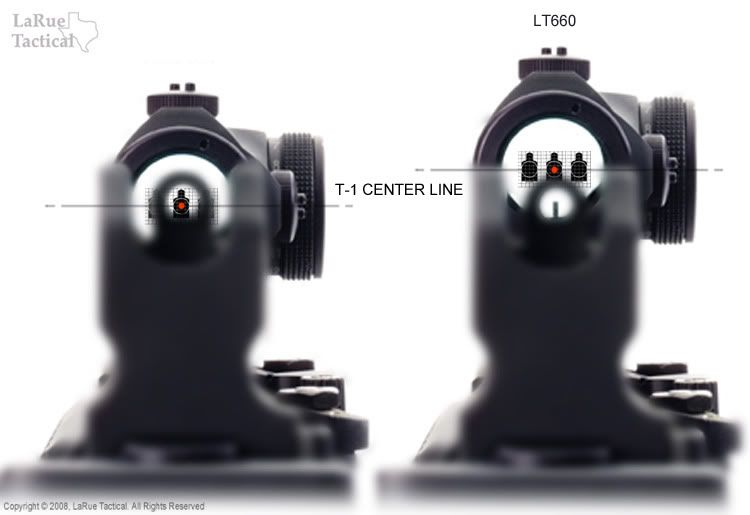
Years ago, I was at a carbine class where the student next to me was noticeably lagging-behind during the live-fire drills. The instructor asked what the issue was, he said he was having problems "precisely lining-up the irons with the EOTech reticle"....and the cluttered view made it "hard to find the target". He wasn't super slow, just slightly slower than everyone else. After we removed his irons, and he almost instantly shot faster when given an unobstructed view, and began using the reticle the way it was intended. It wasn't the last time I observed this behavior. "What about my cheek weld?" Well...cheek weld is one of the most important factors that provide successful results when precision shooting. Especially when using high-magnification...We make several different mount heights for rifle scopes that keep that issue in mind. That being said, cheek weld with a non-magnified red-dot optic (like an Aimpoint or an EOTech) is marginally more important than proper cheek weld with an aiming laser. Generally speaking, if you see the reticle, you're operational. Most people find the cheek weld with our mounts for these optics to be more than adequate, and the shift to the lower 1/3 for irons is minimal and intuitive. Keep in mind, Aimpoints and EOTechs are intended to be used while in a variety of firing positions, many of which have little, or no cheek weld. If you are concentrating on cheek weld too much, you are not using the technology to it's fullest. Hope all this helps clarify... Even when you use the lower-1/3 method, the dot can be used "centered" in the tube. When both irons and dot zeroed, you can hit any target you can put the dot on, anywhere in the viewing area...independent of the irons. When you shift your eye position to the irons, the dot will follow (unless you turn the unit off). 
As you move your head, and keep the weapon steady, the dot will not move. That's the beauty of a red dot (like Aimpoints and EOTechs). The red dot and the Irons work completely independent of each other. It's a common misconception that you need to center the red dot and the irons in the viewing area. 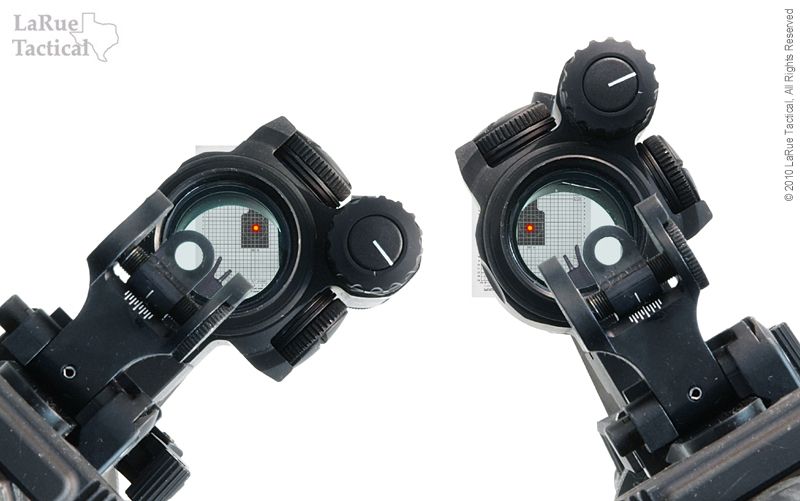
Another illustration that reinforces the advantages of a 1/1 red dot (like this Aimpoint CompM4) If you can see it, you can hit it. |
 much better than mine