


Posted: 12/15/2009 7:04:06 PM EDT
|
Back in the summer of 2002 my son won a goldfish at a carnival. It was one of the throw the ping pong balls into the bottle games. I let him keep the fish and ended up buying a 5 gallon tank for the little guy.
Many other fish have been introduced to "death from above" (what my son named him at 4 years old) and all have perished. Now he's in a 10 gallon tank running with a 30 gallon filter since it shits like a dog. The fish is now around 6-7 inches long and I can no longer remove it to clean the tank...I just siphon out 3/4 of the water and refill. How long do these things live??? ETA: This is just a little feeder type fish. |
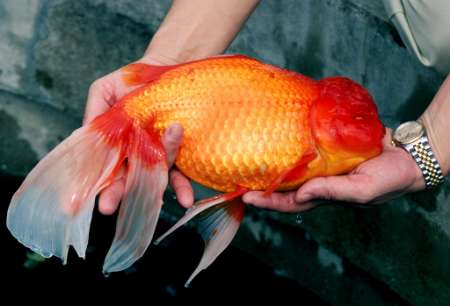
| Holy shit! I could have posted this. My son won 2 goldfish at that ping-pong ball throw game at a carnival. That was 3 years ago. I've upsized his fish tank twice and they're still growing. We're already talking about giving them to our neighbor next Spring. She has a Koi pond and by then they should be big enough to not be eaten by her fish. |
|
Quoted:
Back in the summer of 2002 my son won a goldfish at a carnival. It was one of the throw the ping pong balls into the bottle games. I let him keep the fish and ended up buying a 5 gallon tank for the little guy. Many other fish have been introduced to "death from above" (what my son named him at 4 years old) and all have perished. Now he's in a 10 gallon tank running with a 30 gallon filter since it shits like a dog. The fish is now around 6-7 inches long and I can no longer remove it to clean the tank...I just siphon out 3/4 of the water and refill. How long do these things live??? ETA: This is just a little feeder type fish. They can live forever. The size of the fish is correlated to the size of the tank. Bigger the tank bigger the fish. If you keep cleaning and feeding it, it will outlive you. |
|
I got one as a surprise gift from a friend that was moving.It's been living on my bookshelf for ~3 years and was hers for I don't have a clue before that.It's one of the fancy split finned bubble types of things and has never grown larger than 4" but I'm fine with that.
My last betta lived for 8 years so this thing is probably going to make it forever.The catfish I have in the other aquarium,also a present, survived being forgotten under a table after a move for 2 months of no aeration,filtering or feeding so he's a champ too or else I'm good with fish.The damned quaker parrot of doom someone else foisted on me will probably outlive the roaches by surviving on nothing but spite and meanness but that's another story. |


|
Quoted:
87 years. You're not far off, considering most people see them as a "disposable" pet. I've met plenty who kept their goldfish in proper conditions(filtered tank, periodic maintenance) that had 20 year old goldfish, and Guinness Records lists one that was almost 50 IIRC. |
|
Quoted:
Quoted:
Back in the summer of 2002 my son won a goldfish at a carnival. It was one of the throw the ping pong balls into the bottle games. I let him keep the fish and ended up buying a 5 gallon tank for the little guy. Many other fish have been introduced to "death from above" (what my son named him at 4 years old) and all have perished. Now he's in a 10 gallon tank running with a 30 gallon filter since it shits like a dog. The fish is now around 6-7 inches long and I can no longer remove it to clean the tank...I just siphon out 3/4 of the water and refill. How long do these things live??? ETA: This is just a little feeder type fish. They can live forever. The size of the fish is correlated to the size WATER QUALITY of the tank. Bigger the tank bigger the fish. If you keep cleaning and feeding it, it will outlive you. Fixed. The "they grow to their environment" is a myth that won't die. It comes from the fact that the average goldfish is kept for its entire lifespan(<1 year in many cases) in a 3 quart fishbowl. A consequence of that is it never has optimal water conditions. No filter to get rid of bad stuff, and when the tank finally conditions itself to a point that it can "support" a fish the water gets changed for lack of visibility. Goldfish are a type of carp, and can get huge-I've seen a few that were kept in well maintained koi ponds that rivalled the koi for size(3-5 pounds). I challenge anyone who believes the "fish grow to their environment" theory to buy an arrowana and put it in a 10 gallon tank. You'll be shopping for a 75 gallon by the time summer's over if you run the tank like you should. Same holds true for goldfish. With "Livable" water conditions they grow. Then grow some more. I've seen 10 inch goldfish that grew to that point in a 10 gallon tank. Owner finally bought a 55 gallon. ETA-a goldfish's lifespan in my aquarium is measured in hours. My blackfin shark(a catfish, not a true shark) is voracious and eats everything I put in with him. He's such an eater I want to go back to piranhas. Compared to catfish, piranhas are pussies. |
|
Quoted:
when the tank finally conditions itself to a point that it can "support" a fish the water gets changed for lack of visibility. How often should I change the water? I average a new filter and water change every two weeks. I add water conditioner and salt to the new water. |
|
Quoted:
Pretty damn big, also, the oldest goldfish on record died at 43 years old. http://cellar.org/2002/recordgoldfish.jpg And dude, a 10 gallon tank?! Get the poor thing a bigger tank, look on your local Craigslist for a bigger tank for cheap. My dad has a gold fish that is at least 15 years old and is about that big without the funky head. It kind of looks like a Koi now it's so big. It started life as a feeder fish but had a 25 gallon all to itself for years upon end and it's still going strong. I think being "outside" in a closed but non heated patio has been pretty good for it. Hibernation. |
|
Quoted:
Quoted:
when the tank finally conditions itself to a point that it can "support" a fish the water gets changed for lack of visibility. How often should I change the water? I average a new filter and water change every two weeks. I add water conditioner and salt to the new water. Depending on size and amount of fish, most petshops recommend 10-30% water changes once a week. Running a bigger filter like that you can probably get by with every second week, unless the tank "looks" dirty. Use a siphon and suck water from the bottom of the tank, taking the crap and any other "dirt" with it. Don't overclean, the bacteria that build up in the tank are an important part of the filtration as well. Your schedule sounds good, but I'd recommend "storing" your water in between changes. I have one of the big 5 gallon refill jugs from walmart that I keep extra water in. You can still add the conditioner but if the water is aged in between changes things tend to go better in the tank. "Instant" water conditioners aren't as instant as the manufacturers like you to think. It's a 30 cent goldfish right now but you might eventually move to more expensive fish, and it sucks to lose a $15 fish to a stupid mistake. The arrowana I had last year found the one hole in my tank cover and jumped out. I found him the next day. Bitch of it was, I knew they were jumpers and knew I needed a better cover, so it was my own stupidity. |
|
Fish grow to the size of the tank due to a hormone they secrete into the water. The bigger the tank, the more diluted the hormone is and the quicker they grow. I inherited an iridescent shark and a pleco that were 3-4 years old and kept in a 29 gallon tank - they immediately got noticeably bigger when put in my 55 gallon tank. When I moved my fish from the 55 gallon into a 180 gallon, they again got noticeably bigger (and more active).
Link
Feedback regulation of growth hormone synthesis and secretion in fish and the emerging concept of intrapituitary feedback loop. Growth hormone (GH) is known to play a key role in the regulation of body growth and metabolism. Similar to mammals, GH secretion in fish is under the control of hypothalamic factors. Besides, signals generated within the pituitary and/or from peripheral tissues/organs can also exert a feedback control on GH release by effects acting on both the hypothalamus and/or anterior pituitary. Among these feedback signals, the functional role of IGF is well conserved from fish to mammals. In contrast, the effects of steroids and thyroid hormones are more variable and appear to be species-specific. Recently, a novel intrapituitary feedback loop regulating GH release and GH gene expression has been identified in fish. This feedback loop has three functional components: (i) LH induction of GH release from somatotrophs, (ii) amplification of GH secretion by GH autoregulation in somatotrophs, and (iii) GH feedback inhibition of LH release from neighboring gonadotrophs. In this article, the mechanisms for feedback control of GH synthesis and secretion are reviewed and functional implications of this local feedback loop are discussed. This intrapituitary feedback loop may represent a new facet of pituitary research with potential applications in aquaculture and clinical studies. Another link
Aquarium Giants: Which Fish Get HUGE? Can your tank handle that fish you've been eyeing? It's easy for people looking at the wide selection of fish at the pet store to be tempted to buy a fish they don't know much about because they like the looks of it; unfortunately this can often lead to incompatible fish or an incompatible tank and the fish is the one that gets to suffer for the purchaser's ignorance. Many people even see a little information card informing them that this particular fish reaches very large sizes but perhaps they suscribe to the widely-accepted myth that fish grow to the size of their tank...and that's exactly what it is, a myth. While it is true that fish secrete a growth hormone to keep from entirely growing out of their tank it is equally true that they generally do not stop growing until they are already too large to live comfortably in the tank, their life spans will be shortened by stunting induced by inappropriate housing, and they will never reach their full potential for health and beauty. Some types of fish such as Oscars or Gouramis have a slightly different reaction to that growth hormone...only their heads stop growing, so eventually that poor fish's mouth will morph by the body's continuing growth until the fish can no longer eat and then it dies a slow and painful death. Since you're reading this article I can assume that you are a caring and responsible pet owner who wants to learn what you can to properly care for your pet...perhaps you're looking at adding new fish, maybe you've made the mistake of buying the wrong one for your tank before and are trying to avoid doing it again, whatever the reason you have taken a responsible step in researching these pets. Please be aware that this is only a listing of popular freshwater fish that are often subjected to mistreatment due largely to their adult size (most are sold in pet stores as babies) and you should definitely research any pet you're planning on buying in-depth before making the decision. Goldfish - These rank at the very top because they are the single most abused animal in the United States (I can't speak for other countries as I've never done research on those statistics) and a lot of it is due to their unique size requirements and their ready availability at affordable prices in stores. No, a goldfish is not a "throwaway pet", they are exceptionally hardy and if cared for properly can live for up to...drum roll please...30 years! These are one of those fish that will stop growing entirely if the tank is too small (but are often already too big when they stop growing) and will almost certainly have a significantly reduced life span from the stunting. A single-tailed goldfish such as a common, comet, or shubunkin can and often do reach sizes upward of 16" and need at least 30 gallons per fish with a tank at least four times their size in length and twice their size in width (a size parameter that holds true for most large fish). A double-tailed goldfish such as a ryukin, lionhead, or pearlscale may only reach 8" in length and don't need as much free swim space because of their build but still need a good 10-15 gallons each (more for some of the larger fancies such as orandas). Sadly goldfish bowls are still in common usage and are one of the worst environments for that fish due to improper or no filtering, exceedingly small spaces, and not enough water changes. Bear in mind that goldfish also produce a lot of waste and will need some very strong filtration...for more specifics on proper goldfish care check out the resources available at http://www.kokosgoldfish.com (please note, I am not affiliated with this site in any way, it is merely the best site I've ever found for goldfish information). Tinfoil Barbs - Easily and quickly reaching sizes up to 14" with an attitude to match, these fish are often purchased in the belief that they will get along just fine with their smaller barb cousins such as the Tiger Barb or Gold Barb where in actuality the Tinfoil will be able to cheerfully snack on these smaller fish within a couple short months. These fish are active and an attractive silver with black fins that are often bought for their looks without any prior knowledge regarding their temperment or size requirements. Oscars - I'd like to think most people know what they're getting into with these fish but sadly I'm discovering that that just isn't true. Less than a year ago I had a customer ignore my assertion that the Oscar he was eyeing would not fit in his 10 gallon tank...after all, the fish was only 3" long! He was one of the better ones, though, in that the man returned the fish four months later when the fish had nearly tripled his size rather than making him suffer in a tank unsuited to him as is sadly still common practice. I'd also like to think that this common practice is due to pet owners not knowing any better rather than willfully abusing their fish but unfortunately that's not always true either. Pacus - There are many different species of Pacus, the ones I see most around here are Red-Bellied Pacus but all are closely related to piranhas, have varying levels of aggressiveness, and all get quite large...many over a foot long. A Pacu is a very attractive and outgoing fish but will be a major problem in your tank if you haven't planned properly for him ahead of time. Silver Dollars - Relatively small in this company, the silver dollar generally grows to around 8" in diameter...which is still pretty big compared to most of the popular community fish out there! Silver Dollars prefer to be in groups, and a group of 8" fish takes up a lot of space very fast. Gouramis - Gouramis come in a variety of sizes but all are pretty large...generally sold in pet stores around 2"-3" Gold Gouramis, Blue Gouramis, Pearl Gouramis and the like reach about 8" while Kissing Gouramis hit up to 12" and Giant Gouramis grow to a whopping 28"! There are some smaller Dwarf Gouramis that only grow 4"-5", but be absolutely certain you know what you're getting before you buy them, you don't want to expect 5" and end up with two feet. Knife Fish - Knife fish are a very attractive fish that is also seen in pet stores at just about 2" long...but the Ghost Knife can reach sizes of up to 20", the Banded Knife can get to 24", the Glass Knife hits around 18", and my absolute favorite the Clown Knife can reach a whopping 40" in length. These are exceedingly interesting fish to look at (my sister thinks they're creepy when they're big though) and can make some gorgeous specimens if kept properly. Irridescent Shark - Another fish I often see being sold at Wal-Mart at the adorable size of about 2" long and collected by numerous aquarists who can't understand why their peaceful community fish start disappearing and start wondering when that fish will stop growing. Truth is these attractive little fish need at very least 135 gallons in a long tank and reach sizes of 40". Sadly very few of these fish get to live out their entire life span due to misunderstandings about them and often die within a year or two either from overcrowding or inappropriate water parameters (they can get somewhat picky about that). Common Plecostomus - Another very widely abused fish that can reach over two feet in size. Unlike some of the carnivorous giants the Pleco can take up to a couple of years to reach its full size so it can sneak up on you and reign destruction on your tank décor as it gets larger and more crowded. Pomacea canaliculata - while not a fish I nevertheless felt that these snails deserved a mention...while most "mystery snails" (apple snails) sold in pet stores are Pomacea bridgesii, or Brigs, some do on occasion get canaliculata, or Canas. Canas look, to the untrained eye, nearly identical to Brigs with one important difference. While a Brig grows to about the size of a golf ball and needs about 2 ½ gallons each, a Cana reaches the size of a softball and needs about 10 gallons all to itself. As with all apple snails Canas cannot be expected to live on algae alone and need some greens or snail cookies that are high in calcium to ensure their health and they are very messy creatures that require the same level of filtration you would afford to a goldfish. For more information on the care of apple snails and how to spot a Cana check out http://www.applesnail.net (again, no affiliation, I just think it's an excellent site). This is by no means a comprehensive list and I will probably be adding to it as time goes by, merely some of the most common freshwater fish that are still suffering widespread abuse because of their size and individual needs. I implore anyone who is thinking of getting a fish or has problems with the fish they have to thoroughly research every aspect of their care to ensure they're being cared for properly...if it's something you wouldn't do to a dog why is it alright to do it to a fish? Thank you for taking the time to further your understanding of these amazing animals. |
|
Quoted:
Quoted:
when the tank finally conditions itself to a point that it can "support" a fish the water gets changed for lack of visibility. How often should I change the water? I average a new filter and water change every two weeks. I add water conditioner and salt to the new water. New filter?? You can and should replace those disposable "bio bag" type filters with a sponge that you can just rinse out each week or so. Buy a sponge for an "aquaclear" filter that fits your filter housing and trim to size with a knife. Rinse out the dirty filter in the old tank water in a separate bucket before you dump it down the drain. The good bacteria you need lives in the filter and if you throw it away each week you are doing more harm than good. Tap water chlorine kills bacteria so rinse filters in old tank water and replace into filter housing. water conditioner and salt is ok if you don't want to age your water. ETA: read about the nitrogen cycle if you haven't already. (halfway down page) http://en.wikipedia.org/wiki/Aquarium |
|
Quoted:
Quoted:
Quoted:
Back in the summer of 2002 my son won a goldfish at a carnival. It was one of the throw the ping pong balls into the bottle games. I let him keep the fish and ended up buying a 5 gallon tank for the little guy. Many other fish have been introduced to "death from above" (what my son named him at 4 years old) and all have perished. Now he's in a 10 gallon tank running with a 30 gallon filter since it shits like a dog. The fish is now around 6-7 inches long and I can no longer remove it to clean the tank...I just siphon out 3/4 of the water and refill. How long do these things live??? ETA: This is just a little feeder type fish. They can live forever. The size of the fish is correlated to the size WATER QUALITY of the tank. Bigger the tank bigger the fish. If you keep cleaning and feeding it, it will outlive you. Fixed. The "they grow to their environment" is a myth that won't die. It comes from the fact that the average goldfish is kept for its entire lifespan(<1 year in many cases) in a 3 quart fishbowl. A consequence of that is it never has optimal water conditions. No filter to get rid of bad stuff, and when the tank finally conditions itself to a point that it can "support" a fish the water gets changed for lack of visibility. Goldfish are a type of carp, and can get huge-I've seen a few that were kept in well maintained koi ponds that rivalled the koi for size(3-5 pounds). I challenge anyone who believes the "fish grow to their environment" theory to buy an arrowana and put it in a 10 gallon tank. You'll be shopping for a 75 gallon by the time summer's over if you run the tank like you should. Same holds true for goldfish. With "Livable" water conditions they grow. Then grow some more. I've seen 10 inch goldfish that grew to that point in a 10 gallon tank. Owner finally bought a 55 gallon. ETA-a goldfish's lifespan in my aquarium is measured in hours. My blackfin shark(a catfish, not a true shark) is voracious and eats everything I put in with him. He's such an eater I want to go back to piranhas. Compared to catfish, piranhas are pussies. Ahh Piranhas... when I was a teenager my sisters bf gave me a few adults which later spawned, leaving me with a 10g tank full of fry. The adults definitely were skittish and wimpy and would bash all around the tank walls like pathetic frightened creatures whenever you made sudden movements or turned a light on. The fry I raised, however didn't seem to have fear of me and would actually come to the top of the tank when I was around and feed on hikari cichlid pellets (could never get the parents to eat dry food much less get anywhere near the surface when I was around.) I would toss in a live fish or water dog once and while to entertain friends. I sold all but one with the most personality and kept him as a "pet" for a couple more years before selling him to a local pet store owner. Unusual for a piranha, but he seemed to have a goldfish like memory and seemed to recognize me whenever I was near the tank. Oh and OP, goldfish live a long time and are very hardy.... my parents pool remained empty for years and would collect rain water at the lower levels (I'd have to siphon it every now and again) and once just for the heck of it tossed in a couple of feeder goldfish to see how long they would last. Well, instead of dying, they grew 3-4x the size in less than a year. They fed on mosquito larvae and algae and whatever junk was in there. I think some herons came along and ate them out after they became nice and juicy because one day they all mysteriously disappeared... 
|
|
Quoted:
New filter?? You can and should replace those disposable "bio bag" type filters with a sponge that you can just rinse out each week or so. Buy a sponge for an "aquaclear" filter that fits your filter housing and trim to size with a knife. Rinse out the dirty filter in the old tank water in a separate bucket before you dump it down the drain. The good bacteria you need lives in the filter and if you throw it away each week you are doing more harm than good. Tap water chlorine kills bacteria so rinse filters in old tank water and replace into filter housing. water conditioner and salt is ok if you don't want to age your water. ETA: read about the nitrogen cycle if you haven't already. (halfway down page) http://en.wikipedia.org/wiki/Aquarium We wash our filters when we feel they need it. There's plenty of 'good' bacteria in the tank itself, and after the cleaning the bacteria quickly recolonize the filter. Most non-disposable filter media such as bio-wheels and bio-balls don't need to be washed, but if bio-balls get yucky we don't hesitate to wash them. We've never washed a bio-wheel though. ETA: IIRC, nitrosomas and nitrobacter divide about every 20 minutes, so recolonizing a reusable filter pad really should not take very long in an established tank. |
| My daughter won one of those carnival goldfish in Feb. 2008. It's still going strong, in the same little glass bowl she brought it home in. I put some rocks in the bottom, which helps trap the crap down there and keep the water clean, and change the water every 2 weeks. No filter or anything. It's gotten a bit fatter since she brought it home but the length really hasn't changed much. |