


Posted: 3/17/2009 12:05:31 PM EDT
|
I am watching some footage from the space shuttle/NASA and they are showing the location and trajectory of the SS on a map.
Why is it's path represented as a sine wave? |
|
because an ellipitical orbit around a three dimensional spheroid is sinusoidal when plotted on a two dimensional map
ETA: To demonstrate this to yourself, get a globe and wrap a piece of string around it. this string represents the orbit of the SS aroubnd the earth. Now go grab a flat map of the world and put marks on the flat map where the string is on the globe. |
|
As the ISS orbits the Earth in its elliptical orbit the sine wave is how it gets depicted on a two dimensional map.
The upper peak of the sine wave is where the ISS is going over and "down" the far side of the Earth and the lower peak of the sine wave is where the ISS is appearing coming back "up" the near side - if that makes any sense.... 
|
|
Quoted:
Quoted:
because an ellipitical orbit around a three dimensional spheroid is sinusoidal when plotted on a two dimensional map i have no clue what you just said, can you draw a picture ? 
If you can't dazzle them with briliance, baffle them with bullshit. 
I don't understand either but it sounds mighty smart, so I believe it. 
|
|
Quoted:
Quoted:
Quoted:
because an ellipitical orbit around a three dimensional spheroid is sinusoidal when plotted on a two dimensional map i have no clue what you just said, can you draw a picture ?
If you can't dazzle them with briliance, baffle them with bullshit.
I don't understand either but it sounds mighty smart, si I believe it. I was trying to be precise, not baffle you. The earth is a sphere. Orbits are ellipitical. Ellipses are like a symetrical egg shape. You can think of it as a circle, because a circle is a type of an elipse, and I would imagine the SS has a nearly circular orbit amyway. Imagine a circle aroud a sphere-this is the the space shuttle's orbit. Now imagine slicing the sphere as if you were vertically slicing the skin of an orange. If you flatten the "skin" of this orange on a table, the circle will appear as a sinusoidal line on the flat surface. |
|
Quoted:
because an ellipitical orbit around a three dimensional spheroid is sinusoidal when plotted on a two dimensional map ETA: To demonstrate this to yourself, get a globe and wrap a piece of string around it. this string represents the orbit of the SS aroubnd the earth. Now go grab a flat map of the world and put marks on the flat map where the string is on the globe. 
BURN THE WITCH!!! |
|
Quoted:
Quoted:
because an ellipitical orbit around a three dimensional spheroid is sinusoidal when plotted on a two dimensional map ETA: To demonstrate this to yourself, get a globe and wrap a piece of string around it. this string represents the orbit of the SS aroubnd the earth. Now go grab a flat map of the world and put marks on the flat map where the string is on the globe.
BURN THE WITCH!!! I'm NOT a witch- THEY dressed me this way! |
|
Quoted:
Quoted:
because an ellipitical orbit around a three dimensional spheroid is sinusoidal when plotted on a two dimensional map i have no clue what you just said, can you draw a picture ?
No, but i can send you a link to a website that tracks satellites. Go there. Under "options" set the time to 100x and update rate to 1/4. Then under view make sure "ground trace" in enabled. Then click on any satellite you want, you will be able to see hows its moving AND the path it is tracing on the ground as its orbiting. This will give you a visual understanding of why the orbits look the way they do on a map. ETA:: the mid range altitude satellites will give you more Sinusoidal shapes than the low ones, for example, a GPS satellite. Under view click on "zoom in" or "zoom out" as needed. http://science.nasa.gov/RealTime/jtrack/3d/JTrack3D.html |
|
Quoted:
Quoted:
Quoted:
Quoted:
because an ellipitical orbit around a three dimensional spheroid is sinusoidal when plotted on a two dimensional map i have no clue what you just said, can you draw a picture ?
If you can't dazzle them with briliance, baffle them with bullshit.
I don't understand either but it sounds mighty smart, si I believe it. I was trying to be precise, not baffle you. The earth is a sphere. Orbits are ellipitical. Ellipses are like a symetrical egg shape. You can think of it as a circle, because a circle is a type of an elipse, and I would imagine the SS has a nearly circular orbit amyway. Imagine a circle aroud a sphere-this is the the space shuttle's orbit. Now imagine slicing the sphere as if you were vertically slicing the skin of an orange. If you flatten the "skin" of this orange on a table, the circle will appear as a sinusoidal line on the flat surface. What you said makes perfect sense. I was being sarcastic ( ).
The point being, even if you were incorrect, it sounds so good most people would believe you were correct. |
|
Quoted:
3d to 2d conversion. Take a globe, take a string and encircle the globe anywhere except at the equator. If you were to then flatten out the globe, the path of the string would appear as a sine wave on the flattened map. Has nothing to do with eliptical orbit. Really? So if I place the string on the globe and arange it a shape other than a circle it will still appear as a sinusoid when I flatten the globe? |
|
Quoted:
Quoted:
3d to 2d conversion. Take a globe, take a string and encircle the globe anywhere except at the equator. If you were to then flatten out the globe, the path of the string would appear as a sine wave on the flattened map. Has nothing to do with eliptical orbit. Really? So if I place the string on the globe and arange it a shape other than a circle it will still appear as a sinusoid when I flatten the globe? I wouldn't know about that, but I am pretty sure you would no longer be representing the orbit of a satellite. Rob |
|
Quoted:
Quoted:
Quoted:
3d to 2d conversion. Take a globe, take a string and encircle the globe anywhere except at the equator. If you were to then flatten out the globe, the path of the string would appear as a sine wave on the flattened map. Has nothing to do with eliptical orbit. Really? So if I place the string on the globe and arange it a shape other than a circle it will still appear as a sinusoid when I flatten the globe? I wouldn't know about that, but I am pretty sure you would no longer be representing the orbit of a satellite. Rob It wouldn't. My point is that it matters what shape a satellites orbit is 
Edited for quote fail 
|
|
Quoted:
3d to 2d conversion. Take a globe, take a string and encircle the globe anywhere except at the equator. If you were to then flatten out the globe, the path of the string would appear as a sine wave on the flattened map. Has nothing to do with eliptical orbit. This page should help those still a bit lost link Hot-linking two of their images 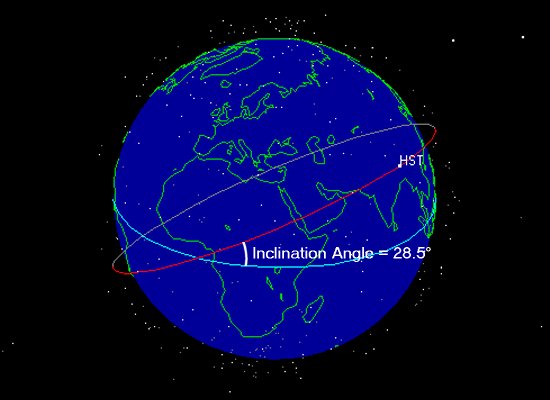
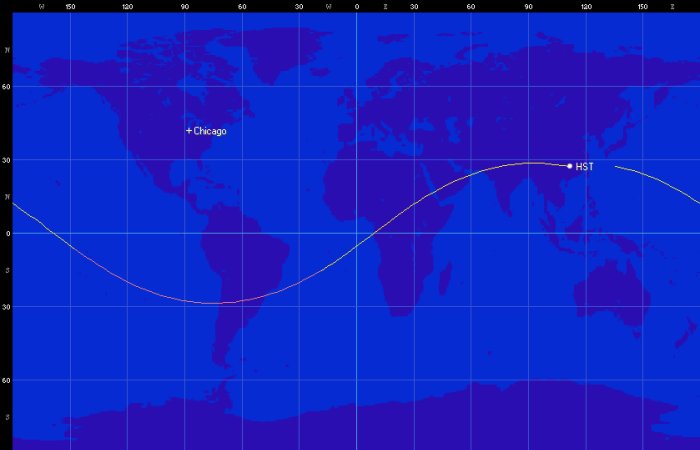
See how the shuttle flys over the same places on both the "round" image and the "flat map" version? The 'wave' is formed by flattening out the sphere. // edit spelling. |
|
posted by AR4U
It wouldn't. My point is that it matters what shape a satellites orbit is All satellites have the same orbit though, circular. You can't circle a body (like the Earth) in any type of an orbit that when represented in 3D does not "cleave" the Earth in two equal portions. I believe there was some confusion initially (re: elliptical orbits) that do not apply; the altitude of a satellite has no bearing on its representation in 2 dimensions. Rob |
|
Quoted:
because an ellipitical orbit around a three dimensional spheroid is sinusoidal when plotted on a two dimensional map ETA: To demonstrate this to yourself, get a globe and wrap a piece of string around it. this string represents the orbit of the SS aroubnd the earth. Now go grab a flat map of the world and put marks on the flat map where the string is on the globe. damn! Beat by 2 seconds 
|
|
Quoted:
Quoted:
3d to 2d conversion. Take a globe, take a string and encircle the globe anywhere except at the equator. If you were to then flatten out the globe, the path of the string would appear as a sine wave on the flattened map. Has nothing to do with eliptical orbit. This page should help those still a bit lost link Hot-linking two of their images http://www.aerospaceweb.org/question/spacecraft/ground-track/hst-orbit.jpg http://www.aerospaceweb.org/question/spacecraft/ground-track/hst-ground-track1.jpg See how the shuttle flys over the same places on both the "round" image and the "flat map" version? The 'wave' is formed by flattening out the sphere. // edit spelling. Ohhhhhhhhh, that makes more sense. |
|
Quoted:
posted by AR4U
It wouldn't. My point is that it matters what shape a satellites orbit is All satellites have the same orbit though, circular. You can't circle a body (like the Earth) in any type of an orbit that when represented in 3D does not "cleave" the Earth in two equal portions. I believe there was some confusion initially (re: elliptical orbits) that do not apply; the altitude of a satellite has no bearing on its representation in 2 dimensions. Rob I was responding to gamma762's assertion that the shape of the orbit doesn't matter, and it does. A Great Circle around a sphere apears sinusoidal on a flattened map of that sphere, and the projection of a satellite's orbit is circular because its orbit is ellipitical. If satellites didn't have elliptical orbits, then their projection on the earths surface would be something other than a Great Circle and thus their 2D representation would be something other than a sinusoid. |


|
Quoted:
Here, I made it simple to see. I took this image.... http://s5.tinypic.com/153o40y.jpg .... and 'glued' it on a sphere using GIMP, for this result... http://s5.tinypic.com/k9v24x.jpg nicely done |
|
Quoted:
That's cool DetOnate. The satellite referenced appears to be the Hubble Space Telescope, which I happened to see launched many, many, years ago on a trip to Florida with the folks. Space is cool. Rob Oooops, you are correct. I did call it the shuttle. I fail
Good catch. I've still never seen a launch. I tried to get tickets to this last shuttle launch, but it was sold out before could. And yes, space is very cool. |
|
Quoted:
because an ellipitical orbit around a three dimensional spheroid is sinusoidal when plotted on a two dimensional map ETA: To demonstrate this to yourself, get a globe and wrap a piece of string around it. this string represents the orbit of the SS aroubnd the earth. Now go grab a flat map of the world and put marks on the flat map where the string is on the globe. Well said. |