


Posted: 9/18/2007 11:40:14 AM EDT
I dont understand how photons from a laser could propel a craft in vacuum...or even in any air environment for that matter. If this guy inventing a new kind of physics or what?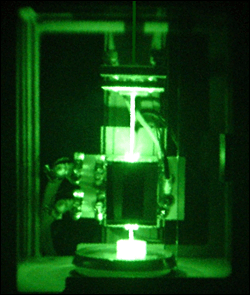  www.photonics.com/content/news/2007/September/7/88894.aspx TUSTIN, Calif., Sept. 7, 2007 -- An amplified photon thruster that could potentially shorten the trip to Mars from six months to a week has reportedly attracted the attention of aerospace agencies and contractors. Young Bae, founder of the Bae Institute in Tustin, Calif., first demonstrated his photonic laser thruster (PLT), which he built with off-the-shelf components, in December. bae2.gifYoung Bae's photonic laser thruster (Photo courtesy Bae Institute) The demonstration produced a photon thrust of 35 µN and is scalable to achieve much greater thrust for future space missions, the institute said. Applications include highly precise satellite formation flying configurations for building large synthetic apertures in space for earth or space observation, precision contaminant-free spacecraft docking operations, and propelling spacecraft to unprecedented speeds -- faster than 100 km/sec. “This is the tip of the iceberg," Bae said in a statement from the institute. "PLT has immense potential for the aerospace industry. For example, PLT-powered spacecraft could transit the 100 million km to Mars in less than a week.” Bae founded the institute to develop space technologies and has pursued concepts such as photon, antimatter and fusion propulsion for more than 20 years at SRI International, Brookhaven National Lab and the Air Force Research Lab. He has a PhD in atomic and nuclear physics from UC Berkeley. Several aerospace organizations have expressed interest in collaborating with the institute to further develop and integrate PLT into civilian, military and commercial space systems, Bae said, and he has recently been invited to present his work by NASA, JPL, DARPA and the Air Force Research Laboratory (AFRL). Franklin Mead, a senior aerospace engineer at AFRL, said in a Bae Institute statement that the PLT demonstration and measurement of photon thrust is "pretty incredible. I don’t think anyone has done this before. It has generated a lot of interest." youngbae.gifYoung Bae, founder of the Bae Institute (Photo courtesy Bae Institute) The institute said Bae’s paper, “Photonic Laser Propulsion: Proof-of-Concept Demonstration,” was recently accepted for publication this year in the American Institute of Aeronautics and Astronautics' Journal of Spacecraft and Rockets. It documents how he overcame the inherent inefficiencies of traditional photon thrusters in generating thrust by amplification with the use of an innovative optical cavity concept. "For decades, rocket scientists have tried to overcome the inefficiency of photon thrusters by amplification based on optical cavities separated from laser sources, but failed," the institute said. "In contrast, Bae’s PLT (patent pending) places the laser medium within a resonant optical cavity between two platforms to produce a very stable and reliable thrust that is unaffected by mirror movement and vibration -- ideal for spacecraft control or propulsion." Bae will present at the AIAA SPACE 2007 Conference & Exposition, to be held Sept. 18-19 in Long Beach, at four sessions: Space Transportation Systems, Promising Space Concepts from the NASA Institute of Advanced Concepts (NIAC), Space Systems for the Next 50 Years, and Advanced Vehicle Systems. The PLT research was partially funded by NIAC (NASA Institute of Advanced Concepts) as part of a spacecraft formation flight concept grant. For more information, visit: www.baeinstitute.com |

Nope same old physics. For every action there is an equal and opposite reaction. Instead of throwing large slow moving chemicals out the back of his engine, he's throwing lots lof light but very fast particles. Sounds similar in idea to an Ion engine. The "get to Mars in a week" statment I'll bet is hype based on 'predicted' future improvments. |
ok, but that only works if the radiation is directed at an object. How does one get forward motion with a thruster attached to the ship with the laser pointing out the back end with nothing for the radiation to splash onto? |
| Scaled up I assume it's going to draw a lot of power. How are you going to power it? Nuclear seems like the most likely candidate, but they aren't too fond of putting that kind of stuff in rockets for fear of a catastrophe (rocket exploding on launch pad, etc) are they? |
| See Tsiolkovsky's rocket equation for a semi-formal explanation of how an ideal rocket works. Most rocket scientists strive to maximize the specific impulse of a rocket to make it more efficient ( specific impulse is the velocity of the exhaust ). You can't do much better than the speed of light :) |
its the same concept though rockets still work in outers space, even though there is nothing to push against so does compressed air en.wikipedia.org/wiki/Newton's_laws_of_motion 35 µN isn't a lot though, the space shuttle engines put out 1.8 MN |

Point. It takes just as much effort to slow down as it does to speed up. IIRC the ion engine that is already working (indeed, I think we've got atleast one deep space satellite using it) is capable of exceptional speeds it's just a problem that it takes a very very long time to accelerate. |
I think the laser is either earth bound or in orbit. The laser is aimed constantly at the craft which has a reflector at its rear. There is that sail idea which uses light and the solar wind to propel a craft at incredible speeds too. The thing about the laser IIRC is that there is no (or much less) drop-off of force as distance increases. With the sun, the force drops off as the square of distance. That is when you are twice as far away, you only get 1/4 the force. With the laser, the force should remain relatively constant. Another interesting idea is to put solar powered lasers in fairly close orbit around the sun, and use combined laser and solar sail technologies---which still need more development. This may allow exploratory missions to reach the nearest stars within a reasonable amount of time---maybe a decade or so. Edit: Spelling. |
Caveat-I did poorly in physics: Wouldn't the orbital platforms actually push themselves away from the spacecraft,as well as pushing the spacecraft,thus altering their orbits/position? |
The slight pushing that the orbiting satellite could also be used to help keep it in orbit. There would be pressure from the sun that would tend to push the satellite outward (mildly), gravity to pull it in, and angular momentum to keep it in orbit. Any additional pushing toward the sun by the laser could be negated easily. |
|
I think the most likely scenario would be to supplement the system with conventional trusters to get it going, then shut them down and use the photon thruster to gradually accelerate over time. The cool thing is, in space, there is no drag, so the vehicle would continue without any thrust once it attains a given speed. Constant thrust should produce constant acceleration. Slowing down would be accomplished with conventional thrusters as well. This method would require a lot less fuel for the conventional thrusters, I'd imagine. The whole "week vs. 6 month" thing might not be that hard to figure out. Just take the mass of the object you want to deliver, and the distance you want to send it. Then you determine how much thrust you can apply using conventional thrusters and compare it to the constant thrust you'd apply using the photons. Another way you could look at it is to calculate how much acceleration you'd get on your object if you apply the constant photon thrust for a week's time. Bear in mind that your starting velocity would not be zero, it would be whatever speed the object was travelling when you shut off your conventional thruster. |
 Thrust systems like this only work because they are on for LOOOOOONG periods of time. If you tried to put one in orbit it would need to track the outgoing spacecraft. As such the thrust would be constantly altering it's angle in relation to the orbital platform Thus just about assuring you're going to screw up the orbit of the orbital platform w/o any interaction. You guy are trying to make complex a very simple idea. This engine is a reactive engine just using photons instead of plasma or chemicals. That's why it's called a 'thruster' and why the company that is developing it is saying it can be used for precision flyng of satelites (because you can have very tight control of it's thrust and allow for very small adjustments). |
It seems like rocket scientists aren't smart as, er, rocket scientists. Any analytical chemists or physicist could tell you that a laser will work better with the gain medium in an optical cavity 
|

Thanks, I need new glasses for these tired eyes. 
|
|
Scaling that device 1 million times still leaves a pretty puny thruster. These type devices are for going to the stars, where time is no object. Work out the problem for yourself to check what it means in no kidding, real life - use 10000 35 microN thrusters to accelerate 2200 kilograms to 100 km/sec. acceleration, a = thrust/mass the time to reach that speed (V), t =V/a Calculate the number of years required Or for more fun, find out the gross weight of the Shuttle, triple or quadruple that, find the distance to Mars (assume our orbits stopped), pick a time of transit, say 8 weeks, then calculate the scaling factor (the number of 35 microN thrusters) required for that mission. Assume your little ship is under constant accleration for one half the distance, then decelerates for the other half at the same rate, and calculate the maximum speed achieved, the thrust required to make that time, and the acceleration in g's.  [I ain't ridin' that bus.] |
RIF:
|
Then again, once you get to Mars, you can use aerobraking to slow down rather than microthrusters. You could put an array of laser diode microthrusters on the back of your spacecraft. I just wouldn't want to be in the beam path when they fire that puppy up. We are discussing the impulse of firing the beam but I'm thinking ot would also make a most excellent laser weapon. That would also make an interesting set of calculations. What is the areal power density of a photon beam which results in a 1MN recoil force?
|
|
Just make sure you don't mix up Feet with Meters.
Interesting question. But will it fit on a sharks head? |
It most certainly would not fit on the head of a shark. Check this out, I could be wrong. Remember, 1 MN thrust is only about 2.2M pounds (I think this is within the state of the art for chemical thrusters): 1 million Newton photon thruster requires 3E20 Watts. 3E20 Watts is about one one-millionth of the suns total power output. I don't think mankind has produced any power source, electrical or otherwise, with 3E20 W of output. I absolutely do not want to be in the beam path, either. If the beam emitter were 100 m by 100 m (two football fields side-by-side), the beam intensity would be 3E13 times the sun's intensity at the equator. I don't think any human understands, intuitively, how intense that would be. Hot does not describe it. While this would be a fantastic propulsion device, it could also be a weapon the likes of which exist only in science fiction - truly, a planet killer. |

It's a freakin ton if you scale it up and wire it up to a nuke reactor and run it constantly though. How long can the shuttle engines run? A couple minutes? Honestly, if it pans out and scales up as this guy imagines this could be all we need to go blasting around our solar system. Combine this with a working space elevator and BAM space is profitable overnight for mining and a hundred other things! |
Just for you, Forest, I redesigned the emmiter. It has been resized downward from 100M X 100 m to 30 cm X 30 cm that it's beam fits on the head of a shark. As a consequence of the redesign, the beam intensity is up to 3E18 times the sun's intensity at the equator (a factor of 111,111X). |