


Posted: 3/21/2005 9:44:02 PM EDT
|
This question is for ex army chopper guys (if any are here) Why does the army not use any other configuration for there helo's IE: compound, pusher, or notar I do know that that the cannot use fixed wing aircraft. And, can they even purchuse V-22? Will that violate the congressional order? Please help an ex navy guy out!!! |
|
I have been out of the Army for about 10 years now but I will answer the best that I can. In regards to the Osprey. The Army backed out of that program several years ago. I believe it was a matter of funding priorities. I saw a prototype of it fly at Fort Rucker, Alabama when I was in flight school in 1984. I was certainly impressed. I believe that there are/were protype NOTAR birds out there at one time. I have no idea what became of them. I think that Special Ops units may have tested them. As far as a congressional ban on the Army having fixed wing aircraft, I have heard that forever, but I have never seen anything in writing about it. I believe that at one time just prior to Gulf War I, the Air Force was considering transferring the A-10' s to the Army. Obviously, that never happened. I don't remember the details about the alleged transfer. I believe that in the 70's, the Army had a prototype of some helicopter with a pusher prop on it. I saw some video from it with the aricraft doing some rolls! Anyone else with more current/accurate info please chime in. |
AH-56 Cheyenne The AH-56 Cheyenne is likely the helicopter you are thinking of, as it has a pusher prop configuration. It was never procured for production for several reasons. Those reasons are stated in the article at the link above.   There is no ban on the Army operating fixed wing aircraft. The Army operates small fixed wing cargo/passenger aircraft currently, and has for several years. C-12 Huron 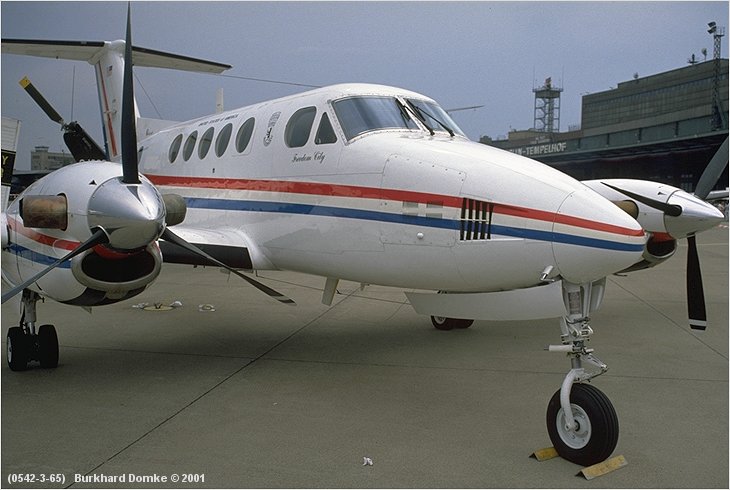 C-23 Sherpa 
|
|
As noted above the Army operates fixed wing aircraft, including some business jets for VIP transport. It's ARMED fixed wing that the Army doesn't do. The Army funded the XV-15 with NASA, and originally was going to buy into the V-22, however the requirement vs the cost just wasn't there. The Army's requirement was only for medical evacuation aircraft at corps level. Since that time, the way paitient transport has evolved, the Army no longer has the requirement, so in the end it was a VERY good move. Because the Army is traditionally a land bound force (duh), it has less problems with setting up places to refuel, so it's organic aircraft have enough range for most air assaults. So the speed and range advantage of the V-22 doesn't off-set it's complexity nor cost for the Army. Remember that the Army and Marine Corps are two very different land combat forces, with two very different missions. They just overlap a bunch. but where they don't overlap, the V-22 makes sense for the Marines. It doesn't make as much sense for the Army. The Army may indeed gravitate towards that type of requirement, but it won't be until alot of other transformation takes place. The Army only uses conventional helicopters, due to cost and complexity issues. Having to maintain aircraft in the field rather than on an airfield or even ship, raises concerns when using any advanced design. Considering that the current fleet is capable of executing current doctrine, there's no point in buying something that's more expensive and harder to deal with in the field. The advantages of compound, pusher, etc. are not really advantages to the way the Army operates aircraft. When that changes (and it always evolves) then aircraft with the required characteristics will be in service. The Army had two NOTAR's for test. They didn't work out. I won't say why as it has to do with operational considerations unique to the particular user. There were some early concerns on battle damage and the tail boom, but the main reason they aren't used is an operational reason. Ross |
Broncos were only operated by the USAF and the USMC. Rockwell built a total of 376, and none went to the Army.  The Mowhawk was the OV-1. It was a corps asset. That's probably the one you're thinking of. The OV-1 had hardpoints on the wings and did carry rockets for marker use in Vietnam. Obviously they got used for things other than marking as well  . The Army didn't get away with it though and all Mowhawks were unarmed after that. . The Army didn't get away with it though and all Mowhawks were unarmed after that.The Mowhawk was fully areobatic and loops and rolls were part of the ATM (Aircrew Training Manual). It used two T53 engines (same engine as the UH-1H Huey) and had alot of power. It also had alot of tourque too. If one failed on takeoff, you had to be quick on the ejection seat. The ejection seat had two levers. One to get out fast and one to get out REAL fast, to be used at low alltitude. The OV-1 B had SLAR and the OV-1C had IR mapping. The OV-1D was configured to do either by swapping out the gear. The Army has also flown in the past: Beech F-33 as the QU-22 Beech Baron as the T-42A Beech Queen Air as the U-8 Beech King Air as the U-21/RU-21 Beech Super King Air as the RU-21J and C-12 Cessna O-1 Cessna 172 as the T-41 DeHaviland Buffalo Fokker (forgot what designation) for the Golden Knights. The USAF got territorial about the Buffalo and the Army gave up on cargo aircraft of their own for a while. They got around the rules by buying National Guard units Sherpas to support SF missions. That way the State can use the Sherpas in peactime, and the USAF couldn't squawk too much about it. The USAF is still wary of the Army getting planes, and has been half-heartedly fighting the funding of newer replacements for the Sherpas. Ross |
|
The Army and Air Force divided their flying roles in the "Key West Agreement" of 1948, which broadly gave the Air Force the vast majority of all transport and fighting aircraft, with only light observation, light cargo and transport, and VIP type planes for the Army. By 1957 the Army had started down the path to lots of helos, and armed helo and observation aircraft types, as well as many small but very useful transport aircraft. Because the Air Force was not very interested in supporting the Army, but also didn't want to lose ground attack and large transport aircraft to the Army and thus glory related funding from congress, a deal was reached by the then SecDef and the two services, and by order the Army was limited to no new fixed wing aircraft of more than 5,000 pounds, and no new helos of more then 10,000 pounds. This policy has gotten more flexible over time, and now the general rule is any helo is allowed, but no new fixed wing for the active Army except for light observation and VIP aircraft. National Guard and Reserve are allowed more leeway in fixed wing due to their different standing and lack of AF support. |
The Army's abandonment of the Osprey really played hell with the unit costs. Not saying they weren't right to do what they did, but their pull-out really dropped the number of airframes and took a lot of money out of the program. The Army's compound helicopter was the AH-56 Cheyenne. It had a wicked top-end speed, greater range and some interesting nose pitch-pointing capabilities. The project was abandoned because or difficulty managing blade flap (in a compound helicopter short wings take produce a greater portion of total lift at higher speeds. this reduces load on the rotor blades resulting in an increase in blade flap). The flap would eventually lead to rotor drive shaft failure. The Navy has investigated a new breed of compound helicopter using the SH-60 with a vector-ducted thruster instead of a pusher prop. The problem is that the wings which provide lift at high speeds catch a lot of rotor wash at low speeds and increase power required to hover. Compounds could fill a limited roll, but the Navy helicopters spend a lot of time in the hover mode and not enough in forward flight to make the performance trade-offs worth it. |
Are you sure the Army never had any Mohawks, because my uncle, who was in the 1st Air Cav, said early on in the Viet Nam war, the Army was using them as FAC/Scout/gunship. He also recalled one getting shot down, and both pilots rescued were Army CWOs. As for other planes the Army flew, dont forget the C-7 Caribou. |
The Army operated the OV-1 Mohawk. www.ov-1.com/ www.ov-1mohawk.org/ 
|
If you re-read my actual post and not the clipped quotes, you'll notice I'm talking about the OV-10 Bronco NOT being used by the Army. The OV-10 (oh vee ten, not oh vee won) was only used by the Marine Corps and the USAF. Then I go on to explain how the OV-1 Mohawk was probably what he was thinking of because that was a corps (as in corps level, as in ARMY corps, meaning a headquarters that commands two or more Army divisions. NOT Marine Corps) asset. (notice the capitalization of corps and Corps) The Mohawk was an (Army) corps level asset. Flown by the Army at the corps level. As in you don't find them at division or lower, but only at corps or theater army level. I supposed I confused some non-ground force folks with corps and Corps. Yes, I'm sure the Army didn't use the OV-10 Bronco. Yes, I'm sure you capitalize Corps when referring to the USMC Yes, I'm sure the Army operated the OV-1 Mohawk at the (Army) corps level and higher. Yes, I'm sure you spell corps.."c.o.r.p.s." and not "core" Yes, I forgot the Caribou, but it was before my time, the Mohawk wasn't. Ross |
|
A link to more info on compound helicopters: www.geocities.com/tacticalstudiesgroup/piaseckivtdp.htm |
The transfer of the A-10 to the Army wasn't going to be like most people think. The gun was to be removed and replaced by a sensor pack (SLAR, etc) and other electronic pods and fuel tanks would be hung off the hardpoints. It would have replaced the OV-1 Mohawk in a non-shooting role, performing recon. The Army would have farmed out the maintenance to contractors, so it wasn't that big a deal as fas as integrating the aircraft into the Army system. The plan was just a trial ballon effort by the USAF to get rid of the much despised (to the high-speed "fighter mafia" who ran the USAF at the time) slow and low A-10. It was never a serious plan. The Gulf War showed that the USAF would pretty much have to keep using the Warthog anyway, so they kept it. It was never a plan to give the Army A-10's that could actually shoot. Ross |
You also must undestand, most people spell "corps" lowercase, because they dont know any better. I am used to it now. |
Yeah, when I started talking about corps asset, I automatically thought everyone would know I was talking about an Army corps. Corps gets captialized when used as a title, like III Corps or 18th Airborne Corps, or when it's the actual name of a corps, like Marine Corps or Military Police Corps. Here's a breakdown how the Army does aircraft. Each division has a Combat Aviation Brigade (CAB). The 101st has two CABs. In the CAB there are attack, assault, Cav, and intel assets (Quick-fix helicopters). In the 101st there is also medium helicopters (CH-47s). It is the only division to have CH-47's. Each corps has it's own CAB as well. That CAB is a corps asset, not belonging to a division. It belongs to the corps headquarters itself. In that corps asset, there are attack, assault, medium (CH-47), and intel assets. This is the first level where you normally find fixed wing in the Army. So this is where you'd find the OV-1. There may also be a Cavalry regiment assigned to the Corps, and it's Air Cav squadron will be separate as well. Each theather army(numbered army like Eighth Army in the ROK) also has it's own CAB as well. It reflects the corps level CAB closely, though most are going to have some differences due to location. the TA CAB will also have fixed wing MI assets, and you may have also found the OV-1 here as well, depending on the situation. Additonally, there are specialized aircraft, like medevac, that don't belong to the CAB's because they are medical assets. They belong to the actual medical support units. You also get odd-ball aviation organizations, like the one in Japan, that has everything in one battalion and is sepcifically structured for a particular mission. There are odd-ball units like that spread out around the world to support a geographical area. Special Forces units have their own organic aviation detatchment for support functions. The 160th SOAR is basically SOCOM's Combat Aviation Brigade. So the Army not only uses aircraft in the division, but also has them at corps and higher levels providing a very large number of aircraft on the battlefield. Ross |
*ahem* That's XVIII Airborne Corps, thankyouverymuch.  Good post, Ross. Here's something I know about Army aviation: it's hard to sleep at 0400 when there's a serial of CH-47s flying over the damned barracks! 
|