


[ARCHIVED THREAD] - M1 TANK... INTERESTING ARTICLE (Page 1 of 2)
Posted: 3/9/2005 6:25:59 PM EDT
|
(please no jokes about Nostradamus/date.) Army Times March 14, 2005 Making the best tank better Abrams fares well in Iraq, but safety upgrades sought by Sean D. Naylor Fighting in conditions far removed from the north European plains for which it was designed, the Abrams tank has proven its value in the war in Iraq, according to the Army’s chief of armor. Not a single tanker has been killed by a conventional antitank weapon, Maj. Gen. Terry Tucker said in a Feb. 18 interview. The few fatalities suffered aboard tanks have been caused by roadside bombs or small arms, he said. Nonetheless, the Army is considering upgrades so the Abrams will prevail on battlefields for the next quarter century. Among changes under consideration for the near term are better protections for the tank’s commander and loader while they fire their machine guns, and a new anti-personnel round for the Abrams’ 120mm main gun. The long-term upgrades on Tucker’s mind include improved armor and a new main gun. About 4,500 troops have served on tanks in Iraq. Of those, three soldiers have been killed inside their tanks by roadside bombs. An additional 10 to 15 crew members have been killed while riding with their heads out of the hatch, standing on the tanks, or, in one case, by an insurgent who climbed onto the tank and shot down into the crew compartment, Tucker said. “I am unaware of any case where any tanker in Iraq has been killed inside of a tank by a penetration of a tank round or RPG or any other munition,” Tucker said. “It’s a pretty safe place to be.” About 1,135 Abrams tanks have seen action in Iraq, Tucker said, some more than once. Of those, he said, “probably 70 percent have been hit or damaged in some way. In fact, it’s hard to find an Abrams tank out there that has fought in Iraq that has not been damaged.” Eighty tanks have sustained damage that required them to be sent back to the United States for repairs, said Tucker, noting that the damage was “fairly minor” in some cases. “If a seam or a weld was broken, that’s pretty delicate work, and we couldn’t do that in theater, so we’ve brought tanks back to the U.S. for welding repairs,” he said. “About 63 of those 80 tanks will go back to the fleet,” Tucker said. The remaining 17 “will probably never go back to the fleet.” Those figures mean that 1 to 1.5 percent of the tanks involved in the fight in Iraq might not return to action. “I’ll take those numbers any day,” Tucker said. A different fight Tucker acknowledged that the loss of even a few Abrams tanks has come as something of a reality check to the armor community. In the 1991 Persian Gulf War, during which Tucker commanded a cavalry squadron, tank combat involved Abrams tanks engaging and destroying their Iraqi counterparts with overwhelming fire in the open desert. “This fight’s different,” he said. “The enemy’s learned from that. And the technique that they’re using is massed fire against one tank: 14, 18, 20 RPGs — I’ve heard reports of tanks taking 50 RPG hits. It’s a new technique that they’re using, and in fact we’re having some significant damage on tanks that has to be repaired before we put them back in the fight.” Tucker cited an Abrams with the 3rd Infantry Division (Mechanized) that took part in the first “thunder run” into Baghdad as an example. The tank was struck by 14 to 18 rocket-propelled grenades, one of which knocked out the hydraulics system so the crew had to operate the turret in manual mode. Nevertheless, the tank completed the first thunder run and then went on the second, its crew still fighting with the tank in manual mode. “That crew refused to get off of it, because that tank couldn’t be killed,” he said. Early problems Not every Abrams was quite as resilient. Tucker estimated that the number of tanks that had to be temporarily abandoned or pulled out of the fight immediately due to combat damage was “at least 17 and probably in the 20s.” However, no tanks have been permanently abandoned in Iraq, he said. Even if U.S. forces had to scuttle a damaged tank — in some cases by having another tank fire on it; in others, by having Air Force jets destroy the damaged tank with Maverick missiles — to prevent sensitive equipment from falling into enemy hands, U.S. troops retrieved the carcasses and brought them all back to the United States. The survival rate of the tank and the soldiers who fight in it was a testament to the Abrams’ design, according to the chief of armor. “The Abrams tank was designed and built to be able to take the kind of punishment it’s been taking in Iraq, and be repaired and put back into the fight,” Tucker said. “That tank is designed with the ammunition separated from the crew compartment, and if the ammunition is ignited in the storage compartment, the tank is designed for the back of the turret to blow out, so the fire and the explosion goes outward, as opposed to inward, so you don’t injure or kill the crew,” Tucker said. The general estimated that Iraqi insurgents have used a dozen different types of RPGs against the Abrams in Iraq. “My concern is that in the future we’ll see more of the newer types, which are more powerful and have more capability,” he said. But contrary to rumor, there is no indication that any “exotic” antitank rounds — including foreign-made missiles such as the Milan, new versions of the RPG, or new tank main gun rounds — have been used against the Abrams in Iraq, the general said. Other than a couple of enormous custom-made bombs, the Abrams and its crews have survived everything that Saddam Hussein’s army and insurgents in Iraq have thrown at it. Meanwhile, the officials the Army pays to plot the future of the Abrams are not resting on their laurels, according to Tucker. “We still think of the Abrams tank as the king of the fight, and I’m here to tell you that it is, but I’m also here to tell you that the Abrams tank is 25 years old,” he said. “We’ve improved it a lot over the years ... but it’s still a 1980 tank, and we have more work to do to keep the Abrams tank king of the battlefield for the next 25 years, because 25 years from now, when the American Army goes to fight, it will go to fight in Abrams tanks.” In the near term, the Army has studied how the Abrams has fared in Iraq and come up with a series of improvements that it refers to collectively as the tank urban survivability kit, or TUSK. But these capabilities are not funded in the Army budget, said Maj. Chad Young, assistant product manager for M1, M1A1 and TUSK. The service has not yet finalized how much it would cost to put TUSK on each tank, Young said. A program that is funded and will be fielded to tank units in Iraq “probably this summer,” according to Tucker, is an anti-personnel canister round (“a big shotgun round,” Tucker calls it) for the Abrams’ 120mm main gun. Meanwhile, looking farther into the future, “the Abrams tank needs to become more lethal ... [and] more survivable than it is now,” Tucker said. “It’s fairly easy to make it more lethal and more survivable,” he continued. “The challenge is going to be to do that while we try to make it lighter and more mobile.” Studying new armor To solve the mobility problem, the Army is examining new types of composite armor and electrified armor that have the potential to be lighter, yet provide a greater level of protection than the highly classified composite armor package with which the Abrams is presently equipped, according to Tucker. In 2008, Army will begin to field its next-generation family of combat vehicles, the Future Combat Systems. That won’t mean the end for the Abrams, which is scheduled to serve until at least 2040. In fact, the first FCS-equipped unit of action will probably include one FCS battalion and one battalion of Abrams tanks and Bradley fighting vehicles, Tucker said. The challenge for the Army’s doctrinal community will be to figure out how the Abrams and the FCS family of vehicles will operate together, according to Tucker. “That’s not an insignificant effort that we have to go through,” he said. The general noted that the issue of what type of gun the FCS mounted combat system should have has yet to be settled. “There’s lots of debate,” he said. “Is it 105 [mm]? Is it 120 [mm]? Is it electromagnetic? Is it a death ray? What’s that gun going to be? We’re not quite sure yet, but ... we probably ought to put the same gun on the Abrams that we’re going to have on the FCS. That would make sense.” Having different main guns on the two systems would entail an unnecessary logistical burden, he added. “I can see some day that the gun in the Abrams tank will be more lethal than it is now, and half the size, half the weight,” Tucker said. Other dramatic changes are in store for the Abrams, he suggested. “I can’t tell you what the tank is going to look like in 2017, when it fights with FCS, but I’ll tell you it’ll be significantly different from what it is now.” |
|
They need to mount that new anti-HEAT system that the Brits have come up that totally defeats it. Put that system on the Abrams, it will be impervious to anything but large IED/mines, aerial bombs, and kinetic projectiles from the rear or top. Vito113 should be around in a few hours to chime in on the British system. |
Chobham Armor. 
|
no, the brits came up with some kind of electrical field armor that deflects the liquified penetraor warheads... they did a demo last year where they rolled a apc out, shot a bnunch of RPGS at it, then drove it away |
No it isn't Chobham, this system completely renders a HEAT charge useless, it destroys the "Jet" created by a shape-charge. Without the jet, there will be no penetration. This system can be fitted to any vehicle also. |
|
The electric armor doesnt work well with all types of rounds and doesnt work well with multiple rounds in its current evolution. Not to mention its lethal for any infantry to be around the target. I have a feeling they will try to make the MBT a creation of the past. They are realitively cheap but heavy. I dont think the M1 will do as well in an environment heavily populated with more modern antitank rounds like the Milan or Kornet. The crews may still survive but the tanks will suffer more damage. |
The electric armour will make the Milan or Komet useless from any angle. I doubt the MIlan or Komet can frontally pierce an M1. I have seen hits on a M1 from a farking AGM-65 Maverick, the Maverick hit the frontal armour and didn't do Jack!!!! The Milan nor the Komet are even close to the power of a Maverick. The had to drop a MK84 2000lb bomb on it to destroy it. The electric armour is mainly for rendering RPG's useless against armour and lightly armoured vehicles. |
Really? The first M-1 that got destroyed was hit and penetrated by what appears to have been a self-forging warhead. If that ain't exotic then what is... |
Yup, thats when all the rumors of Russian Antitank rounds were being considered. There are also PICs of tanks with damage that is not larger then a pencil. But it went though to the the other side. Complete penetration. Every fucking arms producer is there one way or another testing their shit for real. |
I don't know if the M1 has Chobham on top of its turret considering that its armor make up is classified. It wouldn't be too difficult to place Chobham on top. It won't make difference anyhow if this electric Anti-Heat system is fielded, the KORNET will just make a big bang and thats it. The Kornet, like I said before is NOT even close to the power of a Maverick with its 80+ lb HEAT warhead. Vito will be around soon to answer more on the electric armor. The Brits launched multiple heat charge warheads at IIRC a m113 and they all went bang and the m113 drove away with NO DAMAGE. ETA: The pics of the penetration of the M1 were not in any area with Chobham armor. |
Self-forging warheads use the Misznay-Schardin principle to form a piece of steel into a kinetic penetrator. These are found in many AT mines. Front on, they are useless against a M1. |
|
They were in the sides. No modern antitank weapon tries for frontal attacks. Kornets are effective from all sides. If you read the write up on the electric armor you would have read its not effective against all types of warhead. http://www.zid.ru/en/products/military/kornet-e.html |

That is correct on electric armor but it renders ALL HEAT warheads useless but were talking about a a M1A2 that also has Chobham and Depleted Uranium armor that is impervious to virtually everything. The electric armor would prevent the HEAT warheads from doing any damage to any part of the vehicle. The only thing the M1A2 will have to worry about is IED/Mines and kinetic energy weapons from the rear. The biggest advantage is it renders the extremely cheap RPG useless against armor, if you want to kill a armored vehicle, your going to have to field a much larger and expensive weapon. The Hadji's don't have the funds to use Kornets on a large scale basis which are expensive also the Kornet is going to have to come up with a new type of warhead as HEAT is now obsolete. ETA: My British friend Vito113 will be in a few hours to explain what electric armor does, he has the British scoop. The British also developed Chobham armor too. |
|
Regardless of your nic, I'm going to have to call 'B.S.' and ask for some linkage / articles on such a device. |
If you were EOD, you would owe me a Case of Beer.  Misznay-Schardin Misznay-SchardinThe M21 mine uses this principle, notice the concave steel plate - that becomes the self forming penetrator. 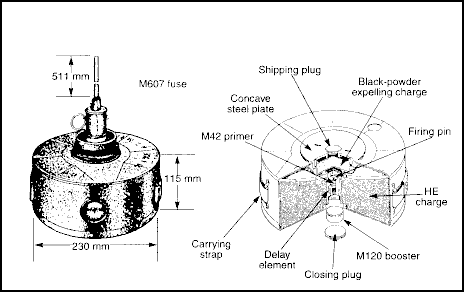
|
You still dont grasp the concept that most modern anti tank weapons do not attack from the front. They will attack from the top or even behind. The M1A2 does not have anywhere near the protection at the turrent top then the front gracis. RPGs maybe rendered obsolete but so fucking what. They are already relatively ineffective against M1s. The weapons that will kill the M1 are out there and will do a good job. As the general pointed out its a 20 plus year old design. A Milan missile would pose a real challenge to the M1. I think its currently the best MBT out there but its survivability will fade rapidly. |
| Another interesting idea that was being talked about for an urban upgrade was placing Claymores around the M1 in key locations for antipersonel. They were remote detonated, they also had cameras mounted around the tank in order to see what was going on. Not sure this was the greatest idea but it was still kinda cool. For true anti-personel fun they need to hurry up and get the canister round out in numbers. |
Actually they did have a reactive armor package that used detectors and cameras to explode charges outward from the vehicle prior to impact with the armor. They tested the devices on hummvees and worked very well. But it was lethal to infantry around the vehicle. |
Ardoc, I'm pretty sure the idea I'm talking about with the Claymore mines was strictly for discouraging enemy infantry from ambushes and such on an M1, thus the cameras and remote control for the claymores, I'm guessing the reason for the idea fading was fear of blue on blue. This was not reactive armor but literally claymores. |
The electric armor that will be fielded in the not to distant future on all M1's and other vehicles. This means Kornets, Milans are expensive junk against armor as their HEAT charges can't even form a JET on a M1A2 that is equipped with it. The electric armor covers the whole tank, they can strike from the top and bang, nothing happens as the copper jet is destroyed before it even gets to form. We know all about Milans, the British make them as the French made models had a habit of doing a loop and coming back down on the crew, the British models are better made. |
Yeah, guidance system kept going after white flags. On another note, apparently the Hadjis had a problem with picking targets. Our guys would drive through in Humvee's without incident. Then the M1A1 would come through. In fits of rage the Hadjis would run out enmasse and empty AK's at the tank before getting mowed down. |
A British Army Milan crew told me about the French models odd quirks and a British EOD troop confirmed it. The British also feel safer that their Milan is built in the UK and not in France. ETA: Enough from me tonight, Vito113 can take care of the situation soon. 
|
ELECTRIC ARMOUR!!! THE LATEST BREAKTHROUGH IN ARMOUR BROUGHT TO YOU BY THE PEOPLE WHO INVENTED CHOBHAM ARMOUR!!!!… the Brits! …Raise the shields! ANdy The contract for full scale development has been issued by the British MoD. The US is in on this to for it's FCS. And if you fit this on the roof of a tank all those Gee Whizz 'Top Attack' missiles are a busted flush too! www.ar15.com/forums/topic.html?b=1&f=5&t=329815  This British Warrior MICV (Brit equivalent of a Bradley) took multiple RPG hits and drove away! 01 July 2002 New age electric armour tough enough to face modern threats Rocket Propelled Grenades (RPGs) are the most prolific ground launched threat to British and Allied armoured fighting vehicles world-wide. To combat this very real and dangerous threat the Defence Science & Technology Laboratory, Dstl, has developed an 'Electric Armour' that reduces the effect of impacts by such projectiles to almost zero, and will ultimately save the lives of soldiers. To get an idea of the damage an RPG can cause, it should be realised that upon impact its 'shaped charge' explosive warhead shoots a rapier-like jet of hot copper into the target at several miles per second. Such jets can penetrate anything upwards of a foot (30cm) of solid steel armour. The effect almost invariably results in loss of life and can destroy a modern armoured infantry combat vehicle or tank costing millions. There is currently no armoured personnel carrier, and few tanks, that could practicably carry the weight of armour needed reliably to resist such impacts from any direction. In recent years intensive research has been conducted at Dstl to find a highly effective, yet lightweight, armour system to address this threat. Dstl scientists have developed a revolutionary Electric Armour system which can resist attack by RPGs or other shaped charge weapons whilst remaining of a practical weight and size for armoured vehicles to carry. A recently demonstrated system, consisting of bulletproof metal plating, insulation, power distribution lines, and storage capacitors weighs a mere couple of tonnes, but has a protective effect equal to carrying an extra 10-20 tonnes of steel armour. Commenting on this latest invention Dstl's Professor John Brown says: "RPG's can be easily picked up from street stalls for as little as $10 in most of the world's trouble spots. It only takes one individual on, say, a rooftop in a village to press the trigger to cause major damage to passing armoured vehicles. The Dstl Electric Armour system is an exciting advance which has generated a lot of interest in both UK and US defence circles. I am confident that our system is the way forward for lightweight defence of military vehicles. It is being strongly supported by the Army and Ministry of Defence to reduce the threat from this highly dangerous class of weapon ." Dstl scientists have recently demonstrated an armoured troop carrier protected by Electric Armour, in which, when danger threatens, an outer skin of metal plates can rapidly be electrified to several thousand volts. When hit by a RPG or other shaped charge warhead, the incoming copper jet has to pass through the electrified layers, where it has to endure the passage of many thousands of amperes of current. Professor Brown explains: "As is well known, a current of just thirteen amps is sufficient to 'blow' and disintegrate the fuse of a household electrical appliance. Similarly, the high speed copper jet from a shaped charge anti-tank warhead is virtually instantaneously dispersed by the high temperatures and powerful fields generated by the so-called 'Pulsed Power' System carried by the vehicle. Any residual debris is absorbed by the vehicle's ordinary armoured hull." Notes to Editors: Electric Armour The system is powered entirely by the normal electrical supply of the vehicle. The electrical load imposed by stopping an RPG attack is no more arduous than for example starting the engine on a cold morning. In the Demonstration to high level British Army and Ministry of Defence (MOD) Customers and invited US witnesses in the Spring of 2002, the target vehicle was subjected to repeated attacks. Post-shot examinations showed it to have sustained no internal damage whatsoever. The target was then driven away under its own power, scarcely the worse for an experience sufficient to destroy other vehicles many times over. The MOD has tasked Dstl to reduce the weight and bulk of armoured vehicles, making them 70% lighter and 50% smaller over the coming two decades. Dstl Dstl (the Defence Science and Technology Laboratory) is the centre of scientific excellence for the Ministry of Defence, housing one of the largest groups of scientists and engineers in public service in the country. Its 3,000 strong workforce at sites all over the UK includes some of the nation's most talented and creative scientists with the brief to ensure that the UK Armed Forces and Government are supported in house by world class scientific advice. Dstl delivers defence research, specialist technical services and the ability to track global technological developments. Its capabilities compare with the best in the world, supporting procurement decisions, defence policy making and operations. www.dstl.gov.uk/pr/press/pr2002/01-07-02.htm |
|
DARPA has been paying the Electro-Mechanical Physics Laboratory at University of Texas, Austin a lot of money for some time to work on EM armor as well. It goes hand in and with their development of Pulsed Power Technology-using flywheels as energy storage, electric powertrain technology for heavy vehicles, and the Cannon Caliber Electromagnetic Gun. UT-Austin also works with the US Navy and Northrup-Grumman shipbuilding on the all-electric drive DD-X destroyers, which ALSO would like to use such things as Electro-magnetic armor and a Coilgun. Trying to get some of this technology scaled down from warship-compatible size to AFV-compatable size is taking up much of the time now. The Army also would like a replacement for the M1 that features besides EM armor, a rail or coil gun, a laser, quiet electric drive, and the ability to switch power from one system to another instantly. A land going DD-X. www.utexas.edu/research/cem/ |

|
PDF on US work on EM armor: www.arl.army.mil/wmrd/Tech/ArmorResearch-both.pdf |
Driving a modern Main Battle Tank is waaaay cool! What a buzz! Me in driver seat of a Challenger…"Were do I go Sargent?"… Sargent in turret……"In this thing… anywhere you want!"… ANdy |
Oh man, that calls for 
|
I am not even going to attempt to lower myself to the crap you just posted above. |
|
Interesting read on the Abrams and updates! Lots of Info here! |
Britain is to retrofit all it's Challenger II's with the Rhinemetall L55 120mm smootbore cannon… ammunition comonality is your friend! ANdy |
It was very exciting. I sat in the gunner's seat and my missus sat in the loader's seat. We just held on. I noticed right off that it was very crowded inside. There is a LOT of room between the outer armor plating and the crew's compartment. |
Dude take it easy, its a joke! Note smiley! |