


|
Some pictures that I haven't ever seen of the Doolittle raid. Doolittle Anniversary April 18, 2026 | Jon Parshall  Doolittle Anniversary April 18, 2026 | Jon Parshall |
|
Documentary on the Avro Arrow Avro CF-105 Arrow: The Fall of Canada's Supersonic Interceptor  Avro CF-105 Arrow: The Fall of Canada's Supersonic Interceptor 00:00:00 The Malton Order: Black Friday 1959 00:01:24 Conception of the Arrow and Postwar Ambitions 00:03:43 The C-102 Jetliner: The First Lost Opportunity 00:05:08 The CF-100 Canuck: Establishing Canada's Jet Industry 00:07:40 Birth of the CF-105: Cold War Threat Over the Arctic 00:08:25 Engineering the Delta: Aerodynamic Heat and Rocket Models 00:10:24 Escalating Budgets and the Shadow of Sputnik 00:13:03 Maiden Flight: Jan Zurakowski Takes Arrow 201 Airborne 00:18:41 Approaching Mach 2 and the Promise of the Orenda Iroquois 00:20:25 Changing Doctrines: Missiles, Budgets, and the Bomarc 00:24:30 The Axe Falls: The House of Commons Announcement 00:28:35 Immediate Layoffs: 14,000 Workers Cast Into the Cold 00:31:39 Arrow 206: The Unflown Potential in Hangar Storage 00:35:38 Compromised Air Defense: Second-Hand American Voodoos 00:43:26 The Cutting Torches: Systematic Destruction of the Airframes 00:48:52 Brain Drain to NASA: From Malton to the Moon 00:54:14 The Unsettled Legacy of Canada's Lost Interceptor |
|
Short video on Stoke space and their reusable rocket design. The Billion Dollar Bet On Redesigning The Reusable Rocket  The Billion Dollar Bet On Redesigning The Reusable Rocket |
|
Discussion on the icy moons of Saturn and Jupiter. Do icy moons hide alien oceans? | with Michele Dougherty  Do icy moons hide alien oceans? | with Michele Dougherty 00:00 Introduction: Saturn, Jupiter and a Hidden Moon 02:18 Inside the Cassini Spacecraft 04:24 How Scientists Measure a Magnetic Field 06:16 Saturn's Rings and a Mysterious Moon 07:38 Enceladus: Too Young to Be True 09:28 Cassini's First Flybys of Enceladus 14:27 The Gamble: Flying Closer 16:27 Discovery: A Plume from the South Pole 18:52 The Ingredients for Life 19:52 Jupiter's Moons: Clues from Galileo 22:29 The Case for a New Mission to Jupiter 24:33 Building the JUICE Spacecraft 26:23 Building Instruments Through Lockdown 30:22 Launch from French Guiana 34:54 The Long Journey to Jupiter (2023–2031) 37:08 Ganymede: The Moon with Its Own Magnetic Field 39:08 Callisto, Europa and the Search for Oceans 44:40 400 Years of Icy Moon Discovery 46:23 Cassini's Grand Finale 51:52 The End of an Icon 53:40 NASA's Farewell Film |
|
Part 3 of their 9/11 series. Was 9/11 an Intelligence Failure?  Was 9/11 an Intelligence Failure? |
|
Old documentary on main battle tanks Battle Tank (1988 Documentary)  Battle Tank (1988 Documentary) 0:00 Introduction 0:07 BATTLETANK 5:47 SCORPION Light Tank 8:07 M60A1 Main Battle Tank 17:17 CHIEFTAIN Main Battle Tank 22:16 LEOPARD 1 Main Battle Tank 32:37 LEOPARD 2 Main Battle Tank 41:20 AMX 40 Main Battle Tank 46:22 M1/M1A1 ABRAMS Main Battle Tank 52:45 Vickers Mk7/2 Main Battle Tank 54:39 CHALLENGER |
|
Another old documentary. The channel has a lot it appears : https://www.youtube.com/@MikeGuardiaAuthor/videos Tank Platoon (1989 Documentary)  Tank Platoon (1989 Documentary) |
|
Discussion of some of the CIA's activites after 9/11. 25 Years After 9/11: The CIA's First Moments Behind Enemy Lines in Afghanistan | SpyCast  25 Years After 9/11: The CIA's First Moments Behind Enemy Lines in Afghanistan | SpyCast |
|
Discussion on a book about the 1st Battalion, 24th Marines in WW2. This Hemisphere of Hell: The 1st Battalion, 24th Marines, in the Pacific War  This Hemisphere of Hell: The 1st Battalion, 24th Marines, in the Pacific War |
|
Title says it all. What if the allies had prioritised the Atlantic NOT the strategic bombing of Germany?  What if the allies had prioritised the Atlantic NOT the strategic bombing of Germany? |
|
What if around Rome and the Battle of Zama. What if Rome had LOST the Battle of Zama & Second Punic War? It all hinges on ONE thing  What if Hannibal had WON the Battle of Zama & Second Punic War? It all hinges on ONE thing… |
|
Interesting looking game Nuclear Design Bureau - A Game Where You Design Nuclear Weapons  Nuclear Design Bureau - A Game Where You Design Nuclear Weapons |
|
Short overview of the A-37 Dragonfly A-37 Dragonfly | Cessna's forgotten fighter  A-37 Dragonfly | Cessna's forgotten fighter 00:00 Introduction 01:25 Background 05:25 Tweet history 07:37 A-37 Development 10:37 Vietnam – Combat Dragon 14:09 A-37B 18:21 End of the program |
Not sure I'm less confused after watching it or not.  Light, Medium, Heavy: How Bomber Classes Evolved (1914-1960)  Light, Medium, Heavy: How Bomber Classes Evolved (1914-1960) 0:00 Establishing the problem 7:00 Understanding Context 9:33 (Insert lecture about bomber development here) |
|
Overview of the Tornado airplane. Tornado: Europe's Swing-Wing Warrior  Tornado: Europe's Swing-Wing Warrior 00:00 Intro 00:49 A New Requirement 06:92 A Space-Age Design 11:09 Wings Of Heroes 12:27 First Flights 15:13 IDS/GR.1 19:03 Air Defence Variant 22:49 The Gulf War 32:39 Post-War Variants 35:07 Balkans (And Beyond!) 36:46 Retirement... or Not? 38:47 Outro |
|
Discussion on China and it's success How China Fakes Its Success with Frank Dikotter  How China Fakes Its Success with Frank Dikotter 00:00 - Trailer 00:53 - No ads 01:13 - Mao’s Body Count and How the Chinese Communist Party Was Born 22:39 - Ad: Monetary Metals 24:07 - How China Became Communist: Japan, Marshall and the Siege of Changchun 51:48 - Ad: Dose Daily 53:07 - The Great Leap Forward: Sparrows, Backyard Furnaces and the Cultural Revolution 01:10:53 - Ad: Shopify 01:11:22 - Famine Tourism and Empty Skyscrapers: Why Outsiders Keep Getting China Wrong 01:33:43 - What’s The One Thing We’re Not Talking About |
|
Documentary on the OV-10 Bronco Generals Tried to Scrap It, But Frontline Troops Kept It Flying: The OV-10 Bronco Story  Generals Tried to Scrap It, But Frontline Troops Kept It Flying: The OV-10 Bronco Story 00:00:00 Jungle Combat and the Close Air Support Dilemma 00:06:31 The Garage Prototype: Rice and Beckett's Design 00:08:44 Bureaucratic Resistance and Requirement Creep 00:15:48 Rebuilding the Airframe: Structural Assembly 00:22:16 Frontline Operations: Supporting SEALs and Recon 00:27:42 Operational Deployments: USAF, USMC, and Navy Black Ponies 00:32:52 Veteran Mechanics and the Bronco Association 00:38:30 Cockpit Reconstruction and Airworthiness Hurdles 00:40:04 Post-War Service: Firefighting and Interdiction 00:43:35 Turboprop Propulsion and Severe Field Testing 00:45:43 Ordnance Capacity and Gunship Configurations 00:50:01 Global Operators and Service Legacy |
|
Short video on the Italian tank Carro Veloce. How This Tiny Tank Terrorised the World  How This Tiny Tank Terrorised the World 00:00 | Intro 01:23 | Size Matters 11:43 | Little Tracks, Big Footprint 16:20 | All Shapes and Sizes 21:16 | Avanti! Avanti! |
|
Documentary on Rommel and North Africa. Rommel: How the 'Desert Fox' Won and Lost North Africa | Free Documentary History  Victory & Defeat: How the Afrika Korps Won and Lost North Africa | FD History Part 1: The 'Afrika Korps' Arrives - 00:00:00 Part 2: Victory at El Alamein - 00:45:01 Part 3: Casablanca Conference - 01:26:37 |
|
Discussion around the atomic programs during WW2. The Untold Race for the Atomic Bomb  The Untold Race for the Atomic Bomb 00:00:00 - Intro 00:46:10 - Revealing the Atom 00:15:26 - The Chain Reaction 00:32:34 - Der Uranverein 00:38:31 - The Plutonium Breakthrough 00:47:31 - The Manhattan Engineering District 01:01:53 - Uranium Enrichment 01:11:28 - Hitler's Secret Weapon 01:28:30 - ALSOS 01:36:14 - The Bomb and Farm Hall 01:45:38 - From Cold War to World War 01:51:47 - Outro and Shoutouts |
|
Discussion around compute and Silicon valley. Silicon Valley’s Starving for Compute  Silicon Valley’s Starving for Compute |
|
More a documentary on the US Air Force after WW2. The Dawn of Jet Combat and the Reign of the Peacemaker 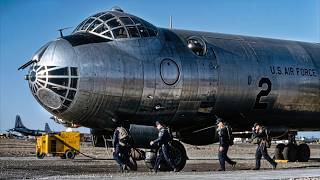 The Dawn of Jet Combat and the Reign of the Peacemaker 00:00:00 The Hot War Nobody Wanted 00:01:37 The Birth of Strategic Air Command 00:03:06 Curtis LeMay and the Cold War Emergency 00:07:01 Forging a Global Striking Force 00:10:46 The Outbreak of the Korean War 00:12:43 F-51 Mustangs and Close Air Support 00:15:16 The Inchon Invasion and Aerial Interdiction 00:20:20 Enter the Jet Age: Sabres and MiGs 00:24:13 The F-84 Thunderjet in Ground Attack 00:29:00 Winning the Air War in MiG Alley 00:33:16 The Rise of the Intercontinental Bombers 00:39:24 The Dawn of the ICBM Era 00:44:48 The Cuban Missile Crisis and Nuclear Deterrence 00:46:59 Lineage of the Giant: The B-36 Peacemaker 00:54:02 Building the Ultimate Long-Range Bomber 00:59:50 The XC-99 and the Challenges of Giantism 01:06:23 The Jet Transition and the B-47 01:12:20 Parasite Fighters: The Goblin and Ficon Projects 01:16:00 Defending the Peacemaker's Legacy in Alaska 01:22:16 From Piston Giants to Supersonic Flight |
|
Heard of some of the other ones, but not this one. Project Hazel. Is This Secret Aircraft Faster Than the SR-71 Blackbird?  Is This Secret Aircraft Faster Than the SR-71 Blackbird? |
|
Interesting video on the Panther ammo used by the Germans in WW2. Poor Panther Anti-Tank Ammo. The German disadvantage no one talks about. AMMO TECH Ep1  Poor Panther Anti-Tank Ammo. The German disadvantage no one talks about. AMMO TECH Ep1. NO AI 00:00 Introduction 00:29 Panzergranatpatrone 39/42 01:45 Armour Penetration Table 02:26 Why is the shell important 03:20 Panzergranatpatrone 40/42 04:30 Cartridge Case 06:10 Steel vs brass shell cases 11: 56 American experiments with steel cases 12:17 The German disadvantage 12:42 Lacquer on case explained 13:19 Production issues with steel cases 16:36 Iron driving bands problems 18:40 Loss of performance 19:30 Shell stencils and stamps 21:39 Use of Tungsten 22:46 Lack of Tungsten |
|
Overview of the PIAT. Was The British PIAT Better? John gives us a masterclass on this much maligned anti-tank weapon  Was The British PIAT Better? John gives us a masterclass on this much maligned anti-tank weapon. The PIAT is often remembered as one of Britain’s more awkward Second World War weapons: heavy, difficult to cock and not always pleasant to fire. But was that reputation entirely deserved? Introduced in 1943, the Projector, Infantry, Anti-Tank gave British and Commonwealth troops a man-portable weapon capable of defeating contemporary German armour at close range—and it did so without the dangerous backblast of a rocket launcher. Unlike the Bazooka, Panzerschreck and Panzerfaust, the PIAT fired a spigot mortar bomb rather than a rocket. That meant it could be used from inside buildings, narrow streets and other enclosed positions where a backblast weapon could be hazardous. Its low firing signature also made it harder for an enemy to immediately identify the firer’s position, while its shaped-charge bomb offered serious anti-tank power when used at the short ranges for which it was intended. This episode looks beyond the PIAT’s notorious drawbacks and asks whether it may have had advantages its critics overlook. Could its concealability, lack of backblast and tactical flexibility make it a better infantry anti-tank weapon in certain situations than the Panzerfaust, Panzerschreck or Bazooka? And why did soldiers who disliked firing it still rely on it in some of the toughest fighting of the war? 00:00 Introduction 01:20 What is a PIAT? 03:08 Why didn’t other countries use spigot weapons? 03:54 Rates of fire comparison 04:38 Misconceptions 05:06 Cocking 06:40 Sights 07:04 Firing 08:35 Mortar mode 10:13 Using the weapon 13:24 Did the soldiers like it? 15:20 The Bomb 18:08 Comparison with other weapons 20:12 Why did the Australians hate them? 22:00 Gurka PIAT versus Japanese tanks |
|
Title says it all. Is the Navy Ready for the Fourth Industrial Revolution?  Is the Navy Ready for the Fourth Industrial Revolution? |
|
Development of the T26 Pershing. Developing the T26 Pershing  Developing the T26 Pershing |
|
Overview of China's Marine Corps. China’s Marine Corps: A Deep Dive  China’s Marine Corps: A Deep Dive |
|
Archive footage from WW2. USS Princeton and Taffy 3 Archival Footage – Episode 616  USS Princeton and Taffy 3 Archival Footage – Episode 616 |
|
Discussion around the potential detection of dark matter. The First Potential Detection of a Dark Matter Particle with Prof. Matthew Szydagis  The First Potential Detection of a Dark Matter Particle with Prof. Matthew Szydagis |
|
Interesting video on some of the things that were taken from the Eagle's Nest. Eagle's Nest Bring Backs - Ultimate GI Souveniers  Eagle's Nest Bring Backs - Ultimate GI Souvenirs From Hitler's Alpine Lair |
|
Short video on the difficultly around drilling a hole. Why Making A Hole Is So Difficult  Why Making A Hole Is So Difficult THE BORING PROBLEM · Watt's 1765 separate condenser forced the piston to seal against the bore itself. · Early cantilevered boring bars referenced off the rough surface they were cutting. · One 18-inch attempt ran out of round by three-eighths of an inch. WILKINSON'S CYLINDER MACHINE · Ran a heavy boring bar clear through the cylinder, supported at both ends. · Made the bar the reference, holding 50-inch bores to a tenth of an inch. · Widely regarded as the first true machine tool, and never patented. THE MORSE TWIST DRILL · Replaced the flat spear-point drill, which scraped and packed chips in blind holes. · Reshaped the groove into a near-radial edge that shears at an acute angle. · Added an "increasing twist," widening flute space as chips travel toward the shank. ANATOMY OF A MODERN BIT · The chisel edge indents rather than cuts, taking half the required thrust. · The margin is the only full-diameter surface, guiding the tool and sizing the hole. · Past three to five diameters deep, chips outrun the flutes. HIGH-SPEED STEEL · Taylor and White pushed heat treatment toward the point of incipient fusion. · Dissolved tungsten carbide produced "red hardness," holding an edge to 600C. · Its 1900 Paris debut exposed how little rigidity existing machine tools had. DEEP HOLE DRILLING · Gun drills pair a single-lip tip with high-pressure oil, reaching past 100:1. · The Single Tube System reverses the flow, running five to seven times the feed rate. · Trepanning cuts an annular groove and leaves a core, dominant past 200mm. CNC AND SPLIT POINT GEOMETRY · Rigidity, spindle speed and tool changing removed drilling's built-in time penalties. · Spot drilling holds a wandering drill on center, but costs an operation per hole. · A notched split point, borrowed from crankshaft work, makes the tool self-centering. CARBIDE AND COATINGS · Tungsten carbide sintered with cobalt holds hardness near 1,000C. · Titanium aluminum nitride survives past 800C behind a self-repairing alumina skin. · Aluminum chromium nitride and nanolayer films push toward 1,100C. |
|
Some interesting learning experiences. Naval Engineering - Mistakes that turned out for the best!  Naval Engineering - Mistakes that turned out for the best! |
|
Overview of China's rocket designs. China Has More Rocket Designs Than Anyone Else  China Has More Rocket Designs Than Anyone Else..... |
|
History of precision rotary motion machines. The Incredible Engineering of Precision Rotary Motion  The Incredible Engineering of Precision Rotary Motion EARLY NEEDS • Water wheels and early motors transferred power through belts and line shafts. • Mechanical rheostats controlled speed by bleeding excess energy off as raw heat. • The result was jerky motion unsuited to elevators or industrial positioning. THE WARD LEONARD DRIVE • Harry Ward Leonard patented one of the first motor control systems in 1891. • A constant-speed prime mover drives a generator wired to the working motor's armature. • A small field current regulates it, producing perfectly stepless acceleration. • MIT's Radiation Laboratory chose it for the SCR-584 anti-aircraft radar. FOUR-QUADRANT OPERATION • The drive commands both direction of rotation and direction of torque. • Dropping voltage below the motor's back-EMF turns it into a controllable brake. • Residual magnetism produced a phantom voltage that made motors creep. SYNCHROS AND RESOLVERS • Naval gunnery required a remote shaft to snap to a computed angle exactly. • General Electric developed the Selsyn around 1925, later known as the synchro. • A resolver's two stator windings sit exactly 90 degrees apart. • Their sine and cosine outputs give absolute position even when the shaft is still. OPTICAL ENCODERS • Baldwin Piano spun etched glass disks to synthesize pipe organ tones. • The U.S. Army Signal Corps contracted Baldwin for optical encoders in 1951. • An 18-bit encoder became the first used in American spaceflight in 1962. • Gurley traded black widow spider silk crosshairs for chrome photo-etched on glass. READING THE FRINGES • Incremental disks count pulses across two channels offset by 90 degrees. • Absolute disks carry concentric tracks forming a unique word at every angle. • Two ultra-fine gratings overlapped at a slight offset produce magnified Moiré bands. • SmarAct's METIRIO system exploits Talbot self-imaging and the Lau effect. NUMERICAL CONTROL • Helicopter rotor blades demanded mathematically defined aerodynamic curves. • John T. Parsons punched calculated airfoil coordinates onto IBM tabulating cards. • MIT demonstrated the first NC machine tool in September 1952. • Its controller held roughly 250 vacuum tubes, 175 relays, and a tape reader. THE STEPPER MOTOR • Variable reluctance pulls a toothed iron rotor toward the path of least reluctance. • Without magnets, the rotor indexes fast but holds no torque when power is cut. • GE's Karl Feiertag filed the hybrid stepper patent in 1952. • Fifty rotor teeth per cup yield 200 steps, or 1.8 degrees per pulse. MICROSTEPPING • Abruptly cut coil current made rotors ring and excite mechanical resonance. • Chopper drivers use PWM and current regulation to synthesize stepped sine waves. • Modern drivers subdivide a single full step into as many as 256 microsteps. BRUSHLESS DC MOTOR • Carbon brushes wore into dust, sparked, and flooded surroundings with interference. • Wilson and Trickey demonstrated solid-state commutation in 1962. • Hall-effect sensors let the controller keep the field just ahead of the rotor. FRAMELESS MOTORS • Neodymium magnets amplified BLDC torque density through the mid-1980s. • Higher torque density made the reduction gearbox unnecessary. • Removing the gear mesh removes backlash and enables sub-micron positioning. FIELD ORIENTED CONTROL • In an induction motor, flux and torque draw on the same stator current. • K. Hasse and Felix Blaschke devised indirect and direct vector control. • Clarke and Park transforms collapse three-phase waves into two DC-like values. THE FUTURE • Algorithms now compensate for parameter drift, thermal expansion, and resonance. • Machine learning can predict error before it ever reaches the shaft. • The mechanical foundation remains, but becomes a substrate for software. |
|
Hadn't heard of this operation before. Operation Sparrow: The Incredible True Story of the Spies Who Tricked Hitler and Won the War  Operation Sparrow: The Incredible True Story of the Spies Who Tricked Hitler and Won the War As D-Day looms, three crack commandos parachute into enemy territory on a high-stakes mission of lies and deception. To succeed - they’ll need to get arrested by the Nazis. By March 1944, the war had raged for four and a half years. Tens of millions were already dead. Adolf Hitler knew an Allied invasion was coming and planned to crush it - if only he knew where it would land. If the führer’s forces were in the right place, the Nazis could stop D-Day and continue their murderous control of Europe. But the Allies had a plan. Operation Sparrow called for an elite three-man commando team to drop behind enemy lines, walk into German hands and craft a web of lies strong enough to sway Hitler. The mission seemed impossible: survive Nazi interrogation while making D-Day lies sound true. The three men would risk everything to convince the führer the invasion would strike the Balkans, two thousand kilometres away from Normandy. It was either genius or suicidal. Probably both. |

We are the Knights who say Fuuuuu!
Joined:
Sep 2004
Posts:
58988
EE: 100% (665)
 TX, USA
|
Originally Posted By DaGoose: Cheap ripoff of the U-2. The Yakovlev Mandrake Was a Cut-Price Soviet U-2  https://www.youtube.com/watch?v=w5Asy__2PFE https://www.youtube.com/watch?v=w5Asy__2PFECheap ripoff of the  Hilarious hearing YouTube censor out the NATO code name for the Soviet MiG-15 [rorl] Bigger_Hammer 
|
LIFE'S JOURNEY IS NOT TO ARRIVE AT THE GRAVE SAFELY IN A WELL PRESERVED BODY,
BUT RATHER TO SKID IN SIDEWAYS, TOTALLY WORN OUT SHOUTING "HOLY $H!T...WHAT A RIDE"!!
BUT RATHER TO SKID IN SIDEWAYS, TOTALLY WORN OUT SHOUTING "HOLY $H!T...WHAT A RIDE"!!
|
Interesting story of a KGB agent in Iran. This Man Betrayed The KGB To SAVE His Sex Life  How Britain Recruited Moscow’s Most Unlikely Spy What Was MI6’s Greatest Mole Doing in Iran?  What Was MI6’s Greatest Mole Doing in Iran? 0:00 Redwood’s double life in revolutionary Iran 1:39 Ad: HP 2:42 What Redwood revealed to MI6 4:21 The Soviet plot to take over Iran 9:30 The strain of living a double life 13:05 MI6 plans Redwood’s escape 17:16 Redwood reaches breaking point 22:22 The escape from Iran 25:50 Why Redwood’s intelligence mattered after his escape 29:47 The decision to tell Iran 33:39 A secret meeting in Islamabad 35:21 The bloody crackdown on Iran’s communists 39:20 The moral cost of the operation 43:32 How the operation shaped Iran’s regime 47:10 Redwood’s life after defection 49:09 Ben Macintyre’s book and the Club bonus |
|
New book on Yamamoto. Admiral Yamamoto - The Japanese Naval Commander Who Planned and Executed the Pearl Harbor Attack  Admiral Yamamoto - The Japanese Naval Commander Who Planned and Executed the Pearl Harbor Attack |
|
History of the B-45 Tornado. North American B 45 Tornado  North American B 45 Tornado |
|
Interesting air rifles. Early Electronic Air Rifles? With Daystate and firearms expert Jonathan Ferguson  Early Electronic Air Rifles? With Daystate and firearms expert Jonathan Ferguson 00:00 Daystate & Air Rifle's 01:15 Daystate's Early Bullpup 03:01 The SA80 Connection 04:37 From SA80 to Air Rifle 05:33 The Problem with Bullpups 06:14 Why Use an Electronic Trigger? 07:30 Daystate Goes Electronic 08:28 Making the System Safe 09:31 Direct Electronic Firing 11:01 Complexity & Servicing 11:47 Bullpup Safety 13:37 What Is a PCP Air Rifle? 16:09 The Early Electronic Air Rifle 17:18 The Breakthrough 18:44 The Daystate Mk3 20:48 An Illuminated Safety Catch 23:01 The Rifle's Civil War Connection 26:15 Why Daystate Abandoned the Bullpup 27:00 Chasing More Power 28:43 Inside the Electronics 31:06 An 8-Ounce Electronic Trigger 31:47 Is This the Future of Triggers? |
|
Discussion around VJ day. Remembering VJ Day in 2026 | McManus & Parshall  Remembering VJ Day in 2026 | McManus & Parshall |
|
Tour of the 5"/38 guns on the USS New Jersey. America's Do-It-All Naval Gun: The 5 Inch Mk12 on the USS New Jersey  America's Do-It-All Naval Gun: The 5 Inch Mk12 on the USS New Jersey |
|
Discussion around why the US didn't use 18 inch guns on the battleships. Why Didn't the Navy Use 18in Guns?  Why Didn't the Navy Use 18in Guns? |
|
Discussion on China's population and reporting of it. China Seems to Have "Misplaced" 120 Million People  China Seems to Have "Misplaced" 120 Million People |
|
Space updates. SpaceX's Falcon 9 Will Be Killed Off - Deep Space Updates September 18th  SpaceX's Falcon 9 Will Be Killed Off - Deep Space Updates September 18th |
|
Overview of the Girardoni Air Rifle. 1789 Girardoni Air Rifle: A Generation Ahead of Its Time  1789 Girardoni Air Rifle: A Generation Ahead of Its Time |
|
Discussion on the Soviet T-60 tank. The Worst Tank in the Red Army  The Worst Tank in the Red Army |
|
Discussion around the death of Himmler. The Men Who Murdered Himmler? New Documents Reveal MI5 Present When Himmler Died!  The Men Who Murdered Himmler? New Documents Reveal MI5 Present When Himmler Died! |
|
Bunch of interviews with Captain Eric Brown. The Test Pilot Who Flew Nazi Germany’s Deadliest Secrets  The Test Pilot Who Flew Nazi Germany’s Deadliest Secrets The progression of military aviation during the mid-twentieth century was driven by fierce technical rivalry, extreme operational peril, and the relentless courage of experimental test pilots. At the center of this transition stood Captain Eric "Winkle" Brown, a Royal Navy aviator whose flight logs captured the exact turning points of modern aerial warfare. Through meticulously restored, high-definition, and colorized archival motion picture footage, this comprehensive documentary traces the evolution of combat flight from piston-engine biplanes to Mach-capable carrier fighters. The journey begins in the skies over Europe and the North Atlantic, where the tactical shortcomings of early medium bombers gave way to the refined multi-role capabilities of the Junkers Ju 88 and the high-speed agility of the Focke-Wulf 190. Brown details the harsh realities of maritime convoy protection aboard Britain’s first escort carrier, HMS Audacity, flying Grumman Wildcats against the persistent threat of four-engine Fw 200 Condors and lurking U-boat wolf packs. Following the harrowing loss of his ship in the freezing waters of the Bay of Biscay, Brown transitioned into test flying, pioneering carrier operations with twin-engine de Havilland Mosquitos and conducting critical compressibility evaluations for General Jimmy Doolittle’s Eighth Air Force. As the Third Reich collapsed in 1945, Brown led Allied technical intelligence teams into occupied territory under Operation Surgeon. There, investigators uncovered operational Messerschmitt Me 262 jet fighters, the straight-wing Arado Ar 234 reconnaissance bomber, and the notoriously volatile Me 163 Komet rocket interceptor. Brown evaluated these platforms firsthand, exposing both their revolutionary performance advantages and their lethal mechanical vulnerabilities, while uncovering Mach 4.4 supersonic wind tunnels hidden deep within Germany. The post-war era brought new aerodynamic challenges, including the historic first carrier landing of a pure jet aboard HMS Ocean, the political cancellation of the British Miles M.52 supersonic research aircraft, and the refinement of the all-flying horizontal tailplane on the North American F-86 Sabre. Concluding with the reformation of West Germany’s naval air branch, the controversial adoption of the Lockheed F-104 Starfighter, and the fleet defense doctrine of the McDonnell Douglas F-4 Phantom II, this film delivers an authoritative assessment of the machines and pilots that forged modern flight. 00:00:00 Evaluating Axis Medium Bombers and Fighters 00:04:03 The Messerschmitt Me 262 Jet Quantum Leap 00:06:20 Flying the Avro Lancaster Four-Engine Bomber 00:09:19 The Ergonomic Cockpit of the Heinkel He 219 00:13:01 Operational Ejection Seats and Schräge Musik 00:17:43 Transonic Characteristics of the F-86 Sabre 00:22:54 Flight Impressions of Frontline Soviet Aircraft 00:29:44 Stalin's Design Bureau Prisons and Air Doctrine 00:32:00 High-Altitude Shortcomings of the P-47 Thunderbolt 00:34:40 De Havilland Vampire: The First Jet Deck Landing 00:38:10 Pre-War Flights in Germany and Ernst Udet 00:43:00 September 1939: SS Arrest and the Phoney War 00:49:06 HMS Audacity and the Battle Against the Fw 200 00:59:02 The Torpedoing and Sinking of HMS Audacity 01:06:38 Carrier Service Trials with the Twin-Engine Mosquito 01:09:01 Tackling High-Altitude Compressibility for the 8th USAAF 01:13:12 Operation Surgeon: Capturing Advanced Axis Aviation 01:16:27 Liberating Belsen and Interrogating Hermann Göring 01:20:06 Piloting the Volatile Rocket-Powered Me 163 Komet 01:24:00 The Miles M.52 Supersonic Cancellation Controversy 01:32:02 High-Altitude Storm Probing and Test Flight Safety 01:38:04 Breaking the Sound Barrier at Patuxent River 01:41:20 Rebuilding the Bundesmarine and the F-104 Crisis 01:46:18 Championing the McDonnell Douglas F-4 Phantom II 01:53:00 Marksmanship and the Disciplines of Combat Flying |