


[ARCHIVED THREAD] - .700 Nitro Express (Page 1 of 2)
Posted: 6/1/2004 4:27:56 PM EDT
Can I please get an upper made for this round. .700 Nitro-Express 1000 grain Soft Nose or Solid Bullet Muzzle Velocity 1853 ft/sec. Energy 7650 ft/lbs. 
|
cool 20mm   EDIT wont the recoll snap the bones in your arm(s)? |

no, they are exempt because they are classified as sporting arms. |
|
The funny part is, those guys are all firing .577 NE cartridge. Not even .600 NE. Please note, I doubt those guys are really shooters, probably just a bunch of freinds/relatives of employees (they don't lean in one bit). BTW, anyone ever fire one of these? Off hand? ETA: .50BMG has less felt recoil, if for any reason, it's because those rifles weigh at most one third of what a loaded .50 weighs. Now, if you had an ultralight 50BMG, that's another story... ETA#2: I've allways thought of a high-caliber Pistol round would be cool. Imagine .50AE, but .703 diameter bullet and casing very much cut down (To give sunsonic muzzle velocities [IE: a silenced round with the knockdown power of the exact opposite. Build a gun for it like the .45ACP bolt action from WW2 [forget the name]]). |
For some reason, I find that fairly easy to belive; especially if it was relatively weak or old shooter. |
"Stopping power" is a load of crap. Newton's law states that the one with the most muzzle energy will have the most "kick", all things being equal. |
Related to kick...energy is energy. Doesn't matter what the bullet is made of. Regarding the effectiveness, why don't you get one really freakin big block of gel and test them :) Oh, and the 50 BMG also travels about 1100fps FASTER than the 700 NE. Of course it weighs 300gr less. |
Yep... Of course, the NFA only applies inside the USA... If the gun never enters the US, then... |

But a "stopping rifle" relies on a hard impact to break shoulders or to simply penetrate the thick skulls of charging animals like rhino, cape buffalo, etc. Using a solid tungsten cored projectile from a 458 WIN MAG or 416 Rigby, loaded properly I can almost guarantee that you could break the shoulder or skull of most any game. One or more broken shoulders = stopped game. The bigger bore guns came about primarily due to primative powders and the need for more power to achieve more energy to achieve more "stopping power". Huge case capacity = more powder. You have more efficient powders now, don't need such a huge friggin' case to get the same performance. |
|
"Stopping Power" is a term that M&S propagated back when their "study" was published. A study which has since been debunked rather thoroughly. This study gave a percent chance that a single shot would stop the fight. Of course, it didn't take into account a ton of variables such as shot placement, state of mind, etc. Shot placement is absolutely the key with hunting, particularly big game. Sure, the 700 NE *might* stop a Nyati in one shot. Then again, so could a 30-06. A 700 NE placed in the gut has less stopping power than a 30-06 placed in the brain pan. So, how can the two be compared? They can't. THAT'S why the term "stopping power" is a load of crap. |
Not quite. It is momentum that is conserved and transferred equally between both the projectile and the weapon. If it were energy that is conserved, the shooter of the .700 NE would get hit with over 7600 ft-lb of KE.  Example to calculate the KE of a recoiling weapon: 14 lb rifle firing a 1000 grain bullet at 1853 ft/s Convert mass of bullet from grains into slugs. 1000 gr / (7000 gr/lb * 32.2 ft/s^2) = 0.00444 slugs = Mb Convert mass of rifle from pounds to slugs. 14 lb / 32.2 ft/s^2 = 0.435 slugs = Mr For conservation of momentum, the mass of the rifle times its velocity must equal the mass of the bullet times its velocity. Mr * Vr = Mb * Vb To find the KE of the recoiling rifle, we use the above equation to determine its velocity. Vr = (Mb * Vb) / Mr = (0.00444 slugs * 1853 ft/s) / 0.435 slugs = 18.9 ft/s Finally, we can calculate the KE of the recoiling rifle. KEr = 0.5 * Mr * Vr^2 = 0.5 * 0.435 slugs * (18.9 ft/s)^2 = 77.7 ft-lb That's a shitload of recoil energy!
|
Now do the math on the 50BMG.......assuming a 14lb rifle....... |
What do I look like, your personal physics bitch? I'll assume 700 grains at 2950 ft/s from the same 14 pound rifle. All in one step and without the units: KE = 0.5 * 0.435 * (((700 / (7000 * 32.2)) * 2950) / 0.435)^2 = 96.5 ft-lb
|
I think this was brou's point.....the more energy the rifle has at the muzzle the more recoil will be felt..... 
|
|
Recoil Table I believe some of this is calculation and some of it is subjective reasoning based on MANY hunts.....these guys are liberal assholes, but they do know their big bore guns.
|
But that's not true. For example, the 9x19 (115gr @ 1190fps) makes 362 ft-lb versus the .45 ACP (230gr @ 835fps) which makes 356 ft-lb. Assuming these are fired from the same handgun, the greater momentum of the slower but heavier .45 round will impart a higher recoil velocity to that handgun than will the faster but lighter 9mm. Fire a 9mm 1911 and then a .45 1911 back-to-back. You won't mistake one for the other. Basically, the more a given projectile's KE is dependent on velocity instead of mass, the less recoil it will generate. That's how the Glaser/Magsafe ammo can generate such a large amount of KE for an identical or even decreased amount of recoil when compared to traditional loads. |

I'm certainly no physicist. However, remember in tha above situation that the 45 also has quite a bit more powder mass than the 9mm, which is not part of the "kick" equation. That powder also accelerates out the barrel (as a gas) contributing to the kick. The recoil reduction system (slide spring) is also different, as is the slide/barrel mass...which rules out any direct comparison. To properly compare, you need to identical weight handguns with no recoil absorption. Right? |
Brou, please see my new thread on the AR15 Ammo board: ar15.com/forums/topic.html?b=3&f=16&t=190762 |
|
It can be confusing, can't it? BTW, the 577 T-Rex can produce over 10k ft/lbs. And my latest "Cartridges of the World" has this to say about the 585 Nyati: ..."In a 10 pound rifle with a good muzzle brake, top loads will generate more than 150 foot-pounds of recoil energy. Compare this to a 30-06, generating a mere 20 foot-pounds. Perhaps a better understanding of what this means is this: Imagine having a 10 pound rifle dropped from a 32 foot cliff and catching it with your shoulder" (top loads listed for this round are a 750gr bullet at 2487fps generating 10,300 ft/lb of energy and 180 of recoil energy [given a 10-lb rifle]!) Ow! |
|
Jesus, why don't we just strap C4 on the end of a broomstick and detonate it? At some point, those numbers get really high, but I would suspect that the recoil is still manageable to a sturdy individual. I bet it would take an absolutely monsterous amount of recoil to crush muscles and dislocate bones. I was actually suprised at how little recoil you feel when shooting a 50 BMG. All the samples I have shot of course had brakes, but with a proper brake, any reasonable size shell ought to be manageable. Spreading out the impact surface reduces felt recoil a lot as well. A 1 square inch buttpad is going to leave a mark with any centerfire rifle round, but an oversize soft-gel pad is going to spread out the punishment of the magnums and make them more shootable. |
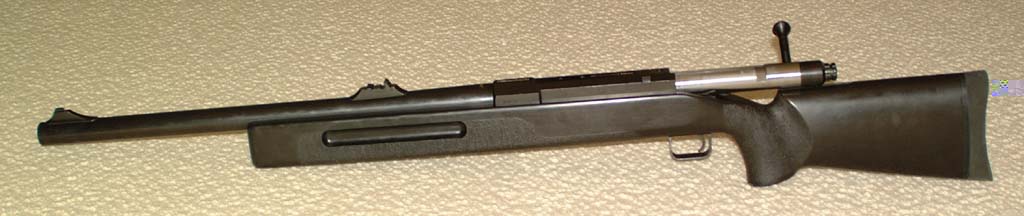
Ooooh, where can I find one of these? Any links? On another note, SSK makes some cool big bores too: SSK 14.5 |
|
So any PHD's in the house want to discuss the anatomical variables of the recoil force on the human body from large bore rifles? ie muscle, bone, ligiment, adrenaline, blood flow, nutrition. Man you guys that really know the physics of bullistic properties are interesting to say the least. I have no clue what some of the calulations are you present. If I read it enough times though I'll get the gist of it. 
|