


Posted: 5/22/2015 5:06:05 PM EDT
|
I revised my paper explaining Mils/MOA, S-MOA and the Range Equations by taking out the math parts and simplifying it for those not interested in all the math. This is a reference manual. I hope you enjoy it, learn from it and pass it along. Thank you. Bob Simeone (Bags) Note: Old original, a little more math involved, paper: |
|
Quoted:
I revised my paper explaining Mils/MOA, S-MOA and the RangeEquations by taking out the math parts and simplifying it for those notinterested in all the math. This is a reference manual. I hope you enjoy it, learn from it and pass it along.Thank you. https://www.scribd.com/doc/265985865/Mils-MOA-A-Basic-Study-for-Shooters Bob Simeone (Bags) Note: Old original, a little more math involved, paper: https://www.scribd.com/doc/251836084/Mils-MOA-and-the-Range-Estimation-Equations Links did not work. Said something about too many redirects and went to a page 404 error. A little help please as this is topic I am interested. TIA. |
|
Quoted:
Links did not work. Said something about too many redirects and went to a page 404 error. A little help please as this is topic I am interested. TIA. Quoted:
Quoted:
I revised my paper explaining Mils/MOA, S-MOA and the RangeEquations by taking out the math parts and simplifying it for those notinterested in all the math. This is a reference manual. I hope you enjoy it, learn from it and pass it along.Thank you. https://www.scribd.com/doc/265985865/Mils-MOA-A-Basic-Study-for-Shooters Bob Simeone (Bags) Note: Old original, a little more math involved, paper: https://www.scribd.com/doc/251836084/Mils-MOA-and-the-Range-Estimation-Equations Links did not work. Said something about too many redirects and went to a page 404 error. A little help please as this is topic I am interested. TIA. I'm curious about reading this as well. |

| Actually, artillery and tanks,especially,use mils differently. What they are referring to is a gunner's mil, not a miliradian. A gunner's mil is 1/6400 part of a circle. So there are 17.778 mils per degree. There are 17.453 miliradians per degree. Russian and some other armies use different # of mils per degree. |
|
Quoted: Actually, artillery and tanks,especially,use mils differently. What they are referring to is a gunner's mil, not a miliradian. A gunner's mil is 1/6400 part of a circle. So there are 17.778 mils per degree. There are 17.453 miliradians per degree. Russian and some other armies use different # of mils per degree. I do talk about that briefly in the paper, bottom of page 14 and start of 15. |

|
Quoted:
Oh shoot!!!, I didn't know that. For those who can't get it online, I will be glad to email you it. Coming your way D-bass. Quoted:
Quoted:
It says I have to have a facebook or join with email, last I did that I got spammed horrible. PDF Please? Can I get both of them via email as well please? Thanks |
|
Quoted:
Can I get both of them via email as well please? Thanks Quoted:
Quoted:
Quoted:
It says I have to have a facebook or join with email, last I did that I got spammed horrible. PDF Please? Can I get both of them via email as well please? Thanks I would like them as well. Can't ever have too many MIL/MOA explanations layin around 
|
|
Quoted:
Oh shoot!!!, I didn't know that. For those who can't get it online, I will be glad to email you it. Coming your way D-bass. Quoted:
Quoted:
It says I have to have a facebook or join with email, last I did that I got spammed horrible. PDF Please? Yeah I just don't jack with facebook but I'd appreciate the reading material. Thanks again, email sent |
|
Quoted: Oh shoot!!!, I didn't know that. For those who can't get it online, I will be glad to email you it. Coming your way D-bass. Quoted: Quoted: It says I have to have a facebook or join with email, last I did that I got spammed horrible. PDF Please? |
|
Quoted: It says I have to have a facebook or join with email, last I did that I got spammed horrible. PDF Please? |
|
Quoted:
Actually, artillery and tanks,especially,use mils differently. What they are referring to is a gunner's mil, not a miliradian. A gunner's mil is 1/6400 part of a circle. So there are 17.778 mils per degree. There are 17.453 miliradians per degree. Russian and some other armies use different # of mils per degree. There is no such thing as a gunners mil, its a mil or a NATO Mil. The Russian system is called the DC system and is 1/6000 of a circle. The Mil has been used by European militaries since the late 1800s and entered US military service in 1904 when we bought French Pantels, it also used on various other sights, compasses and on tripods. The shooting community has misappropriated the term Mil to refer to milaradians, a term that had been used for over a hundred years and on thousands of weapons sights prior to the guys at WTBN using milradians instead of mils like the rest of the military. |
|
Quoted:
I do talk about that briefly in the paper, bottom of page 14 and start of 15. Quoted:
Quoted:
Actually, artillery and tanks,especially,use mils differently. What they are referring to is a gunner's mil, not a miliradian. A gunner's mil is 1/6400 part of a circle. So there are 17.778 mils per degree. There are 17.453 miliradians per degree. Russian and some other armies use different # of mils per degree. I do talk about that briefly in the paper, bottom of page 14 and start of 15. I am certainly NO EXPERT.........was it wrong for me to always assume that 1 mil is 1,000th of my distance to the target? |
|
Quoted:
There is no such thing as a gunners mil, its a mil or a NATO Mil. The Russian system is called the DC system and is 1/6000 of a circle. The Mil has been used by European militaries since the late 1800s and entered US military service in 1904 when we bought French Pantels, it also used on various other sights, compasses and on tripods. The shooting community has misappropriated the term Mil to refer to milaradians, a term that had been used for over a hundred years and on thousands of weapons sights prior to the guys at WTBN using milradians instead of mils like the rest of the military. Quoted:
Quoted:
Actually, artillery and tanks,especially,use mils differently. What they are referring to is a gunner's mil, not a miliradian. A gunner's mil is 1/6400 part of a circle. So there are 17.778 mils per degree. There are 17.453 miliradians per degree. Russian and some other armies use different # of mils per degree. There is no such thing as a gunners mil, its a mil or a NATO Mil. The Russian system is called the DC system and is 1/6000 of a circle. The Mil has been used by European militaries since the late 1800s and entered US military service in 1904 when we bought French Pantels, it also used on various other sights, compasses and on tripods. The shooting community has misappropriated the term Mil to refer to milaradians, a term that had been used for over a hundred years and on thousands of weapons sights prior to the guys at WTBN using milradians instead of mils like the rest of the military. How did they get 1/6,000? There are always double the PIE amounts of radius around a circle........or 6.28 times the radius and 3.14 times the diameter across the circle. |
|
Quoted: Oh shoot!!!, I didn't know that. For those who can't get it online, I will be glad to email you it. Coming your way D-bass. Quoted: Quoted: It says I have to have a facebook or join with email, last I did that I got spammed horrible. PDF Please? Jason |
|
How did they get 1/6,000? There are always double the PIE amounts of radius around a circle........or 6.28 times the radius and 3.14 times the diameter across the circle. 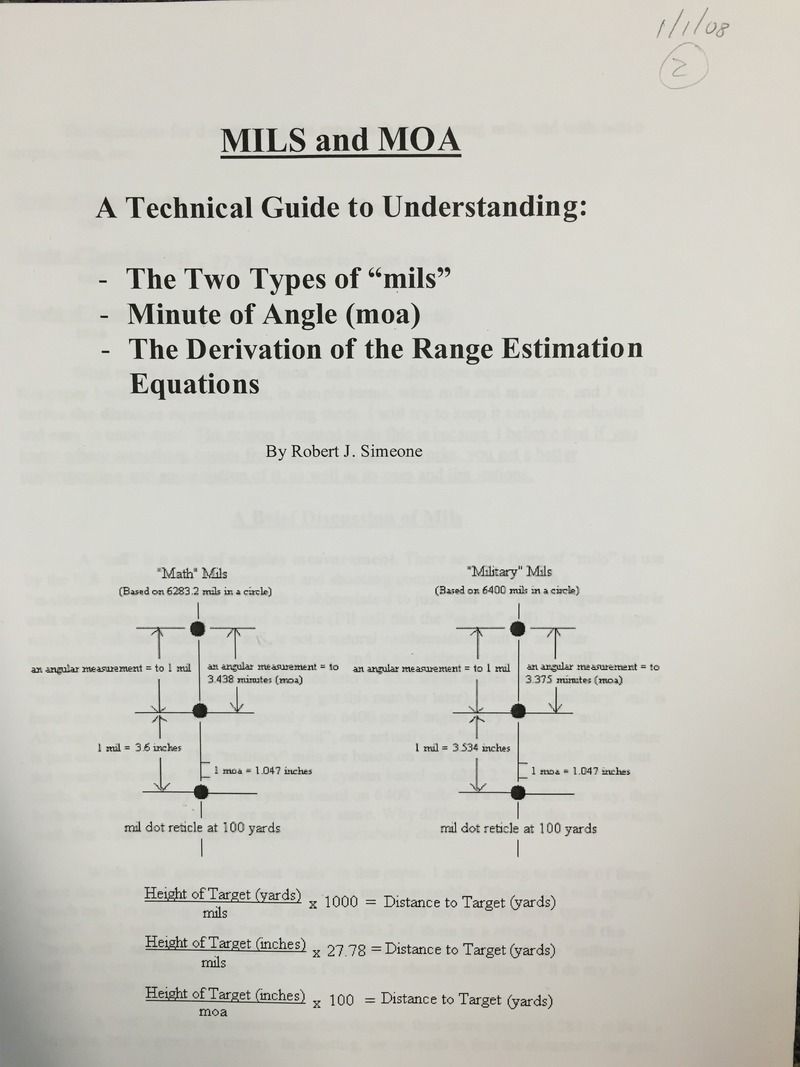 |
|
Quoted:
They artificially divid a circle into however many "mils" they want, whether it's 1/6000, 1/6400, 1/6300 etc. They then use trigonometry to figure out the equations for distance measurements. In 2007 when I first wrote my papers on the subject, I actually did it on both the "true mil" and what some called the "military mil" (1/6400). When I called the scope manufactures up to find out which one they used, (many didn't really know at first and had to research it) they all said they used the real or "true mil" in their scopes. Therefore, I rewrote it on just the "true" mil version. I might have an old copy of it. I'll see if I can't fetch out a picture of it. Quoted:
How did they get 1/6,000? There are always double the PIE amounts of radius around a circle........or 6.28 times the radius and 3.14 times the diameter across the circle. Thanks........I am assuming the Russians just made 6 equal triangles out of a circle and 1,000 mils per each triangle..........which gave them 1/6000 per mil. Just arbitrary I assume. Also........if you have a guy you know is, or assume is, 2 meters tall and he covers 2 mils on your target you would know he was 1,000 meters distant.............right? ETA: Thanks for the update!! I like the non Russian one (true mil) better.........easier math wise IMHO. Your update shows the height of the target in yards in our system is what is used rather than in meters...........I always assumed meters.........thanks again!! |
|
Quoted: Thanks........I am assuming the Russians just made 6 equal triangles out of a circle and 1,000 mils per each triangle..........which gave them 1/6000 per mil. Just arbitrary I assume. Also........if you have a guy you know is, or assume is, 2 meters tall and he covers 2 mils on your target you would know he was 1,000 meters distant.............right? ETA: Thanks for the update!! I like the non Russian one better.........easier math wise IMHO. Your update shows the height of the target in yards in our system is what is used rather than in meters...........I always assumed meters.........thanks again!! Quoted: Quoted: How did they get 1/6,000? There are always double the PIE amounts of radius around a circle........or 6.28 times the radius and 3.14 times the diameter across the circle. Thanks........I am assuming the Russians just made 6 equal triangles out of a circle and 1,000 mils per each triangle..........which gave them 1/6000 per mil. Just arbitrary I assume. Also........if you have a guy you know is, or assume is, 2 meters tall and he covers 2 mils on your target you would know he was 1,000 meters distant.............right? ETA: Thanks for the update!! I like the non Russian one better.........easier math wise IMHO. Your update shows the height of the target in yards in our system is what is used rather than in meters...........I always assumed meters.........thanks again!! Yes, using the 4th equation down on page-25 of the short version, you would get 1000 meters distance to him. P.S. I hope I'm not that guy that I just helped you range.  |
|
Quoted:
................. Yes, using the 4th equation down on page-25 of the short version, you would get 1000 meters distance to him. P.S. I hope I'm not that guy that I just helped you range.
No, no.........you are just affirming things I assumed...........nice to know I was right on something for a change.
ETA: But now I don't know how the heck our military got 1/6,400? 6.4 triangles per circle? 
|
|
Your update shows the height of the target in yards in our system is what is used rather than in meters...........I always assumed meters.........thanks again!! Remember, mils are independent of the units used. They express a ratio of the arc to the radius in whatever units you prefer. See pages 5-7 of the short version. Edit: |
|
Quoted:
Remember, mils are independent of the units used. They express a ratio of the arc to the radius in whatever units you prefer. See pages 5-7 of the short version. Edit: RDak, Roger. Sorry I misunderstood. Quoted:
Your update shows the height of the target in yards in our system is what is used rather than in meters...........I always assumed meters.........thanks again!! Remember, mils are independent of the units used. They express a ratio of the arc to the radius in whatever units you prefer. See pages 5-7 of the short version. Edit: RDak, Roger. Sorry I misunderstood. Got it.......................thanks for affirming all this stuff..........I never really knew for sure at all. I was just going by what I thought the math was.........had no idea if it was correct. |
|
ETA: But now I don't know how the heck our military got 1/6,400? 6.4 triangles per circle? They worked backwards. They just divided up the circle into 6400 small sections they called "mils", then figured out via trigonometry what each of those "mils" equaled and came up with an equation. That's how I did it way back in '08 (see my pic posted a few above of that original paper). |