


[ARCHIVED THREAD] - Military Rank Questions (Page 1 of 3)
Posted: 11/23/2014 10:10:51 AM EDT
|
I have no experience with the military, anything I know is from movies or from hearing people talk about it.
Why does it seem like solder's promotions go from Sergeant to Lieutenant? It seems like they jump over Warrant Officers. Is it just typical movie inaccuracy? Second question, is it true that a college graduate, even with only a liberal arts degree from a community college, can join the Army and go thru OCS and be a Lieutenant from the start? That seems to be a huge jump, some of the simplest people I know have a BA. |
|
Quoted:
I have no experience with the military, anything I know is from movies or from hearing people talk about it. Why does it seem like solder's promotions go from Sergeant to Lieutenant? It seems like they jump over Warrant Officers. Is it just typical movie inaccuracy? Second question, is it true that a college graduate, even with only a liberal arts degree from a community college, can join the Army and go thru OCS and be a Lieutenant from the start? That seems to be a huge jump, some of the simplest people I know have a BA. I don't really know what you are asking. 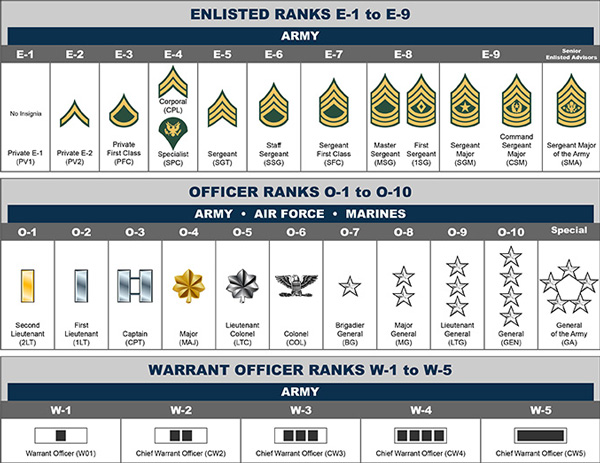
|
|
Quoted:
I don't really know what you are asking. http://static.oprah.com/images/own/2012/marriedtothearmyalaska/MTAA-RankStructure-11132012-01a-600x463.jpg Quoted:
Quoted:
I have no experience with the military, anything I know is from movies or from hearing people talk about it. Why does it seem like solder's promotions go from Sergeant to Lieutenant? It seems like they jump over Warrant Officers. Is it just typical movie inaccuracy? Second question, is it true that a college graduate, even with only a liberal arts degree from a community college, can join the Army and go thru OCS and be a Lieutenant from the start? That seems to be a huge jump, some of the simplest people I know have a BA. I don't really know what you are asking. http://static.oprah.com/images/own/2012/marriedtothearmyalaska/MTAA-RankStructure-11132012-01a-600x463.jpg I know I'm not explaining it well, sorry. When watching a movie or show, like band of brothers, I see Sergeants and I see Lieutenants. When those Sergeants get promoted, what do they get promoted to? Why are there no warrant officers there? |
|
The rank of Sergeant is a vague term as there are different levels within the rank, such as: Staff, Technical, Master, Senior Master, Chief Master. (USAF), and Army and Marines have their different levels as well. Going up a line of rank, the next rank after all of the ranks of Sgt would be Lt (or WO if your service has it).
I think when you mention of rank going from Sgt to Lt you might be thinking of a battlefield commission which is typically use to quickly promote people into low ranking command positions due to battlefield losses Depending on what the liberal arts degree is it is possible for someone to become an officer with that degree. |
|
Quoted: I know I'm not explaining it well, sorry. When watching a movie or show, like band of brothers, I see Sergeants and I see Lieutenants. When those Sergeants get promoted, what do they get promoted to? Why are there no warrant officers there? Quoted: Quoted: Quoted: I have no experience with the military, anything I know is from movies or from hearing people talk about it. Why does it seem like solder's promotions go from Sergeant to Lieutenant? It seems like they jump over Warrant Officers. Is it just typical movie inaccuracy? Second question, is it true that a college graduate, even with only a liberal arts degree from a community college, can join the Army and go thru OCS and be a Lieutenant from the start? That seems to be a huge jump, some of the simplest people I know have a BA. I don't really know what you are asking. http://static.oprah.com/images/own/2012/marriedtothearmyalaska/MTAA-RankStructure-11132012-01a-600x463.jpg I know I'm not explaining it well, sorry. When watching a movie or show, like band of brothers, I see Sergeants and I see Lieutenants. When those Sergeants get promoted, what do they get promoted to? Why are there no warrant officers there? Warrants didn't exist during WWII. It's a school, like OCS, you go to to specialize in a job. It's usually enlisted guys going to warrant school...the pay is in between enlisted and officer. The jumps from SGT to 2LT in WWII were out of necessity more than anything. Not a normal situation by any means. He posted the normal progression above. Just follow the chart from left to right. And yes...any degree will do for OCS/ROTC. The Academy requires at least a minor in Engineering of some sort. |
|
Quoted:
I know I'm not explaining it well, sorry. When watching a movie or show, like band of brothers, I see Sergeants and I see Lieutenants. When those Sergeants get promoted, what do they get promoted to? Why are there no warrant officers there? Quoted:
Quoted:
Quoted:
I have no experience with the military, anything I know is from movies or from hearing people talk about it. Why does it seem like solder's promotions go from Sergeant to Lieutenant? It seems like they jump over Warrant Officers. Is it just typical movie inaccuracy? Second question, is it true that a college graduate, even with only a liberal arts degree from a community college, can join the Army and go thru OCS and be a Lieutenant from the start? That seems to be a huge jump, some of the simplest people I know have a BA. I don't really know what you are asking. http://static.oprah.com/images/own/2012/marriedtothearmyalaska/MTAA-RankStructure-11132012-01a-600x463.jpg I know I'm not explaining it well, sorry. When watching a movie or show, like band of brothers, I see Sergeants and I see Lieutenants. When those Sergeants get promoted, what do they get promoted to? Why are there no warrant officers there? You've explained your question okay. You don't understand the first bit of information about ranks in the military. However, there's a good chance that you've seen a WWII movie in which a sergeant was given a field promotion to lieutenant. That is a long obsolete practice, and I expect it was extremely rare even in WWII. |
|
Quoted:
I know I'm not explaining it well, sorry. When watching a movie or show, like band of brothers, I see Sergeants and I see Lieutenants. When those Sergeants get promoted, what do they get promoted to? Why are there no warrant officers there? Quoted:
Quoted:
Quoted:
I have no experience with the military, anything I know is from movies or from hearing people talk about it. Why does it seem like solder's promotions go from Sergeant to Lieutenant? It seems like they jump over Warrant Officers. Is it just typical movie inaccuracy? Second question, is it true that a college graduate, even with only a liberal arts degree from a community college, can join the Army and go thru OCS and be a Lieutenant from the start? That seems to be a huge jump, some of the simplest people I know have a BA. I don't really know what you are asking. http://static.oprah.com/images/own/2012/marriedtothearmyalaska/MTAA-RankStructure-11132012-01a-600x463.jpg I know I'm not explaining it well, sorry. When watching a movie or show, like band of brothers, I see Sergeants and I see Lieutenants. When those Sergeants get promoted, what do they get promoted to? Why are there no warrant officers there? Sgt's can be promoted up to a higher rank of Sgt (Sgt to Staff Sgt, etc) or to Lt. Warrant Officers are used in for certain jobs and the rank is not seen service wide, so a Sgt wouldn't receive a battlefield promotion to WO if his job or MOS didn't have a WO position. Instead he would receive a battlefield promotion to Lt |
|
Officers and enlisted are a different group.
Think of it as the difference between the nobility and the commoners. It’s possible for an enlisted man to become an officer, but it rarely happens. If you enlist you move up the enlisted ranks and retire as some kind of a sergeant. Second lieutenants usually come out of ROTC somewhere when they are 22 years old or so. They don’t have much experience which is why, (at least in combat units) they have a platoon sergeant to keep an eye on them. |
|
Thanks for the replies.
The thing confusing me was that when looking at this rank list it seems as if you have to go thru the Warrant Officer ranks before getting to Lieutenant: http://www.military-ranks.org/army |
|
Quoted:
Sgt's can be promoted up to a higher rank of Sgt (Sgt to Staff Sgt, etc) or to Lt. Warrant Officers are used in for certain jobs and the rank is not seen service wide, so a Sgt wouldn't receive a battlefield promotion to WO if his job or MOS didn't have a WO position. Instead he would receive a battlefield promotion to Lt This sums up the answer to my question perfectly. |
|
Its pretty rare for an enlisted man to be commissioned as a officer. They do exist and are referred to as "Mustangs." Mustangs enlist then finish their Bachelor's degree and go through OCS. Most officers get a degree first and then go to OCS or attend a service academy. WOs are a different breed altogether. Not sure about the criteria for selection to WO.
There are two kinds of officers, Limited Duty Officer and (I guess) unlimited. LDOs generally cannot hold command and hold billets administrative billets.. WOs are LDOs and in the past, some were weapons officers on some aircraft and were/are referred to as "Gunner" or "Mister.". LDOs usually cannot advanced past O-4 (Major), WO or regular officer. There are always exceptions and field commissions were pretty common in the past but I don't of any since at least Vietnam. My intel is dated. I got out in '86, so someone with more current infor correct me if i'm wrong. |
|
Sergents can become Lieutenants by taking a Battlefield Commission and that was fairly common during WW1, WWII and Korea. It happened some during Vietnam. Prior enlisted ranks can also apply for OCS and receive their Commission that way through program training too.
Prior enlisted ranks can also become specialist Warrant Officers in their field of specialty. This is fairly common. Warrant Officers can also change over and take a Direct Commission to Lieutenant or Captain. This is also fairly common. ETA: I'm speaking of the U.S. Army, I have no idea what the other branches of the military do. |
|
Quoted:
You've explained your question okay. You don't understand the first bit of information about ranks in the military. However, there's a good chance that you've seen a WWII movie in which a sergeant was given a field promotion to lieutenant. That is a long obsolete practice, and I expect it was extremely rare even in WWII. Quoted:
Quoted:
Quoted:
Quoted:
I have no experience with the military, anything I know is from movies or from hearing people talk about it. Why does it seem like solder's promotions go from Sergeant to Lieutenant? It seems like they jump over Warrant Officers. Is it just typical movie inaccuracy? Second question, is it true that a college graduate, even with only a liberal arts degree from a community college, can join the Army and go thru OCS and be a Lieutenant from the start? That seems to be a huge jump, some of the simplest people I know have a BA. I don't really know what you are asking. http://static.oprah.com/images/own/2012/marriedtothearmyalaska/MTAA-RankStructure-11132012-01a-600x463.jpg I know I'm not explaining it well, sorry. When watching a movie or show, like band of brothers, I see Sergeants and I see Lieutenants. When those Sergeants get promoted, what do they get promoted to? Why are there no warrant officers there? You've explained your question okay. You don't understand the first bit of information about ranks in the military. However, there's a good chance that you've seen a WWII movie in which a sergeant was given a field promotion to lieutenant. That is a long obsolete practice, and I expect it was extremely rare even in WWII. Direct commissioning still happens, but it is now a formalized process with requirements attached. Rare, due mostly to the fact that general officers get pissy about giving enlisted soldiers a free ride to a commission. I believe, but don't really recall, that a certain command level can give one direct commission a year. |
| Those classic war movies are not how military promotions occur anymore. When you take heavy losses, leadership had to be filled and logistics were much different too. Vietnam as the end of that. I had a professor make Cpt with 13months total mil time in the late 60s.......doesn't happen like that anymore. |
| You are thinking of "field commissions". The last one of which happened in Vietnam. Basically in the event of lack of manpower in the lower officer area, an enlisted leader with the right experience could get a field commission to fill the role of platoon commander or whatever. Before the time when leadership and decision making was "expected", or rather, respected at lower enlisted ranks. Hollywood and all its wisdom thinks field commissions were an everyday occurrence in wars past. It is now commonly accepted that the enlisted simply "step up" without fear of repercussion for not being an officer or whatever. And yes, any degree can get you a shot at being an officer, unless the job field is super specific like some type of engineering. I've seen literary history majors lead grunts and do well. The degree doesn't really matter. It's how receptive they are to OCS or other training. |
|
There are three separate scales. Enlisted, Warrant, and Commissioned Officer. You can't just go from one to the other. If you're enlisted, you start as an E1 and work your way up to E9. Sergeant is an enlisted rank, E5 to be precise. If you start as a Warrant Officer you start as a W1 and work your way up to W5. The Air Force is the only branch that doesn't have Warrants. If you're a commissioned officer you start as an O1 and work your way up to O10. Obviously not everyone makes it all the way to the top.
You need a bachelor's degree to become a Commissioned Officer. The Army at times will accept an associate's, but you're non promoteable until you complete your bachelor's. Field promotions from the enlisted side to the commissioned side like you see in the old war movies are unheard of today. Yes you can cross over from Enlisted to Warrant or Commissioned, but it's not just a promotion. You have to apply just like a civilian would. If your application is accepted then you'll go the necessary schools such as OCS. You can do this at any pretty much any point in your enlisted career as long as you meet the requirements. I've seen everything from E3s to E8s get their commission and become O1s. I've also seen commissioned officers that were separated from the military due to cutbacks come back in as enlisted. TLDR: You can't get promoted from Sergeant to Warrant or Lieutenant. |
|
"A mustang is slang term in the United States Armed Forces, referring to a commissioned officer who began his or her career as an enlisted service member. Mustangs are usually older and more experienced than their peers-in-grade who entered the military via commissioning from one of the service academies, Officer Candidate School, or the Reserve Officer Training Corps. During the Vietnam War, however, some Army warrant officer pilots were offered a direct commission to 2nd or 1st Lieutenant,"
The original definition of a mustang was a military officer who had earned a battlefield commission; they were especially prevalent during World War II and the Korean War. Notable examples include Audie Murphy (World War II) and David Hackworth (Korean War). A mustang is currently defined[citation needed] by a continuity in military service from enlisted to officer (i.e., no break in military service). Being a slang term, there is no precise definition or set of criteria to determine which officers can properly be called a "mustang"; as the term varies in usage and criteria from service to service. The term originated either just prior to, or during[which?] World War II, initially as a naval term, although other services' officers are beginning to adopt the term." edited for brevity. |
| Warrant Officers are specialists in a certain field, usually drawn from the enlisted ranks because of their expertise. Enlisted personnel from the rank of E-5 (sometimes E-4) to E-9 are known as Non Commissioned Officers (NCO's). Second lieutenant through General are Commissioned Officers. The promotions you see in movies from Sergeant to Lieutenant are called battlefield commissions. Often after the conflict was over, they would be returned to a NCO rank. There were also temporary battlefield promotions to higher ranks for commissioned officers that were later reduced. |
|
Quoted:
Thanks for the replies. The thing confusing me was that when looking at this rank list it seems as if you have to go thru the Warrant Officer ranks before getting to Lieutenant: http://www.military-ranks.org/army You don't climb up the rank list like in the picture, it's in order of seniority (in theory  ). I was never enlisted before I got my commission, I started out of ROTC as a 2Lt. ). I was never enlisted before I got my commission, I started out of ROTC as a 2Lt.
To the question in your first post, yes, you can have a BA and get a commission. I have a BA in Poli Sci. |
|
Quoted:
You don't climb up the rank list like in the picture, it's in order of seniority (in theory ). I was never enlisted before I got my commission, I started out of ROTC as a 2Lt.
To the question in your first post, yes, you can have a BA and get a commission. I have a BA in Poli Sci. Quoted:
Quoted:
Thanks for the replies. The thing confusing me was that when looking at this rank list it seems as if you have to go thru the Warrant Officer ranks before getting to Lieutenant: http://www.military-ranks.org/army You don't climb up the rank list like in the picture, it's in order of seniority (in theory ). I was never enlisted before I got my commission, I started out of ROTC as a 2Lt.
To the question in your first post, yes, you can have a BA and get a commission. I have a BA in Poli Sci. Ya see, I had it all wrong. I thought that most lieutenants started as privates and worked their way up thru the ranks of enlisted and warrant officer before becoming a lieutenant. So that's why it seemed odd for someone with a simple college degree to cut in front of all the other people who needed 14 promotions to get to lieutenant 
|
|
Quoted:
You mean there aren't really Prestige Level 5s hidden away in some secret facility? Quoted:
Quoted:
Yeah, the military rank system doesn't work like how it does in Call of Duty or Battlefield in real life. You mean there aren't really Prestige Level 5s hidden away in some secret facility? OPSEC! |
|
Quoted:
Second question, is it true that a college graduate, even with only a liberal arts degree from a community college, can join the Army and go thru OCS and be a Lieutenant from the start? That seems to be a huge jump, some of the simplest people I know have a BA. Correct. Most of my Officers were art, history, and criminal justice majors. Only one that I can recall was STEM. |
|
There may be some Warrants hanging on in other services but I don't think anyone but the Army still technically has Warrant Officers. Army Warrant Officers are technical experts, they are so far as the service is concerned the most knowledgeable/skilled at what they do, but it is a very focused/narrow skillset. Most Warrants are college grads, to remain promotable they pretty much have to attain a degree.
Enlisted soldiers are promoted through the enlisted ranks, E1-E9, an enlisted soldier can at the E4? stage go to WOCS if there is a Warrant similar to their M.O.S. and enter that career path. Flight is an exception, WOFT can be entered into without ever truly being an enlisted soldier. An enlisted soldier can if they have earned a degree apply for OCS, to my knowledge direct commissions do not happen anymore and haven't for quite sometime. I'm not sure it is required but most Senior NCOs I've known have had a 4 year degree. Commissioned officers this day and age are college grads, they have been through ROTC or OCS and received a commission. A commissioned officer is expected to be a Jack of all trades and Master of none, his primary duty is leadership, he doesn't need great technical skills only a vague understanding so as not to be bullshitted by his charges, he needs Enlisted men and Warrants with great technical skills to be successful. And anymore he needs to have the finely honed ass kissing skills of a politician. Someone more knowledgeable than me will be along to rip everything I've said to shreds, so don't take it as gospel. |
|
The easiest way to relate to is to think of blue collar versus white collar. When you enlist, you start on a blue collar track where you just execute a job and work your way up the ranks. After a few years of experience, you are promoted to the non-commissioned officer (Sergeant) or petty officer ranks. At this point, you are a team leader or "foreman" who leads based on job knowledge and OJT leadership training. Small teams like fire teams (4), squads (8-13), and sometimes platoons/flights/sections/etc. (can vary a lot depending on branch of service, type of job, technical demands, etc.) are led directly by enlisted leaders. Past these job levels, you are filling a staff role, or are the senior enlisted advisor to an officer. Even when you hit the top rank (Sergeant Major/Chief Master Sergeant/Master Chief Petty Officer), there are different "levels" of jobs you can be hired for. For instance, in the AF, you might be the Chief for a squadron (200 people) or for a Major Command (10s of thousands). So progression doesn't necessarily stop even when you hit that highest rank.
Officers are basically white collar. In the olden days, military units were led by nobles, who understood the political aims and grand strategy of the nation and could be trusted by the nation's leadership, and were far better educated and experienced than their men. That can still be more or less accurate depending on what country you're in. In the US military, the general idea is to get officers into leadership and management positions as quickly as possible to give them experience. A platoon or section commander in the US military should not be a mere figurehead - he is responsible for everything that unit does, ensures the unit carries out its mission completely and lawfully, and often makes tactical decisions. However, the actual execution is performed by enlisted troops, and a Lieutenant who doesn't listen to his senior enlisted is stupid and will usually fail - unless his are terrible, then he needs to find one outside the organization for advice. Responsibility and span of control increase very quickly for most officers, and you have to sink or swim. You better learn your leadership lessons and technical knowledge quickly at the beginning of your career. There are a few officers who are not leaders in the beginning of their career, and do highly technical jobs. Lawyers, chaplains, most pilots, doctors, nurses, and nuclear missileers are the most common. These are all based on the level of education required. Back in WWII, when college educations were rare, you could become an aviation cadet with a couple years of college and no degree. However, all of these will lead organizations and projects later in their careers. Most officers today have a bachelor's degree at minimum. Technically, you can commission into the Army with an associates, and have to earn your bachelor's in a certain time frame or get out. I hear that was more common during the Iraq surge, and nearly impossible today. Warrant Officers can come from the ranks or be direct commission. To put it way too basically, Warrant Officers are recruited solely for their outstanding technical skill and are not trained for strategic level leadership. Depending on career field, warrants can lead small units in the same way a senior NCO or Lieutenant can, but they are not on a command track. |
|
Good question op. I don't have mil. experience either but have always been interested in the ranking system
My question is that I've often wondered what the actual process there is of obtaining a certain rank I've always guessed that for some ranks, especially enlisted, that one simply takes a test to advance in rank However, what are the requirements for officers? Especially the higher-ups? Tests, kissy kissy, etc.? |
|
Quoted:
Ya see, I had it all wrong. I thought that most lieutenants started as privates and worked their way up thru the ranks of enlisted and warrant officer before becoming a lieutenant. So that's why it seemed odd for someone with a simple college degree to cut in front of all the other people who needed 14 promotions to get to lieutenant Quoted:
Quoted:
Quoted:
Thanks for the replies. The thing confusing me was that when looking at this rank list it seems as if you have to go thru the Warrant Officer ranks before getting to Lieutenant: http://www.military-ranks.org/army You don't climb up the rank list like in the picture, it's in order of seniority (in theory ). I was never enlisted before I got my commission, I started out of ROTC as a 2Lt.
To the question in your first post, yes, you can have a BA and get a commission. I have a BA in Poli Sci. Ya see, I had it all wrong. I thought that most lieutenants started as privates and worked their way up thru the ranks of enlisted and warrant officer before becoming a lieutenant. So that's why it seemed odd for someone with a simple college degree to cut in front of all the other people who needed 14 promotions to get to lieutenant The ranks on the right hand side of the chart above require the full length of a career. There'd be some broken down Gray headed 2Lt's that progressed through the entire progression of the enlisted ranks! |
|
Quoted:
I believe you might be thinking of a battlefield promotion. Not exactly the same thing. Quoted:
Quoted:
25,500 battlefield commissions in WW2, according to the interwebs. Last one was not in Vietnam, but recently in Afghanistan. I believe you might be thinking of a battlefield promotion. Not exactly the same thing. And don't forget operational rank either in WW2. A colonel stateside could be a brigadier in theater. |
|
Quoted:
Good question op. I don't have mil. experience either but have always been interested in the ranking system My question is that I've often wondered what the actual process there is of obtaining a certain rank I've always guessed that for some ranks, especially enlisted, that one simply takes a test to advance in rank However, what are the requirements for officers? Especially the higher-ups? Tests, kissy kissy, etc.? How high? I believe that if you look at most General Officers, you will notice that they aren't the only one in the family. |
|
Quoted:
Good question op. I don't have mil. experience either but have always been interested in the ranking system My question is that I've often wondered what the actual process there is of obtaining a certain rank I've always guessed that for some ranks, especially enlisted, that one simply takes a test to advance in rank However, what are the requirements for officers? Especially the higher-ups? Tests, kissy kissy, etc.? It varies between the branches. Some ranks are virtually automatic, for commissioned and enlisted alike. These are the earlier ranks, basically you don't screw up, you meet the minimum time in requirements and you get the next rank handed to you. Once you get to a certain level you actually have to compete for the next rank. You may have to test, meet a board, send in a promotion package for review, etc. |
|
Quoted:
Good question op. I don't have mil. experience either but have always been interested in the ranking system My question is that I've often wondered what the actual process there is of obtaining a certain rank I've always guessed that for some ranks, especially enlisted, that one simply takes a test to advance in rank However, what are the requirements for officers? Especially the higher-ups? Tests, kissy kissy, etc.? In the AF, for the first O ranks it is just time in grade. Two years from 2Lt to 1Lt, then another two years for 1Lt to Capt. At that point you'll normally spend ~4 years as a Capt before meeting a board to be promoted to Major. You don't actually go sit in front of a board, just your records do. They look at your last few performance reports and determine if you are qualified to be promoted. The process repeats for promotion to Lt Col and Col. |
|
Quoted:
My question is that I've often wondered what the actual process there is of obtaining a certain rank I've always guessed that for some ranks, especially enlisted, that one simply takes a test to advance in rank However, what are the requirements for officers? Especially the higher-ups? Tests, kissy kissy, etc.? I don't really know how officers get their promotions, but in the enlisted side of the Army, we got automatic promotions up to E4 (specialist) as long as you didn't fuck up and get flagged for something like failing a drug test or PT test. After that, we got promoted based on a point system where you were graded on an assessment by NCO's in your chain of command, your PT and rifle scores, medals and awards, education, etc. |
|
Quoted:
And don't forget operational rank either in WW2. A colonel stateside could be a brigadier in theater. Quoted:
Quoted:
Quoted:
25,500 battlefield commissions in WW2, according to the interwebs. Last one was not in Vietnam, but recently in Afghanistan. I believe you might be thinking of a battlefield promotion. Not exactly the same thing. And don't forget operational rank either in WW2. A colonel stateside could be a brigadier in theater. That still happens. |
|
Quoted:
The ranks on the right hand side of the chart above require the full length of a career. There'd be some broken down Gray headed 2Lt's that progressed through the entire progression of the enlisted ranks! Quoted:
Quoted:
Quoted:
Quoted:
Thanks for the replies. The thing confusing me was that when looking at this rank list it seems as if you have to go thru the Warrant Officer ranks before getting to Lieutenant: http://www.military-ranks.org/army You don't climb up the rank list like in the picture, it's in order of seniority (in theory ). I was never enlisted before I got my commission, I started out of ROTC as a 2Lt.
To the question in your first post, yes, you can have a BA and get a commission. I have a BA in Poli Sci. Ya see, I had it all wrong. I thought that most lieutenants started as privates and worked their way up thru the ranks of enlisted and warrant officer before becoming a lieutenant. So that's why it seemed odd for someone with a simple college degree to cut in front of all the other people who needed 14 promotions to get to lieutenant The ranks on the right hand side of the chart above require the full length of a career. There'd be some broken down Gray headed 2Lt's that progressed through the entire progression of the enlisted ranks! They might be gray, but at least they'd add some common sense to all that education found in the officer's ranks! 
|
|
Quoted:
. And anymore he needs to have a the finely honed ass kissing skills of a politician. . That has always been true. For most of history, officers were politicians, straight up. Even today, officers manage large bureaucratic organizations ultimately directed by civilian politicians. Units with officers who prefer to work down and dirty and ignore their management, outside networking, and command climate responsibilities may have more fun for a while, but eventually the missing supplies and poor discipline will cause problems. Not defending officers who gain rank by stepping on their subordinates or sabotaging their peers, at all. Just saying that knowing how to work with people and get your way is not a bad thing if you use it for good. Poor "politicians" tend to get their units interfered with by their leadership, which is never good for the troops. |
|
I graduated from SUNY Maritime College with a BS in Marine Transportation / Economics .They gave us commissions as Ensign USNR (Inactive). I had two 3 credit Naval Science courses, weapons and engineering in addition to my Merchant Marine proffesional courses.
If I had gone active duty I would have had to depend very heavily on my chief petty officers. Ensigns are basically in charge of the paperwork. The Chiefs actually run the show. Unlike a merchant marine vessel witha very small crew and even a 3rd mate will be on watch on the bridge of a thousand foot ship with only 1 helmsman. |
|
Quoted:
They might be gray, but at least they'd add some common sense to all that education found in the officer's ranks!
Quoted:
Quoted:
Quoted:
Quoted:
Quoted:
Thanks for the replies. The thing confusing me was that when looking at this rank list it seems as if you have to go thru the Warrant Officer ranks before getting to Lieutenant: http://www.military-ranks.org/army You don't climb up the rank list like in the picture, it's in order of seniority (in theory ). I was never enlisted before I got my commission, I started out of ROTC as a 2Lt.
To the question in your first post, yes, you can have a BA and get a commission. I have a BA in Poli Sci. Ya see, I had it all wrong. I thought that most lieutenants started as privates and worked their way up thru the ranks of enlisted and warrant officer before becoming a lieutenant. So that's why it seemed odd for someone with a simple college degree to cut in front of all the other people who needed 14 promotions to get to lieutenant The ranks on the right hand side of the chart above require the full length of a career. There'd be some broken down Gray headed 2Lt's that progressed through the entire progression of the enlisted ranks! They might be gray, but at least they'd add some common sense to all that education found in the officer's ranks!
The worst Officer I knew was a prior snco mustang. The best was a 23 year old from jersey. |

|
Quoted:
Its pretty rare for an enlisted man to be commissioned as a officer. They do exist and are referred to as "Mustangs." Mustangs enlist then finish their Bachelor's degree and go through OCS. Most officers get a degree first and then go to OCS or attend a service academy. WOs are a different breed altogether. Not sure about the criteria for selection to WO. There are two kinds of officers, Limited Duty Officer and (I guess) unlimited. LDOs generally cannot hold command and hold billets administrative billets.. WOs are LDOs and in the past, some were weapons officers on some aircraft and were/are referred to as "Gunner" or "Mister.". LDOs usually cannot advanced past O-4 (Major), WO or regular officer. There are always exceptions and field commissions were pretty common in the past but I don't of any since at least Vietnam. My intel is dated. I got out in '86, so someone with more current infor correct me if i'm wrong. Your information is specific to the Marine Corps. OP, the reason you wouldn't have had someone become a warrant like that, even if the rank existed at the time, is that warrant officers are experts in their field. You can't just tell someone they're now an expert. That's the reason they have their rank and hold their position. Essentially every warrant officer position (in the Army), other than pilot, does require prior enlisted experience before you can apply to the position. Then they go to courses on being a warrant officer and their specialty. They're not a position of leadership primarily, they're a position of expertise. It's not a requirement for a combat unit to have warrant officers to function, again, other than aviation units. By contrast commissioned officers are supposed to be primarily focused on leadership positions, even if they tend to be shoved into essential staff positions. Your platoon leaders (usually Lieutenants), company/battery/troop commanders (usually Captains), battalion/squadron commanders (usually Lieutenant Colonels) and so on are positions that are supposed to be held only by officers. When there was a vacancy in those positions due to whatever reason, they pull in a new officer. In WWII, those vacancies couldn't be filled as fast due to the pace of the war when compared to the process to create an officer, which is why battlefield promotions were used. It wasn't always because of casualties, though. Sometimes entirely new units were created and officers were moved to start filling that unit, and were drawn from existing units. It's still common to see a platoon temporarily without a platoon leader these days, just because of how quickly LTs are promoted out of the position or moved. One poster mentioned that they revert back to their old rank when they're no longer needed as an officer, and that's generally true. Audie Murphy was one that did not revert back. He was technically supposed to, and they were actually planning on pushing him through training to keep his rank, but he went to the reserve components and nothing came of it. (I'm a commissioned officer, who was prior enlisted.) |
|
Quoted: All you really need to know about the junior enlisted, NCO, Officer and Warrant Officer rank structure. https://fbcdn-sphotos-a-a.akamaihd.net/hphotos-ak-xaf1/v/t1.0-9/149975_1596004293197_7513366_n.jpg?oh=74a4eef39bbc43e7fdc553f91113f3fe&oe=54E0015C&__gda__=1427964533_d4e065834cdc036cb0cb11760ad0378d  |