


Posted: 10/12/2014 10:53:11 AM EDT
|
This summer, I finally got over my trepidation towards building uppers. Am quite comfortable doing lowers, but uppers always intimidated me due to increased failure potential. But I finally bit the bullet and rebuilt my rifle upper, then a pistol upper. They've both shot well so far, but I haven't had the chance to put a ton of rounds through them. My question is this: under heavy use, what are the most common failures for built uppers?
|
|
Quoted:
This summer, I finally got over my trepidation towards building uppers. Am quite comfortable doing lowers, but uppers always intimidated me due to increased failure potential. But I finally bit the bullet and rebuilt my rifle upper, then a pistol upper. They've both shot well so far, but I haven't had the chance to put a ton of rounds through them. My question is this: under heavy use, what are the most common failures for built uppers? Nothing really. Most issues that are upper related have to do with the bolt/ BCG. |
|
Loose barrel nuts, like the kind you can take off with your hand.
Improperly aligned gas blocks, and barrel nuts. Lack of lubrication between the barrel nut and receiver. Gas tubes which are not straight inside the receiver. Improperly timed muzzle devices. I've seen charging handles bind a carrier up inside a receiver. If it does it once, throw it away. If you're into staking your own gas keys onto the carrier, always test fit after it's finished because the staking might cause the carrier to bind also. |
|
Quoted:
the only common failure is people installing shit wrong... seems I have seen either gas tube issues whether it be upside down (i know right? lol) or mis-aligned with the gas port... or improperly torques barrel nut/handguard. not much to screw up really I think so too 
|
|
Quoted:
My KAC SR15 was delivered like that. Quoted:
Quoted:
Loose barrel nuts, like the kind you can take off with your hand. My KAC SR15 was delivered like that. Now that I would be pissed about. i realize shit happens but for the price of their shit that shit should be QC inspected 9 times before it leaves the door. |
|
Quoted:
Loose barrel nuts, like the kind you can take off with your hand. Improperly aligned gas blocks, and barrel nuts. Lack of lubrication between the barrel nut and receiver. Gas tubes which are not straight inside the receiver. Improperly timed muzzle devices. I've seen charging handles bind a carrier up inside a receiver. If it does it once, throw it away. If you're into staking your own gas keys onto the carrier, always test fit after it's finished because the staking might cause the carrier to bind also. To add to the above- Using set screw gas blocks without dimpling the barrel and also not using loktite on the screws. After that, guys using shitty out of spec parts. Use quality parts, install it right (don't rush), test the fuck out of it, keep it clean and lubed, and you're good to go. |
|
Quoted:
And that's the one thing you can't do anything about really, so don't worry about it.
Quoted:
And that's the one thing you can't do anything about really, so don't worry about it.
Quoted:
It's a Lego kit. Have fun. About the only thing you need to really worry about is headspace. Best you can do is keep a bolt and barrel matched together. Eventually though the barrel well outlive the bolt. |
|
Quoted:
How great a sin is overtightening a flash hider? I've been told that you never want to exceed 20 lb-ft under any circumstances. However, a bolt-stretch calculation of 4130 steel suggests that plastic axial deformation of the barrel wouldn't occur until somewhere around 80 lb-ft. |
|
Quoted:
Quoted:
Quoted:
Quoted:...
Using set screw gas blocks without dimpling the barrel...
Under recoil it is likely that your block will eventually move. At best you'll be under gassed and the gun will short stroke from misalignment. Worst is your BCG lunches your gas tube. I'd get it to a machine shop if you don't have the tools to do it. It doesn't cost much to dimple the 2-3 screws. Then re loktite and test shoot again. |
|
Quoted:
How great a sin is overtightening a flash hider? Accuracy can suffer. We generally stay between 15-20ft-lbs. Shims will help you time one that needs it. Biggest failure points on uppers is starting with substandard materials, and improper assembly. As mentioned before, gas tube alignment with the carrier key can cause early wear on the gas tube flange, which will result in short stroking due to loss of gas seal. The most difficult gas system length to get aligned properly is the RLGS. With high volume, your ejector spring and pin channel in the bolt can get gummed up with carbon and brass shavings, so they need to be changed every 2000-4000rds. Many ejector springs are garbage steel, so use quality ones that meet or exceed the Mil-spec. Same goes for gas ring quality, as well as internal carrier bore machining quality. If there are rough tool marks in the bolt bore in the carrier, they will thrash gas rings. That area needs to be QC'd bigtime in terms of the 3 ID's, smoothness, and correct chrome lining or other surface hardening process, whether it be NiB or Nitride. Carriers warp when they are heat-treated, so the heating process needs to be controlled by someone that knows their kiln operations very well. 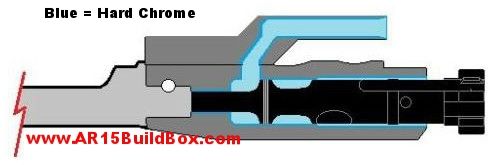
Even some of the big name, very high end companies have had problems with this. Another huge failure point is gas port diameter and gas system length. Select barrels from companies that have done the engineering, not fly-by-night no-names who don't understand why port diameters need to be specific. Even high end barrel makers will put a grotesquely large port on a CLGS or MLGS in ignorance, since .094" works just fine on a 20" RLGS. Barrel extensions are another part that is almost totally overlooked. We're in the age where new companies on the market think that using certain processes on critical components should be applied across the board, like NiB, melonite, nitriding, etc. I was just polishing the feed ramps on one of these barrels the other day, and the lip on the right feed ramp shattered off like glass. It seems clear that the shop that put this barrel out does not fully understand metallurgy, and had case hardened 8620 extensions nitrided heavily, to the point that the nitriding through-hardened the thin areas of the extension-in this case, the feed ramp lips. I have never seen an extension so brittle like this before, and polishing the ramps with a rubber Crtaex bit would not cause any damage. That barrel maker used to advertise that he took his surface hardness to 75 or 75 Rockwell, which is about 20 Rockwell too high, leaving a very brittle surface on a critical part, prone to boundary separation between the substrate and the surface, especially under heating and high shock values. The biggest area is materials selection really, from raw to finished machine parts. We have very limited ownership over the whole parts market, since so many outlets know they are only selling parts. It's up to you to be the QC now, but most of us don't have the tooling or know how to inspect parts. |
|
Quoted:
My KAC SR15 was delivered like that. Quoted:
Quoted:
Loose barrel nuts, like the kind you can take off with your hand. My KAC SR15 was delivered like that. I recently took apart an upper to install a new barrel. I had assembled the original upper myself years ago. I put maybe 15,000 rounds through it; most of which was Wolf. I probably took six or more carbine classes with it. When I took it apart, the barrel nut wasn't even tight. I don't remember how exactly I built it, but I was shocked to say the least. But it obviously didn't hurt anything. |
|
Quoted: Accuracy can suffer. We generally stay between 15-20ft-lbs. Shims will help you time one that needs it. ... Quoted: Quoted: How great a sin is overtightening a flash hider? Accuracy can suffer. We generally stay between 15-20ft-lbs. Shims will help you time one that needs it. ... thanks for taking the time to write all this up--tremendously helpful!  |
|
Quoted:
Accuracy can suffer. We generally stay between 15-20ft-lbs. Shims will help you time one that needs it. Biggest failure points on uppers is starting with substandard materials, and improper assembly. As mentioned before, gas tube alignment with the carrier key can cause early wear on the gas tube flange, which will result in short stroking due to loss of gas seal. The most difficult gas system length to get aligned properly is the RLGS. With high volume, your ejector spring and pin channel in the bolt can get gummed up with carbon and brass shavings, so they need to be changed every 2000-4000rds. Many ejector springs are garbage steel, so use quality ones that meet or exceed the Mil-spec. Same goes for gas ring quality, as well as internal carrier bore machining quality. If there are rough tool marks in the bolt bore in the carrier, they will thrash gas rings. That area needs to be QC'd bigtime in terms of the 3 ID's, smoothness, and correct chrome lining or other surface hardening process, whether it be NiB or Nitride. Carriers warp when they are heat-treated, so the heating process needs to be controlled by someone that knows their kiln operations very well. http://i1085.photobucket.com/albums/j422/LRRPF52/AR15BCG.jpg Even some of the big name, very high end companies have had problems with this. Another huge failure point is gas port diameter and gas system length. Select barrels from companies that have done the engineering, not fly-by-night no-names who don't understand why port diameters need to be specific. Even high end barrel makers will put a grotesquely large port on a CLGS or MLGS in ignorance, since .094" works just fine on a 20" RLGS. Barrel extensions are another part that is almost totally overlooked. We're in the age where new companies on the market think that using certain processes on critical components should be applied across the board, like NiB, melonite, nitriding, etc. I was just polishing the feed ramps on one of these barrels the other day, and the lip on the right feed ramp shattered off like glass. It seems clear that the shop that put this barrel out does not fully understand metallurgy, and had case hardened 8620 extensions nitrided heavily, to the point that the nitriding through-hardened the thin areas of the extension-in this case, the feed ramp lips. I have never seen an extension so brittle like this before, and polishing the ramps with a rubber Crtaex bit would not cause any damage. That barrel maker used to advertise that he took his surface hardness to 75 or 75 Rockwell, which is about 20 Rockwell too high, leaving a very brittle surface on a critical part, prone to boundary separation between the substrate and the surface, especially under heating and high shock values. The biggest area is materials selection really, from raw to finished machine parts. We have very limited ownership over the whole parts market, since so many outlets know they are only selling parts. It's up to you to be the QC now, but most of us don't have the tooling or know how to inspect parts. Quoted:
Quoted:
How great a sin is overtightening a flash hider? Accuracy can suffer. We generally stay between 15-20ft-lbs. Shims will help you time one that needs it. Biggest failure points on uppers is starting with substandard materials, and improper assembly. As mentioned before, gas tube alignment with the carrier key can cause early wear on the gas tube flange, which will result in short stroking due to loss of gas seal. The most difficult gas system length to get aligned properly is the RLGS. With high volume, your ejector spring and pin channel in the bolt can get gummed up with carbon and brass shavings, so they need to be changed every 2000-4000rds. Many ejector springs are garbage steel, so use quality ones that meet or exceed the Mil-spec. Same goes for gas ring quality, as well as internal carrier bore machining quality. If there are rough tool marks in the bolt bore in the carrier, they will thrash gas rings. That area needs to be QC'd bigtime in terms of the 3 ID's, smoothness, and correct chrome lining or other surface hardening process, whether it be NiB or Nitride. Carriers warp when they are heat-treated, so the heating process needs to be controlled by someone that knows their kiln operations very well. http://i1085.photobucket.com/albums/j422/LRRPF52/AR15BCG.jpg Even some of the big name, very high end companies have had problems with this. Another huge failure point is gas port diameter and gas system length. Select barrels from companies that have done the engineering, not fly-by-night no-names who don't understand why port diameters need to be specific. Even high end barrel makers will put a grotesquely large port on a CLGS or MLGS in ignorance, since .094" works just fine on a 20" RLGS. Barrel extensions are another part that is almost totally overlooked. We're in the age where new companies on the market think that using certain processes on critical components should be applied across the board, like NiB, melonite, nitriding, etc. I was just polishing the feed ramps on one of these barrels the other day, and the lip on the right feed ramp shattered off like glass. It seems clear that the shop that put this barrel out does not fully understand metallurgy, and had case hardened 8620 extensions nitrided heavily, to the point that the nitriding through-hardened the thin areas of the extension-in this case, the feed ramp lips. I have never seen an extension so brittle like this before, and polishing the ramps with a rubber Crtaex bit would not cause any damage. That barrel maker used to advertise that he took his surface hardness to 75 or 75 Rockwell, which is about 20 Rockwell too high, leaving a very brittle surface on a critical part, prone to boundary separation between the substrate and the surface, especially under heating and high shock values. The biggest area is materials selection really, from raw to finished machine parts. We have very limited ownership over the whole parts market, since so many outlets know they are only selling parts. It's up to you to be the QC now, but most of us don't have the tooling or know how to inspect parts. Thanks for posting that |
|
Quoted:
This summer, I finally got over my trepidation towards building uppers. Am quite comfortable doing lowers, but uppers always intimidated me due to increased failure potential. But I finally bit the bullet and rebuilt my rifle upper, then a pistol upper. They've both shot well so far, but I haven't had the chance to put a ton of rounds through them. My question is this: under heavy use, what are the most common failures for built uppers? Under or over torqued barrels Improperly installed gas blocks The are the two biggest and most important. |
|
Quoted:
To add to the above- Using set screw gas blocks without dimpling the barrel and also not using loktite on the screws. After that, guys using shitty out of spec parts. Use quality parts, install it right (don't rush), test the fuck out of it, keep it clean and lubed, and you're good to go. Quoted:
Quoted:
Loose barrel nuts, like the kind you can take off with your hand. Improperly aligned gas blocks, and barrel nuts. Lack of lubrication between the barrel nut and receiver. Gas tubes which are not straight inside the receiver. Improperly timed muzzle devices. I've seen charging handles bind a carrier up inside a receiver. If it does it once, throw it away. If you're into staking your own gas keys onto the carrier, always test fit after it's finished because the staking might cause the carrier to bind also. To add to the above- Using set screw gas blocks without dimpling the barrel and also not using loktite on the screws. After that, guys using shitty out of spec parts. Use quality parts, install it right (don't rush), test the fuck out of it, keep it clean and lubed, and you're good to go. Set screw gas blocks without dimpling on the barrel are not a problem...if you properly (that's the key word here) degrease and use red lock tight. |
|
Quoted:
the only common failure is people installing shit wrong... seems I have seen either gas tube issues whether it be upside down (i know right? lol) or mis-aligned with the gas port... or improperly torques barrel nut/handguard. not much to screw up really That |