


Posted: 1/28/2013 5:18:28 PM EDT
|
I'm doing some remedial econ reading. I came upon the following: Three workers produce sugar and tea as follows:
1. Draw the combined PPF for these three workers with tea on the horizontal axis. 2. If together they produce 3 units of sugar efficiently, how much tea will they be producing? 3. What will <st1:state>Brittany</st1:state> be producing in this case? 4. Would they agree to trade with the outside world at a price of 1 tea=2 sugar? Explain why or why not. A graphical explanation that shows the CPF is the best. Anyone know how to show the CPF graphically? |

|
I should have put this in the OP... It's not my homework. I'm a 56 year old electrical engineer who has owned a specialty tech company for the last 23+ years. One son is in med school, the other is finishing a CS engineering degree, so it's not their homework either. Wife has her own retail business. I just try to keep learning things. |

|
David Richardo's trade theory - it's a very important concept, and one that runs counter intuitive sometimes. The thing to remember is that even if one trade partner is better at doing EVERYTHING than the other trade partner, there are STILL gains to be made from trade:
Ricardo argued that there is mutual benefit from trade (or exchange) even if one party (e.g. resource-rich country, highly skilled artisan) is more productive in every possible area than its trading counterpart (e.g. resource-poor country, unskilled labourer), as long as each concentrates on the activities where it has a relative productivity advantage.
Here's a fun link explaining it in extra sexist terms for the GD crowd 
http://www.economistsdoitwithmodels.com/2010/03/17/comparative-advantage-and-gains-from-trade-feminazi-edition/ 
|
I tried to do a Google Image search for good graphs, but WTF is wrong with Google?!  I've getting all sorts of blank black screens after clicking pictures, etc. Did they have some strange update? I've getting all sorts of blank black screens after clicking pictures, etc. Did they have some strange update?
Here's a good link: http://www.econport.org/content/handbook/productionpossibilities/Comparative-Advantage.html The key is to find places on the graph/chart where all trade partners get more stuff working together than they'd get working alone. Here are a few I found: 

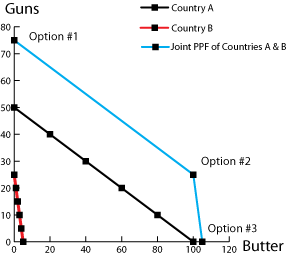
Here's a good graph showing applicable production possibility curves: 
ETA: typos |
|
You can put all three of your proposed trade partners on the same graph, use tea production on one axis (instructions say used the bottom) and sugar on the other axis. Each partner will have a separate line.
The total productivity line (combined possibilities frontier, the CPF) is all three outputs added together. This line will be above and to the right of the other lines since it represents the combined output at each individual possibility. Once you have your three production lines plus the CPF (four lines total, should all be diagonal), play with it. Try 3 sugar on the vertical axis, follow it across until it hits the CPF line. then down to the horizontal tea axis. How much tea it that? That's the answer to question #2. But questions 3 & 4 are best answered using basic substitution algebra...see next post. |
|
For question #3, you could walk away from the graph and go back to your chart. Use the chart to calculate an "opportunity cost" for each partner individually, just like in the "sexist" ironed shirts vs. changed tires example I quoted in my first reply. Look at the part that shows that when a woman gives up X amount of tire changes when she irons 1 shirt, and a guy gives up Y amount tire changes when he irons 1 shirt.
Using that method, you can then calculate how much tea Brittany gives up when she only makes sugar, and how much sugar she gives up when she only makes tea. That's her opportunity cost for switching from one to the other. Glancing at the chart, Brittany makes 1 unit of tea just as efficiently as she makes 1 unit sugar. The other two partners make a lot more sugar than tea in the same amount of time, so Brittany will make the tea and trade for sugar. To actually answer #4, you need to draw the proposed graph with the 4 production lines (3 personal, and one additive CPF). Then make a line that represents a ratio of 1 tea to 2 sugar - draw that line across the whole graph right out to the CPF line. Where does it hit on the CPF? Does it benefit all 3 partners (see where it hits their individual lines)? In other words, does that 1:2 ratio (tea to sugar) mean that Brittany has more TOTAL STUFF than she would working alone? What about Adam and Carlos? If they get MORE than they could working alone, they'll all agree to trade at that rate. If not, the person who's getting LESS will refuse to trade. Ain't no body workin' for free up in dis bitch!
ETA: corrected insane numbers of typos |
|
Quoted: For question #3, you could walk away from the graph and go back to your chart. Use the chart to calculate an "opportunity cost" for each partner individually, just like in the "sexist" ironed shirts vs. changed tires example I quoted in my first reply. Look at the part that shows that when a woman gives up X amount of tire changes when she irons 1 shirt, and a guy gives up Y amount tire changes when he irons 1 shirt. Using that method, you can then calculate how much tea Brittany gives up when she only makes sugar, and how much sugar she gives up when she only makes tea. That's her opportunity cost for switching from one to the other. Glancing at the chart, Brittany makes 1 unit of tea just as efficiently as she makes 1 unit sugar. The other two partners make a lot more sugar than tea in the same amount of time, so Brittany will make the tea and trade for sugar. To actually answer #4, you need to draw the proposed graph with the 4 production lines (3 personal, and one additive CPF). Then make a line that represents a ratio of 1 tea to 2 sugar - draw that line across the whole graph right out to the CPF line. Where does it hit on the CPF? Does it benefit all 3 partners (see where it hits their individual lines)? In other words, does that 1:2 ratio (tea to sugar) mean that Brittany has more TOTAL STUFF than she would working alone? What about Adam and Carlos? If they get MORE than they could working alone, they'll all agree to trade at that rate. If not, the person who's getting LESS will refuse to trade. Ain't no body workin' for free up in dis bitch! ETA: corrected insane numbers of typos Thank you, this is the thought process boot I was looking for. RE: #4 - when you say "draw that line... to the CPF line", where is the CPF line? That's the part I don't get. Again, thanks for this help. |
|
Quoted:
Quoted:
For question #3, you could walk away from the graph and go back to your chart. Use the chart to calculate an "opportunity cost" for each partner individually, just like in the "sexist" ironed shirts vs. changed tires example I quoted in my first reply. Look at the part that shows that when a woman gives up X amount of tire changes when she irons 1 shirt, and a guy gives up Y amount tire changes when he irons 1 shirt. Using that method, you can then calculate how much tea Brittany gives up when she only makes sugar, and how much sugar she gives up when she only makes tea. That's her opportunity cost for switching from one to the other. Glancing at the chart, Brittany makes 1 unit of tea just as efficiently as she makes 1 unit sugar. The other two partners make a lot more sugar than tea in the same amount of time, so Brittany will make the tea and trade for sugar. To actually answer #4, you need to draw the proposed graph with the 4 production lines (3 personal, and one additive CPF). Then make a line that represents a ratio of 1 tea to 2 sugar - draw that line across the whole graph right out to the CPF line. Where does it hit on the CPF? Does it benefit all 3 partners (see where it hits their individual lines)? In other words, does that 1:2 ratio (tea to sugar) mean that Brittany has more TOTAL STUFF than she would working alone? What about Adam and Carlos? If they get MORE than they could working alone, they'll all agree to trade at that rate. If not, the person who's getting LESS will refuse to trade. Ain't no body workin' for free up in dis bitch!
ETA: corrected insane numbers of typos Thank you, this is the thought process boot I was looking for. RE: #4 - when you say "draw that line... to the CPF line", where is the CPF line? That's the part I don't get. Again, thanks for this help. The CPF is the other 3 partners' outputs all added together, then formed into a 4th line. In the below graphs, see the 3rd line? It's the output of the first two lines added together at each point. [There are two trade partners in these, rather than three, but the concept is the same] http://04.edu-cdn.com/files/static/mcgrawhillprof/9780071621861/COMPARATIVE_ADVANTAGE_AND_GAINS_FROM_TRADE_04.GIF]http://04.edu-cdn.com/files/static/mcgrawhillprof/9780071621861/COMPARATIVE_ADVANTAGE_AND_GAINS_FROM_TRADE_04.GIF]http://04.edu-cdn.com/files/static/mcgrawhillprof/9780071621861/COMPARATIVE_ADVANTAGE_AND_GAINS_FROM_TRADE_04.GIF 
http://www.econport.org/content/handbook/productionpossibilities/Comparative-Advantage/mainColumnParagraphs/0/content_files/file1/comp_advantage_graph2.gif]http://www.econport.org/content/handbook/productionpossibilities/Comparative-Advantage/mainColumnParagraphs/0/content_files/file1/comp_advantage_graph2.gif]http://www.econport.org/content/handbook/productionpossibilities/Comparative-Advantage/mainColumnParagraphs/0/content_files/file1/comp_advantage_graph2.gif If all three partners make sugar, and NO tea at all, how much sugar is made? Place a dot on the graph at that point {x,y} = {zero tea and # amount of sugar} Forgive me, but I forgot which item was placed on which axis... Now see what happens if all partners make only tea and no sugar at all. place a dot at sugar = zero and tea = whatever. Congrats, you have 2 points on your CPF!! CPF's are not always straight lines, though, so you need to keep plotting points until you get a good picture of the total output at each point. Don't forget to try a few decimals, because the trade partners might want to make 3.5 units of tea total, etc. ETA: Sorry about the messy links. 
|
|
Quoted: Quoted: Quoted: For question #3, you could walk away from the graph and go back to your chart. Use the chart to calculate an "opportunity cost" for each partner individually, just like in the "sexist" ironed shirts vs. changed tires example I quoted in my first reply. Look at the part that shows that when a woman gives up X amount of tire changes when she irons 1 shirt, and a guy gives up Y amount tire changes when he irons 1 shirt. Using that method, you can then calculate how much tea Brittany gives up when she only makes sugar, and how much sugar she gives up when she only makes tea. That's her opportunity cost for switching from one to the other. Glancing at the chart, Brittany makes 1 unit of tea just as efficiently as she makes 1 unit sugar. The other two partners make a lot more sugar than tea in the same amount of time, so Brittany will make the tea and trade for sugar. To actually answer #4, you need to draw the proposed graph with the 4 production lines (3 personal, and one additive CPF). Then make a line that represents a ratio of 1 tea to 2 sugar - draw that line across the whole graph right out to the CPF line. Where does it hit on the CPF? Does it benefit all 3 partners (see where it hits their individual lines)? In other words, does that 1:2 ratio (tea to sugar) mean that Brittany has more TOTAL STUFF than she would working alone? What about Adam and Carlos? If they get MORE than they could working alone, they'll all agree to trade at that rate. If not, the person who's getting LESS will refuse to trade. Ain't no body workin' for free up in dis bitch! ETA: corrected insane numbers of typos Thank you, this is the thought process boot I was looking for. RE: #4 - when you say "draw that line... to the CPF line", where is the CPF line? That's the part I don't get. Again, thanks for this help. The CPF is the other 3 partners' outputs all added together, then formed into a 4th line. In the below graphs, see the 3rd line? It's the output of the first two lines added together at each point. [There are two trade partners in these, rather than three, but the concept is the same] http://04.edu-cdn.com/files/static/mcgrawhillprof/9780071621861/COMPARATIVE_ADVANTAGE_AND_GAINS_FROM_TRADE_04.GIF]http://04.edu-cdn.com/files/static/mcgrawhillprof/9780071621861/COMPARATIVE_ADVANTAGE_AND_GAINS_FROM_TRADE_04.GIF]http://04.edu-cdn.com/files/static/mcgrawhillprof/9780071621861/COMPARATIVE_ADVANTAGE_AND_GAINS_FROM_TRADE_04.GIF http://www.econport.org/content/handbook/productionpossibilities/Comparative-Advantage/mainColumnParagraphs/0/content_files/file1/comp_advantage_graph2.gif]http://www.econport.org/content/handbook/productionpossibilities/Comparative-Advantage/mainColumnParagraphs/0/content_files/file1/comp_advantage_graph2.gif]http://www.econport.org/content/handbook/productionpossibilities/Comparative-Advantage/mainColumnParagraphs/0/content_files/file1/comp_advantage_graph2.gif http://www.econport.org/content/handbook/productionpossibilities/Comparative-Advantage/mainColumnParagraphs/0/content_files/file1/comp_advantage_graph2.gif]http://www.econport.org/content/handbook/productionpossibilities/Comparative-Advantage/mainColumnParagraphs/0/content_files/file1/comp_advantage_graph2.gif]http://www.econport.org/content/handbook/productionpossibilities/Comparative-Advantage/mainColumnParagraphs/0/content_files/file1/comp_advantage_graph2.gif If all three partners make sugar, and NO tea at all, how much sugar is made? Place a dot on the graph at that point {x,y} = {zero tea and # amount of sugar} Forgive me, but I forgot which item was placed on which axis... Now see what happens if all partners make only tea and no sugar at all. place a dot at sugar = zero and tea = whatever. Congrats, you have 2 points on your CPF!! CPF's are not always straight lines, though, so you need to keep plotting points until you get a good picture of the total output at each point. Don't forget to try a few decimals, because the trade partners might want to make 3.5 units of tea total, etc. ETA: Sorry about the messy links. Outstanding! Thank you very much. I see you are in VA - I need to get you a beer (or 6) sometime soon.  |
|
I really like this "Guns vs Butter" graph because I think it's easy to understand. Also "Guns vs Butter" is such a classic example that economists often just say that for verbal shorthand. Sometimes an economist or politician will say something like "I support cutting the defense budget because of 'Guns vs Butter' "...then the guy will smirk at anyone who looks confused, like "How could you not know what I mean you uneducated hick!" It's bullshit, but it's one of those show-off look-at-me things mildly educated assholes do.
http://www.econport.org/content/handbook/productionpossibilities/Comparative-Advantage/mainColumnParagraphs/0/content_files/file1/comp_advantage_graph2.gif |
|
Quoted:
Quoted:
Quoted:
[snip] [/div] Outstanding! [div] [/div][div]Thank you very much. [/div][div]I see you are in VA - I need to get you a beer (or 6) sometime soon. Don't thank me yet, I could be misremembering how to do this. I haven't taken an econ class in years and my brain is fried from running after my toddlers all day. There are only so many diapers you can change before the poop smell destroys your ability to think. 
|
|
Quoted:
Quoted: Quoted: Quoted: [snip] [/div] Outstanding! [div] [/div][div]Thank you very much. [/div][div]I see you are in VA - I need to get you a beer (or 6) sometime soon. Don't thank me yet, I could be misremembering how to do this. I haven't taken an econ class in years and my brain is fried from running after my toddlers all day. There are only so many diapers you can change before the poop smell destroys your ability to think. No, this seems correct - at the very least, it put things in order logically for me. I can proceed now, thank you. [div] [/div] |
|
Spend some time on Public Choice Theory when you get a chance. It's one of the best things I learned in Economics, and should be required learning for all voters.
And for your reading pleasure, here's my favorite economics blog - fresh and fun, with a nice free-market/libertarian perspective: http://marginalrevolution.com/ |