


Posted: 3/4/2010 1:59:08 PM EDT
|
Please post a pic, the name, the body's relative size, relative distance from the earth, and mass if they are applicable, or add any fun facts.
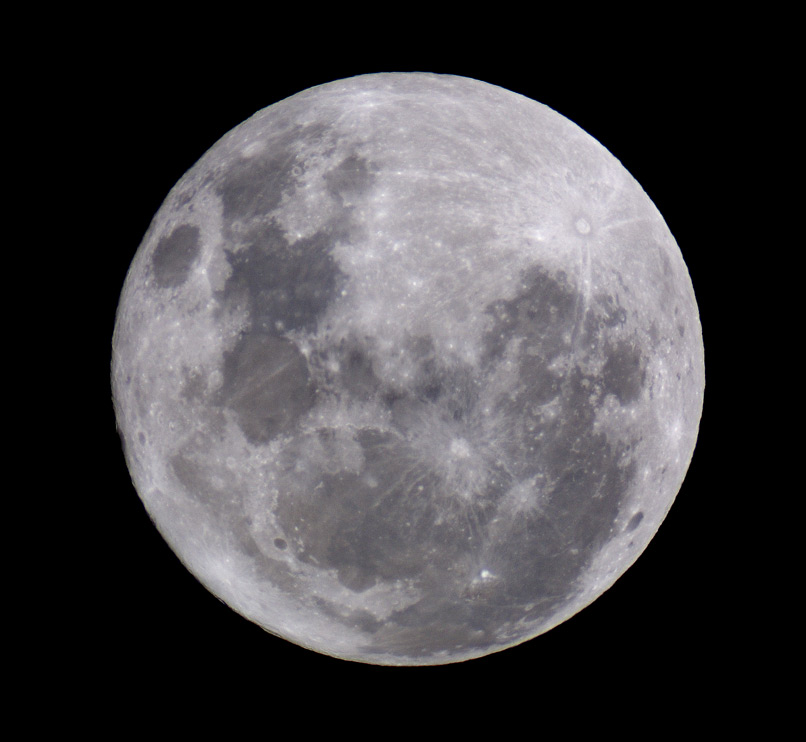
I'll start us out: Deimos: 
Mass: 1.48x10^(15)kg Mean Radius: 6.2km Equatorial Surface Gravity: .0039m/s^(2) (For comparison, earth's is 9.8m/s^(2) Info: It is one of Mars' two moons. |



|
Here is a list of all known moons in the solar system. That is all I have to add for now.
http://www.windows.ucar.edu/tour/link=/our_solar_system/moons_table.html |
|
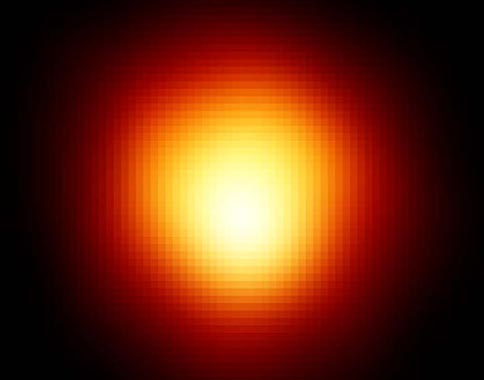
Polaris "The North Star"
Spectral type F7 Ib-II SB Distance 430 ± 30 ly Mass 7.54±0.6 M Radius 30 R☉ Temperature 7200 K 
Because in the current era
 α UMi lies nearly in a direct line with the axis of the Earth's rotation "above" the North Pole — the north celestial pole — Polaris stands almost motionless on the sky, and all the stars of the Northern sky appear to rotate around it. Therefore, it makes an excellent fixed point from which to draw measurements for celestial navigation and for astrometry. The antiquity of its use is attested by the fact that it is found represented on the earliest known Assyrian tablets.[citation needed] In more recent history it was referenced in Nathaniel Bowditch's 1802 book, The American Practical Navigator, where it is listed as one of the navigational stars.[9] At present, Polaris is 0.7° away from the pole of rotation (1.4 times the Moon disc) and hence revolves around the pole in a small circle 1½° in diameter. Only twice during every sidereal day does Polaris accurately define the true north azimuth; the rest of the time it is only an approximation and must be corrected using tables or a rough rule of thumb. α UMi lies nearly in a direct line with the axis of the Earth's rotation "above" the North Pole — the north celestial pole — Polaris stands almost motionless on the sky, and all the stars of the Northern sky appear to rotate around it. Therefore, it makes an excellent fixed point from which to draw measurements for celestial navigation and for astrometry. The antiquity of its use is attested by the fact that it is found represented on the earliest known Assyrian tablets.[citation needed] In more recent history it was referenced in Nathaniel Bowditch's 1802 book, The American Practical Navigator, where it is listed as one of the navigational stars.[9] At present, Polaris is 0.7° away from the pole of rotation (1.4 times the Moon disc) and hence revolves around the pole in a small circle 1½° in diameter. Only twice during every sidereal day does Polaris accurately define the true north azimuth; the rest of the time it is only an approximation and must be corrected using tables or a rough rule of thumb.
Due to the precession of the equinoxes, Polaris will not always be the pole star. Over tens of thousands of years, perturbations to the Earth's axis of rotation will cause it to point to other regions of the sky, tracing out a circle over 25,800 years. Other stars along this circle would have served as the pole star in the past and will again in the future, including Beta Ursae Minoris from 1500 BC to 500 AD, Thuban around 2500 BC and Vega 12000 BC. |
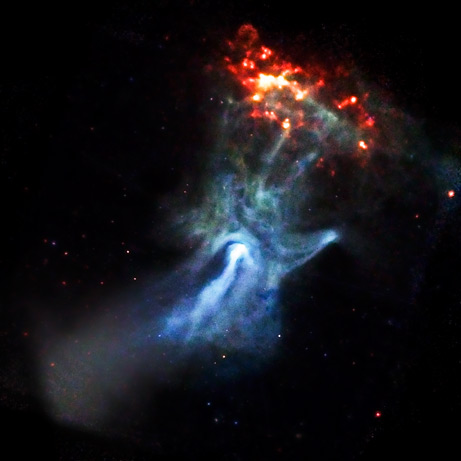
NASA’s Chandra X-ray observatory recently snapped the image of this unusual hand-shaped nebula. The by-product of a star gone supernova, its energetic particles span 150 light-years. This is big considering their source (a pulsar) spans a mere 19.3 km. The particles have had such wide reach because the pulsar spins incredibly fast: seven complete rotations every second. The particles that form the fingers appear to be transferring energy to a nearby gas cloud (the part that glows orange and red on the image). Dubbed B1509, the pulsar is believed to be 1,700 years old. It’s about 17,000 light-years from Earth |
|
Eta Carinae
Spectral type Peculiar Distance: 7,500 to 8,000 ly Mass 100–150 M Radius 85–195 R Temperature 36–40,000 K 
Eta Carinae's chief significance for astrophysics is based on its giant eruption or supernova impostor event, which was observed around 1843. In a few years, Eta Carinae produced almost as much visible light as a supernova explosion, but it survived. Other supernova impostors have been seen in other galaxies, for example the false supernovae SN 1961v in NGC 1058[6] and SN 2006jc in NGC 4904,[7] which produced a false supernova, noted in October 2004. Significantly, SN 2006jc was destroyed in a supernova explosion two years later, observed on October 9, 2006.
The supernova impostor phenomenon may represent a surface instability[9] or a failed supernova. Eta Carinae's giant eruption was the prototype for this phenomenon, and after 160 years the star's internal structure has not fully recovered. |
|
Quoted:
http://www.draganakovacevic.com/wp-content/uploads/2009/04/hand-shaped-nebula.jpg NASA’s Chandra X-ray observatory recently snapped the image of this unusual hand-shaped nebula. The by-product of a star gone supernova, its energetic particles span 150 light-years. This is big considering their source (a pulsar) spans a mere 19.3 km. The particles have had such wide reach because the pulsar spins incredibly fast: seven complete rotations every second. The particles that form the fingers appear to be transferring energy to a nearby gas cloud (the part that glows orange and red on the image). Dubbed B1509, the pulsar is believed to be 1,700 years old. It’s about 17,000 light-years from Earth I bet there is a another hand on the other side. Goatseaxy 
|


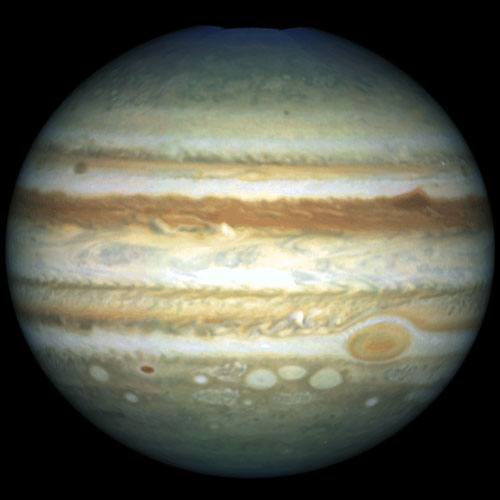


Neptune Mass: 1.0243×1026 kg 17.147 Earths Equatorial radius: 24,764 ± 15 km 3.883 Earths Equatorial surface gravity: 11.15 m/s² 1.14 g Neptune has the highest recorded wind speeds of any planet in the solar system. They are in the 2100 km/h range. Its largest moon, Triton is currently in a decaying orbit around the planet and it is thought that it will eventually crash into Neptune or break up and become part of Neptune's ring system. Picture of clouds |
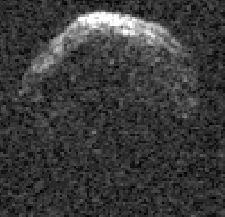
(29075) 1950 DA Asteroid (29075) 1950 DA was lost after its discovery in 1950 since not enough observations were made to allow plotting of its orbit, and then rediscovered on December 31, 2000. The chance it will impact Earth on March 16, 2880 during its close approach has been estimated as 1 in 300. This chance of impact for such a large object is roughly 50% greater than that for all other such objects combined between now and 2880. It has a diameter of about a kilometer (0.6 miles). |
|
Quoted:
"That's no moon." Mimas Saturn Moon http://img63.imageshack.us/img63/5737/124600mainpia0625851660.jpg Mass: (3.749 3 ± 0.003 1) × 1019 kg (6.3 × 10⁻⁶ Earths) Mean Density: 1.147 9 ± 0.005 3 g/cm3 I knew I'd seen that picture before... 

|
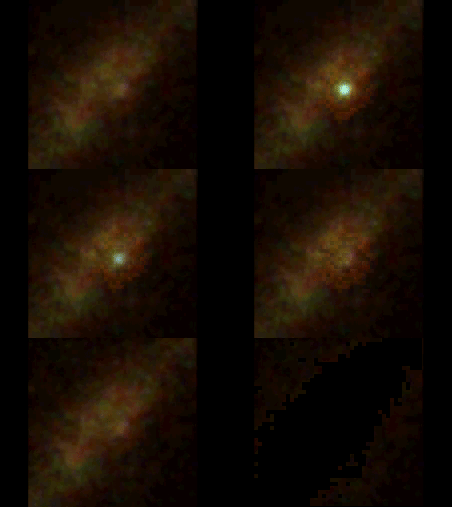
Pulsars are highly magnetized, rotating neutron stars that emit a beam of electromagnetic radiation. The observed periods of their pulses range from 1.4 milliseconds to 8.5 seconds.[1] The radiation can only be observed when the beam of emission is pointing towards the Earth. This is called the lighthouse effect and gives rise to the pulsed nature that gives pulsars their name. Because neutron stars are very dense objects, the rotation period and thus the interval between observed pulses is very regular. For some pulsars, the regularity of pulsation is as precise as an atomic clock.[2] A few pulsars are known to have planets orbiting them, as in the case of PSR B1257+12. Werner Becker of the Max Planck Institute for Extraterrestrial Physics said in 2006, "The theory of how pulsars emit their radiation is still in its infancy, even after nearly forty years of work."[3] 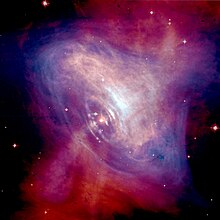
Composite Optical/X-ray image of the Crab Nebula, showing synchrotron emission in the surrounding pulsar wind nebula, powered by injection of magnetic fields and particles from the central pulsar. |

This is a view of the Russian Mir Space Station photographed by a crewmember of the fifth Shuttle/Mir docking mission, STS-81. The image shows: upper center - Progress supply vehicle, Kvant-1 module, and Core module; center left - Priroda module; center right - Spektr module; bottom left - Kvant-2 module; bottom center - Soyuz; and bottom right - Kristall module and Docking module. |
|
Quoted:
Quoted:
"That's no moon." Mimas Saturn Moon http://img63.imageshack.us/img63/5737/124600mainpia0625851660.jpg Mass: (3.749 3 ± 0.003 1) × 1019 kg (6.3 × 10⁻⁶ Earths) Mean Density: 1.147 9 ± 0.005 3 g/cm3 I knew I'd seen that picture before... http://almostnot.files.wordpress.com/2009/07/deathstar.jpg http://img63.imageshack.us/img63/5737/124600mainpia0625851660.jpg I bet Lucas was inspired by that... |
