


Posted: 10/22/2011 8:50:53 AM EDT
| The light coming from any star reaching us today left that star a long long time ago, so how do we know if that star or any star still exists? |
|
Quoted:
The light coming from any star reaching us today left that star a long long time ago, so how do we know if that star or any star still exists? We can tell how old a star is by its size and emissions. I'm pretty sure we can see some stars right now that we know are already dead. |
|
Quoted:
The light coming from any star reaching us today left that star a long long time ago, so how do we know if that star or any star still exists? Our view of the stars is days-weeks-years-millenia behind their actual state depending on how far away the star is. Now you understand why looking at star\s very far away is looking back in time. |
|
Yes, it's possible that some stars we can see today are already dead. Stars go through a standard life cycle, during which their size and frequencies of radiation change. We can determine where a star is in the cycle by observing it, so we know how long it has left.
However, the only individual stars that we can see are in our own galaxy, which means that they're no more than a few hundred thousand light-years away (if I recall). Since stars live millions of years, most of the visible ones are still around. |
.jpg)
|
Quoted:
The light coming from any star reaching us today left that star a long long time ago, so how do we know if that star or any star still exists? First they estimate the size and the age of the star by the light it emits. The life cycle of stars is pretty well understood. Different sized emit different colors of light and this changes during the life of the star. Then analyze the red-shift to get the distance to the star. Now you have an idea whether the star has ceased to exist even though we can still its light. Here is a list of supernova candidates. Don't hold your breath waiting for them to pop. We haven't figured it out that accurately. |
|
Quoted:
Quoted:
On the same note, dependent of its mass, the life span of a star reportedly can be thousands of years. Billions of years. For example, we suspect our sun will run out of hydrogen in the next 5 billion years. That depends on mass. A blue super giant can burn through its hydrogen in hundreds of thousands of years. |
|
Quoted: Quoted: Quoted: On the same note, dependent of its mass, the life span of a star reportedly can be thousands of years. Billions of years. For example, we suspect our sun will run out of hydrogen in the next 5 billion years. That depends on mass. A blue super giant can burn through its hydrogen in hundreds of thousands of years. Yep and cause a hell of a mess. More mass = faster death = supernova. What's really interesting is that when a specific point is reached and the begins to succumb to gravity, a red giant can collapse to the size of mercury in seconds. Good news is, every element (that we know of) heavier than iron is created during these events. |
|
Quoted:
Quoted:
The light coming from any star reaching us today left that star a long long time ago, so how do we know if that star or any star still exists? Our view of the stars is days-weeks-years-millenia behind their actual state depending on how far away the star is. Now you understand why looking at star\s very far away is looking back in time. This fact in action. 
Telescopes are time machines. |
|
Quoted:
Quoted:
Quoted:
The light coming from any star reaching us today left that star a long long time ago, so how do we know if that star or any star still exists? Our view of the stars is days-weeks-years-millenia behind their actual state depending on how far away the star is. Now you understand why looking at star\s very far away is looking back in time. This fact in action. http://upload.wikimedia.org/wikipedia/commons/b/b4/Hubble_Ultra_Deep_Field_diagram.jpg Telescopes are time machines. I find it interesting (and I'll admit, a little confusing) how everything in that graphic is still true if you turn Hubble 180 degrees and look the other way. |
|
Quoted:
Quoted:
Quoted:
Quoted:
The light coming from any star reaching us today left that star a long long time ago, so how do we know if that star or any star still exists? Our view of the stars is days-weeks-years-millenia behind their actual state depending on how far away the star is. Now you understand why looking at star\s very far away is looking back in time. This fact in action. http://upload.wikimedia.org/wikipedia/commons/b/b4/Hubble_Ultra_Deep_Field_diagram.jpg Telescopes are time machines. The limits are spherical and apply in every direction. I find it interesting (and I'll admit, a little confusing) how everything in that graphic is still true if you turn Hubble 180 degrees and look the other way. |
|
Quoted:
Quoted:
Quoted:
Quoted:
The light coming from any star reaching us today left that star a long long time ago, so how do we know if that star or any star still exists? Our view of the stars is days-weeks-years-millenia behind their actual state depending on how far away the star is. Now you understand why looking at star\s very far away is looking back in time. This fact in action. http://upload.wikimedia.org/wikipedia/commons/b/b4/Hubble_Ultra_Deep_Field_diagram.jpg Telescopes are time machines. I find it interesting (and I'll admit, a little confusing) how everything in that graphic is still true if you turn Hubble 180 degrees and look the other way. How is that? You mean, that the cosmos exists in that fashion in any direction we look? |
|
Quoted:
Quoted:
Quoted:
Quoted:
Quoted:
The light coming from any star reaching us today left that star a long long time ago, so how do we know if that star or any star still exists? Our view of the stars is days-weeks-years-millenia behind their actual state depending on how far away the star is. Now you understand why looking at star\s very far away is looking back in time. This fact in action. http://upload.wikimedia.org/wikipedia/commons/b/b4/Hubble_Ultra_Deep_Field_diagram.jpg Telescopes are time machines. I find it interesting (and I'll admit, a little confusing) how everything in that graphic is still true if you turn Hubble 180 degrees and look the other way. How is that? You mean, that the cosmos exists in that fashion in any direction we look? Yes. I was just pointing out the fact that no matter what direction you look you keep looking back in time towards the creation of the Universe. It just seems counter intuitive to most people that you can not say "the Big Bang happened in that direction." |
|
Quoted: Quoted: Quoted: Quoted: Quoted: The light coming from any star reaching us today left that star a long long time ago, so how do we know if that star or any star still exists? Our view of the stars is days-weeks-years-millenia behind their actual state depending on how far away the star is. Now you understand why looking at star\s very far away is looking back in time. This fact in action. http://upload.wikimedia.org/wikipedia/commons/b/b4/Hubble_Ultra_Deep_Field_diagram.jpg Telescopes are time machines. I find it interesting (and I'll admit, a little confusing) how everything in that graphic is still true if you turn Hubble 180 degrees and look the other way. How is that? You mean, that the cosmos exists in that fashion in any direction we look? Adding a bit more onto the above, more of an interesting story than anything: When Hubble himself originally observed the universe, he thought that the entire universe appeared to be retreating from us or our general area specifically. A bit later he realized that he was observing the entire universe expanding in unison. For a quick and easy demonstration of this: 1. Take a rubber band. 2. With a magic marker draw three dots on the rubber band. One in the center of the band, then one on either side of it spaced out by an inch. 3. Now stretch the rubber band, you'll see basically the same thing he saw through his early observations. The center dot (earth) doesn't move while the other two retreat exponentially. |
|
Quoted:
Quoted:
Quoted:
Quoted:
Quoted:
Quoted:
The light coming from any star reaching us today left that star a long long time ago, so how do we know if that star or any star still exists? Our view of the stars is days-weeks-years-millenia behind their actual state depending on how far away the star is. Now you understand why looking at star\s very far away is looking back in time. This fact in action. http://upload.wikimedia.org/wikipedia/commons/b/b4/Hubble_Ultra_Deep_Field_diagram.jpg Telescopes are time machines. I find it interesting (and I'll admit, a little confusing) how everything in that graphic is still true if you turn Hubble 180 degrees and look the other way. How is that? You mean, that the cosmos exists in that fashion in any direction we look? Yes. I was just pointing out the fact that no matter what direction you look you keep looking back in time towards the creation of the Universe. It just seems counter intuitive to most people that you can not say "the Big Bang happened in that direction." The "Big Bang" IS the universe, it is in every direction. |
|
Quoted: I still struggle with where the center of the universe is, I would think this to be measurable. However that said, one theory states (i am praphrasing) that the center is everywhere . Drink a 6-pack and wrap your head around that! It's things like the below I have a hard time with. Read the below then consider that we expect our sun to live for another 5,000,000,000 years.: The sun burns 6.3x10¹¹ KG of Hydrogen into Helium per second. |
|
Quoted:
Quoted:
I still struggle with where the center of the universe is, I would think this to be measurable. However that said, one theory states (i am praphrasing) that the center is everywhere . Drink a 6-pack and wrap your head around that! It's things like the below I have a hard time with. Read the below then consider that we expect our sun to live for another 5,000,000,000 years.: The sun burns 6.3x10¹¹ KG of Hydrogen into Helium per second. Especially when you consider that Sol is relatively small compared to the likes of Betelgeuse, Eta Carinae, or VY Canis Majoris. While they won't burn as long as ours, I'm sure those fusion rates are staggering. Right click>view image 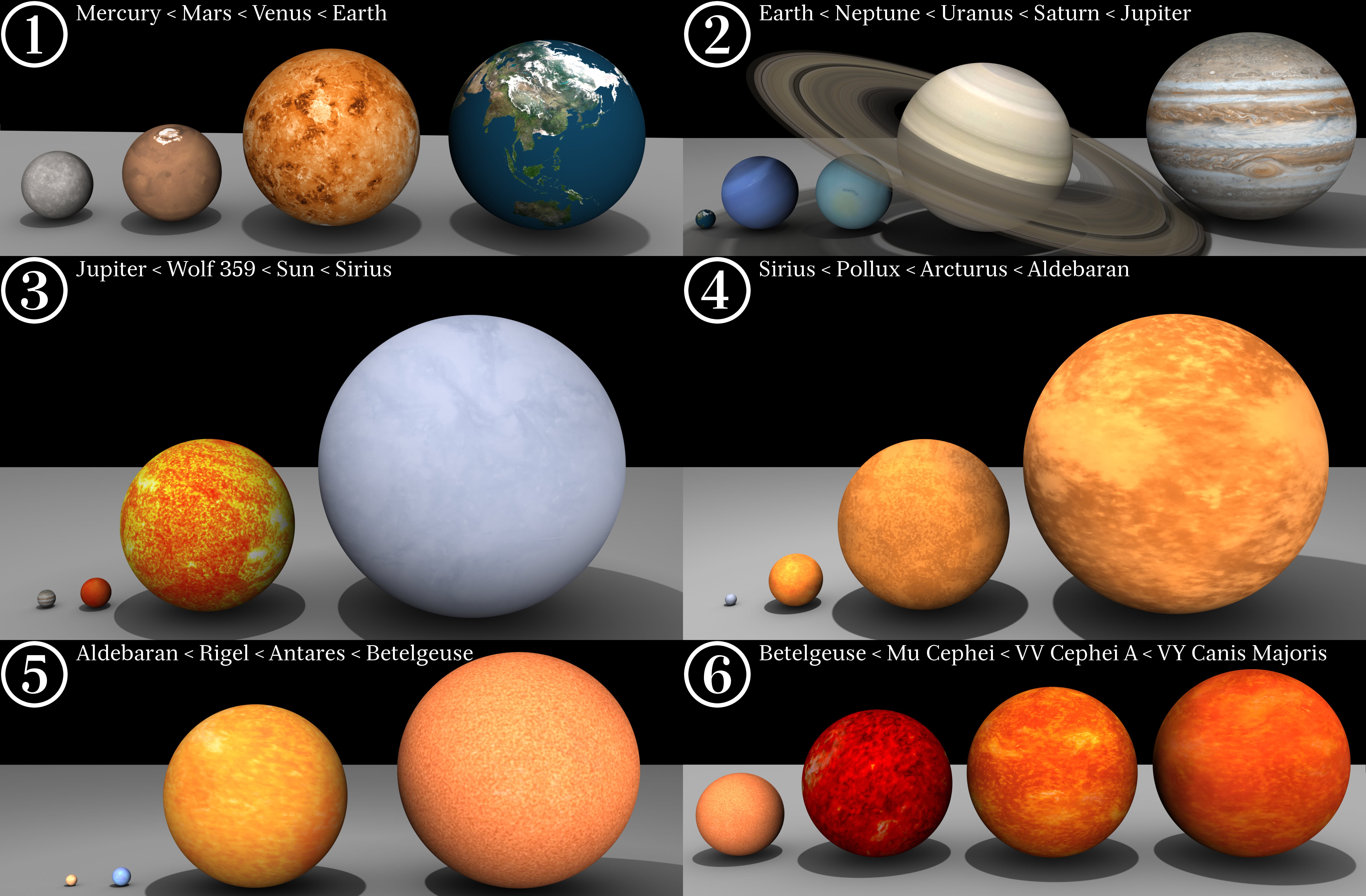
|
|
Quoted:
Quoted:
Quoted:
Quoted:
Quoted:
Quoted:
The light coming from any star reaching us today left that star a long long time ago, so how do we know if that star or any star still exists? Our view of the stars is days-weeks-years-millenia behind their actual state depending on how far away the star is. Now you understand why looking at star\s very far away is looking back in time. This fact in action. http://upload.wikimedia.org/wikipedia/commons/b/b4/Hubble_Ultra_Deep_Field_diagram.jpg Telescopes are time machines. I find it interesting (and I'll admit, a little confusing) how everything in that graphic is still true if you turn Hubble 180 degrees and look the other way. How is that? You mean, that the cosmos exists in that fashion in any direction we look? Adding a bit more onto the above, more of an interesting story than anything: When Hubble himself originally observed the universe, he thought that the entire universe appeared to be retreating from us or our general area specifically. A bit later he realized that he was observing the entire universe expanding in unison. For a quick and easy demonstration of this: 1. Take a rubber band. 2. With a magic marker draw three dots on the rubber band. One in the center of the band, then one on either side of it spaced out by an inch. 3. Now stretch the rubber band, you'll see basically the same thing he saw through his early observations. The center dot (earth) doesn't move while the other two retreat exponentially. But only because you drew the center dot in the center of the band, right? Wouldnt this mean that we are in the center of the universe, and doesnt that seem incredibly unlikely? I am ignorant of all this, but that was my first thought. |

|
Quoted:
I still struggle with where the center of the universe is, I would think this to be measurable. However that said, one theory states (i am praphrasing) that the center is everywhere . Drink a 6-pack and wrap your head around that! It's possible that the universe is like the surface of a sphere. The surface of a sphere has a finite area, but no edges and no center. And the expansion of the universe is like the expansion of the sphere; everything gets farther from everything else at a rate that's proportional to their separation. |
|
Quoted:
Quoted:
Quoted:
Quoted:
Quoted:
Quoted:
Quoted:
The light coming from any star reaching us today left that star a long long time ago, so how do we know if that star or any star still exists? Our view of the stars is days-weeks-years-millenia behind their actual state depending on how far away the star is. Now you understand why looking at star\s very far away is looking back in time. This fact in action. http://upload.wikimedia.org/wikipedia/commons/b/b4/Hubble_Ultra_Deep_Field_diagram.jpg Telescopes are time machines. I find it interesting (and I'll admit, a little confusing) how everything in that graphic is still true if you turn Hubble 180 degrees and look the other way. How is that? You mean, that the cosmos exists in that fashion in any direction we look? Adding a bit more onto the above, more of an interesting story than anything: When Hubble himself originally observed the universe, he thought that the entire universe appeared to be retreating from us or our general area specifically. A bit later he realized that he was observing the entire universe expanding in unison. For a quick and easy demonstration of this: 1. Take a rubber band. 2. With a magic marker draw three dots on the rubber band. One in the center of the band, then one on either side of it spaced out by an inch. 3. Now stretch the rubber band, you'll see basically the same thing he saw through his early observations. The center dot (earth) doesn't move while the other two retreat exponentially. But only because you drew the center dot in the center of the band, right? Wouldnt this mean that we are in the center of the universe, and doesnt that seem incredibly unlikely? I am ignorant of all this, but that was my first thought. That's the problem with that analogy. The universe does not have a center. The balloon illustration suggests that it does, mostly because that's the easiest way for us to understand it. |
|
Quoted:
That's the problem with that analogy. The universe does not have a center. The balloon illustration suggests that it does, mostly because that's the easiest way for us to understand it. If you consider only the surface of the balloon, there's no problem. The surface is finite without having boundaries or a center. |
|
Quoted:
Quoted:
I still struggle with where the center of the universe is, I would think this to be measurable. However that said, one theory states (i am praphrasing) that the center is everywhere . Drink a 6-pack and wrap your head around that! It's possible that the universe is like the surface of a sphere. The surface of a sphere has a finite area, but no edges and no center. And the expansion of the universe is like the expansion of the sphere; everything gets farther from everything else at a rate that's proportional to their separation. Uh....said sphere does have a center....not a perfect analogy or model... |
|
Quoted:
Quoted:
That's the problem with that analogy. The universe does not have a center. The balloon illustration suggests that it does, mostly because that's the easiest way for us to understand it. If you consider only the surface of the balloon, there's no problem. The surface is finite without having boundaries or a center. Right, but most people end up with the sphere expanding from the center, rather than a universe that just expands. My experience with that analogy led to lots of people who misunderstood it. |
|
Quoted:
Quoted:
Quoted:
I still struggle with where the center of the universe is, I would think this to be measurable. However that said, one theory states (i am praphrasing) that the center is everywhere . Drink a 6-pack and wrap your head around that! It's possible that the universe is like the surface of a sphere. The surface of a sphere has a finite area, but no edges and no center. And the expansion of the universe is like the expansion of the sphere; everything gets farther from everything else at a rate that's proportional to their separation. Uh....said sphere does have a center....not a perfect analogy or model... If you consider only the surface of the sphere and not its interior, there is no center. The surface is only a two-dimensional space, so it doesn't really model our three dimensional universe. However, if you could imagine the surface of a four-dimensional sphere, it would be three dimensional without a center - a good analogy of our universe. What's a 4-dimensional sphere? Well, in 3 dimensions, a sphere of radius R centered on the point (0,0,0) is the set of points that satisfy x^2 + y^2 + z^2 = R^2. So a 4-dimensional sphere is the set of points that satisfy w^2 + x^2 + y^2 + z^2 = R^2, where w is the coordinate of the fourth dimension. |
|
Quoted:
Quoted:
Quoted:
That's the problem with that analogy. The universe does not have a center. The balloon illustration suggests that it does, mostly because that's the easiest way for us to understand it. If you consider only the surface of the balloon, there's no problem. The surface is finite without having boundaries or a center. Right, but most people end up with the sphere expanding from the center, rather than a universe that just expands. My experience with that analogy led to lots of people who misunderstood it. They are not understanding that the surface is the universe. ALL MODELS ARE WRONG BUT SOME ARE USEFUL
Section heading, page 2 of Box's paper, "Robustness in the Strategy of Scientific Model Building" (May 1979) in Robustness in Statistics: Proceedings of a Workshop (1979) edited by RL Launer and GN Wilkinson |
|
IIRC, we have 8 light minutes from when it occured in Sun time to realize that anything has changed on our own Sun back on the blue planet.
On a Mars mission we will have 8 light minutes min. to 20 light minutes max. to know of any event occuring on the red planet in time back here on earth. |
|
Quoted:
Yes. I was just pointing out the fact that no matter what direction you look you keep looking back in time towards the creation of the Universe. It just seems counter intuitive to most people that you can not say "the Big Bang happened in that direction." first, there was nothing. and then it exploded. ar-jedi 
|
|
Quoted: Quoted: Quoted: Hubble Space Telescope - quite possibly the greatest single invention of makind,... ever! Kepler, once launched, will be monumental to the scientific community. Kepler? You didn't mean the James Webb telescope, did you? Crap sorry. I was working on Kepler data at the time for SETI at Home and got screwed up  |
|
Quoted:
Quoted:
Quoted:
Quoted:
Hubble Space Telescope - quite possibly the greatest single invention of makind,... ever! Kepler, once launched, will be monumental to the scientific community. Kepler? You didn't mean the James Webb telescope, did you? Crap sorry. I was working on Kepler data at the time for SETI at Home and got screwed up
We'll let it slide this time. 
|