


Posted: 7/20/2011 4:37:16 PM EDT
|
Thought I'd get a thread going on this. I'm thinking we could post neat facts, cool pictures, and other sweet things regarding stuff out there.
I'll start us off with a picture of the Stickney Crater on Phobos, which is one of the two Martian moons. 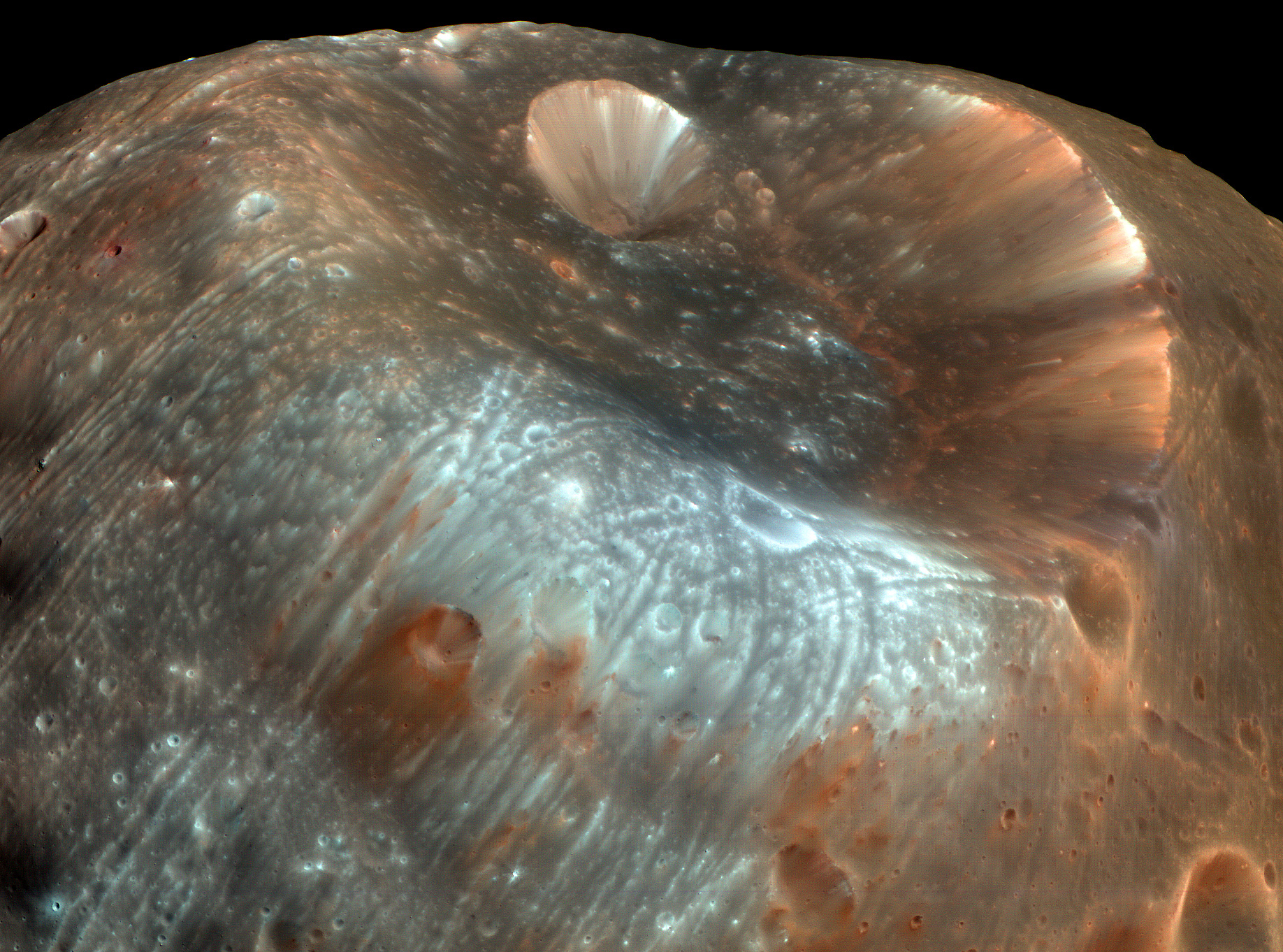
|


|
I think the coolest image I've ever seen was the Hubble image from the Wide Field Camera that was pointed at a dark, blank spot in the sky believed to be totally devoid of any objects. This area was selected because of this empty characteristic.
BOY! Were they wrong. Every object in this image is yet another galaxy. 
|
|
One thing I find fascinating is our galaxy itself.
The best and brightest minds THINK we have around 400,000,000,000 stars in the Milkyway alone, however we're not sure. Milkyway At Home is trying to hash this out, but they're still decades at best away. 400 Billion. Let's say that only 5% of those have planets. 20,000,000,000 planet possibilities. Just in our galaxy. Now look at the post above mine to the image of literally hundreds of galaxies in one small spot in space. Imagine the possibilities. |
|
Quoted:
One thing I find fascinating is our galaxy itself. The best and brightest minds THINK we have around 400,000,000,000 stars in the Milkyway alone, however we're not sure. Milkyway At Home is trying to hash this out, but they're still decades at best away. 400 Billion. Let's say that only 5% of those have planets. 20,000,000,000 planet possibilities. Just in our galaxy. Now look at the post above mine to the image of literally hundreds of galaxies in one small spot in space. Imagine the possibilities. Mind boggling. It's not a matter of "what if" there is intelligent life out there. It's 'which part of the galaxy they're in.' Even 'Star Wars' uses a small portion of they're galaxy. Disregard. I know it's fiction, but who knows if this is how it is in another galaxy. Star Wars Galaxy Also, again part of sci-fi....the newest Battlestar Galactica....did they start in another galaxy or are they in the milky way? I'm assuming since they use a lot of the same star, they started in the milky way. |
|
Keeping in the theme we seem to have running here, if you're bored do a bit of research on the Kepler mission. SETI at Home is working with the Kepler group as well as the GBT observatory to collect data on earth like planets we didn't even know existed until Kepler was launched.
Best part of the Kepler mission is that to date they have surveyed .005% of the sky. We're looking at 68 candidates from that survey pool. |
|
http://www.space.com/12569-meteorites-dna-building-blocks-discovery.html
Building blocks of DNA found in meteorite samples. |
|
Quoted:
Keeping in the theme we seem to have running here, if you're bored do a bit of research on the Kepler mission. SETI at Home is working with the Kepler group as well as the GBT observatory to collect data on earth like planets we didn't even know existed until Kepler was launched. Best part of the Kepler mission is that to date they have surveyed .005% of the sky. We're looking at 68 candidates from that survey pool. Just found out about it. 
Here's a pretty neat link for those of us, who aren't very well informed: http://kepler.nasa.gov/Mission/discoveries/ As far as habitable planets are concerned, there's a star in the Libra constellation called Gliese 581, which has several planets, and a few of them are earth-like. I think they're outside the habitable zone though. |
|
Quoted:
http://www.space.com/12569-meteorites-dna-building-blocks-discovery.html Building blocks of DNA found in meteorite samples. How long until the AP runs "Life found in asteroid belt!!"? |
|
Quoted:
As far as habitable planets are concerned, there's a star in the Libra constellation called Gliese 581, which has several planets, and a few of them are earth-like. I think they're outside the habitable zone though. WHat determines a habitable zone? Distance from the sun relative to the suns size? |
|
Quoted:
Quoted:
As far as habitable planets are concerned, there's a star in the Libra constellation called Gliese 581, which has several planets, and a few of them are earth-like. I think they're outside the habitable zone though. WHat determines a habitable zone? Distance from the sun relative to the suns size? Pretty much. Within the planetary system, it must be able to have liquid water on its surface. Within the galactic system, it must not be in the center of the galaxy. |
|
Quoted:
Quoted:
Quoted:
As far as habitable planets are concerned, there's a star in the Libra constellation called Gliese 581, which has several planets, and a few of them are earth-like. I think they're outside the habitable zone though. WHat determines a habitable zone? Distance from the sun relative to the suns size? Pretty much. Within the planetary system, it must be able to have liquid water on its surface. Within the galactic system, it must not be in the center of the galaxy. Yep, the zone is simply a formula where one takes the type of sun + distance from said sun to the planet in question. This distance determines if liquid water is viable on that particular planet. Habitable zone simply tells us "life could be here". Then we get into the myriad of complexities involving the composition of the planet, atmo, magnetic sphere and so on and so forth. |
|
Quoted: Quoted: Quoted: Quoted: As far as habitable planets are concerned, there's a star in the Libra constellation called Gliese 581, which has several planets, and a few of them are earth-like. I think they're outside the habitable zone though. WHat determines a habitable zone? Distance from the sun relative to the suns size? Pretty much. Within the planetary system, it must be able to have liquid water on its surface. Within the galactic system, it must not be in the center of the galaxy. Yep, the zone is simply a formula where one takes the type of sun + distance from said sun to the planet in question. This distance determines if liquid water is viable on that particular planet. Habitable zone simply tells us "life could be here". Then we get into the myriad of complexities involving the composition of the planet, atmo, magnetic sphere and so on and so forth. Life "as we know it".   Imagine if there's alien beings that do not require liquid water for life...
|
|
There are some fundamental reasons to believe that "water-carbon chauvinism" in terms of speculating about exobiology is a correct assumption to make.
There may certainly be some surprises, there even are some here on earth. For instance, most every living thing on Earth from single celled organisms to humans uses ATP or Adenosine triphosphate in our cells. It's the energy molecule that powers most everything in a cell. However, there are strains of archea bacteria that do not use Adenosine triphosphate, but instead use a similar molecule that uses Arsenic instead of the Phosphorus. So in a way, it's "alien life" right here on Earth. A completely fundamentally different branch from the earliest times on our planet. However, it's still largely carbon-water based otherwise. When you look at other chemistry other than carbon-water, you're not really left with much in the way of enough complexity for even something as basic as the simplest cells or viruses here on Earth. The working fluids are exotic and too rare to be statistically significant among the stars, or it requires temperatures too cold to keep them stable, meaning the interactions take way too long. The first cell on a world using liquid methane as "water" might take billions of years for random chance to evolve it, and then it might take days to do what our cells do in seconds or less. Conversely, other chemistries that require high temperatures way beyond that of boiling water, the molecules never stick together long enough to make anything complex. So if/when we find other life, it may have a whole host of surprises for us, but the basic amino acids and whatnot, when you find them on chunks of comets and asteroids, or even floating in nebula's light-years away from Earth, it's a pretty big clue that 99.99% of any life out there will share a same basic commonality with us on a chemical level. |
|
Oh, I can't disagree. Just merely underlining and asterisking the criterion for defining the habitable zone. If we do discover alien life, I personally believe that we'll find it is stunning similar to our own. From what I seem to remember, the thing about liquid water that encourages (probably not the right word) life so significantly is due to its polarity and the fact that it is miscible (sp?) with so many other fluids. I may be wrong since I haven't had a chemistry class in years, but water is a very unique fluid. |
|
Quoted:
One thing I find fascinating is our galaxy itself. The best and brightest minds THINK we have around 400,000,000,000 stars in the Milkyway alone, however we're not sure. Milkyway At Home is trying to hash this out, but they're still decades at best away. 400 Billion. Let's say that only 5% of those have planets. 20,000,000,000 planet possibilities. Just in our galaxy. Now look at the post above mine to the image of literally hundreds of galaxies in one small spot in space. Imagine the possibilities. The number of galaxies in the ultra deep field is incredibly small once you start reading about galaxy clusters and filaments. The number of celestial objects and the distances involved absolutely blows my mind. This is a pretty good video on the subject. 
|
|
Just FYI guys: Netflix now has 3 great Space shows. The Universe, How the Universe Works and a series made by Dr. Hawking (can't remember the name offhand). If you want an in depth look at particular subjects, look to The Universe. If you want a more general overview, try How the Universe Works. Both series are excellent. The Hawking series really makes you think and should also be watched when you want a little mental stimulation. |
|
Anyone have the Google Sky Map app? I was showing my wife and kids where the sun, moon and some of the planets were in relation to how we were standing, stuff like that. Of course though, jokes flew about Uranus.
Anyway, you can select showing constellations, planets, stars (without constellation lines), glaxies,comets. You can select to show all or some. |
|
Quoted: Anyone have the Google Sky Map app? I was showing my wife and kids where the sun, moon and some of the planets were in relation to how we were standing, stuff like that. Of course though, jokes flew about Uranus. Anyway, you can select showing constellations, planets, stars (without constellation lines), glaxies,comets. You can select to show all or some. Yep. It's a fun app and great for astronomy when you forget your star map at home. |