


Posted: 7/8/2011 1:38:46 AM EDT
|
I see this on some of the big jets but not all of them. Sometimes it appears to have exhaust like an engine. If it is an engine, where are the intakes?
Is it exhausting something else? What does it do? 
|
|
The APU exhaust. The APU is a small turbine engine that provides electrical power and bleed air without having to run an engine. Bleed air is used to run the A/C packs, and start the engines. IIRC the intake on an A320 is on the bottom, and is flush. 767s have the intake on the starboard side, I think, with a little scoop that opens when the APU is running. The DC-10 has a big square intake that is flush with the aft belly, with opening clamshell doors, and exhaust on the starboard side, with an opening air deflector door. Two DC-10 APUs 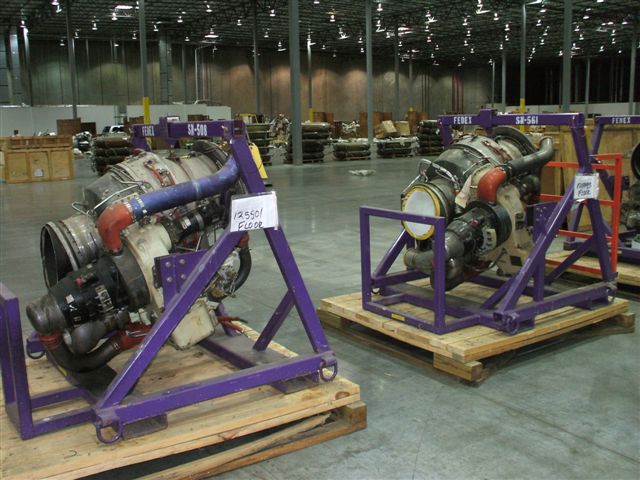 The DC-10 APU exhaust is extremely useful at cold duty stations. The ground crew can stand in it to warm up.
 |
|
While APUs are "small"in comparison with the main enignines, they run from 200 hp for the RJs, to 600 hp for the 767/757, to 2000 hp for the 747/A380.
For the "older" airplanes, (pre 787) they supply electricity and compressed air. The 787, being an all-electric airplane, gets only electricity from the APU––no compressed air. Depending on the airplane, APU functionality is requires for ETOP (extended twin operations) certified ailplanes. APU inlets vary from scoops (757/767) to naca inlets with diverters(B737), to simple holes in the airframe. Airplane manufacturers have been trying to get rid of APUs for decades beause of weight considerations, and because they are fuel hogs. The electric 787 is a step in that direction, but their contribution to ETOPS, can't be denied, at least for the present. If I recall, the Boeing guys claimed that the 747 was actulay a tiny bit faster with the APU running, presumably because the base drag ws reduced by a small amount. The apu thrust wss minimal. They weren't even tied down in the tet cell. |

|
Quoted:
extra thrust for short field take off............................................................. on the G4 the poo provides air and electric on the ground and emergency electric in flight Well, that's actually more or less true on the An-24RV. Staboard nacelle only has an APU/extra thrust engine for STOL. 2000lbs of thrust, iirc. 
An-24RV is a modification of AN-24 with a jet APU, that can be used as a third engine and gives the aircraft extra thrust during take-off.
The An-24RV passenger turboprop aircraft was developed in mid-sixties, it contains the 800 kgf-thrust auxiliary power unit (APU) RU-19A300 within RH turboprop nacelle. This engine helped to improve considerably the aircraft takeoff performance. |
|
Quoted:
The APU exhaust. The APU is a small turbine engine that provides electrical power and bleed air without having to run an engine. Bleed air is used to run the A/C packs, and start the engines. IIRC the intake on an A320 is on the bottom, and is flush. 767s have the intake on the starboard side, I think, with a little scoop that opens when the APU is running. The DC-10 has a big square intake that is flush with the aft belly, with opening clamshell doors, and exhaust on the starboard side, with an opening air deflector door. Two DC-10 APUs The DC-10 APU exhaust is extremely useful at cold duty stations. The ground crew can stand in it to warm up. An interesting aside, the APU for the DC-10 was converted into one of the most popular corporate jet engines of all time the Garrett TFE-731, 3500lbs of thrust on a Lear 35, a little more in some other aircraft |
|
Quoted:
Quoted:
extra thrust for short field take off............................................................. on the G4 the poo provides air and electric on the ground and emergency electric in flight Well, that's actually more or less true on the An-24RV. Staboard nacelle only has an APU/extra thrust engine for STOL. 2000lbs of thrust, iirc. http://upload.wikimedia.org/wikipedia/commons/d/d0/Voronezhavia_Antonov_An-24RV_Osokin.jpg An-24RV is a modification of AN-24 with a jet APU, that can be used as a third engine and gives the aircraft extra thrust during take-off.
The An-24RV passenger turboprop aircraft was developed in mid-sixties, it contains the 800 kgf-thrust auxiliary power unit (APU) RU-19A300 within RH turboprop nacelle. This engine helped to improve considerably the aircraft takeoff performance. Let me get this straight. An intentional assymetric thrust takeoff? No thanks. Haha |
|
Quoted:
Quoted:
Quoted:
extra thrust for short field take off............................................................. on the G4 the poo provides air and electric on the ground and emergency electric in flight Well, that's actually more or less true on the An-24RV. Staboard nacelle only has an APU/extra thrust engine for STOL. 2000lbs of thrust, iirc. http://upload.wikimedia.org/wikipedia/commons/d/d0/Voronezhavia_Antonov_An-24RV_Osokin.jpg An-24RV is a modification of AN-24 with a jet APU, that can be used as a third engine and gives the aircraft extra thrust during take-off.
The An-24RV passenger turboprop aircraft was developed in mid-sixties, it contains the 800 kgf-thrust auxiliary power unit (APU) RU-19A300 within RH turboprop nacelle. This engine helped to improve considerably the aircraft takeoff performance. Let me get this straight. An intentional assymetric thrust takeoff? No thanks. Haha Yup, designed specifically for hot and high + heavy conditions. In Soviet Russia... |
|
Quoted:
Quoted:
Quoted:
Quoted:
extra thrust for short field take off............................................................. on the G4 the poo provides air and electric on the ground and emergency electric in flight Well, that's actually more or less true on the An-24RV. Staboard nacelle only has an APU/extra thrust engine for STOL. 2000lbs of thrust, iirc. http://upload.wikimedia.org/wikipedia/commons/d/d0/Voronezhavia_Antonov_An-24RV_Osokin.jpg An-24RV is a modification of AN-24 with a jet APU, that can be used as a third engine and gives the aircraft extra thrust during take-off.
The An-24RV passenger turboprop aircraft was developed in mid-sixties, it contains the 800 kgf-thrust auxiliary power unit (APU) RU-19A300 within RH turboprop nacelle. This engine helped to improve considerably the aircraft takeoff performance. Let me get this straight. An intentional assymetric thrust takeoff? No thanks. Haha Yup, designed specifically for hot and high + heavy conditions. In Soviet Russia... In Soviet Russia, one leg HUGE! |
|
Quoted:
Quoted:
Quoted:
Quoted:
Quoted:
extra thrust for short field take off............................................................. on the G4 the poo provides air and electric on the ground and emergency electric in flight Well, that's actually more or less true on the An-24RV. Staboard nacelle only has an APU/extra thrust engine for STOL. 2000lbs of thrust, iirc. http://upload.wikimedia.org/wikipedia/commons/d/d0/Voronezhavia_Antonov_An-24RV_Osokin.jpg An-24RV is a modification of AN-24 with a jet APU, that can be used as a third engine and gives the aircraft extra thrust during take-off.
The An-24RV passenger turboprop aircraft was developed in mid-sixties, it contains the 800 kgf-thrust auxiliary power unit (APU) RU-19A300 within RH turboprop nacelle. This engine helped to improve considerably the aircraft takeoff performance. Let me get this straight. An intentional assymetric thrust takeoff? No thanks. Haha Yup, designed specifically for hot and high + heavy conditions. In Soviet Russia... In Soviet Russia, one leg HUGE! A little rudder trim, but only on the NO EXPORTZ model. |