


Posted: 10/4/2011 5:48:21 AM EDT
|
Year or so ago, I posted a thread about running a new electric line to my barn. They had run 12/2w/ground to a breaker panel in the barn. Main panel had a single pole, dual slot 30amp breaker, barn side had two 20A breakers. black was one hot, white was coded as the other hot, ground wire was used as the neutral. Barn has it's own ground.
In the next week or so, I am going to be running a water line to the barn. Renting a trencher. So, I'd like to run 10/3 (w/gnd) UF in the same trench as the PEX water line. Any problem with that? Next question, Since the main panel, and the barn panel both have their own ground, do I not connect the 10/3 ground on one end? I am not an electrician, so I'm not up to date on code. |
|
Quoted:
I don't know about running it with water... but run bigger than 10 gauge. Re-trenching to add capacity later is a PITA. A possibility I had considered, and may end up doing. The plus sides to running alongside water are A: one trench B: PEX would not be detectable via metal detector. running UF copper alongside would make it traceable. |

|
Quoted:
Pipe is cheap, I would run 2'' pvc for the future in case you want to add a full size 200a panel for a shop some day. Then run the uf in the pipe. When you decide to upgrade your barn the uf will make a good pull wire. An option, but extremely unlikely. Would be a hard sell to the wife. Cash is tight. Main service stop is in an old pumphouse, which is my "workshop". 200 amp panel. Plan wasn't to run conduit, to keep costs down. UF is ok for direct bury, right? Also going to be running PEX for water, and 1, maybe 2 flooded Cat 5 lines as well. |
|
Quoted:
Quoted:
Pipe is cheap, I would run 2'' pvc for the future in case you want to add a full size 200a panel for a shop some day. Then run the uf in the pipe. When you decide to upgrade your barn the uf will make a good pull wire. An option, but extremely unlikely. Would be a hard sell to the wife. Cash is tight. Main service stop is in an old pumphouse, which is my "workshop". 200 amp panel. Plan wasn't to run conduit, to keep costs down. UF is ok for direct bury, right? Also going to be running PEX for water, and 1, maybe 2 flooded Cat 5 lines as well. If you run the pipe then you can pull THHN wire though the pipe which might be cheaper than UF cable and yes UF is ok for direct bury |
|
Quoted:
Quoted:
Quoted:
Pipe is cheap, I would run 2'' pvc for the future in case you want to add a full size 200a panel for a shop some day. Then run the uf in the pipe. When you decide to upgrade your barn the uf will make a good pull wire. An option, but extremely unlikely. Would be a hard sell to the wife. Cash is tight. Main service stop is in an old pumphouse, which is my "workshop". 200 amp panel. Plan wasn't to run conduit, to keep costs down. UF is ok for direct bury, right? Also going to be running PEX for water, and 1, maybe 2 flooded Cat 5 lines as well. If you run the pipe then you can pull THHN wire though the pipe which might be cheaper than UF cable and yes UF is ok for direct bury you can't pull THHN in underground conduit, which is classed by the NEC as a wet location. you have to use THWN or THWN-2. ar-jedi |


|
Quoted:
Quoted:
Next question, Since the main panel, and the barn panel both have their own ground, do I not connect the 10/3 ground on one end? I am not an electrician, so I'm not up to date on code. http://losdos.dyndns.org/public/misc/detached-feed-2.jpg http://losdos.dyndns.org/public/misc/detached-feed-1.jpg So the ground IS connected, but not bonded with the neutral at the subpanel. Makes perfect sense. Thanks! (May have to check my house, as I believe neutral is bonded at house panel, as well as main panel. The electrician they hired before we move it was a POS. ) |
|
Quoted:
How far is the run to your barn? Amperage drop over a long run could require a larger gauge wire regardless of how you do it. ~100 feet. We're planning on running about 2 feet in from a retaining wall, then along that 2 ft separation to the barn. To the wall is 25 feet, to the barn is 45 feet. Add a few extra for pulling in the building and terminating....planning on picking up 125 ft of either 8/3 or 10/3. Leaning towards 8/3, and the wife is in agreeance. |
|
Quoted:
~100 feet. We're planning on running about 2 feet in from a retaining wall, then along that 2 ft separation to the barn. To the wall is 25 feet, to the barn is 45 feet. Add a few extra for pulling in the building and terminating....planning on picking up 125 ft of either 8/3 or 10/3. Leaning towards 8/3, and the wife is in agreeance. as suggested above, compare the cost of qty 4 125' lengths of #8 THWN wire + 1" (or 1.5") conduit, versus 125 feet of 10/3 w/ GND UF. note: you can use buy a single 250' roll of black #8 THWN wire and cut it in half. it will be cheaper that way. mark the ends of one piece with red tape. then you need a length of white and a length of green. that completes the 4 conductors. ps how are you getting the feed out of the house and then back up into the detached structure? ar-jedi ETA http://www.electrician2.com/calculators/rf_calculator.html |
|
UF is fine, The Conduit Idea is better.
I would not run anything less than #6 to supply a sub panel. As a rule I always go larger than required because I know down the road most will be hooking up more stuff than they thought they were ever going to requiring more power. |
|
Quoted:
as suggested above, compare the cost of qty 4 125' lengths of #8 THWN wire + 1" (or 1.5") conduit, versus 125 feet of 10/3 w/ GND UF. note: you can use buy a single 250' roll of black #8 THWN wire and cut it in half. it will be cheaper that way. mark the ends of one piece with red tape. then you need a length of white and a length of green. that completes the 4 conductors. Considered this option, but figured it would be more pricey. In all honesty, did not run actual prices ps how are you getting the feed out of the house and then back up into the detached structure? Main service drop is in a detached structure. Currently, 12GA 2 wire romex (NOT UF) is run out a hole in the building, into the ground. I was going to do similar, run out same hole, but in a different trench area, alongside water and Cat5/phone. Seemed to make more sense to run all in the same trench. However, now that you mention it....conduit start to stop might not be a bad idea, if nothing other than for protection where it enters/exits. Maybe I will take some photos tonight to give you a better idea. ar-jedi ETA http://www.electrician2.com/calculators/rf_calculator.html |
|
Quoted:
Main service drop is in a detached structure. Currently, 12GA 2 wire romex (NOT UF) is run out a hole in the building, into the ground. lulz. Quoted:
I was going to do similar, run out same hole, but in a different trench area, alongside water and Cat5/phone. Seemed to make more sense to run all in the same trench. However, now that you mention it....conduit start to stop might not be a bad idea, if nothing other than for protection where it enters/exits. per NEC, if the feed is exiting the structure above the burial depth, you'll need to provide supplemental protection. for example, if it is exiting above the finished grade, i would use an LB and a short length of conduit and a long sweep elbow to get down to 24" below grade in the trench. see also http://www.hammerzone.com/archives/utility/conduit/underground/house_to_garage.htm ar-jedi 
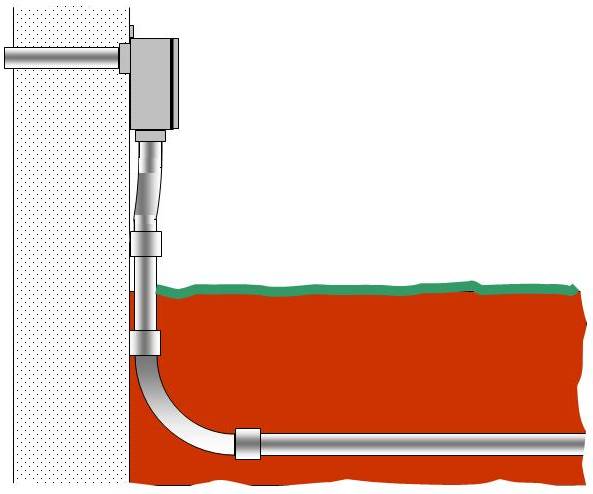
|
|
Quoted:
Quoted:
Main service drop is in a detached structure. Currently, 12GA 2 wire romex (NOT UF) is run out a hole in the building, into the ground. lulz. yeah...there have been lots of suprises that made me giggle, in a "how did the place not burn down" way. Quoted:
I was going to do similar, run out same hole, but in a different trench area, alongside water and Cat5/phone. Seemed to make more sense to run all in the same trench. However, now that you mention it....conduit start to stop might not be a bad idea, if nothing other than for protection where it enters/exits. per NEC, if the feed is exiting the structure above the burial depth, you'll need to provide supplemental protection. for example, if it is exiting above the finished grade, i would use an LB and a short length of conduit and a long sweep elbow to get down to 24" below grade in the trench. I had thought conduit penetrating ground would mean conduit was needed from point A to point B continuously. However, If i can just protect from exit above grade to the bottom of the trench, that is definitly an option. I'll have to do some wire pricing locally. see also http://www.hammerzone.com/archives/utility/conduit/underground/house_to_garage.htm ar-jedi http://bolty.net/wp-content/uploads/2009/03/pvc_conduit_lb.jpg http://www.renovation-headquarters.com/images/conduit%20underground%20cr.jpg |
|
Quoted:
I had thought conduit penetrating ground would mean conduit was needed from point A to point B continuously. However, If i can just protect from exit above grade to the bottom of the trench, that is definitly an option. I'll have to do some wire pricing locally. ooops, i think i may have confused you above by switching gears a bit. to clarify... a) if you are running UF (multi-conductor, direct burial) cable, you can use conduit as supplemental protection just at the egress/ingress to the buildings. come out of the building with conduit/LB/elbow/etc, then the length of the span is only UF cable, then back up into the detached structure with conduit/LB/elbow/etc. note burial depth for unprotected UF is 24". pick up some plumbers putty when you buy the conduit, and plug the open ends of the underground conduit to prevent bugs/etc entering the structures via the conduit. b) if you are running THWN/THWN2 individual wire, you will have to run conduit the entire length. burial depth for this approach is 18". ar-jedi |
|
Quoted:
ooops, i think i may have confused you above by switching gears a bit. to clarify... Nope. We're 100% on the same page. 
Trencher we're renting will go to 3 feet, so that's the plan. Frost line is around 14-18" in this area, so we want to make sure we're plenty below that for the PEX line we'll be running in that same trench. Only question now is to check the price of wire, and decide if I want to go THWN, or UF. Greatly appreciate the help! I am not an electrician, but know my way around the basics. After seeing what is deemed "acceptable" by the local electricians, I'd much rather do the work myself. Just want to make sure what I'm doing is up to code/safe. |
|
if you are running THWN/THWN2 individual wire, you will have to run conduit the entire length. burial depth for this approach is 18".
Depends on what you are passing under and what type of conduit. Use rigid or intermediate and you may only need 6 inches of cover. |
|
Quoted:
if you are running THWN/THWN2 individual wire, you will have to run conduit the entire length. burial depth for this approach is 18".
Depends on what you are passing under and what type of conduit. Use rigid or intermediate and you may only need 6 inches of cover. Depth is going to be 3 feet (due to water lines in same trench), nothing above trench (not going under buildings, slabs, anything like that.) |
|
Quoted:
Quoted:
if you are running THWN/THWN2 individual wire, you will have to run conduit the entire length. burial depth for this approach is 18".
Depends on what you are passing under and what type of conduit. Use rigid or intermediate and you may only need 6 inches of cover. Depth is going to be 3 feet (due to water lines in same trench), nothing above trench (not going under buildings, slabs, anything like that.) If you already have a trench use non-metallic (PVC) conduit and be done with it. If you use larger than the minimum for the wires you want now you can easily go larger later without digging again. |
|
Checked the local chain hardware store (Menards).
125 feet of UF rated 8/3 w/ground was $188 ~ $.376/ft /wire 125 feet of UF rated 10/3 w/ ground was $132 ~ $.264/ft /wire 500 ft spool of THHN/THWN rated 8 gauge was $209 $.418/ft 500 ft spool of THHN/THWN rated 6 gauge was $290 $.58/ft Going off the numbers of locally procured wire, provided I can use one color of wire for all, and "code" it, looks like the UF is the cheapest. I understand in UF, the ground is usually smaller. The problem is, the store sells in 25, 50, 100, and 500 ft spools. So, a 500 ft spool would perfectly come out to 4 125ft wires. So purchasing just the needed amount of hot/neutral wire, then smaller ground, would still leave me with left over wire, or paying a premium for the smaller quantities. The cost of PVC conduit was minimal. About $4 for 10 feet, 90 degree elbows about $5. |
|
Quoted:
One more thought came up when looking at cable pricing. What about picking up a 500 ft spool of THWN, and just "coding" the wires (colored tape)? legal/acceptable, or no-go? A NEC "no-go" for manually color-coding the neutral (grounded) or egc (grounding).. both your single conductors are smaller then #4 AWG. NEC 200.6 ....0:00/2:48 and NEC 250.119 ETA..Would I still just "color code correctly" the neutral and grounding conductors w/ tape?... yes, if I wasn't having the work inspected and I am a $254/yr. City of PGH Licensed Electrician FWIW 
|
|
Quoted:
From what I know from past experience, you do not, and should not, run a ground between buildings. Each should have their own independent ground. This should save you $$$ as well. before offering any further "advice" on residential electrical topics, please read the National Electric Code. http://www.nfpa.org/catalog/product.asp?pid=7011SB&order%5Fsrc=B484 ar-jedi |
|
Quoted:
Checked the local chain hardware store (Menards). 125 feet of UF rated 8/3 w/ground was $188 ~ $.376/ft /wire 125 feet of UF rated 10/3 w/ ground was $132 ~ $.264/ft /wire 500 ft spool of THHN/THWN rated 8 gauge was $209 $.418/ft 500 ft spool of THHN/THWN rated 6 gauge was $290 $.58/ft Going off the numbers of locally procured wire, provided I can use one color of wire for all, and "code" it, looks like the UF is the cheapest. I understand in UF, the ground is usually smaller. The problem is, the store sells in 25, 50, 100, and 500 ft spools. So, a 500 ft spool would perfectly come out to 4 125ft wires. So purchasing just the needed amount of hot/neutral wire, then smaller ground, would still leave me with left over wire, or paying a premium for the smaller quantities. The cost of PVC conduit was minimal. About $4 for 10 feet, 90 degree elbows about $5. Can you do a price comparison w/ any electrical supply companies, like where the local electrical contractors shop? I would assume they offer single conductor cut prices and UF rolls and/or cut to order lengths or price Graingers, you can open a cash/CC account w/o a business license there |
|
Quoted:
So, a 500 ft spool would perfectly come out to 4 125ft wires. So purchasing just the needed amount of hot/neutral wire, then smaller ground, would still leave me with left over wire, or paying a premium for the smaller quantities. a) you have to run a WHITE wire for neutral. b) up to 50A feeder, you can use #10 GREEN. so, ideally you need: qty 250' THWN black #8 qty 125' THWN white #8 qty 125' THWN green #10. ar-jedi |
|
Quoted:
From what I know from past experience, you do not, and should not, run a ground between buildings. Each should have their own independent ground. This should save you $$$ as well. Just wrong. You are required under the 2008 NEC to run a 4-wire service. Older code revisions allowed a 3-wire service if NO other metallic connections exist between the structures. the 4-wire has always been a better option. |
|
Quoted:
From what I know from past experience, you do not, and should not, run a ground between buildings. Each should have their own independent ground. This should save you $$$ as well. I wonder why every power pole down the street has its own ground. What happens when there is a massive ground fault in the out building? |
|
Well shit. It's looking like the cheapest will be running UF. Made a call to the local electrical supploy place. They require you set up a line of credit if you want to purchase, even if paying cash. That's F-ing stupid.
Lowes sells by the foot. $.78/ft for 8 gauge. $1.12/ft for 6ga, but if you buy 500 feet, it's $.58 /ft. I'd have to buy a whole 500 ft. spool, can't mix and match colors. Crud. |
|
Quoted:
Made a call to the local electrical supploy place. call these guys, read them your list, see what they can do. http://www.dale-electric.com/ i have ordered stuff from them before, "J.T." will help you out. ar-jedi |
|
Quoted:
call these guys, read them your list, see what they can do. http://www.dale-electric.com/ i have ordered stuff from them before, "J.T." will help you out. ar-jedi They are closed now, but checked out their website. 6 ga is only available in black. 8 ga is available in colors, but they do not show enough white, and no green in stock. However, assuming it is in stock (guessing they have extra spools around) it is .39/foot. 10 ga green wire is .23/ft 125x3x.39= $144.75 (red, black, white) 125x.23= $ 28.62 (green) subtotal: $173.37 Add on shipping (~$20, they don't estimate online), and the cost of conduit, and we're already over the $188 for 8/3 UF. The other kicker is, I had planned on doing it this weekend. I know...poor planning on my part.  There's a chance I could schedule it for the weekend of the 22nd, but even then...we're cutting it close. The following weekend is a definite no-go. Beyond that, November. Welcome to cold and frost. There's a chance I could schedule it for the weekend of the 22nd, but even then...we're cutting it close. The following weekend is a definite no-go. Beyond that, November. Welcome to cold and frost.
And i still have to put in my chimney for the wood stove. lol...too many projects, not enough hours in the day. |
|
Quoted:
Quoted:
From what I know from past experience, you do not, and should not, run a ground between buildings. Each should have their own independent ground. This should save you $$$ as well. Just wrong. You are required under the 2008 NEC to run a 4-wire service. Older code revisions allowed a 3-wire service if NO other metallic connections exist between the structures. the 4-wire has always been a better option. So your saying that under the old code, you could run say a 10-2 with ground to a sub-panel with a 30 amp main, and pull a 20 amp 240 volt circuit and a 15 amp 120 volt for lights and service recepticle so long as there was NO OTHER metallic connections between the source pannel and the sub-panel as long as you grounded the sub-panel with a grounding rod? Would the Neutral for the 120 volt service be connected to the same bar as the gound, panel to ground? I have trouble getting this worked out in my mind. |
|
Quoted:
So your saying that under the old code, you could run say a 10-2 with ground to a sub-panel with a 30 amp main, and pull a 20 amp 240 volt circuit and a 15 amp 120 volt for lights and service recepticle so long as there was NO OTHER metallic connections between the source pannel and the sub-panel as long as you grounded the sub-panel with a grounding rod? Would the Neutral for the 120 volt service be connected to the same bar as the gound, panel to ground? I have trouble getting this worked out in my mind. I cannot comment for brickeye. But in my case, they used 12-2. black was hot, white was coded as a hot, ground wire was used as "neutral". No other metallic connections between buildings. Both buildings had their own independant ground, neutral was bonded only at the main panel, not the subpanel. The panel was set up for 2 20amp 120v circuits. no 240v with the way the box was set up. |
|
Quoted:
Quoted:
Quoted:
From what I know from past experience, you do not, and should not, run a ground between buildings. Each should have their own independent ground. This should save you $$$ as well. Just wrong. You are required under the 2008 NEC to run a 4-wire service. Older code revisions allowed a 3-wire service if NO other metallic connections exist between the structures. the 4-wire has always been a better option. So your saying that under the old code, you could run say a 10-2 with ground to a sub-panel with a 30 amp main, and pull a 20 amp 240 volt circuit and a 15 amp 120 volt for lights and service recepticle so long as there was NO OTHER metallic connections between the source pannel and the sub-panel as long as you grounded the sub-panel with a grounding rod? Would the Neutral for the 120 volt service be connected to the same bar as the gound, panel to ground? I have trouble getting this worked out in my mind. a 3-wire feed with isolated neutral fro ground was allowed up until 2008 ONLY if no other metallic connections between the structures was present. No water lines, no phone line, NO metallic connections. The neutral is always isolated from ground in a sub-panel. In 2008 the exception was removed and ALL feeds to a separate structure require a 4-wire (hot-hot-neutral-ground) except for small buildings fed from a single circuit (like a shed needing a single light).. The earth grounding is not for personnel safety like the safety ground, but for lightning and leakage in the pole transformer from the high side (usually at least 7.2 kV). At 120 V the earth is a very poor conductor, and even a direct connection through the earth will often not even have 15 amps to flowing to trip a breaker. By using an Edison circuit (a center tapped secondary ties to earth and declared ground) we have two 120 V circuits available and a single 240 V circuit, but never have more than 120 V above ground. |
|
Quoted:
THHN is fine in PVC conduit. It is a damp location not wet ! uh, no. 2008 NEC Sections 300.5(B) and 300.9 cover raceways in underground and above ground locations. these Sections state that these locations are considered "wet locations" and that conductors and cables installed in the raceways are to be listed for use in wet locations. http://www.southwire.com/commercial/2008NecCode.htm 2008 NEC Code Change Summary Raceways and wet locations, NEC Sections 300.5(B) and 300.9 The inside of a conduit installed in a wet location is to be considered a wet location. This sounds redundant but many people believe the inside of a conduit should be considered a dry environment. The 2008 NEC Section 300.5(B) now clearly states that underground raceways are considered a wet location that require conductors rated for wet locations. The NEC has also added new wording to this section that helps to clarify that cables installed under a building shall be in a raceway, even if they are rated for direct burial. Section 300.9 also addresses raceways. It states that where raceways are installed in wet locations above ground, the interior of the raceway shall also be considered a wet location, again requiring conductors listed for wet locations. in time the conduit, any underground conduit, will fill with water. ar-jedi |
|
Have two projects at the same time, and two different threads. Probably should have combined into one.
Photos at http://www.ar15.com/forums/t_1_139/1240021_Running_Water_to_an_outbuilding__barn_.html |


|
lol.....yeah....that's what I'm trying to avoid doing. Problem is, with regards to the water, I don't know that the foundation would hold up to holes being drilled/knocked out. The foundation is already cracked in a few places. The ground was placed there right before we moved in, buy a licensed electrician. The romex has been there for a long time, long before we got there. The water pipe used to go to an animal waterer, but was long ago disconnected. I can only assume it broke somewhere underground, and they decided not to fix it. My main, #1 concern is to get the water line installed before winter. I want the wiring fixed too, so planned on doing that while the trench was open. Part of me is saying that I'm rushing this, and it will end up being a shit job. ~$100 for a plug in garden hose may be worth it, to know that next spring, I will be able to do the project properly. Wife ain't going to be happy, I'm not happy, but maybe that is what's best. |
|
I was going to ETA that THHN /THHW are usually labeled with both ratings. !
Just wanted to see how many more code articles you could refer me to ..lol Let me guess are you a retired engineer, AR JEDI ? well over versed under field trained? <––-25 years in the trade |
|
Quoted:
I was going to ETA that THHN /THHW are usually labeled with both ratings. ! good grief. most THHN is dual-rated THHN/THWN or THHN/THWN-2, not THHW. for subfeeds and branch circuits no one specs THHW. Quoted:
Just wanted to see how many more code articles you could refer me to ..lol Let me guess are you a retired engineer, AR JEDI ? well over versed under field trained? you posted incorrect information, which i corrected so the OP knows what is NEC compliant. and then you launch a personal attack, simply because you were wrong and someone corrected you. butt hurt much? next time try something on the order of, "shoot, i don't know what the hell i was thinking when i wrote that. my bad." Quoted:
<––-25 years in the trade and yet you apparently don't know branch wire types, nor the NEC definition of an underground conduit as a wet location. this is basic stuff. enough with the BS, ace. help the OP with information he is looking for, and make sure it's correct. if you aren't sure you can look it up in the 2011 NEC, which you undoubtedly have a copy of. here is the link: http://www.nfpa.org/catalog/product.asp?pid=7011SB&order%5Fsrc=B484 ar-jedi |
|
Quoted:
Any panel after the first protective device is a sub-panel. I think he's saying split the service drop just past the meter, so there are technically two separate breaker panels directly connected to the meter. I am not an electrician, but I would imagine the power company would not be happy with this. |
|
Quoted:
Quoted:
Any panel after the first protective device is a sub-panel. I think he's saying split the service drop just past the meter, so there are technically two separate breaker panels directly connected to the meter. I am not an electrician, but I would imagine the power company would not be happy with this. It is done for higher power houses to gain breaker space. A 320 amp service (AKA '400 amp) is often fed into two panels to gain enough breaker space. Since there is no overcurrent protection before either panel they can be mains. You do have to have them near each other, and watch out how many throws you need to disconnect ALL the power. As soon as you hit an overcurrent device, everything after that MUST be treated as a sub-panel. |